
Santorini, the island of thousand emotions
One of the most important destination for tourists worldwide, Santorini is a dream that you can really see with your eyes wide open.
The loyal friends of Santorini who visit the island with boat can feel every single time that rare emotion, even when they come across with the first lines of the scenery of the volcanic island.
For those who visit Santorini for the first time face ecstatic the traditional residential areas that spread at the edge of Kaldera, while the sea aura keeps them company till the Athinio, the small yet busy port of the island, which welcomes the travelers.
Climbing up the snaky turns of the hillside above the Athinio
An Athinios private transfer is a recommended activity for those who don’t know from previous visits to the island, are able to have a taste what is about to come.
Arriving after a while at Fyra, the capital of Santorini island, you are able to enjoy the magical view of Kaldera, the New and the Old Kameni and Thirasia. Only then you will realize that nature created and man built where the view is breathtaking.
Visit the endless landmarks of Santorini
However, it’s not only the remarkable view of Kaldera and the wondrous sunset that catches the attention of visitors in Santorini.
There are numerous sights and landmarks: you can enjoy the architectural sights, which are true representatives of thiraic architecture (Fira, Dirostefani, Hmerovigli, Oia) with a Santorini historical private tour, the great archaeological sights (Akrotiri, ancient Thira), traditional settlements (Emporio, Megalohori, Pyrgos), the islands Nea and Old Kameni, monuments of exquisite natural beauty and great scientific interest, the astonishing Museum of Prehisoric Thira at Fira,you can taste the amazing products of the traditional wineries by booking now a private tour in Santorini, where you can find out all the secrets to the production of the famous santorinian wine.
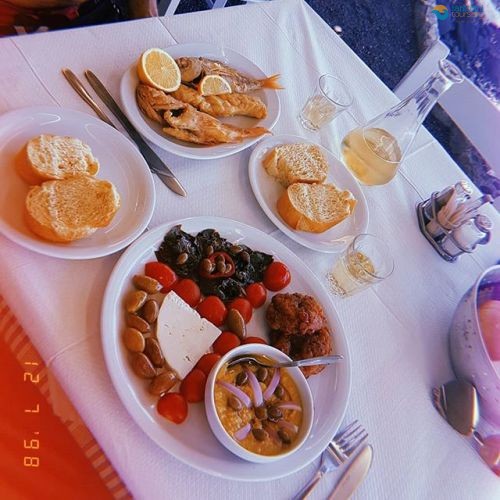
And all these combined with exceptional hotel infrastructure for your accommodation in Santorini island, the intense night-life, the glamorous resorts with the organised beaches (Kamari, Perissa, Perivolos), the magnificent local cuisine (fava, white aubergines, sun-dried tomatoes, tomato-balls and others).
The Santorini Landmarks That Define the Island
Everything written above is the feeling of arriving. What follows is the list itself: the Santorini landmarks we drive guests to every week of the season, in the order they actually matter, with the practical detail nobody puts on a postcard. We live on this island and we see these places on ordinary Tuesdays in February as well as in the crush of August, so the notes below are what we would tell a friend.
The caldera itself. The first and greatest of the santorini landmarks is not a building. It is a flooded volcanic crater roughly eleven kilometres across, with a rim that stands three hundred metres above the water on the western side. Every village on that western edge is built on the lip of it. Nothing else in the Mediterranean is shaped this way, and the whole island exists as a consequence of it.
Oia. The most photographed of all santorini landmarks, and the one that carries the island’s image worldwide. White and pale-blue houses stacked down a cliff at the northern tip, the ruined Venetian castle at the end of the lane, and the sunset that draws thousands of people onto one narrow street every evening between June and September.
Fira. The capital, the transport hub, and the balcony over the caldera. Fira is where the cable car comes up from the old port, where the buses leave from, and where the Museum of Prehistoric Thera sits. It is one of the santorini landmarks that people underrate because they only see it at midday when the cruise crowd is in.
Akrotiri. A Bronze Age town buried by the eruption around 1600 BC and dug out from under the ash with its streets, drains and three-storey houses intact. It is roofed, shaded and cool, and it is the single most important of the santorini landmarks for anyone who wants to understand why this island matters beyond the view.
Ancient Thera. The other archaeological site, on the ridge of Mesa Vouno at three hundred and sixty metres, founded by Dorian settlers in the ninth century BC and lived in through the Roman period. Long lines of terraces, a theatre looking straight down at the sea, and almost nobody there.
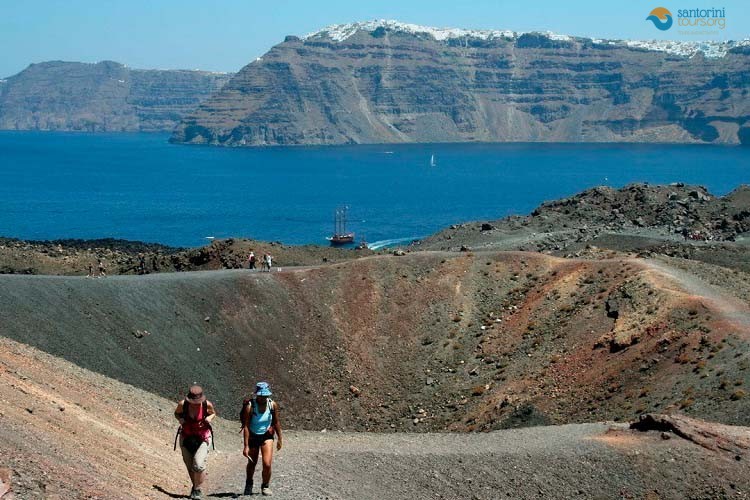
Nea Kameni. The black lava island in the middle of the caldera, still the active vent of the volcano, reachable only by boat and climbed on a gravel path to the crater rim. Of the santorini landmarks reachable in a half-day, this is the one that changes how people think about the place.
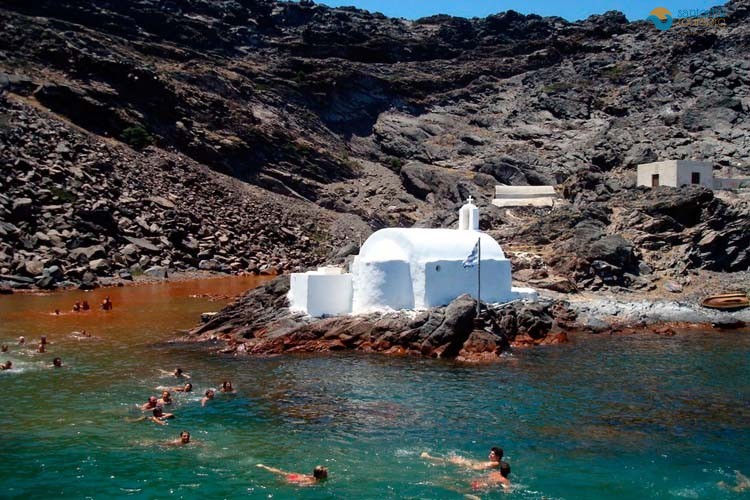
Palea Kameni and the hot springs. The older lava island next to it, with a shallow rust-coloured bay of warm sulphurous water where the boats stop and people swim in from anchor.
Skaros Rock. The headland below Imerovigli that held the island’s medieval capital until earthquakes brought it down. A short walk out along the ridge to the little chapel of Theoskepasti, and the best free view on the rim.
The Akrotiri lighthouse. The southwestern tip, built in 1892, and the quietest place on the island to watch the sun go down. It is the answer people are looking for when they ask which of the santorini landmarks gives Oia’s sunset without Oia’s crowd.
Profitis Ilias. The eighteenth-century monastery on the island’s highest point at five hundred and sixty-seven metres, with the whole of Santorini laid out below it and Ios and Anafi on a clear horizon.
Panagia Episkopi. The Byzantine church at Mesa Gonia, built in the late eleventh century under Alexios Komnenos, and the oldest standing building on the island.
Pyrgos. The old capital, a spiral of lanes climbing to a Venetian kastelli, and the one village where the santorini landmarks and the everyday life of the island still occupy the same streets.
Megalochori and Emporio. Two inland villages with fortified cores, bell towers, vaulted lanes and almost no tourism. Emporio has the largest and best-preserved kastelli in the Cyclades.
Thirasia. The piece of the old island that broke away, across the water from Oia, with one village on a cliff and a population under three hundred.
The Three Bells of Fira. The blue-domed church of Agios Theodoros on the path below Fira, which is the photograph everybody has seen and very few people can name.
Santorini Landmarks Village by Village
The island is seventy-six square kilometres and everything is within forty minutes of everything else, but the roads are narrow and the parking is the real constraint. Grouping the santorini landmarks by where they sit saves more time than any other single decision a visitor makes.
Oia, at the northern tip. The castle ruin at Agios Nikolaos, the blue domes on the lane below the main street, the marine museum in a nineteenth-century captain’s house, and the two hundred and eighty steps down to Amoudi Bay. Three hours covers it properly if you arrive before nine.
Amoudi Bay. The fishing harbour under Oia, with tavernas on the water and a swim off the rocks at Agios Nikolaos chapel. Of all the santorini landmarks reached on foot, this is the one that punishes people who come down at four in the afternoon and have to climb back up.
The santorini landmarks at Imerovigli. The highest point of the rim, the walk out to Skaros, and the chapel of Agios Georgios. Quieter than Fira, and what you come for here is the cliff and the light rather than any single building.
The santorini landmarks at Firostefani. Between Imerovigli and Fira, with the church of Agios Gerasimos and the wide terrace that produces the classic picture of Fira spilling down the rim.
Fira. The Museum of Prehistoric Thera, the Archaeological Museum, the Orthodox Metropolitan Cathedral, the Catholic cathedral and Dominican convent in the old Catholic quarter, the cable car, and the six hundred zigzag steps to the old port. Half a day, and best in the early morning or after six.
Karterados and Messaria. Inland, flat, and full of neoclassical captains’ mansions from the nineteenth-century shipping years. The Argyros Mansion at Messaria is the grandest of these lesser-known santorini landmarks and it is open to visitors.
The santorini landmarks in Pyrgos. The kastelli, the church of Theotokaki, ten small churches in a village of a thousand people, and the highest rooftops on the island’s inland ridge. Two hours on foot and no crowd at any hour.
Profitis Ilias, above Pyrgos. The monastery on the summit, reached by a road that switchbacks up from the village. The view takes in both coasts at once.
The santorini landmarks in Megalochori. Vaulted lanes, two Venetian bell towers standing free in the square, cave houses cut into the rock and some of the oldest wineries on the island around it.
The santorini landmarks in Emporio. The largest village on the island and the most intact fortified settlement in the Cyclades: the kastelli with its Goulas tower, the windmills on the ridge above, and a maze of lanes designed to confuse pirates that still confuses visitors.
Mesa Gonia and Panagia Episkopi. The abandoned earthquake village below the church, and the Byzantine basilica itself, nine hundred years old with its original marble iconostasis.
Akrotiri village and the excavation. The Bronze Age site, the Venetian castle ruin above the modern village, and the road on to the lighthouse and the Red Beach. The best-value cluster of santorini landmarks on the island, and the whole southwest can be done in one afternoon.
The Red Beach, White Beach and Mesa Pigadia. Volcanic coves under coloured cliffs, reached by a short scramble or by small boat from Akrotiri.
Kamari and Perissa, on the east coast. Black sand, organised beaches, and the Mesa Vouno ridge between them carrying Ancient Thera on top. The santorini landmarks here are geological as much as historical: the mountain is limestone, and it is older than the volcano under it.
The santorini landmarks at Vlychada. The south coast beach under wind-carved white cliffs, with the Tomato Industrial Museum in the old cannery beside it.
Athinios. The ferry port itself, cut into the cliff with a single hairpin road, is one of the santorini landmarks that everybody experiences and nobody photographs. It is also the most stressful twenty minutes of most people’s arrival.
Thirasia, across the water. Manolas village on the cliff top, two hundred and fifty steps or a mule from the harbour at Riva, and a pace of life that Santorini itself lost in about 1975.
The Archaeological and Historic Santorini Landmarks
Most visitors come for the cliff and leave without seeing the reason the cliff is famous among archaeologists. The historic santorini landmarks are the deepest layer of the island and they are also, in August, the coolest and least crowded hours of the day.
Akrotiri, the Bronze Age town. Excavations began under Spyridon Marinatos in 1967 and the site is still only partly uncovered. Streets, squares, drainage, three-storey houses with windows, and wall paintings so well preserved that they are now the anchor of the whole Aegean chronology. No human remains and very little gold were found, which tells us the population left before the eruption.
What the frescoes show. The originals are in Athens, with superb reproductions on the island. Blue monkeys, antelopes, a fleet of ships, boys boxing, a young fisherman holding his catch. Among the santorini landmarks this is the one that makes people stop talking.
Why Akrotiri is roofed. A bioclimatic shelter was completed in 2012 after the first roof collapsed in 2005. It means the site is walkable in the middle of an August afternoon, which is true of almost nothing else on the island.
Ancient Thera on Mesa Vouno. Dorian settlers arrived in the ninth century BC, and the town grew through the Hellenistic period into a Ptolemaic naval station. The agora, the theatre, the gymnasium of the garrison, and rock-cut inscriptions that are among the oldest Greek writing anywhere. Of the hilltop santorini landmarks this is the hardest to reach and the emptiest when you get there.
The Museum of Prehistoric Thera, in Fira. The finds from Akrotiri: the golden ibex figurine, painted pottery, the furniture casts taken from voids in the ash. Small, air-conditioned, and the correct companion to the excavation itself.
The Archaeological Museum of Thera. The classical and later material from Ancient Thera and the necropolises, including a remarkable series of archaic sculpture.
Panagia Episkopi at Mesa Gonia. Founded in 1115 by the emperor Alexios I Komnenos, and the only building on Santorini that survived both the 1956 earthquake and nine centuries of everything else. The marble screen is original. It is the oldest of the santorini landmarks still standing and in use.
The Monastery of Profitis Ilias. Founded in 1711 on the summit ridge, with a small museum of icons, manuscripts and a preserved workshop quarter — a cobbler, a carpenter, a wine press — showing how a self-sufficient monastery worked.
The kastelia. Five fortified settlements were built under Venetian rule after 1207: Skaros, Oia, Pyrgos, Emporio and Akrotiri. Emporio’s is the most complete, Pyrgos the most atmospheric, and Skaros is a ruin on a rock. These five santorini landmarks are the medieval skeleton of the island.
The Catholic quarter of Fira. The cathedral, the Dominican convent and the Lazarist monastery, a legacy of four centuries when Santorini had one of the largest Catholic populations in Greece.
The 1956 earthquake. A magnitude 7.5 quake on 9 July 1956 destroyed much of Oia and the northern villages and emptied the island of half its people. Most of what looks charmingly ruined in Oia today dates from that morning, and understanding it changes how you read these santorini landmarks.
The wine heritage. Ungrafted vines trained into basket-shaped koulouri, some of them two hundred years old, growing without irrigation on volcanic ash. The wine museum in a cave at Koutsoyannopoulos lays out the whole working year underground.
The Tomato Industrial Museum at Vlychada. A 1945 cannery kept as it was left, with the machinery in place. A small, strange and very good hour among the industrial santorini landmarks nobody expects to find here.
The Lost Atlantis Experience. A modern exhibition connecting the eruption to Plato’s account, useful for children and for anyone who wants the geology before the ruins.
The Natural Santorini Landmarks: Volcano, Caldera and Coast
The built landmarks sit on top of a geological event. The natural santorini landmarks are the event itself, and several of them are still active.
The caldera, greatest of the santorini landmarks. Roughly eleven by seven kilometres, and up to three hundred and ninety metres deep in places, which is why cruise ships cannot anchor and use tenders instead. The rim you walk along in Fira and Oia is the inside wall of a volcano.
The Minoan eruption. Around 1600 BC, one of the largest eruptions of the last ten thousand years emptied the magma chamber and dropped the centre of the island into the sea. The layered white and pink cliff face is the ash and pumice from it, and reading those layers is the reason geologists rank these santorini landmarks among the most studied on earth.
Nea Kameni. The young lava island, built up by eruptions between 1707 and 1950. A thirty-minute walk on loose red gravel takes you to a crater rim at about a hundred and thirty metres, with steam still coming out of the ground and the smell of sulphur. Of the volcanic santorini landmarks it is the only one you can stand on. The walk up to the crater is short but there is no shade at any point.
Palea Kameni and the hot-spring santorini landmarks. The older island, first recorded in 197 BC, with the hot springs bay on its north side where iron-rich water turns the sea ochre and the temperature reaches the low thirties.
Aspronisi. The small white islet on the southwest of the ring, the third surviving fragment of the pre-eruption island along with Thira and Thirasia.
Thirasia. Broken off from the main island in an eruption long before the Minoan one, and now the quietest of the inhabited santorini landmarks.
The Red Beach. Under a collapsing cliff of oxidised scoria at Akrotiri. The colour is real and startling. Access has been restricted repeatedly because of rockfall, and the honest advice is to see it from the viewpoint or from a boat.
The White Beach, one of the coastal santorini landmarks. Next along the same coast, under pale pumice cliffs, reachable only by small boat.
Vlychada. Wind and rain have carved the soft white cliffs behind this south-coast beach into something closer to a desert canyon than an Aegean shoreline. It is the most photogenic of the quiet santorini landmarks.
The black-sand santorini landmarks at Kamari and Perissa. Volcanic sand and shingle, dark enough to burn bare feet by eleven in the morning, with the Mesa Vouno ridge dividing the two.
Mesa Vouno and Profitis Ilias. These two limestone peaks are the pre-volcanic island, marine sediment two hundred million years old, and they are older than everything else you can see. Among the santorini landmarks they are the geological odd ones out.
Indian Rock at Armeni. A weathered lava headland below Oia that reads as a face in profile from the water, and a fixture of every caldera cruise.
The Cape Columbo reef. An underwater volcano eight kilometres northeast of the island, the site of a violent eruption in 1650 that killed people on shore with its gases. It is one of the santorini landmarks you will never see, and geologists watch it more closely than anything on land.
Seismic reality. The 2025 earthquake swarm in the strait between Santorini and Amorgos ran from late January into the spring and then subsided to background levels. Monitoring on the island is now among the densest in Europe, and normal life resumed the same season.
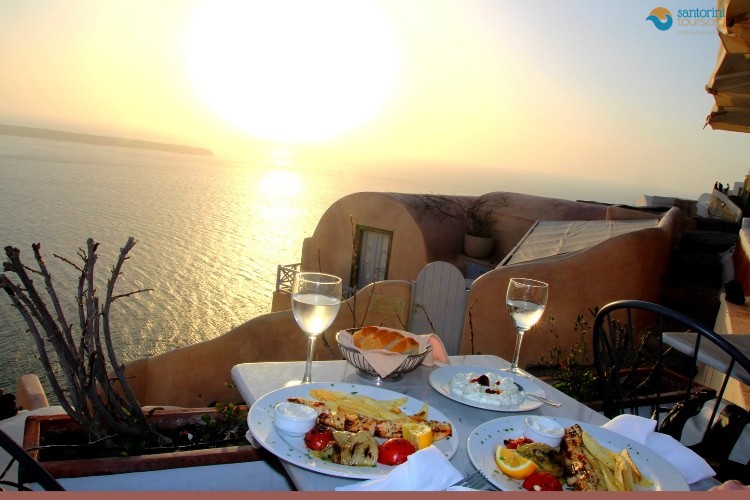
Water and soil. No rivers, no springs, all water desalinated, and a soil of pumice and ash that holds night humidity. That combination is the reason the tomatoes, the fava and the Assyrtiko taste the way they do, and it connects the natural santorini landmarks directly to the dinner table.
How to See the Santorini Landmarks in One, Two or Three Days
The mistake is not choosing the wrong places. It is doing the right places at the wrong hour. These are the routes we actually drive, built around light, crowds and the cruise schedule rather than around a map.
One day, arriving by cruise ship. Tender, cable car up before the second ship’s passengers land, straight out of Fira by road, Oia for an hour, then south to Akrotiri or a winery, and back down with an hour in hand. Trying to add the volcano to a six-hour call is how people miss the ship. A private vehicle on a cruise day is the difference between three of the santorini landmarks and one.
One day, staying on the island. Oia at seven, breakfast in Firostefani, Akrotiri at eleven when the roof gives you shade, lunch in Megalochori, Pyrgos in the late afternoon, sunset at the lighthouse. That is a full sweep of the headline santorini landmarks without ever queueing.
Two days of santorini landmarks: day one. The rim. Oia early, the Fira to Oia path in reverse if you walk, the Fira museums in the heat of the day, Skaros before the sun drops, dinner inland.
Two days of santorini landmarks: day two. The south. Akrotiri excavation, the lighthouse, the Red Beach viewpoint, a winery on the way back, Emporio at dusk. Two days done this way covers the santorini landmarks that matter and leaves out only the volcano.
Three days of santorini landmarks: day one. The caldera villages on foot, with the cable car and the old port, and the Museum of Prehistoric Thera as the anchor.
Three days of santorini landmarks: day two. The boat. Nea Kameni crater, the hot springs, Thirasia for lunch, and back under the cliff in the evening light. The santorini landmarks look completely different from three hundred metres below rather than above.
Three days of santorini landmarks: day three. Inland and south: Pyrgos, Profitis Ilias, Episkopi, Akrotiri, a winery, and the Akrotiri lighthouse for the sunset.
Where the fourth day goes. Ancient Thera in the morning, Vlychada and the tomato museum after, and an afternoon on a beach. This is the day most visitors never book and the one that finishes the santorini landmarks properly.
The early-morning rule. Between seven and nine the rim is empty, the light is better and the temperature is twelve degrees lower. Every complaint about crowds at these santorini landmarks disappears at that hour.
The midday rule. From twelve to four, go where there is a roof: Akrotiri, the museums, a winery cellar, or the sea. Walking Oia at two in the afternoon in July is the single most common mistake made here.
Check the ship schedule. Three or four ships in one day puts eight thousand extra people into Fira and Oia between ten and four. The calendar is published in advance and planning around it is free.
Driving and parking at the santorini landmarks. Oia’s car parks fill by nine thirty in season and the police close the approach road. Akrotiri, Pyrgos and Emporio are easy. Fira is not, at any hour.
The bus. Everything runs through Fira, so a journey between two villages that are four kilometres apart can take an hour and two buses. It is cheap and it works, but it costs you the early hours at the santorini landmarks that reward them most.
Walking the rim path between santorini landmarks. Fira to Oia is about ten kilometres along the cliff, three to four hours, and best started at six thirty. There is no shade and no water on the route.
What the ferry port adds. Arriving at Athinios on a summer afternoon puts you in the middle of six ferries unloading at once, and losing ninety minutes there eats the first of your days among the santorini landmarks.
What we would cut. The sunset in Oia, if your trip is short. Swap it for Imerovigli, Pyrgos or the lighthouse and use the saved two hours on Akrotiri instead.
Practical Detail for Every Landmark
Opening hours, season and access change the answer more than any ranking does. These are the practical notes that decide whether a visit to the santorini landmarks works or falls apart, and the ones we are asked about every day.
Akrotiri hours. Open daily in season from the morning to early evening, with reduced winter hours and one closed day in the low season. It is roofed, so it is the reliable choice in heat, rain and wind.
Akrotiri timing. Ninety minutes is right. Coach groups arrive in waves from about ten thirty, and going first thing or after four gives you the walkways to yourself.
Ancient Thera access. A steep switchback road from Kamari, or a footpath from Perissa that takes about an hour. Morning only in summer: the ridge is exposed and there is no water at the top. Of the santorini landmarks this one is closed on more days than any other, so check before driving up.
One ticket for four santorini landmarks. A single combined ticket covers Akrotiri, Ancient Thera and the two Fira museums over several days, and it costs less than two separate entries. Nobody at the gate volunteers this.
Museum hours among the Fira santorini landmarks. The Museum of Prehistoric Thera closes one day a week and the Archaeological Museum closes a different one, which catches people out. Both are ten minutes apart on foot.
The cable car to the Fira santorini landmarks. Runs from early morning to late evening in season, a three-minute ride, and the queue is the problem rather than the ride. On a heavy cruise day it can reach two hours downhill in the late afternoon.
The old port steps below the santorini landmarks. Six hundred of them, shared with mules, and unpleasant underfoot in either direction. Walking down is hard on the knees and walking up is hard on everything else.
The donkeys. We do not recommend riding them and neither do the welfare inspectors. Weight limits now apply and the cable car exists.
Entry to the volcanic santorini landmarks. A national geological park with a small entrance fee paid on the island, on top of the boat ticket. Closed shoes, not sandals — the lava gravel is sharp.
Hot springs reality. You swim from the boat to the bay; the boats do not dock. The water is warm rather than hot, the iron stains light swimwear permanently, and this is one of the santorini landmarks people wish they had been warned about.
Profitis Ilias monastery. Open mornings, closed on some feast days, and modest dress is required. The road up is narrow with passing places.
Panagia Episkopi. Open most mornings, free, and almost always empty. Of all the santorini landmarks it is the one with the highest ratio of significance to visitors.
Oia castle. Free, open at all hours, and completely full from an hour before sunset. At seven in the morning there will be two other people on it.
Skaros Rock. A free walk of about twenty-five minutes each way from Imerovigli, with a steep unsurfaced section. Not suitable in flip-flops or after rain.
The Red Beach. Access has been closed and reopened repeatedly because of rockfall. Respect the signs, and see it from the viewpoint above or from the water.
Wineries among the santorini landmarks. Eight estates take visitors and most run tastings through the afternoon without booking, though August weekends fill. Somebody has to drive, and the roads here are not forgiving.
Season. Most of the santorini landmarks stay open all year, but boat trips to the volcano stop in winter and the Oia rim largely shuts from November to March.
Accessibility at the santorini landmarks. Akrotiri is level and step-free inside the shelter. Ancient Thera, Nea Kameni, Skaros and Amoudi are not, and the rim villages are staircases with no alternative route.
Water and shade at the santorini landmarks. Carry two litres per person in July and August. There is no shade at Ancient Thera, on Nea Kameni, or on the rim path, and the pharmacy in Fira sells more rehydration salts than aspirin.
Santorini Landmarks: The Questions We Are Asked
What is the most famous landmark in Santorini? The caldera, and within it the blue domes and castle of Oia. If a single image represents the santorini landmarks worldwide, it is the northern tip of the island at sunset.
How many santorini landmarks can you see in one day? Three or four properly, six in a rush. Distance is never the problem here; parking and crowds are.
Which is the oldest? Panagia Episkopi from 1115 is the oldest standing building. Akrotiri from the seventeenth century BC is the oldest site, and Mesa Vouno is two hundred million years old.
Are the santorini landmarks free? Most are. Oia castle, Skaros, the lighthouse, the villages, Episkopi and the rim path cost nothing. Akrotiri, Ancient Thera, the museums and Nea Kameni charge.
Is Akrotiri worth it if you are not interested in archaeology? Yes. It is an intact town with streets and houses, it is roofed and cool, and it takes ninety minutes.
Can you walk to the volcano? Not from the main island. Nea Kameni is a separate island and only boats go there.
Which of the santorini landmarks is best at sunset? The Akrotiri lighthouse for space and parking, Imerovigli for the cliff, Pyrgos for the whole island at once, Oia for the photograph and the crowd.
Are the blue domes in Oia or Fira? Both. The famous three-dome view is in Oia; the Three Bells of Fira is the other one people recognise.
How long is the Fira to Oia walk? About ten kilometres and three to four hours, along the rim, with no shade.
Is there a landmark that children enjoy? Nea Kameni, because it is a volcano they can climb, and the hot springs afterwards.
What about the santorini landmarks in winter? The archaeological sites and museums stay open, the villages are yours alone, and the boats stop. It is a different island and a very good one.
Is it safe after the earthquakes? Yes. The 2025 swarm ended in the spring and activity returned to normal background levels, with monitoring now denser than almost anywhere in Europe.
Do you need a car? Not strictly, but the bus network routes everything through Fira and costs you the early hours, which are the hours that make these santorini landmarks enjoyable.
Which landmark disappoints people most? The Red Beach, because access is often restricted, and the hot springs, because they are warm rather than hot.
Which one surprises people most? The inland villages. Pyrgos, Emporio and Megalochori are consistently what guests talk about on the drive back.
How many days for all of them? Four. Three covers the santorini landmarks everybody names; the fourth gets Ancient Thera, Vlychada and a beach.
Are the sites open on Greek holidays? Variable, and 1 January, 25 March, Orthodox Easter Sunday, 1 May and 25 December are usually closed. Check the week you travel.
Can a cruise day cover the main santorini landmarks? Oia plus one southern site, comfortably, with a driver waiting. Not with the public bus.
What should we skip? The donkey ride, the sunset scrum in Oia if your trip is short, and any plan that puts you in Fira between eleven and three in high season.
Seeing the Santorini Landmarks With Us
We are a local operator and we drive this island for a living. What a private vehicle buys on Santorini is not luxury, it is hours: the early start, the parking that does not exist, the route that skips Fira at the wrong time of day, and somebody who can drive back from a winery.
The full-day sweep. Oia, a village, an archaeological site and a sunset point, ordered around the ship calendar rather than a fixed itinerary. This is the standard way people cover the santorini landmarks in one go.
The southern santorini landmarks in half a day. Akrotiri, the lighthouse, the coloured beaches and a winery. Four to five hours, and the best value on the island in high summer because it is all shaded or coastal.
The historic route. Akrotiri, the Museum of Prehistoric Thera, Episkopi and Pyrgos, for people who want the santorini landmarks in chronological order rather than photographic order.
The wine route between santorini landmarks. Three estates, the caves, the basket vines and Assyrtiko, with nobody in the group having to stay sober for the drive home.
The volcanic santorini landmarks and the springs. The boat to Nea Kameni, the crater, the swim at Palea Kameni, and Thirasia if the day is long enough.
Arrival and departure. The port and the airport are the two points where a Santorini holiday most often starts badly. Both are fixed in advance and cheaply.
Cruise calls. A vehicle waiting at the top of the cable car turns a six-hour call into three santorini landmarks instead of one queue.
Small groups at the santorini landmarks. The semi-private option splits the cost across a handful of people and keeps the early start, which is the part that matters.
What we will tell you honestly. Which of the santorini landmarks to drop from your list, which hour to move, and when the answer is that you should walk rather than ride.
Ask us first. Send the dates, the ship name if you have one, and how many hours you have. We will tell you what fits before you book anything.
Why This Island Earns the List
There is a version of Santorini that is a queue in the sun, and there is the island underneath it: a Bronze Age town under a roof, a Byzantine church nobody visits, a monastery on the summit, a crater still steaming in the middle of the bay, and five fortified villages that were built to hide from pirates and now hide from tourism. The santorini landmarks are not in competition with the view from the rim. They are the explanation for it.
Seen in the right order and at the right hour, the whole set fits into three unhurried days, and the island that a great many visitors describe as overcrowded turns out to be, for most of the daylight, almost empty.
Whichever of these you have time for, ask before you fix the order. The list below is a good place to carry on reading, and whether Santorini is worth visiting at all is answered on its own page.