
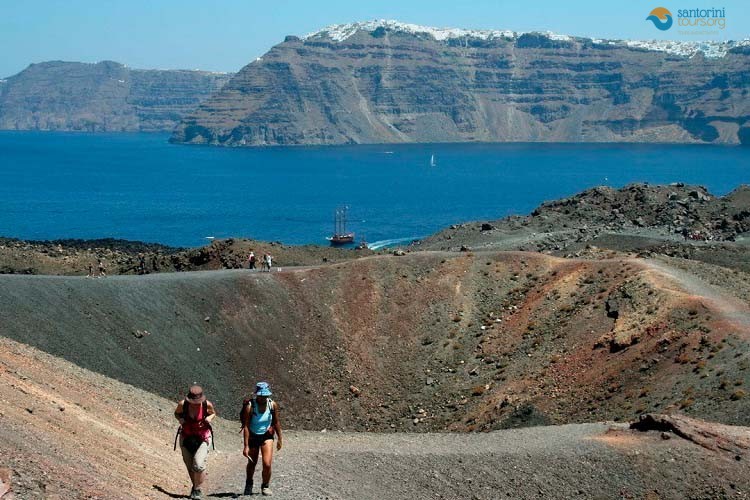
Walk to the volcano of Santorini
Walking to the volcano of Santorini is between the things that someone must do while visiting the Greek islands, mentions the magazine from London, TNT. The astonishing scenery is, according to TNT, “ideal for hiking”.
Also according to the magazine “it’s recommended to a start a hiking which will end at Oia, not only because there is a very busy harbor but also for the famous elegant, white, made of stone houses with the blue domes, and that is the other thing you should see.
Tour along Nea Kameni
Walking along Nea Kameni is like if you walk along the moon. A landscape full of volcanic sand and the rocks that came out from the middle earth during the larger volcanic eruption of all the time.
A magical private transfer at Nea Kameni is the perfect way for you and your company to learn everything about the mysterious island of Santorini and about the history and mythology that make a great combination between truth and imagination.
The wild earth shades of the rocks makes you feel the secret energy of the land beneath you, a sleeping beast that waits to sweep with wrath those who will dare to wake it up.
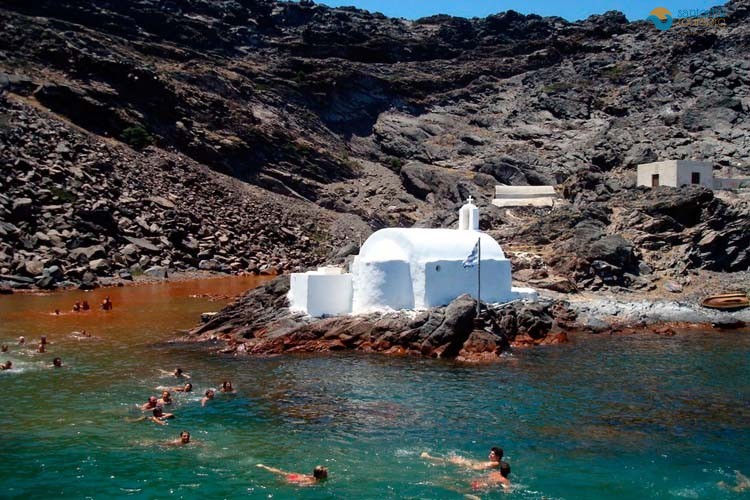
Enjoy the waters of Palia Kameni
Palia Kameni is a small volcanic island next to Nea Kameni and it is a part of land that came out due to the volcanic explosion of at the year 46 to 47. Palia Kameni private transfers is the ideal way to enjoy the island and the swimming at the thermal waters.
During the summer a great number of tourists come to the small island in order to swim at the yellow thermal waters of the sea and they take a tour in Santorini. The sulfur that came out the earth from the eruption of the volcano. The most visited area of Palia Kameni is the beach near to the church of Agios Nicolaos.
See more about vacations in Santorini island:
- The best private tours and activities to join in Santorini
- Santorini at the top 5 google searches
- The amazing stairs of Santorini
- Cruise to Santorini
Santorini Volcano Walk: The Short Answer
The walk itself is thirty minutes uphill on loose black rock to the rim of an active crater, and it is the only place in Europe where you can stand inside a caldera that is still growing. Everything else about the day is boat logistics. This page is about the walk: the path, the surface, the shoes, the heat and what you actually see when you get to the top.
Where the santorini volcano walk happens. Nea Kameni, the black island in the middle of the caldera, reached only by boat.
How long the santorini volcano walk takes. About twenty-five to thirty minutes up, fifteen to twenty back down, plus twenty at the top.
The santorini volcano walk distance. Roughly one and a half kilometres each way on a marked path.
The santorini volcano walk height gain. About one hundred and thirty metres from the landing to the highest crater rim.
The santorini volcano walk surface. Loose volcanic scree and lava rubble. No steps, no handrail, no paving.
Is the santorini volcano walk a hike. No. It is a steady uphill walk on bad footing, and reasonably fit people find it straightforward.
Shoes for the santorini volcano walk. Closed shoes with a sole. This is the single most important thing on the page, and sandals ruin the day.
Shade on the santorini volcano walk. None at all. Not one metre of it on the whole island.
The santorini volcano walk entry fee. A few euros paid on landing, separate from the boat ticket.
The santorini volcano walk guide. Boats usually include one who walks with the group and explains the eruptions at the top.
Is the santorini volcano walk worth it. Yes, once. It is the reason the caldera exists and photographs do not convey the scale of it.
Who should skip the santorini volcano walk. Anybody with bad knees, a heart condition, breathing difficulty, or who cannot manage uneven ground in heat.
The one-line answer. The santorini volcano walk is half an hour of loose black rock in full sun, and the view from the rim makes the whole island make sense.
The Boat Out
You cannot reach Nea Kameni any other way, so the boat is part of the walk whether you wanted it to be or not.
Where boats for the santorini volcano walk leave from. The old port below Fira, Ammoudi below Oia, and Vlychada on the south coast, depending on the operator.
The crossing time to the santorini volcano walk. Twenty to thirty minutes from the old port, longer from Ammoudi or Vlychada.
The vessels. Traditional wooden caiques, modern motor boats and catamarans, and the experience differs enormously between them.
The caique. Cheapest, most crowded, and the classic version. Expect eighty to a hundred and twenty people aboard.
The catamaran. Fewer people, food aboard, longer day, and it usually combines the santorini volcano walk with the hot springs and a swim stop.
A private boat. Your own schedule, your own landing time, and you avoid the crowd on the path entirely.
The half-day santorini volcano walk trip. Volcano and hot springs, four to five hours, and the commonest booking.
The full-day santorini volcano walk trip. Adds Thirasia and a longer lunch, seven to eight hours.
The sunset version. The volcano in the afternoon, then the caldera at sunset on the way back.
Getting to the boat. From the old port that means the cable car, five hundred and eighty steps, or a donkey. Take the cable car.
The queue. Twenty minutes to over an hour for the cable car when several cruise ships are tendering.
Wind and the santorini volcano walk. The meltemi cancels sailings from June to September, usually announced the evening before or the same morning.
Seasickness. The caldera is sheltered and the crossing is short. This is not a rough trip in normal conditions.
What to book. A morning departure, because the santorini volcano walk in the afternoon is a different and much hotter experience.
The Landing and the Path
The landing before the santorini volcano walk. A small concrete jetty on the north-east side of Nea Kameni, where boats tie up two or three abreast.
Getting off. Across the deck of another boat sometimes, then a step down onto the jetty. Hands free helps.
The ticket booth at the santorini volcano walk. Immediately on landing. A few euros, cash, and the fee goes to the archaeological and geological site fund.
The first hundred metres. Flat, past the wardens’ hut, and the only easy part.
The santorini volcano walk path. A single marked route of loose lava gravel, red and black, about a metre and a half wide.
The santorini volcano walk gradient. Steady rather than steep, with two or three short pitches that make people stop.
The santorini volcano walk switchbacks. Three long zigzags up the flank, each one opening the view a little further.
The surface underfoot on the santorini volcano walk. Scoria, which is lava that cooled full of gas bubbles. Sharp, light and unstable.
Why it slides. Loose gravel on hard rock. Every step gives a little, which is what tires people on the way up.
The crowd. On a four-ship day the santorini volcano walk becomes a queue. Go early or go private.
The wardens on the santorini volcano walk. Present, and they close the route in dangerous wind or when gas readings require it.
Staying on the santorini volcano walk path. Required. The ground off it is unstable and the fissures are hot.
The smell. Sulphur, faint at the bottom and stronger near the fumaroles at the top.
The heat from below. Real. Put your hand near a vent and the ground is warm. The rock under the whole path holds the day’s sun.
The Crater Rim
The top of the santorini volcano walk. A broad rim of black rubble around a shallow crater, at about one hundred and thirty metres.
The crater at the end of the santorini volcano walk. Not a dramatic hole. A wide bowl of ash and lava blocks, steaming gently in places.
The fumaroles on the santorini volcano walk. Vents releasing steam and sulphur dioxide, yellow-stained around the edges, and the proof the volcano is alive.
Can you go down into it. No. The rim path is the limit and the wardens enforce it.
The view from the santorini volcano walk. The whole caldera at once: Fira and Oia strung along the cliff, Thirasia opposite, Palia Kameni below.
The scale. This is where the island makes sense. You are standing in the middle of a crater ten kilometres across.
The colours. Black and rust red underfoot, white villages three hundred metres up, and impossibly blue water between.
Time at the top of the santorini volcano walk. Fifteen to twenty-five minutes, which is what most operators allow.
The guide talk. Usually given here: the Minoan eruption, the cones, the 1950 eruption and the monitoring.
Photographs. Wide angle for the caldera, and the best shot is back along the rim with Fira behind it.
The wind at the top. Stronger than at the landing, and welcome in August.
Coming down from the santorini volcano walk. Faster and harder on the knees. The loose gravel slides and short steps beat long ones.
What people say afterwards. That the santorini volcano walk was hotter than expected and more interesting than expected, in that order.
The one thing to do at the top. Stop looking at the crater and turn around. The caldera wall is the actual spectacle.
What You Are Actually Standing On
Nea Kameni, where the santorini volcano walk happens. The “new burnt island”, and the youngest land in the eastern Mediterranean.
The age of the rock under the santorini volcano walk. It began forming in 1573 and most of what you walk on is younger than four hundred years.
Palia Kameni. The older cone next to it, which emerged around 197 BC and again in 46 to 47 AD.
The 1707 eruption. Built much of the central mass of Nea Kameni over several years.
The 1866 to 1870 eruption. Watched and recorded by scientists, and the birth of modern volcanology in Greece.
The 1925 to 1928 eruption. Created the Dafni lava flows you cross on the santorini volcano walk.
The 1939 to 1941 eruption. More cones and flows, during the war, with almost nobody watching.
The 1950 eruption, the last before the santorini volcano walk opened to visitors. Small, brief, and there has been none since.
The Minoan eruption. Around 1600 BC, one of the largest in ten thousand years, which blew out the centre of the island and made the caldera.
What that did. Buried Akrotiri in ash, sent a tsunami across the Aegean, and ended the island’s Bronze Age in a season.
The caldera depth. Up to three hundred and ninety metres of water where the centre of the island used to be.
Is the santorini volcano walk on active ground. Yes. Monitored continuously by the National Observatory of Athens with seismometers, GPS and gas sensors.
The 2011 to 2012 unrest. Ground inflation and small quakes that passed without an eruption, which is the normal pattern.
Is the santorini volcano walk safe. Yes. Access is restricted immediately if instruments show anything unusual, and the wardens close the path.
What to Wear and Carry
Shoes for the santorini volcano walk. Closed, with a proper sole. Trainers or walking shoes. This is the one thing that ruins the day if you get it wrong.
Why not sandals. Sharp lava gravel gets inside them within twenty metres and the sole gives no grip on the slide.
Not flip-flops. People try, and they walk back down carrying them.
A hat for the santorini volcano walk. Compulsory in practice. There is no shade anywhere on Nea Kameni.
Sunglasses. The black rock throws glare, and so does the water on the crossing.
Sun cream. Applied before you leave, not on the boat.
Water for the santorini volcano walk. At least a litre each. There is nothing to buy on the island.
Light clothing. Anything you do not mind getting black dust on, because everything will.
A swimsuit after the santorini volcano walk. Worn underneath, if the trip includes the hot springs stop afterwards.
A dark towel for after the santorini volcano walk. The hot spring water is ochre with iron and sulphur and it stains anything pale.
A dark or old swimsuit. Same reason. White does not survive the springs.
A camera. Dust is the enemy here. Keep it in a bag on the way up.
What not to bring on the santorini volcano walk. Wheeled bags, heels, anything valuable you would mind dropping on rock.
The packing rule for the santorini volcano walk. Closed shoes, a hat, a litre of water and a dark towel, and nothing else matters.
How Hard Is It, Honestly
The short version of the santorini volcano walk difficulty. Moderate. Not technical, not steep, and harder than it looks because of the surface and the heat.
The santorini volcano walk for a fit adult. Twenty-five minutes up at a steady pace with one or two pauses. Unremarkable.
The santorini volcano walk for an average adult. Thirty to thirty-five minutes with several stops. Still fine.
The santorini volcano walk for someone unfit. Forty minutes and genuinely tiring in summer heat. Doable if you take it slowly.
What makes the santorini volcano walk hard. Not the gradient. The loose gravel, the reflected heat off black rock and the complete absence of shade.
In August at noon. The hardest version of the santorini volcano walk, and the one most people book without thinking.
In May or October. Pleasant. The same path in twenty-two degrees is a different walk entirely.
The way down from the santorini volcano walk. Faster and harder on the knees. Short steps, and use the inside of the switchbacks.
Falls on the santorini volcano walk. The commonest incident, almost always on the descent, almost always in the wrong footwear.
Is there a handrail. No. Nowhere on the route.
Are there benches. No. There is nothing on the island but the path and the wardens’ hut.
Toilets. Basic facilities near the landing. Nothing above that.
Turning back on the santorini volcano walk. Entirely normal. Plenty of people walk ten minutes, look at the view and return to the boat.
The honest advice. If you are unsure, go in the morning, take twice the time you think, and stop whenever you like. Nobody is timing you.
Children, Older Walkers and Limited Mobility
Children on the santorini volcano walk. Fine, and most of them enjoy it. The moonscape is genuinely exciting at that age.
Younger children. Hard work. Loose gravel and small legs do not combine, and carrying a toddler up is unpleasant.
Pushchairs and the santorini volcano walk. Impossible. Do not attempt to bring one onto the island.
Baby carriers. Workable, and hot for both of you. Go in the morning if at all.
Older walkers on the santorini volcano walk. Many manage it comfortably. The limiting factors are knees on the descent and heat on the ascent.
Walking poles. Genuinely helpful on this surface, and almost nobody brings them.
Knee or hip problems. The descent is the problem, not the climb. Consider staying on the boat.
Heart or breathing conditions. Take advice before booking. It is a sustained effort in heat with no shade and no quick way back.
Wheelchair users and the santorini volcano walk. The santorini volcano walk is not accessible. The path is loose gravel with no surfaced section.
Staying on the boat instead of the santorini volcano walk. Always an option. Most operators expect a few people to do it and nobody comments.
What the boat does meanwhile. Waits at the jetty for the whole landing window, usually ninety minutes.
The alternative for those who cannot walk it. A caldera cruise that sails close to Nea Kameni without landing, plus the hot springs from the boat.
Group pace. On a private boat you set it. On a caique you are moving with a hundred other people.
The fair summary. Most people who worry about the santorini volcano walk manage it, and the ones who struggle are almost always in sandals at two in the afternoon.
Timing and Season
The best hour for the santorini volcano walk. The first boat of the morning, usually between nine and ten. Cooler rock, thinner crowd, better light.
The worst hour for the santorini volcano walk. Between noon and three in July and August. Full sun on black rock with no shade.
The sunset trip. The walk in the late afternoon and the caldera at sunset on the way back. Excellent in September and October.
The santorini volcano walk in April. Cool, green on the big island, and the santorini volcano walk at its most comfortable.
The santorini volcano walk in May. The best month overall. Warm, clear, boats running full schedules and the crowds not yet arrived.
June. Very good, getting hot, and the meltemi beginning.
July and August. Hot, crowded and windy. Morning departures only, and expect the path to be busy.
The santorini volcano walk in September. Superb. The wind drops, the sea is warmest for the springs, and the crowds thin.
The santorini volcano walk in October. Good until the third week, then boat schedules reduce.
The santorini volcano walk from November to March. Most operators stop. A handful run on demand in calm weather.
The wind. The single biggest cause of cancellation. The meltemi blows for days at a time in summer.
How you find out. The operator calls or messages, usually the evening before or early the same morning.
Cruise passengers and the santorini volcano walk. A half-day volcano trip fits a six-hour call only if the tender and cable car queues cooperate. It is tight.
The booking rule. Two to four weeks ahead in July and August, a few days in the shoulder months, and always a morning slot.
The Hot Springs Stop
Almost every santorini volcano walk is sold with the springs attached, so it is worth knowing what they actually are.
Where the springs are after the santorini volcano walk. A shallow bay on Palia Kameni, the older cone next to Nea Kameni.
The colour. Ochre and rust, from iron oxide and sulphur leaching out of the sea floor.
The spring temperature after the santorini volcano walk. Warm rather than hot. Around thirty to thirty-five degrees where the vents are, and cooler as you move away.
The honest expectation. This is not a thermal pool. It is a patch of warmer, discoloured seawater in a bay.
How you get in. You swim. Boats anchor offshore and you jump off the back and swim thirty to eighty metres in.
The cold bit. The open water between the boat and the bay is normal Aegean temperature, which is a shock.
Can you skip the swim. Yes, and many do. Staying aboard is completely normal.
Staining from the springs after the santorini volcano walk. Real and permanent. Pale swimwear comes out orange. Wear something dark or old.
The smell. Sulphur, on your skin, until you shower.
Jewellery. Take silver off. The sulphur tarnishes it.
The chapel. Agios Nikolaos, the small church above the bay, and the landmark you aim for.
How long at the springs after the santorini volcano walk. Twenty to thirty minutes in the water, which is plenty.
Is it worth it. As an experience, yes. As a spa, no.
The combination. The walk, then the springs, is the standard half day, and doing the walk first is the right order because you will want the swim afterwards.
The Monitoring, and Why It Is Safe to Stand There
Who watches the ground under the santorini volcano walk. The Institute of Geodynamics at the National Observatory of Athens, plus Greek and international university networks.
Seismometers. On the island and around the caldera, recording continuously and publishing events in near real time.
GPS stations. Measuring ground movement to the millimetre. The island inflates and deflates as magma moves at depth.
Satellite radar. InSAR imagery showing deformation across the whole caldera between passes.
Gas sensors. Carbon dioxide and sulphur measured at the fumaroles you walk past, because gas changes precede magma movement.
Sea-floor instruments. Around Kolumbo, the underwater cone north-east of the island, which is a separate system.
Warning time before the santorini volcano walk closes. Volcanic systems like this give days to weeks of instrumental warning before an eruption, not minutes.
The 2011 to 2012 unrest. Measurable inflation and small earthquakes that passed without an eruption. The ordinary pattern here.
The 2025 swarm. Tectonic, offshore to the north-east, attributed to magma moving at depth stressing faults. It ended that spring.
Access control on the santorini volcano walk. The wardens close the santorini volcano walk immediately when instruments, gas readings or wind require it.
What that means practically. If the path is open, it has been assessed as open that morning.
The real risks on the santorini volcano walk. Heat, dehydration and a fall on loose gravel. Not the volcano.
Where to check. The National Observatory of Athens publishes recorded events, and Greek Civil Protection issues instructions.
The honest reassurance. This is one of the most closely watched volcanoes in Europe, and the santorini volcano walk is open because somebody checked.
Combining It With the Rest of the Day
Akrotiri with the santorini volcano walk. The best pairing on the island. The eruption that made the caldera, and the town it buried.
Why that order works. Akrotiri in the morning, shaded and cool, then the volcano in the afternoon light.
Thirasia with the santorini volcano walk. Added on a full-day boat, with lunch at Korfos where the fish comes off the boat outside.
The hot springs with the santorini volcano walk. The standard half-day pairing, and the walk should come first.
With the Museum of Prehistoric Thera. The frescoes and finds from Akrotiri, in Fira, and the indoor half of the story.
With a sunset. The afternoon boat returns across the caldera at the best hour of the day.
What not to combine it with. A land tour on the same cruise call. There is not time.
The cruise day santorini volcano walk. Tight in six hours. Comfortable in eight.
For a week-long stay. Day two or three, after you have seen the caldera from above and want to understand it.
What guests say. That the santorini volcano walk made everything else on the island make sense, which is the reason to do it early rather than late.
The photograph to take on the santorini volcano walk. From the crater rim looking back at Fira and Oia on the cliff, with the boats below.
What to do afterwards. Swim at the springs, then eat somewhere inland. You will be covered in black dust and nobody will mind.
Costs and What Is Included
The shared caique to the santorini volcano walk. Roughly twenty-five to forty euros a person for the half day with the hot springs.
The site entry for the santorini volcano walk. A few euros paid on landing at Nea Kameni, cash, and separate from the boat ticket.
What that catches people. Almost every complaint about the price is about this fee not being mentioned at booking.
The catamaran to the santorini volcano walk. Ninety to a hundred and fifty euros a person, with food, drinks and fewer people aboard.
A private boat to the santorini volcano walk. Priced per boat rather than per head, and worth it from four people upward.
The cable car before the santorini volcano walk. Six euros each way from the old port, and not included in any boat ticket.
The guide. Usually included on the walk itself. Ask, because a santorini volcano walk without one is just a hill.
Water aboard. Included on catamarans, rarely on caiques. Bring your own.
Lunch. On full-day trips only. Half-day trips return in time to eat ashore.
Tips. Not obligatory. A few euros for the crew is normal.
Cancelling the santorini volcano walk. Operators refund or rebook for wind. Check the wording before paying.
Booking direct or through a hotel. Hotels add a commission. Direct is cheaper and the boat is the same.
What we run. Private caldera cruises where the walk, the springs and the timing are yours rather than a schedule’s.
The value verdict. The shared caique is the cheapest way onto the island and the least pleasant. The private boat is the opposite.
Santorini Volcano Walk: Questions People Ask
How long is the santorini volcano walk? About twenty-five to thirty minutes up, fifteen to twenty down, on a marked path of roughly one and a half kilometres each way.
How difficult is the santorini volcano walk? Moderate. Not steep and not technical, but the surface is loose lava gravel and there is no shade at all.
What shoes for the santorini volcano walk? Closed shoes with a proper sole. Sandals and flip-flops fill with sharp gravel and give no grip.
Is there a santorini volcano walk entry fee? Yes, a few euros paid in cash on landing, separate from the boat ticket.
Can you go inside the crater? No. The rim path is the limit and the wardens enforce it.
Is the volcano still active? Yes. The last eruption was 1950 and it is monitored continuously by the National Observatory of Athens.
Is it safe? Yes. Access is restricted immediately if the instruments or the wind require it.
Can children do the santorini volcano walk? From about six, comfortably. Younger children find the loose gravel hard work and pushchairs are impossible.
Is it wheelchair accessible? No. There is no surfaced section anywhere on the route.
Do I have to do the santorini volcano walk? No. Staying on the boat is normal and nobody comments.
What time for the santorini volcano walk? The first boat of the morning. The rock is cooler and the path is emptier.
Are the hot springs hot? Warm, around thirty to thirty-five degrees near the vents, and they stain pale swimwear orange.
What if the wind cancels it? Operators refund or rebook. The meltemi stops sailings for days at a time in summer.
Is it worth doing? Once, yes. Standing on the rim is the only place the scale of the caldera becomes obvious.
Mistakes People Make
Wearing sandals on the santorini volcano walk. The one that ruins the day, every day, for somebody.
Booking the midday boat in August. Black rock, full sun, no shade, and the hottest hours of the year.
Not bringing water on the santorini volcano walk. Nothing is sold on Nea Kameni.
Not bringing cash for the entry fee. A few euros, paid on landing, and card is not an option.
Wearing a white swimsuit. The hot springs turn it orange permanently.
Assuming the springs are a spa. Warm discoloured seawater in a bay, reached by swimming from the boat.
Leaving the cable car to the last minute. The queue back up from the old port passes an hour on a heavy cruise day.
Booking a boat and a land tour on the same cruise call. It does not fit.
Expecting lava on the santorini volcano walk. There is none flowing. The last eruption was 1950 and what you see is steam and old rock.
Expecting a dramatic crater. It is a wide shallow bowl, and the caldera behind you is the real view.
Rushing the top of the santorini volcano walk. Twenty minutes is what you get. Spend it looking outward, not down.
Ignoring the wind forecast. The meltemi cancels the santorini volcano walk without much notice.
Taking a good camera without a bag. Volcanic dust gets into everything.
Doing the santorini volcano walk without a guide. The rock means nothing without somebody explaining which eruption made it.
How We Run It
Private boats for the santorini volcano walk. Our caldera cruises carry six to twelve people, so the walk happens on your schedule rather than a caique timetable.
The timing we recommend for the santorini volcano walk. First departure in the morning from June to September, afternoon in the shoulder months for the light.
Where we leave from for the santorini volcano walk. Ammoudi, the old port or Vlychada depending on the boat and where you are staying.
Getting you to the boat. A transfer to the departure point, which on an Ammoudi morning saves three hundred steps.
The cable car. We meet you at the top rather than the bottom, so the queue works for you rather than against you.
The guide. Included on the santorini volcano walk, and it is the difference between a hill and a geology lesson.
What we carry on the santorini volcano walk. Chilled water, which on a forty-degree morning matters more than anything else aboard.
The springs. We anchor as close as conditions allow, and nobody is pressured to swim.
Thirasia. Added on the full day, with lunch at Korfos where the fish comes off the boat outside.
Sunset return. The caldera wall from the water at the end of the day, which is the best light on the island.
If the wind cancels. We rebook or refund, and we do not sail when it is unpleasant.
Pairing the santorini volcano walk. Akrotiri in the morning and the volcano in the afternoon makes the island’s whole geological story legible in a day.
Who should not book it. We will tell you honestly if the walk is not right for your group rather than take the booking.
What to send us. Your dates, your group, and whether anybody has knee or breathing trouble, and we will build the day around it.