
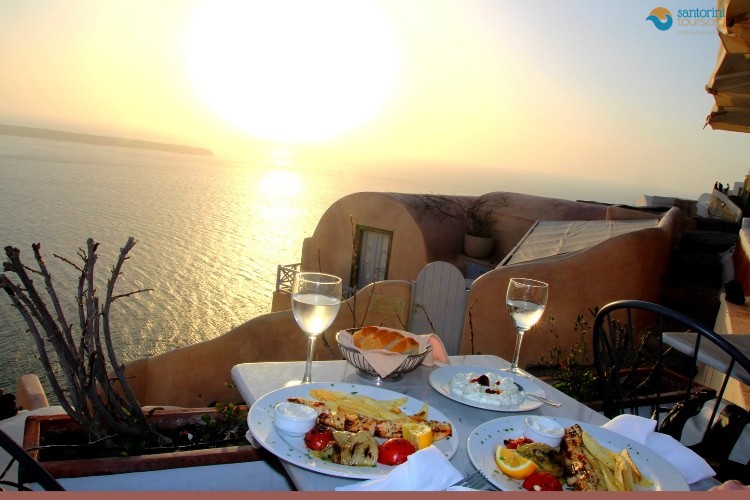
Santorini: A Great Gastronomic World
Santorini food is what grows on a volcano with almost no rain: a tiny dry-farmed cherry tomato, yellow split pea fava, white aubergine, wild capers, fresh chloro cheese and saline Assyrtiko wine. Santorini Tours runs private food and wine days on the island.
Santorini is not just the most emblematic island of Greece. It is also the home of a gastronomic cosmopolitanism, a paradise for lovers of special, elegant and authentic flavour.
The cuisine of the island is based mainly on its agricultural products, fed with its volcanic soil, the coolness of the sea and the Aegean sun.
The theatrical land offers not only a spectacular sight. The villages of Santorini also give birth to products blessed by nature – excellent fresh products – for original, tasty, healthy foods with divine flavours, simple, primary.
With an immediacy that penetrates the mind and touches the heart directly!
The famous Santorini Gastronomy
So let’s go around the “temples” of pleasure, where thousands of people from all over the world are bowed every year.
There are too many options to taste the famous Santorini gastronomy. Greek restaurants with traditional recipes, creative with new refined ideas, taverns with local appetizers…
Discover the hidden in the hinterland or by the sea taverns and let yourself in the moment where flavours and aromas, married harmoniously, are recorded indelibly in your memory.
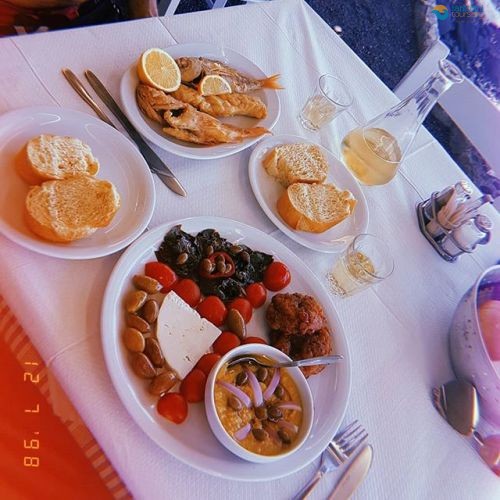
1. Meet the Santorini fava
The best of Santorini’s diet, is “the fava“, as the locals call it. A gift of nature on the island – a product now Protected Designation of Origin – is an ancient fruit with a distinct natural flavour.
A taste that the Minoans enjoyed several thousand years ago is still unparalleled in our dish. Taste the freshly sprinkled with just it aromas and a bit of butter as an appetizer.
“Married” with tomatoes, onions and capers, with eggplant sauce or pork chunks as a regular meal. Fava-soup, fava-meatballs, fava-rice, fava in omelettes. Fava everywhere!
2. Meet the legendary Santorini tomato
Another favourite product of Thira, is the legendary Santorini tomato. Red, smoky and aromatic is the king of the local traditional salad with lobster, katsouni (a dry cucumber), capers and goat cheese.
The greatness of simplicity! Enjoy it in fluffy tomato balls or in a piece of “Thira” type tomato juice.
3. Meet the Santorini white eggplants
Similarly, the delicious white eggplants that impress with their silky texture are also excellent in a plethora of deep-tasting Mediterranean dishes.
It is worth even trying it plain in a simple eggplant sauce or in a Santorini moussaka, a hug with small potatoes and round courgettes that are being produced in the island. Let all summer sit on your plate!
4. Meet Santorini fresh fish
When the appetite “wants a fish“, choose from an abundance of fresh sea treasures from the nearby fishing grounds.
A delicious idea is the local Mprantada. It is accompanied by a garlic sauce with eggplant. You can also try smelt pies, or savoir fish, fried with vinegar and garlic.
5. Meet traditional Santorini treats
Leave space in the end for a sweet spoon of small tomatoes Jams, garnished with cinnamon and whole almonds. If you are lucky, you will try melletinia, a traditional Easter candy, or sugarplum, a classic wedding treat.
Apart from the traditional desserts, you will also taste “sophisticated” flavours such as tiramisu with roasted eggplant, almond praline and sunflower sauce or kantaifi sauce, with an improbable mizithra mousse. All Divine!
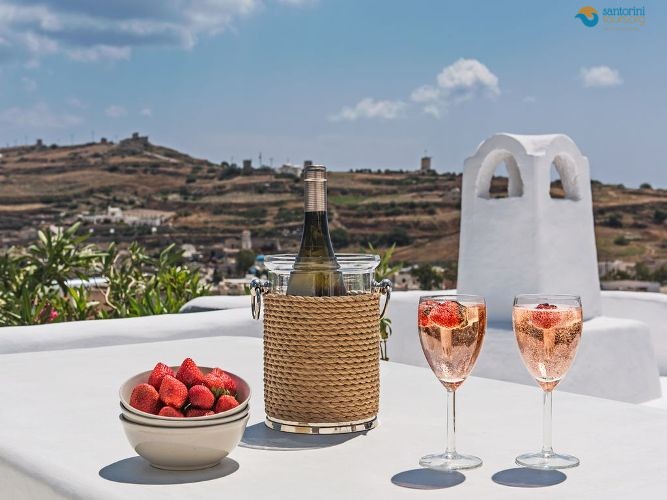
The famous Santorini wines
An excellent food company at the table will keep you the famous Santorini wines. Asyrtiko, Athiri, Aidani, Mandilaria, Mavratragano are just some of the dozens of native varieties that have been popular over the centuries on the island, sinking their roots deep in the volcanic soil.
The Thira vines shaped on terraces to facilitate the cultivation and knitting of the bunch-shaped stump to protect the fruit from the “great” winds and the relentless Cycladic sun, are characteristic elements of the environment.
The peculiarity of Santorini’s soil and microclimate, coupled with the constant effort of local producers to harness their land, yields high yielding wines with a strong structure, cool acidity, intense metallicity and aromatic complexity.
In the picturesque village of Pyrgos you will find the winery of the rural cooperative and there, on its picturesque balcony that looks like it hovers on the Caldera, you will say goodbye to the beautiful sunset with a glass of Vinsanto wine – this sweet diamond of the Santorini vineyard – or a cool Assyrtiko.
Most wineries can be visited on the island. One can take tours of Santorini to visit Santorini’s sightseeings and wineries.
Take a Santorini private tour
Santorini private tours offer tasting tours of production sites and vineyards; visits to museums and traditional canaves are some of the options that will give you an intoxicating experience.
- Santorini Full Day Private Tour
- Santorini Sightseeing Private Tour
- Santorini Private Custom Tour
- Popular Destination Santorini Private Tour
- Santorini Private Tour and Food Experience
- Santorini Exclusive Shore Private Tour
- Santorini Impressive Caldera Private Tour
- Santorini South Part Private Tour
- Santorini North Part Private Tour
- Santorini Historical Private Tour
- Santorini Sunset Private Tour
Unique wines and splendid flavours make up the magical world of Santorini island. So Santorini puts its personal stigma on the gastronomic map of the planet.
Read more about Santorini Tours
Read more in our Blog
Santorini Food: What Makes It Different
Santorini food is what grows on a volcano with almost no rain. That single fact explains everything on the menu here: the tiny concentrated tomatoes, the dense yellow fava, the sweet white aubergine, the saline wine and the salted wild capers.
The island gets very little rainfall and has no natural fresh water at all – it runs on desalination. Traditional agriculture here uses no irrigation whatsoever. Plants survive on moisture that the porous volcanic soil pulls out of the night air and holds against their roots. The result is small fruit with a fraction of the water content and several times the flavour.
Add to that a poor island’s history. Until tourism arrived in the 1970s this was a hard place to live, and the cooking is built on pulses, preserved things, wild greens, capers and small quantities of meat. That frugality is still the backbone of a village taverna menu, and it is why the best Santorini food is cheap food cooked carefully rather than expensive food cooked showily.
This page is about what to eat and why it tastes the way it does. Where to eat it is a separate question, answered on our Santorini restaurants page.
Why Does the Volcano Change the Taste?
The soil
The eruption of around 1600 BC buried the island under metres of ash and pumice. That layer – called aspa locally – drains water instantly, holds minerals, and reflects heat back up at the plants. Roots go deep looking for moisture. Nothing here is grown in soil that behaves like ordinary farmland, and the mineral, almost salty edge you taste in Santorini food comes directly out of it.
No irrigation
The traditional crops are dry-farmed. A Santorini cherry tomato is watered by fog and dew and nothing else. Because the plant is under constant mild stress it concentrates sugars and acids into very small fruit. The same principle applies to the fava, the aubergine and the vines.
The wind
The meltemi blows hard for months. Vines are woven into low ground-level baskets called kouloura, sheltering the fruit inside; crops are grown low and close. Everything on this island grows defensively, and that shapes the flavour as much as the soil does.
No phylloxera
The volcanic soil is hostile to the phylloxera louse that destroyed European vineyards in the nineteenth century. Santorini’s vines are therefore ungrafted, growing on their own roots, some of them centuries old. There are very few places left in Europe where that is true.
The sea
Fishing here is small-boat rather than industrial, and the caldera drops four hundred metres almost from the shore. Catch is small, varied and priced by the kilo, which is why fish arrives at the table whole and chosen at the counter.
What that means at the table
Order the things that only happen here. Anything on a Santorini food menu that could have been cooked in Athens is not the reason you came.
What Are the Signature Santorini Food Ingredients?
Seven things grow here that do not grow the same way anywhere else, and they are the foundation of all Santorini food worth travelling for.
The Santorini cherry tomato
The most recognisable Santorini food ingredient of all. Tomataki Santorinis, protected by origin. Tiny – often no bigger than a thumbnail – thick-skinned, dense, and intensely sweet with a sharp acid finish. It is dry-farmed, harvested in July and August, and traditionally sun-dried or made into paste because there was never enough water to grow it soft and large. There was a tomato paste factory at Vlychada that is now an industrial museum, which tells you how central this fruit was to the island’s economy.
Fava
Not broad bean fava. Santorini fava is Lathyrus clymenum, a yellow split pea grown here for over three thousand years, with PDO protection. It is boiled down to a thick puree, served warm with olive oil, raw onion and capers, sometimes topped with caramelised onion or octopus. It is the first thing to order anywhere on the island, because how a kitchen makes fava tells you exactly what kind of Santorini food you are about to be served.
White aubergine
Melitzana Santorinis, a local variety, pale to the point of ivory, with fewer seeds, less water and none of the bitterness of the purple kind. Sweet enough to be used in desserts historically. Usually grilled, sometimes as a spread, occasionally stuffed.
Katsouni
A local cucumber left on the plant to ripen until it turns yellow, when it eats more like a melon than a cucumber. Rare on menus, and a strong signal that a kitchen shops locally.
Capers and caper leaves
Gathered wild from the dry stone walls and terraces, salted rather than pickled. The leaves are the local touch that surprises visitors – they turn up in salads, on fava, and folded into rusks.
Chloro cheese
Fresh, soft, slightly sour goat cheese, made in small quantities on the island and barely exported off it. It goes into salads instead of feta, on top of tomatokeftedes, and into a dish called chlorotyri me domata. If a menu offers it, that is a good sign.
Barley and rusks
Barley grows where wheat will not, and it is the oldest Santorini food staple there is. Dried barley rusks – paximadia and koukouvagia – softened with tomato, oil and cheese, are among the oldest Santorini food there is and still on menus everywhere.
Wild greens
Horta: whatever is growing on the terraces, boiled and dressed with lemon and olive oil. Cheap, ubiquitous, ordered by almost no visitors, and the healthiest thing in the room.
Yellow split pea, capers, tomato, aubergine, cheese
That short list is essentially the whole traditional larder. Everything else – meat, most fish, flour, rice – historically arrived by boat, and much of it still does. It is why prices here are higher than on the mainland even away from the caldera, and why the dishes built on local ingredients are the ones worth ordering.
Which Santorini Food Dishes Should You Order?
Working through a Santorini food menu in order, with what each dish actually is and whether it is worth the space on the table.
Fava me karamelomeno kremmydi
Fava with caramelised onion. The Santorini food benchmark. Should be smooth, warm, loose rather than stiff, and taste of the pea rather than the oil. Order it first, every time.
Tomatokeftedes
Fritters of chopped Santorini tomato, onion, mint and flour, deep fried and served with tzatziki or a yoghurt dip. The single most recognisable dish in all of Santorini food, and the one visitors remember. Good ones are light and taste of tomato; bad ones are heavy and taste of batter.
Melitzanosalata with white aubergine
Smoked aubergine spread, sweeter and paler than the mainland version.
Koukouvagia
Literally “owl”. A barley rusk topped with grated tomato, chloro or feta, capers, oregano and oil. Peasant food, five minutes to make, and better than it has any right to be.
Chlorotyri
The fresh goat cheese served plainly with tomato and oil, or fried.
Kritharaki or fava salad
Cold fava dressed as a salad with onion, caper leaves and lemon. A summer variation you will not see off the island.
Grilled octopus
Hung to dry in the sun outside the taverna, then grilled over charcoal. Standard across Greece and done well at the harbour tavernas here.
Fish by the kilo
Chosen at the counter, weighed, grilled whole with lemon and oil. Ask the price per kilo and the weight before you agree – this is normal practice and nobody is offended. Ammoudi below Oia and the marina at Vlychada are the two places to do it. Vlychada.
Brantada
Salt cod in a tomato and garlic sauce, an old island dish that appears on traditional menus and almost nowhere else.
Slow-cooked goat or rabbit
In tomato, with wine, cooked for hours. Inland village tavernas do this properly; caldera-rim kitchens rarely bother. If you see it on a board in Pyrgos or Emporio, order it. Pyrgos · Emporio.
Sfougato
A baked courgette and cheese dish, somewhere between an omelette and a gratin. Homely, filling, and rare on tourist menus.
Apochti
The forgotten Santorini food. Cured pork loin, salted, spiced with cinnamon and pepper and air-dried. A charcuterie tradition specific to this island and a genuine find when you see it.
Horta
Boiled wild greens with lemon and oil. Order them.
Souvlaki and gyros
The cheapest good meal on the island, in Fira, Karterados, Kamari and Perissa. Not Santorini food in the specific sense, but it will feed you for single figures anywhere.
What to skip
Anything on a laminated photo menu described as a “Santorini special”; imported seafood presented as local; and any dish with a long international name on a caldera terrace. The traditional dishes above cost a fraction and are the reason the island’s cooking has a reputation at all.
What Should You Drink With It?
The wine is not an accompaniment to Santorini food here; it comes out of the same ground and it is arguably the more remarkable half of the story.
Assyrtiko
The island’s white grape and one of the great white varieties in the world. Bone dry, very high acid, low aromatics, and a distinct saline minerality that comes from the volcanic soil. It does not taste like Assyrtiko grown anywhere else in Greece. Drink it with fish, with fava, with capers, with everything.
Nykteri
Assyrtiko picked and pressed overnight – the name means “working through the night” – to protect the fruit from the heat, then aged in oak. Fuller, rounder, and made for slow-cooked dishes rather than raw fish.
Vinsanto
Grapes sun-dried on mats for up to two weeks, then fermented and aged in barrel for years. Amber, sweet, with dried fig and caramel and enough acid to stop it cloying. It has been made here since the Middle Ages and it is the bottle most visitors take home. Have a glass after dinner once.
Mavrotragano
The red. Nearly extinct forty years ago and deliberately revived by a handful of growers. Dark, structured, low-yielding and expensive. If you see it by the glass, take it.
Athiri and Aidani
The two supporting white grapes, softer and more aromatic, usually blended with Assyrtiko.
The kouloura
The basket-trained vine. Canes are woven into a low circular nest with the fruit growing inside, sheltered from the wind and the sun and catching night moisture. It takes decades to train and there is nothing else like it in European viticulture. Seeing one explains the wine faster than any tasting note. Wine tour.
The estates
A dozen or so working wineries, most of them within fifteen minutes of each other in the middle of the island. Three in an afternoon is the right number, with someone else driving.
Beer, ouzo, tsipouro
There is a local microbrewery and its beers are on plenty of menus. Ouzo and tsipouro go with mezedes rather than with a meal.
Coffee
Freddo espresso and freddo cappuccino are the national drinks in summer, and a frappe is the older version. Greek coffee, made in a briki, is a thing you sit down with for an hour.
Water
The island runs on desalination. It is fine for teeth and washing; drink bottled.
What About Sweets and Baking?
Melitinia. The island’s own sweet, and the Santorini food most visitors never try. Small open cheese pastries made with fresh mizithra or chloro, sweetened and scented with mastic, traditionally baked for Easter and increasingly available year round. The island’s own sweet, and the one to look for.
Koufeto. The rarest Santorini food sweet. A wedding sweet of white pumpkin and almonds in honey, given to guests. Rare, traditional, and worth asking about.
Bougatsa. Semolina custard in filo with sugar and cinnamon, from any bakery, for breakfast.
Galaktoboureko and loukoumades. Standard Greek sweets, done well everywhere.
Christmas baking. The best Santorini food fortnight of the winter. Melomakarona soaked in honey and kourabiedes buried in icing sugar, in every bakery from mid-December.
Vasilopita. The New Year cake with a coin baked into it, cut just after midnight.
Bakeries generally. Every village has one, they open early, and breakfast there costs a fifth of a hotel buffet. It is the single easiest saving in a week of Santorini food.
A Closer Look at the Wine
The wine deserves more than a paragraph, because it is the part of Santorini food that has travelled furthest.
Why the vines look like nests
A kouloura is a vine trained in a spiral, flat to the ground, with the canes woven into a basket and the grapes hanging inside it. It takes years to build and decades to mature. The basket shelters the fruit from the meltemi and from direct sun, and traps the night moisture the plant lives on. It is a viticultural system found essentially nowhere else, and it produces very small yields.
Why the vines are old
Phylloxera cannot survive in the sandy volcanic soil, so the vines were never destroyed and never replanted on American rootstock. Many root systems here are well over a century old and some are considerably older, even where the visible canes have been replaced.
Why the harvest is early
Picking often starts in the first half of August, among the earliest in Europe, because the heat pushes ripening forward. Harvest is done by hand, low to the ground, in temperatures that make it brutal work.
Assyrtiko in detail
High acid that survives the heat, low aromatic intensity, and a citrus-and-sea character with a mineral, almost salty finish. It ages far better than most people expect. Young it goes with fish and fava; with five years on it, it goes with almost anything.
How Vinsanto is made
Grapes are laid on mats in the sun for up to a fortnight until they raisin, which concentrates the sugar. What ferments is slow and difficult, and the wine then sits in barrel for years – often a decade or more for the best bottlings. The result is amber, sweet, figgy, and cut through with enough acidity to stay drinkable.
Visiting the estates
Three in an afternoon is right, and it is the best Santorini food afternoon available. Tasting fees are small and usually waived against a purchase, tasting rooms are open all year, and winter visits are the most interesting because the winemakers have time. Nobody should drive. Private wine tours.
Buying
At the estate door, always. The same bottle in a Fira gift shop costs noticeably more, and the estates will crate and ship a case home.
The One-Paragraph Version
Order fava first and judge the kitchen by it. Eat tomatokeftedes in July when the tomato is in season and skip them in February. Get white aubergine, chloro and horta on the table. Have fish by the kilo once, at Ammoudi or Vlychada, and ask the price per kilo before you agree. Drink Assyrtiko throughout and one glass of Vinsanto at the end. Do all of it inland, at nine at night, sharing plates, in a village that cooks for its neighbours – and do the caldera view exactly once, deliberately, for the occasion. That is Santorini food, and done that way it is one of the best-eating islands in Greece rather than one of the most expensive.
The History Behind Santorini Food
Almost every dish on this island is an answer to a problem, and knowing the problem makes the dish better.
Before the eruption
Santorini food is older than the caldera itself. Akrotiri, the Bronze Age town buried around 1600 BC, has storage jars still in place holding barley, pulses, olives and fish bones. People were eating a recognisable version of this diet three and a half thousand years ago, on the same soil. Akrotiri.
The medieval island
Under Venetian rule the island exported wine in volume, and Santorini food became an export trade rather than a subsistence one. and the underground vaulted cellars called canavas were cut into the pumice to keep it cool without ice. Several of the working estates today are built around one.
The Russian trade
In the eighteenth and nineteenth centuries Santorini shipped enormous quantities of wine to Russia and the Black Sea ports, much of it sweet. That trade built the captains’ mansions you see in Megalochori and Oia, and it collapsed with the Russian Revolution.
The tomato century
From the late nineteenth century the island turned to tomato paste, and that single crop carried Santorini food for a hundred years. with factories at Vlychada and elsewhere processing the dry-farmed crop for export. It was the backbone of the economy until the 1970s and it is why the tomato is so central to the island’s identity.
The lean years
The 1956 earthquake, emigration and the loss of the wine trade left a poor island. Cooking became what it still is: pulses, preserved things, wild greens, capers, very little meat, and nothing wasted.
Tourism
From the 1970s onward, tourism paid better than farming. Vineyard and tomato acreage fell, restaurants multiplied, and the ingredients that define the island became scarcer and more valuable at the same time. PDO protection for the tomato, the fava and the wine exists to slow that down.
Why that matters at the table
A plate of fava with capers and a barley rusk is not a rustic affectation. It is the oldest Santorini food there is. It is what people here ate because it was what there was, and it survived because it is good. The best of it is still cooked in villages by families who were doing it before anybody came to photograph the sunset.
Three Things to Try That Nobody Tells You About
Caper leaves. The Santorini food nobody orders. Not the buds – the leaves, salted, folded into a salad or laid over fava. Almost impossible to buy outside Greece and on half the tables here.
Apochti. Cured, cinnamon-spiced pork loin, air-dried. A local charcuterie tradition that never travelled, and a genuine find when a taverna has it.
Melitinia. Sweet cheese pastries scented with mastic, baked for Easter and increasingly year round. The island’s own sweet, and the thing to buy from a bakery rather than a gift shop.
Each of them is cheap, each is on menus if you look, and each is a piece of Santorini food history rather than a garnish invented for visitors. Ask for them by name and the kitchen will notice.
Order those three and you have eaten something almost no visitor does, which is a reasonable definition of having eaten well here.
When Is Each Santorini Food in Season?
Santorini food is genuinely seasonal because so little of the traditional larder is imported, and a July menu is not a February menu.
March and April
The best Santorini food months for vegetables. Wild greens at their best, artichokes, broad beans, and the Lenten cooking that runs up to Easter. Nistisima – the fasting dishes – are effectively vegan and are some of the best cooking of the year. Melitinia are baked for Easter.
May and June
The first tomatoes and courgettes, fresh chloro, and the transition into summer menus. Capers are gathered from late spring.
July and August
Tomato harvest, and the peak of the Santorini food year. This is when the cherry tomato is at its best and when tomatokeftedes taste like a different dish. Also the hottest, busiest and most expensive time to eat anywhere on the island.
Late August and September
The grape harvest, which starts earlier here than almost anywhere in Europe because of the heat. The wineries are working, the smell of fermentation is in the villages, and the estates are at their most interesting to visit.
October and November
Root vegetables, pulses, slow-cooked Santorini food returning to the menus, returning to the menus, and prices falling.
December to February
Winter Santorini food is the honest version: pulses, salt cod, slow-cooked meat, cured apochti, and bakeries full of Christmas sweets. Fewer places open, better cooking in the ones that are, and prices for residents. Santorini in winter.
What Do the Feast Days Bring?
Christmas and New Year. Christopsomo bread, melomakarona, kourabiedes and vasilopita. The fortnight around them is the liveliest of the winter.
Epiphany, 6 January. The blessing of the waters, with a cross thrown into the sea at Ammoudi and the old port.
Carnival and Clean Monday. Three weeks of eating before Lent, ending with kites, seafood, taramosalata and lagana flatbread eaten outdoors.
Lent. Forty days of nistisima, which is the best time of year to be vegan in Greece.
Easter. The biggest event in the Greek calendar. Midnight resurrection service, magiritsa soup afterwards, red eggs, and lamb on the Sunday. The island fills with Greek visitors rather than foreign ones.
Village panigiria. Saint’s day festivals through the summer, unadvertised, with communal cooking and music. If you stumble on one, stay.
How Do You Eat Santorini Food Like a Local?
Later than you think
Santorini food runs on Greek hours. Lunch is from about half past one to four. Dinner starts at nine. A restaurant full at seven is cooking for tourists; one full at ten is cooking for Greeks.
Shared, not plated
Order mezedes for the middle of the table and one main between two. Ordering a main each is both more expensive and less interesting, and it is the most common mistake visitors make with Santorini food.
Fava first
Then a salad, then two or three hot mezedes, then a main if you still want one.
House wine in a jug
By the half litre, cheap, and usually perfectly good. Save the bottled Assyrtiko for the fish.
Bread is charged
A small cover, standard across Greece, and it is on the menu.
Dessert arrives free
Usually fruit, a small cake or a shot of something. Ordering more is often unnecessary.
Coffee elsewhere
Greeks eat, then move to a kafeneio for coffee. It is a separate event.
Tipping
Not obligatory. Rounding up is normal, ten percent is generous.
Inland, not on the rim
A village taverna costs roughly a third of a caldera-view restaurant and generally cooks better. This is the one habit that changes a week of eating here more than any other.
Where Does Santorini Food Come From?
Worth knowing, because a good number of Santorini food menus import almost everything and the honest ones will tell you which is which.
The fields
The flat middle of the island, between Pyrgos, Megalochori, Vothonas and Exo Gonia, is where the tomatoes, fava, aubergines and vines grow. Drive through it in July and you will see low tomato plants in bare ash with no irrigation lines anywhere.
The terraces
Dry stone walls hold soil on the slopes and grow capers, wild greens and figs. They are also where a good deal of the island’s abandoned agriculture sits, because tourism pays better than farming.
The vineyards
Around two thousand hectares, shrinking, and among the most valuable agricultural land in Greece. The vines are ungrafted, some over a century old, and yields are tiny.
The boats
Small-boat fishing out of Vlychada, Ammoudi and the smaller harbours. Not everything on a fish menu is local; ask.
What is imported
Almost all meat, most flour, rice, and out-of-season vegetables. There is very little grazing land here. Anyone selling you “local lamb” in February is selling you something else.
What that means for prices
Everything that is not grown here arrives by ferry, which is why Santorini food costs more than mainland food even in a village taverna with no view at all.
What Can You Do With Food Here?
Cooking classes
Three to four hours, usually at a family kitchen or a farm inland, working with the island’s own ingredients and ending with lunch. The good ones start at a producer rather than a supermarket. Food and wine experience.
Wine tasting
Three estates in an afternoon with a driver. The single best food-related thing to do on this island and the one that most rewards not driving yourself.
Farm and producer visits
Tomato growers, caper gatherers and small cheese makers, mostly by arrangement rather than walk-in. This is where Santorini food stops being a menu and starts being agriculture.
The tomato industrial museum
The best place to understand Santorini food as an industry. At Vlychada, in the old tomato paste factory, with the original machinery. It explains the island’s economy before tourism better than anything else on it.
The wine museum
Six metres underground in a cave at Vothonas, with life-size animated figures showing winemaking as it was done, an audio guide and a tasting. Ninety minutes and weather-proof. Wine museum.
Food tours
Guided Santorini food walks through Fira or the inland villages, usually three to four hours and several stops. Good value if you want the context rather than just the plate.
A long village lunch
Free, if you count the meal. Pyrgos, Megalochori, Emporio or Exo Gonia, at two in the afternoon, with nothing planned after it. Ask anyone who lives here what the best food experience on the island is and this is the answer. Megalochori.
What Should You Take Home?
Vinsanto. The Santorini food souvenir everybody buys, and rightly. and the estates will crate and ship a case.
Assyrtiko. Cheaper at the winery door than in a Fira gift shop, every time.
Capers in salt. The easiest Santorini food to carry. Light, cheap, unbreakable, and genuinely local.
Fava. Dried, keeps for a year, and the PDO version is worth the small premium.
Tomato paste and sun-dried tomatoes. Made from the island’s own fruit.
Caper leaves. Almost impossible to buy outside Greece.
Dried herbs. Oregano and thyme from the terraces.
What not to buy. Anything in a gift shop on the caldera rim. The same products sit in a village grocery at a third of the price, and the wine sits at the estate cheaper still.
A Beginner’s Santorini Food Glossary
The Santorini food words you will see on a menu, in the order you are likely to meet them.
Meze / mezedes. Small shared plates. The structure of every good meal here.
Fava. Yellow split pea puree. Not broad beans.
Tomatokeftedes. Tomato fritters.
Melitzanosalata. Smoked aubergine spread.
Horta. Boiled wild greens with lemon and oil.
Chloro. Fresh island goat cheese.
Koukouvagia. Barley rusk with tomato, cheese and capers.
Paximadi. The barley rusk itself.
Apochti. Cured, spiced pork loin.
Brantada. Salt cod in tomato and garlic.
Sfougato. Baked courgette and cheese.
Melitinia. Sweet cheese pastries with mastic.
Koufeto. White pumpkin and almond wedding sweet.
Nistisima. Lenten, and effectively vegan.
Kouloura. The basket-trained vine.
Nykteri. Oak-aged Assyrtiko, pressed overnight.
Vinsanto. Sweet sun-dried wine.
Mavrotragano. The revived local red grape.
Kafeneio. The traditional coffee house.
Panigiri. A village saint’s day festival, with food.
Twenty words is most of the Santorini food vocabulary you will need, and knowing half of them changes how a taverna treats you.
How Do You Order Well Without Speaking Greek?
Six things that work in any Santorini food setting on the island.
Ask what is cooked today. The answer is the daily pot, and it is almost always the best thing in the kitchen.
Point at the counter. In fish tavernas and older places, the food is on display and pointing is the normal way to order.
Order in two rounds. Mezedes first, then decide about a main once you see the quantity. Nobody minds and it stops over-ordering.
Say the number of people, not the number of plates. Let the kitchen scale it.
Ask for the house wine. Krasi chyma. It arrives in a jug and it is cheap.
Learn two words. Efcharisto and kalimera. They cost nothing and they change the room.
None of this is complicated, and it turns Santorini food from a menu-reading exercise into the way the island actually eats.
Where Do You Eat Each Santorini Food Dish?
Matching Santorini food to place, because some dishes only exist properly in one part of the island.
Fava
Everywhere, and that is the point – it is the comparison dish. The best versions are inland, at Pyrgos, Megalochori, Emporio and Exo Gonia, where kitchens make it daily rather than in batches.
Tomatokeftedes
Best in July and August when the tomato is in season. Any village taverna; avoid them in February when the tomato is imported.
Fish
Ammoudi below Oia for the setting, Vlychada marina for the fish. Late lunch at either. Oia.
Slow-cooked meat
Inland only, and mostly in winter and the shoulder months. A board outside a taverna in Emporio or Exo Gonia is the signal. Exo Gonia.
Wine with the vines in front of you
The estates in the middle of the island, most of them within fifteen minutes of Megalochori and Pyrgos.
Souvlaki
Fira and Karterados, eaten standing up, for single figures. Karterados.
Bakery breakfast
Whichever village you are in. All of them have one and all of them open early.
A caldera-view dinner
Firostefani or Imerovigli rather than Oia: same view, calmer room, smaller bill. Firostefani.
Beach-front lunch
Perissa, Perivolos or Kamari, where a long lunch and a swim are the same afternoon. Kamari.
What Is the Food Culture Actually Like?
Santorini food is not a cuisine in the way French cooking is a cuisine. It is a small set of ingredients, a handful of dishes, and a very strong sense of when and how you eat them.
Meals are long
Two hours for lunch is normal and nobody will bring the bill until you ask. Asking early is not rude, but not asking is the default.
The table is shared
Plates go in the middle. Santorini food is not a plated cuisine. Portioning food onto individual plates and eating in silence reads as slightly odd here.
Nobody is rushing you
Service that feels slow is usually service that is leaving you alone. Catch an eye when you want something.
Children belong
Families eat late, together, and children run around tavernas until midnight in summer. This is not tolerated; it is normal.
Hospitality is real
The free dessert, the extra glass of raki, the plate that arrives without being ordered – these are not upselling. Accepting them graciously is the correct response.
Sunday lunch is the event
Village tavernas fill from two o’clock with three generations at one table. It is the best time to eat Santorini food and the hardest table to get without calling.
Winter is when they cook properly
Fewer covers, more time, slower Santorini food, and menus written for people who will come back next week.
What Changed, and What Did Not?
The wine got serious. It is the biggest change in Santorini food in a generation. Thirty years ago Santorini wine was mostly bulk. Today Assyrtiko is exported worldwide and the island’s estates are among the most respected in Greece. That is the biggest change in the island’s food story.
Agriculture shrank. There is less Santorini food grown here every year. Vineyard area has fallen and tomato acreage has fallen further, because tourism pays better than farming. PDO protection for the tomato and the fava exists partly to stop that decline.
Fine dining arrived. There are now genuinely serious kitchens here taking the local larder seriously, which did not exist a generation ago.
The rim got expensive. Caldera frontage has risen faster than anything else on the island, which is why the price gap between a view and a village is now so wide.
What did not change. The village taverna cooking fava and horta and a slow-cooked pot for its neighbours, at nine at night, with a jug of house wine. That is still the best Santorini food available and it still costs a third of a caldera dinner.
Is Santorini Food Good for Special Diets?
Vegetarian
Santorini food serves vegetarians exceptionally well, almost by accident. The traditional larder is pulses, vegetables, greens and cheese, and every taverna carries fava, gigantes, dolmades, briam, horta, tomatokeftedes and grilled vegetables as standard. A vegetarian eats better here than in most of Europe without asking for anything special.
Vegan
Easier than people expect. Vegan Santorini food is everywhere because Greek Lenten cooking – nistisima – is vegan by religious design, and those dishes are on menus all year. Check that fava has not been finished with anything and that horta is dressed with oil rather than butter. In Lent itself, whole menus turn vegan.
Gluten free
Grilled fish and meat, salads, fava, horta and vegetables are naturally fine. Bread, pitta, rusks and tomatokeftedes are not. Cross-contamination in a small kitchen is a real consideration and worth flagging clearly.
Dairy free
Straightforward, with two traps: yoghurt in dips, and cheese appearing uninvited in salads.
Nut allergies
Sweets are the risk rather than savoury dishes. Koufeto, kourabiedes and baklava all carry nuts.
Shellfish
Say so early. Fish tavernas cook everything on the same grill.
Children
Very welcome everywhere and often actively fussed over. Grilled chicken, chips, plain pasta and yoghurt are available without a fuss, and nobody minds a child moving around a taverna.
How to ask
Clearly, at the start, and specifically. Greek kitchens are generally helpful and generally informal, so naming the ingredient works better than naming the diet.
What Does Santorini Food Cost?
Santorini food costs what you decide it costs. Bands rather than prices, per person, food only.
Bakery breakfast. A few euro. Bougatsa, tiropita, koulouri, coffee.
Gyros or souvlaki. Single figures, and genuinely good.
Village taverna meal. A salad, two or three mezedes, a shared main and house wine at an ordinary Greek price.
Beach front. Slightly above village prices with a wider menu.
Fish by the kilo. An occasion meal. Ask the price per kilo and the weight before agreeing.
Caldera-view dinner. Two to three times a village taverna for comparable cooking.
Tasting menu. European city prices, at a handful of serious kitchens.
Wine tasting. A small fee per estate, frequently waived against a purchase.
Cooking class. Roughly a good dinner, and you eat what you make.
The honest summary. Santorini food is expensive on the caldera rim and ordinarily priced everywhere else. Eating inland roughly halves a week’s bill and improves the food.
What Santorini Food Mistakes Do People Make?
Eating every meal on the rim. Triple the price for the same food.
Ordering a main each. Greek eating is shared mezedes.
Turning up at seven. Dinner is at nine.
Not asking the price of fish per kilo. The source of most complaints about being overcharged, and entirely avoidable.
Skipping fava. The cheapest dish on the menu and the one that defines the island.
Never ordering horta. On every menu, ordered by almost no visitors.
Buying wine in a gift shop. The estates are fifteen minutes away.
Eating international food. There is a version of Santorini food that could have been cooked anywhere, and a version that could only have been cooked here. Order the second.
Assuming a picture menu means convenience. It means a kitchen that expects you once.
Drinking the tap water. Desalinated. Order bottled.
Santorini Food for Cruise Passengers
You have one meal and about two hours less than your published call time, so it is worth spending deliberately.
Do not eat in Fira. It is the most crowded place on the island between eleven and five, and the rim prices are at their highest exactly when the queue is longest.
Go fifteen minutes inland. Megalochori, Pyrgos, Exo Gonia or Emporio. A full village lunch for a third of the rim price, no queue, and the best Santorini food you will get in a single day ashore.
Order for speed and for the island. Fava, tomatokeftedes, a salad with chloro and capers, horta, one shared main. Forty-five minutes, and it is everything the island does well.
One glass of Assyrtiko. Not a bottle. You have a cable car queue ahead of you.
Buy the wine at an estate, not in a Fira shop, if you are taking any home.
Timing. Eat at half past twelve rather than two. Greek lunch runs late and you do not have late. Cruise guide · Shore excursion.
What Do Visitors Say Afterwards?
The pattern is consistent enough to report.
The tomatoes. The one Santorini food nobody forgets. More people mention the cherry tomato than mention any restaurant. It is genuinely a different fruit and nobody expects it.
The fava. Ordered reluctantly, remembered afterwards.
The wine. The Santorini food story that travels furthest. Visitors who had never heard of Assyrtiko arriving go home looking for it.
The village lunch. Almost always the meal people describe, and almost never the one they planned.
The regret. Having eaten too many meals on the caldera rim, and having discovered the inland villages on day five rather than day one.
That last one is the reason this page exists. The best Santorini food is not hidden and it is not expensive; it is simply fifteen minutes away from where the photographs are taken, and most visitors run out of days before they find it.
How Does It Compare to the Rest of Greece?
Useful context, because visitors often arrive having eaten in Athens or Crete and expect the same thing.
Against mainland Greek cooking. Santorini food is less meat, fewer stews, far more pulses and vegetables. Less meat, fewer stews, far more pulses and vegetables. The mainland has the great slow-cooked dishes; the island has the great ingredients.
Against Crete. Crete has water, mountains, sheep and one of the most celebrated diets in Europe. Santorini food is narrower and more specific: a handful of PDO ingredients, done well, plus world-class wine. Crete feeds you better; Santorini surprises you more.
Against Naxos. Naxos is the agricultural island of the Cyclades – potatoes, cheese, citrus, meat – and it is cheaper and more abundant. Santorini is drier, scarcer and more concentrated.
Against Mykonos. Similar prices, similar pressure from tourism, less distinctive local production.
What Santorini has that none of them do. Ungrafted vines on volcanic ash, a PDO split pea, a PDO cherry tomato, and Vinsanto. That combination exists nowhere else, and it is why the island’s food has a reputation out of proportion to its size.
A Week of Eating, Planned
One worked Santorini food plan, dish by dish rather than restaurant by restaurant.
Day 1. Arrive late. Gyros, or whatever is nearest. Do not waste a booking on a travel day.
Day 2. Bakery breakfast. Village lunch inland: fava, tomatokeftedes, horta, a shared main. Something light in the evening.
Day 3. Beach day. Lunch on the front at Perissa or Perivolos. Dinner in Fira, one lane back from the rim.
Day 4. A wine day. Three estates with a driver, lunch at one of them, Assyrtiko and Nykteri and a glass of Vinsanto at the end.
Day 5. Late lunch at Ammoudi or Vlychada: octopus, fish by the kilo, a bottle of Assyrtiko. Nothing in the evening.
Day 6. A cooking class in the morning, which is also lunch. The one caldera dinner in the evening, booked for half past nine.
Day 7. Emporio or Exo Gonia for a last long lunch, and a bakery on the way to the airport.
That covers every significant thing in Santorini food, costs roughly half what seven rim dinners cost, and leaves you with the two or three meals people actually remember.
Santorini Food: Frequently Asked Questions
What is Santorini famous for food-wise? The dry-farmed cherry tomato, yellow split pea fava, white aubergine, capers, chloro cheese, and Assyrtiko and Vinsanto wine. All of them are shaped by volcanic soil and almost no rainfall.
What should I eat in Santorini? Fava first, then tomatokeftedes, grilled white aubergine, chloro, horta and either fresh fish by the kilo or a slow-cooked meat dish inland.
Why do the tomatoes taste so different? They are grown with no irrigation at all, on volcanic ash, and survive on night moisture. The fruit stays tiny and the flavour concentrates.
What is fava exactly? A yellow split pea, Lathyrus clymenum, grown here for over three thousand years and protected by origin. Not broad bean fava.
Is Santorini food expensive? On the caldera rim, yes. Inland it is priced like the rest of Greece, and eating in the villages roughly halves a week’s food bill.
What wine should I drink? Assyrtiko with everything from the sea, Nykteri with slow-cooked dishes, and a glass of Vinsanto after dinner once.
Is it good for vegetarians and vegans? Very. The traditional larder is pulses and vegetables, and Greek Lenten cooking is vegan by design.
What time do people eat? Lunch from half past one, dinner from nine, busiest between half past nine and eleven.
What should I bring home? Vinsanto, salted capers, dried fava and tomato paste, bought at the estate or a village grocery rather than a gift shop.
Is the tap water drinkable? The island runs on desalination. Drink bottled.
What is the best food experience on the island? Three wineries and a long inland lunch, in the same afternoon, with somebody else driving.
Can you arrange it? Yes. That is what we do.
Eat the Island, Not the View
We are a local operator running private tours and transfers in our own vehicles. A food day here means three wineries, a producer or two, and a long lunch in a village that cooks for its neighbours – with nobody driving afterwards.
Tell us your dates, where you are staying and what you have already booked. Prices are per vehicle rather than per person, so a family of four pays what a couple pays, hotel pickup anywhere on the island is included, and an 80 EUR deposit confirms a date.
See the food and wine experience, the food and fun tours, the full list of tours, or the FAQ.
Every Village and Site on the Island
Any of these can be built into a private day. Each has its own page with what to see and how long to allow.
Caldera villages: Fira · Firostefani · Imerovigli · Oia · Finikia · Baxedes
Inland villages: Pyrgos · Megalochori · Emporio · Mesaria · Karterados · Vothonas · Vourvoulos · Exo Gonia · Mesa Gonia · Pigadia
Beaches: Perissa · Perivolos · Kamari · Vlychada · Monolithos · Red Beach · White Beach · Agios Georgios · Agia Paraskevi
Sites and landmarks: Akrotiri · Ancient Thira · Akrotiri Lighthouse · Nea Kameni · Palia Kameni · Thirasia · Athinios Port
All our tours: All Santorini tours · Full day tour · Sightseeing tour · Personalised tour · North part tour · Horse riding · South part tour · Sunset tour · Shore excursion · Caldera tour · Food experience · Wine tour · Historical tour · Small group tour
Planning and services: Famous sights tour · Private transfers · Transfers to Oia and Finikia · Transfers to other villages · Villages of Santorini · History of Santorini · Tours near you · Languages we guide in · Food and fun tours · Gay friendly tours · Our tour buses · Daily tours · Day tours · FAQ · Gallery · Tour photo gallery · About us · Contact · Blog