

VILLAGES OF SANTORINI
The villages of Santorini are the reason to come back a second time. Santorini is widely considered the most spectacular of all the Greek Islands, and the villages of Santorini are thought to be among the quaintest, most charming, and scenic of all Greek villages.
Some of the villages on Santorini are better known than others. For example, most of the visitors of the island know more about Fira and Oia, with their breathtaking views of the volcano’s caldera and the sparkling Aegean Sea below. But less-known villages like Imerovigli, Firostefani and Emporio also have their own unique charms. Here is an overview of some of Santorini’s villages. Most Santorini tours begin with Fira and Oia. Lets start here:
FIRA

Fira is on the west side of Santorini, only 10 kilometers away from the island’s main port at Athinaios. It is not large, having a population of only around 1,600 people, but in addition to being Santorini’s capital, Fira serves as the island’s central transportation hub.
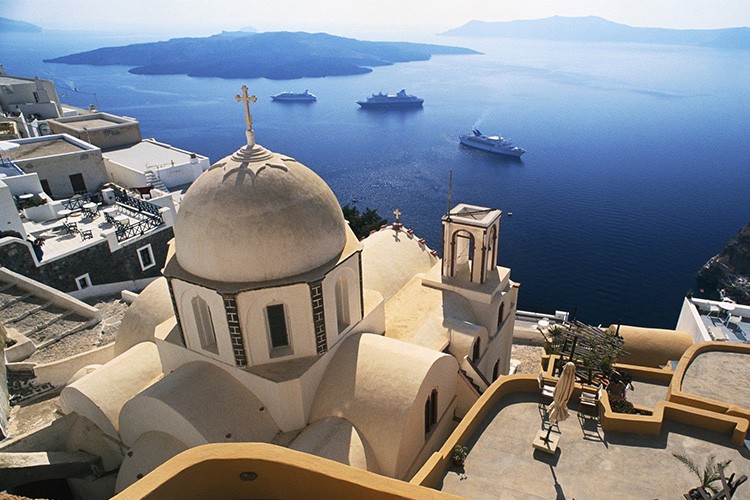
The village perches precariously on the side of the caldera, and it offers some of the island’s most magnificent sunsets and views of the volcano and the sparkling Aegean waters. It gets a little crowded during the summer tourist season because of its panoramic views, but Fira is still full of charm. Most of its hotels offer swimming pools and private verandas to enjoy the scenery. A cruise ship port sits at the base of the caldera, and visitors can get up and down the steep rocky path by cable car or on the back of a mule, like the locals.
Fira’s quiet lanes are lined by quaint whitewashed houses decorated by blue doors and windows – a color scheme often used for homes in the Clyclades. But, the main streets of the village are festooned with restaurants, cafés, tavernas, jewelry shops, smart boutiques and night clubs, so Fira offers plenty of things to do.
About local culture, Fira’s Archaeological Museum is the home of many interesting artifacts dug out of the earth at the ruins of Akrotiri, an ancient Minoan settlement on the island. The village cathedrals, monasteries and blue-domed churches add a touch of local color and culture.
OIA

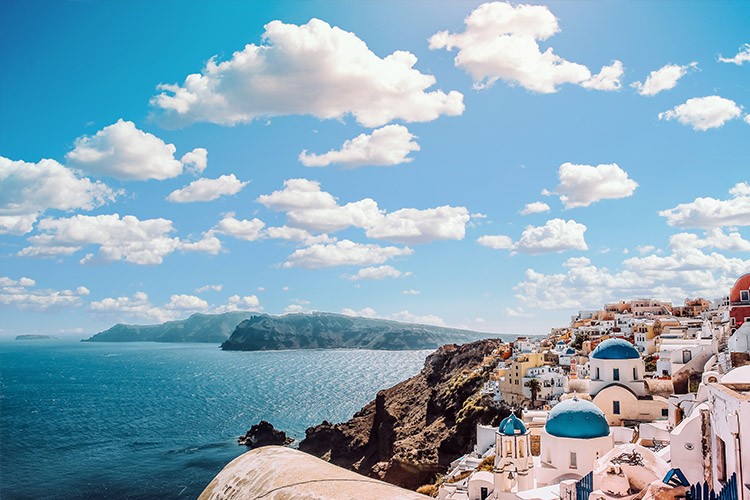
Oia, located about 11 kilometers northwest of Fira, is the best known and perhaps most picturesque of Santorini’s villages. Like Fira, Oia sits atop a cliff on the rim of the caldera and it offers spectacular sunsets and panoramic views of the surrounding area. Its architecture resembles that of Fira and the town is every bit as pretty. However, Oia is predominantly quiet and peaceful, while Fira is more commercialized – at least along its main roads.
Oia has long streets, where you will encounter a number of charming cafés, tavernas, local craft shops and boutiques. Artists have always gravitated toward Oia, and you will be able to browse through a number of art galleries in the village.
Oia overlooks Thirassia, a neighboring island, and the views are beautiful. However, if you are looking for the best views of the volcano, you are probably better off in Fira.
A Maritime Museum houses a variety of nautical items and the ruins of a medieval Venetian fortress. The 300 steps leading down to Armeni Bay and Ammoudi, a small port, are near Oia’s Central Square. Don’t expect a sandy beach because the shoreline is pebbled, but you can take a small tour boat from Ammoudi over to Thirassia.
IMEROVIGLI
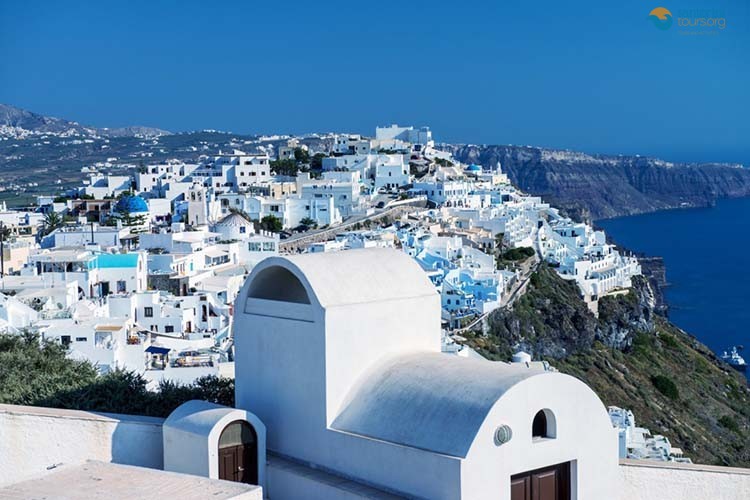
This village lies between Fira and Oia, but it is located on a higher cliff so its views are even better. In many ways, it is like a suburb of Fira – quieter and more charming, but with plenty of opportunities for tourists. Hotels are abundant in Imerovigli, but it also has a large number of quaint houses.
FIROSTEFANI

Like Imerovigli, Firostefani is within walking distance of Fira. And also like Imerovigli, it seems like an extension of the capital. Firostefani features charming examples of the quaint local architecture, wonderful views due to its position high on the caldera rim, and a variety of activities for tourists. In addition to its hotels and restaurants, Firostefani has an interesting monastery which is open for public tours during the day.
PYRGOS
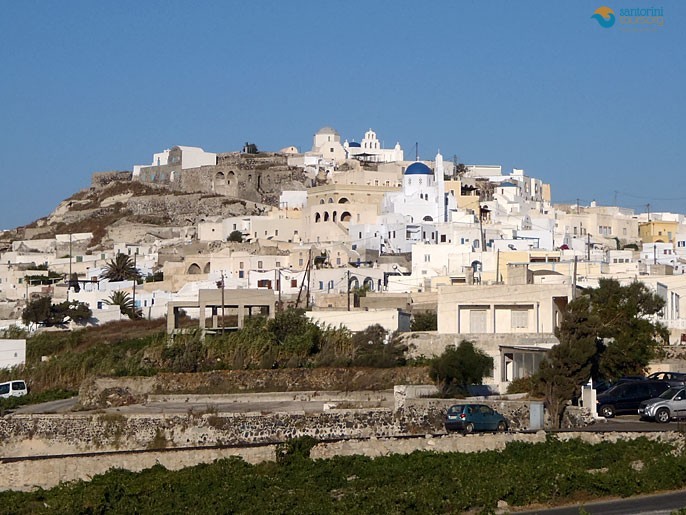
Pyrgos is a charming traditional village located just a few kilometers southeast of Fira. Among its other attractions, the village sits atop a hill and gives its visitors an impressive array of views of the entire island. It is a tiny place with a population of only 500 people, and it is full of traditional houses that were built under the protection of an old Venetian castle. Pyrgos is known for its many old blue-domed churches, including the most famous church on Santorini: the Monastery of Prophitis Ilias.
EMPORIO

Emporio is another traditional village in Santorini. Located about 8 kilometers south of Fira, Emporio is surrounded by a long string of windmills on the hillside and a number of verdant vineyards. The village itself has two beautiful blue-domed churches and a dilapidated medieval-era fortress sitting atop the hill. Perissa Beach, a tremendously popular spot on Santorini, is located near Emporio.
FOINIKIA

Finikia, about 10 kilometers northwest of the capital, is a quiet, calm little place “next door” to Oia. There are not many hotels in Finikia, but it does have something that makes it unique: “cave houses” dug into the island’s soft volcanic rock. By taking advantage of the rock’s natural insulating properties, these cave houses keep their residents toasty in winter and cool in summer.
AKROTIRI
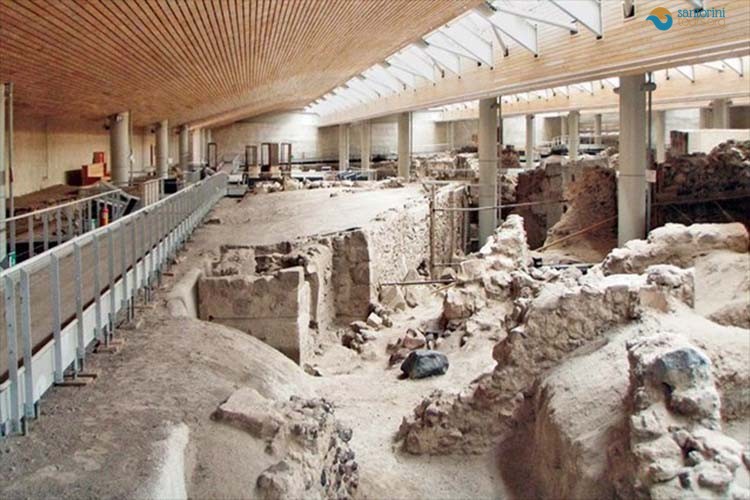
Quite possibly the quietest, calmest spot on the entire island, Akrotiri is also the most historically significant place on Santorini. Located adjacent to Red Beach, about 10 kilometers southwest of Fira, Akrotiri has not yet been spoiled by armies of tourists. The ruins left behind by an ancient Minoan settlement make Akrotiri the most significant archaeological site on the island.
BOOK A PRIVATE TOUR
Whether you are looking for spectacular natural scenery, local color in the form of quaint whitewashed houses and blue-domed churches, fresh Greek or Mediterranean cuisine, or a glimpse of the remains of one of the most ancient civilizations on Earth, you will find it in the villages of Santorini.
Book now and discover our amazing tours in Santorini!
SEE MORE ABOUT SANTORINI PRIVATE TOURS

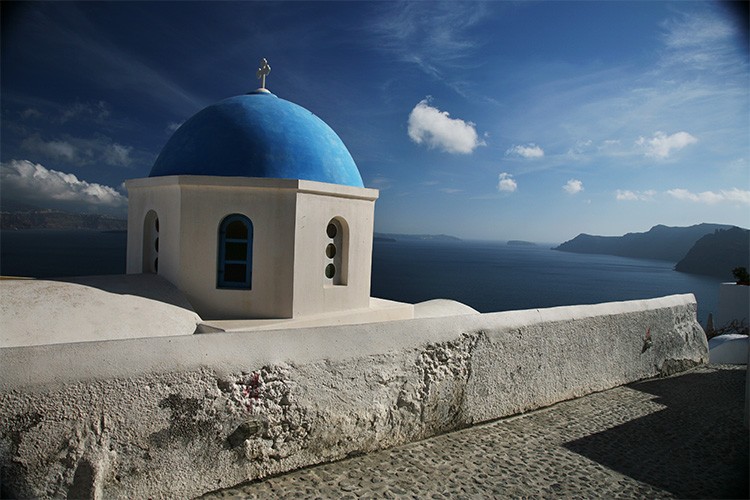





The Villages of Santorini: A Complete Guide to All 32
Most people arrive on this island with two names in their head: Fira and Oia. They are the two everybody photographs and the two everybody stays in, and between them they absorb the overwhelming majority of the traffic that comes off the boats and the aircraft. Book with Santorini Tours, a licensed local operator.
There are thirty-two other places worth knowing. Some are medieval fortress settlements with the houses built as the outer wall. Some are villages dug sideways into a ravine. One is a farming village emptied by an earthquake in 1956 and only half rebuilt since. One is an island of three hundred people across the water. Two are volcanic islets in the middle of the crater.
This page is the complete index to the villages of Santorini – every settlement, beach village, archaeological site and islet on and around the island, with what each one actually is, who it suits, and a link to the full guide for it.
How the villages of Santorini are organised
The villages of Santorini fall into four natural groups, and understanding the groups makes the whole island legible:
The caldera rim. Fira, Firostefani, Imerovigli, Oia and Finikia, strung along the top of a three-hundred-metre cliff on the western side. The view, the prices and the crowds.
The inland plain and hills. Pyrgos, Megalochori, Emporio, Mesaria, Karterados, Vothonas, Vourvoulos, Exo Gonia, Mesa Gonia and Pigadia. Where the island actually lives, where the wine comes from, and where a meal costs a third of what it costs on the rim.
The east and south coasts. Kamari, Perissa, Perivolos, Agios Georgios, Agia Paraskevi, Monolithos, Akrotiri, Vlychada and Baxedes. Black sand, the resorts, and the beaches nobody has heard of.
The sites and the islands. Ancient Thira, the Akrotiri lighthouse, the Red and White beaches, Mesa Pigadia, Nea Kameni, Palia Kameni, Thirasia and Athinios port.
How to use this guide to the villages of Santorini
Read the group of villages of Santorini that matches the holiday you want. If you are choosing where to sleep, go straight to the section on where to stay further down, which sets the villages of Santorini against each other on price, view, transport and noise.
The Caldera Villages of Santorini
Five of the villages of Santorini sit on the rim, in a line from south to north. These are the villages of Santorini that appear on postcards, and between them they hold most of the island’s expensive beds.
Fira
The capital, halfway along the rim, with a population of around sixteen hundred and every service on the island. Museums, the cable car down to the old port, banks, the bus station from which every route on Santorini departs, and the densest concentration of restaurants and nightlife anywhere on the island. It is also where the cruise passengers land, which between eleven and four in season makes the main street close to impassable. Stay here if you want everything within walking distance and do not mind the crowd. Full guide to Fira.
Firostefani
Ten minutes’ walk north along the rim from Fira and a completely different atmosphere: the same caldera view, quieter lanes, better-value rooms and no cruise traffic. For a great many visitors this is the sensible version of Fira. Full guide to Firostefani.
Imerovigli
The highest point of the caldera rim, with what is generally agreed to be the best view on the island, looking down onto Skaros rock and straight across the crater. Quiet, residential, expensive, and reached only on foot at the far end. No nightlife whatsoever, which is exactly why people choose it. Full guide to Imerovigli.
Oia
The northern tip, and the most photographed village in Greece. Blue domes, cave houses down the cliff, the castle where several thousand people gather every evening for the sunset, and the harbour at Ammoudi below. Extraordinary, and extraordinarily crowded. Nobody should miss it and rather fewer people should sleep in it. Full guide to Oia.
Finikia
One kilometre east of Oia, behind the ridge, and one of the best-preserved settlements on the island. Stepped whitewashed lanes, cave houses, the church of Agia Matrona from 1859, and rooms at a fraction of Oia prices with Oia a ten-minute walk away. The single best-value decision at this end of the island. Full guide to Finikia.
The Inland Villages of Santorini
Ten of the villages of Santorini lie on the plain and the hills behind the rim. These are the villages of Santorini where people actually live, where the wine is made, and where almost no coach stops.
Pyrgos, the old capital of the villages of Santorini
The old capital, built up a conical hill at the highest inhabited point on the island, with a Venetian castle at the summit and a medieval kastelli of lanes spiralling below it. From the top you see both coasts and, on a clear day, half the Cyclades. Ten minutes from Fira and one of the two best inland afternoons on Santorini. Full guide to Pyrgos.
Megalochori
The wine merchants’ village: vaulted mansion houses, free-standing bell towers arching over the lanes, ornate gateways in blank white walls, and vineyards on three sides. The money came from Vinsanto shipped to Russia and it stopped a century ago, which is why the village still looks like itself. Tavernas at a third of caldera prices. Full guide to Megalochori.
Emporio
The largest village on the island and close to the least visited. It has the best-preserved medieval kastelli on Santorini – a genuine fortified maze where the outer ring of houses forms the wall – plus the Goulas tower, eight windmills on the ridge above, and a third-century BC marble temple that became a church. Full guide to Emporio.
Mesaria
The village at the centre of the island, four kilometres from Fira, with two neoclassical merchant mansions from 1888 and 1893, rock-cut canava wine cellars, and the best-value central beds on Santorini. Open all year, which most of the island is not. Full guide to Mesaria.
Karterados
Two kilometres from Fira, built into a shallow gorge, with houses cut into the ravine walls and nineteenth-century sea captains’ mansions among them. The only village on the island from which you can comfortably walk into the capital for dinner. Full guide to Karterados.
Vothonas
A village dug into a ravine on the Fira–Kamari road, entirely below the level of the surrounding land. Cave houses, a church built inside the rock called Panagia Sergena, and the Koutsoyannopoulos wine museum eight metres underground at the edge of it. Full guide to Vothonas.
Vourvoulos
A farming village two and a half kilometres north of Fira with its own undeveloped beach a kilometre below it, war memorials to the villagers killed after 1940, and a view east over the Aegean. Five minutes from the capital and almost nobody goes. Full guide to Vourvoulos.
Exo Gonia
Built along the eastern slope below Pyrgos, looking over vineyards towards Kamari. It holds Art Space, a gallery and working winery inside a rock-cut cellar, and a cultural centre in an old tomato paste factory. One of the emptiest inhabited places on the island. Full guide to Exo Gonia.
Mesa Gonia
The inner corner, in a hollow below Exo Gonia, wrecked by the 1956 earthquake and only partly rebuilt – roofless houses with vines growing through them beside restored courtyards. Above it stands Panagia Episkopi, a Byzantine church of around 1100 and the oldest intact building on Santorini. Full guide to Mesa Gonia.
Pigadia
Mesa Pigadia, a small sheltered cove on the southwest coast below Akrotiri, with white pumice cliffs, fishermen’s shelters cut into the rock and a single taverna. Reached by boat or a rough track. Full guide to Mesa Pigadia.
The Coastal Villages of Santorini
The east and south coasts hold the beach villages of Santorini, where the black sand is and where most of the island’s beach holidays happen. These villages of Santorini have no caldera view and considerably lower prices.
Kamari
The largest beach resort on the island: a crescent of black volcanic sand with a Blue Flag, a pedestrian promenade closed to traffic through the summer, an open-air cinema, a diving school, and the cliff of Mesa Vouno closing the southern end with Ancient Thira on the ridge above. The most practical base on Santorini for a week. Full guide to Kamari.
Perissa
The other side of the same mountain, at the northern end of a seven-kilometre run of black sand. Cheaper and younger in feel than Kamari, with the church of Timios Stavros at the beach entrance, the rock-cut chapel of Panagia Katefiani above, and the footpath up to Ancient Thira. Full guide to Perissa.
Perivolos
The middle stretch of that same beach, and the beach club end of the island: day beds, cocktails, volleyball courts and the best food served on sand anywhere on Santorini. Full guide to Perivolos.
Agios Georgios
The southern end of the same seven kilometres, where the loungers, bars and music all stop. No facilities at all, no shade, and the most space on the south coast. Full guide to Agios Georgios.
Agia Paraskevi
A small settlement on the east coast between Kamari and Monolithos, minutes from the airport, with a long unorganised beach, low prices and a genuine village festival at its chapel every 26 July. Full guide to Agia Paraskevi.
Monolithos
The beach islanders take their own children to: shallow gently shelving water, free shade under tamarisk trees, a playground and a football pitch behind the sand, and the single standing rock that gives the place its name. The best family beach on the island by a distance. Full guide to Monolithos.
Akrotiri
The village at the southwestern end, above the most important archaeological site in the Aegean – a Bronze Age town buried by the eruption around 1600 BC and preserved under ash, with streets, multi-storey houses and drainage. There is also a fourteenth-century Venetian castle above the village that almost nobody visits. Full guide to Akrotiri.
Vlychada
The strangest landscape on the island: black sand beneath a wall of white volcanic ash carved by wind and rain into pinnacles, gullies and fluting. A working marina with fish tavernas at the western end, and almost nobody on the sand. Full guide to Vlychada.
Baxedes
The north coast below Oia: a long dark beach with tamarisk trees giving real shade for free, shallow water, a few tavernas and free parking. Exposed to the north wind, so check the forecast before driving down. Full guide to Baxedes.
The Sites and Islands Around the Villages of Santorini
Not settlements, but they belong beside the villages of Santorini in any complete account of the island and each has its own guide.
Ancient Thira
A Greek and Roman city along the ridge of Mesa Vouno, three hundred and sixty metres above Kamari and Perissa. Founded by Dorian settlers around the ninth century BC, expanded under the Ptolemies, occupied until the eighth century AD. A main street, an agora with a royal stoa, a theatre cantilevered over the drop, temples, a gymnasium and rock inscriptions among the oldest in the Greek world. Full guide to Ancient Thira.
Faros, the Akrotiri lighthouse
A nineteenth-century lighthouse on the southwestern cape, one of the oldest in Greece, on a bare headland with the whole caldera opening to the north. The best uncrowded sunset on the island and it costs nothing. Full guide to Faros.
Kokkini Ammos, the Red Beach
A small cove beside the Akrotiri excavation under a sixty-metre cliff of iron-rich volcanic scoria oxidised to rust. Spectacular, unserviced, and subject to genuine rockfall. Full guide to the Red Beach.
Aspri Ammos, the White Beach
The next cove west, enclosed by pale pumice cliffs, with a canteen cut into the rock and sunbeds in season. Reached by small boat from the Red Beach. Full guide to the White Beach.
Nea Kameni
The active volcanic islet in the middle of the caldera, built by eruptions from the sixteenth century onward. A thirty-minute climb up black cinder to a crater rim with fumaroles venting steam and sulphur. Reached only by boat. Full guide to Nea Kameni.
Palia Kameni
The older, smaller islet beside it, with the hot springs in the bay of Agios Nikolaos. Boats anchor outside and you swim in. The iron in the water stains light swimwear permanently. Full guide to Palia Kameni.
Thirasia
The inhabited island across the caldera, part of the same land mass before the eruption split them. Around three hundred residents, the cliff-top village of Manolas above two hundred steps from the harbour at Korfos, and the cave villages of Potamos and Agrilia. What Santorini looked like fifty years ago. Full guide to Thirasia.
Athinios
The main ferry port, cut into the base of the caldera cliff twelve kilometres south of Fira. Not a village – a quay, two mini markets and a hairpin road – but the first thing a great many visitors see of the island. Full guide to Athinios.
Which of the Villages of Santorini Should You Stay In?
Choosing between the villages of Santorini shapes the whole trip, and the honest answer depends on three things: whether you must wake up to the caldera, how much you intend to drive, and what you are prepared to pay.
Villages of Santorini for the caldera view
Imerovigli for the best view and the most quiet, Firostefani for the same view with services ten minutes’ walk away, Fira if you want everything on your doorstep, Oia if you want the famous one and have the budget for it. All four are expensive and all four involve steps.
If you want the view without paying for it
Finikia, a kilometre from Oia behind the ridge. Karterados or Vourvoulos, both five minutes from Fira. You give up the view from the room and keep the view from the terrace you walk to, plus several hundred euro across a week.
Villages of Santorini for swimming
Kamari for the most complete resort, Perissa for the same thing cheaper and younger, Perivolos for the beach clubs, Monolithos or Agia Paraskevi for quiet with a car.
If you are travelling with small children
Kamari for the services and the flat traffic-free front, with days at Monolithos for the shallow water and the playground. Avoid the caldera villages entirely: they are built down a cliff with unfenced drops and long flights of steps.
If you are hiring a car and want the island rather than the photograph
Mesaria is the cheapest genuinely central base on Santorini. Megalochori, Pyrgos and Emporio are the three most rewarding villages to sleep in.
If you are on a tight budget
Perissa, Emporio, Mesaria and Karterados, in that order. A week in any of them costs roughly what three nights cost on the rim.
The one rule
Do not book a caldera-rim room and then spend the week driving to beaches. Among the villages of Santorini the rim and the coast are twenty-five minutes and one very different holiday apart, and people who want both are usually happier basing themselves inland between the two.
Getting Between the Villages of Santorini
By bus. Every route between the villages of Santorini on the island radiates from the central station in Fira, and almost every journey between two villages of Santorini means going into Fira and changing. The Fira–Oia, Fira–Kamari and Fira–Perissa services are frequent from early until late in season; everything else is thinner, and the inland and northern villages are poorly served.
By car. The island is roughly eighteen kilometres end to end and nothing is more than forty minutes from anything else. Roads are narrow, parking in Fira and Oia is difficult, and the caldera villages are largely pedestrian.
By scooter or quad. Popular and responsible for a great many holiday injuries. The roads are loose at the edges and the drivers are not gentle.
By taxi. Santorini has a famously small licensed fleet. In August it is effectively fully booked, and after the Oia sunset it is unobtainable.
On foot. The caldera path from Fira through Firostefani and Imerovigli to Oia is about ten kilometres and the best walk on the island. The path from Kamari over Mesa Vouno to Perissa through Ancient Thira is the second best.
By boat. The only way to reach Nea Kameni, Palia Kameni and Thirasia, from the old port below Fira, from Ammoudi or from Athinios.
By private transfer. Door to door, per vehicle rather than per person. Our private transfers run from 40€ and cover the airport and both ports, with a dedicated Oia and Finikia service for the north and a service for every other village.
Distances Between the Main Villages
Driving times, which are what matter when you are choosing a base.
From Fira: Firostefani 5 minutes · Imerovigli 8 · Oia 25 · Finikia 20 · Karterados 5 · Vourvoulos 5 · Mesaria 10 · Vothonas 10 · Pyrgos 15 · Megalochori 15 · Emporio 20 · Kamari 10 · Monolithos 10 · Perissa 15 · Perivolos 20 · Vlychada 20 · Akrotiri 20 · the lighthouse 25 · the airport 10 · Athinios port 20.
From Oia: Finikia 3 minutes · Baxedes 10 · Imerovigli 15 · Fira 25 · the airport 30 · Athinios 35 · Akrotiri 45.
From Kamari: Agia Paraskevi 5 · Monolithos 10 · Exo Gonia 10 · Mesa Gonia 5 · Pyrgos 10 · Ancient Thira 20 by road · Perissa 20 by road or 2 hours on foot over the mountain.
From Perissa: Perivolos 5 · Agios Georgios 8 · Emporio 10 · Vlychada 15 · Akrotiri 20.
The practical conclusion is that among the villages of Santorini the inland ones – Mesaria, Megalochori, Pyrgos, Karterados – are the best connected to everything, and Oia is the worst.
What the Villages of Santorini Have in Common
Once you have seen four or five of the villages of Santorini the vocabulary repeats, and knowing it makes every subsequent village more interesting.
Yposkafa – the cave house of the villages of Santorini
Rooms dug horizontally into the volcanic ash rather than built, with only the façade in masonry. Cheap to make, cool in August and warm in February without any mechanism, and highly resistant to earthquakes because there is no structure to fall. The cave suites sold on the caldera today are the same thing that housed the island’s poorest families a century ago.
The barrel vault
Where rooms were built rather than dug they were vaulted in volcanic stone and lime. A vault throws its load sideways into the walls rather than spanning across, which on an island that had a magnitude 7.7 earthquake in 1956 is structural sense rather than decoration.
The kastelli
A fortified village where the outer ring of houses forms the defensive wall, with two gates and a deliberately confusing maze inside. Five were built on Santorini against Aegean piracy. Emporio has the most complete, Pyrgos a partial one.
The canava
The winery cellar, cut into the pumice below the house or into a hillside, holding a steady temperature all year without machinery. Many are now tasting rooms and restaurants.
The cistern
Beneath almost every old house, catching winter rain off the roof. The island has no rivers and very little rainfall, and until desalination arrived that tank was the entire water supply of the household. It is the reason the roofs are shaped as they are.
The free-standing bell tower
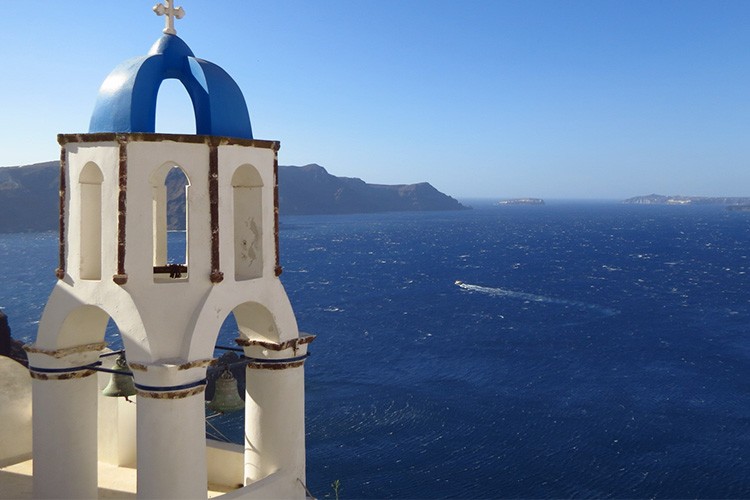
A wall pierced with arches for the bells, standing apart from the church rather than attached to it. A Cycladic form you will not see on the mainland, and Megalochori has the finest examples among the villages of Santorini.
The whitewash
Lime, applied for hygiene and to reflect heat, long before anybody thought of it as a look. The blue on the domes and shutters came from whatever pigment arrived cheaply as ballast.
A Short History of the Villages of Santorini
The eruption. The villages of Santorini begin with it: around 1600 BC the volcano emptied its magma chamber and the centre of the island collapsed into the sea, leaving the crescent of Santorini, the fragment of Thirasia and the islet of Aspronisi. The Bronze Age town at Akrotiri went under the ash and was preserved by it.
The Dorians. Settlers founded the city on the ridge of Mesa Vouno around the ninth century BC. Ancient Thira was the principal settlement on the island for over a thousand years.
Pirates. From the medieval period until the eighteenth century the Aegean was raided continuously, and every settlement retreated inland, uphill or into a ravine, out of sight of the sea. This single fact explains the position of almost all the villages of Santorini: Emporio behind its walls, Vothonas in its gorge, Pyrgos on its cone, Megalochori behind blank façades.
Wine. From the seventeenth century the island’s sweet Vinsanto went by the barrel to Russia as communion wine, and it made a handful of families rich. The mansions at Megalochori and Mesaria and the oversized churches at Karterados were all built on it. The Russian Revolution ended the trade.
1956. The Amorgos earthquake, magnitude 7.7, wrecked the caldera villages and emptied Mesa Gonia entirely. Emigration followed across the whole island through the 1960s.
Tourism. It arrived on the caldera rim in the 1970s and 1980s and largely stopped there. That is why the inland villages of Santorini still look the way they do, and why they are the interesting half of the island today.
The Villages of Santorini by Theme
If you have limited time, pick between the villages of Santorini by what you actually want rather than by what is famous.
Best for the view
Imerovigli first, Firostefani second, Oia third, Fira fourth. Then, off the rim entirely, Pyrgos for the whole island at once and the lighthouse at Faros for the widest look at the caldera anywhere.
Villages of Santorini for architecture
Emporio for the kastelli, Megalochori for the mansions and bell towers, Vothonas and Karterados for cave houses in a ravine, Mesaria for two neoclassical merchant houses. These are the villages of Santorini that repay slow walking.
Best for history
Akrotiri for the Bronze Age town, Ancient Thira for the Greek and Roman city, Mesa Gonia for the Byzantine church and the earthquake, Emporio for the medieval fortification.
Best for wine
Megalochori, Pyrgos, Exo Gonia and Mesa Gonia, all within ten minutes of each other, with Vothonas for the underground wine museum.
Best for eating
Megalochori and Emporio for village tavernas, Vlychada marina for fish off the boats, Perivolos for food on the sand, Kamari for the widest choice.
Best for beaches
Kamari and Perissa for the full resort, Perivolos for beach clubs, Monolithos for children, Vlychada for the strangest landscape, Baxedes and Agios Georgios for space.
Villages of Santorini for quiet
Exo Gonia, Mesa Gonia, Agios Georgios and Thirasia. Among the villages of Santorini these four are as empty as the island gets while still having somewhere to eat.
Best for walking
The caldera rim from Fira to Oia, the mountain crossing from Kamari to Perissa through Ancient Thira, the vineyard descent from Finikia to Baxedes, and the whole of Thirasia end to end.
Best for a first trip
Fira, Oia, Akrotiri and one black sand beach. That is the island’s headline and four days is enough for it.
Best for a second trip
Everything else on this page. The villages of Santorini that nobody photographs are the reason people come back.
What the Villages of Santorini Cost
The price difference between the villages of Santorini is larger than most visitors expect, and it is almost entirely a function of whether you can see the crater.
Coffee. 4–7€ on the caldera rim. 2–3.50€ in every inland village. The same coffee.
Dinner with wine. 45€ and upward a head in Oia, Imerovigli and Firostefani. 20–32€ in Kamari and Perissa. 15–28€ in Megalochori, Emporio, Mesaria, Karterados and Vourvoulos.
A double room in shoulder season. From around 200€ on the rim with a view, 120€ on the rim without one, 80€ in Finikia, 60€ in Kamari, and 55€ in Mesaria or Perissa.
August. Every one of those numbers rises, and the gap between the rim and the villages of Santorini inland widens rather than narrows.
Sunbeds. 15–25€ a pair at Kamari, Perissa and Perivolos, frequently waived if you eat at the bar behind them. Free at Baxedes and Agios Georgios, because there are none.
Entry fees. Akrotiri and Ancient Thira each cost a few euro and are the two best value tickets on the island. Every village on this page is free to walk into.
Transfers. From 40€ per vehicle from the airport or either port, to any of the villages of Santorini, with luggage included.
A private tour. From 220€ for the whole vehicle rather than per person, which is why a family of four pays what a couple pays.
The honest summary. A week inland with a hire car, eating in villages and driving to the rim for the evenings, costs roughly half what the same week costs on the caldera, and you see considerably more of the island.
The Villages of Santorini With Children
The villages of Santorini are harder work with small children than the photographs suggest, and choosing the wrong village makes it much harder.
What to avoid. The caldera rim. Fira, Firostefani, Imerovigli and Oia are built down a cliff face, with long flights of steps, unfenced drops beside the lanes, and hotels reached on foot with luggage. They are beautiful and they are difficult with a toddler.
What works. Kamari, which is flat, has a traffic-free promenade, supermarkets, a pharmacy, a doctor, family rooms with kitchens and an open-air cinema. Perissa for the same idea more cheaply.
The right beach. Monolithos, five minutes from the airport, with shallow gently shelving water, free shade under tamarisk trees, a playground and a football pitch. It is the only beach on the island where a small child can stand up a long way out.
The second best. Baxedes on the north coast, for the tamarisk shade, on a day when the wind is not blowing onshore.
Inland with children. Mesaria and Karterados are flat, cheap and central. Megalochori and Pyrgos are lovely to walk but stepped.
The hot sand. Black volcanic sand burns bare feet from mid-morning in July and August, on every beach on the island. Take shoes for the sand; this catches families out every single year.
What children actually enjoy. The cable car at Fira, the boat to the volcano, the donkeys, the water park behind Perissa, and the kastelli maze at Emporio, which is the best thing on the island to get lost in.
Photographing the Villages of Santorini
The caldera villages. Blue hour rather than sunset. Twenty minutes after the sun has gone, the lights come on down the cliff and the sky still holds colour, and most of the crowd has already left.
Oia. Early morning is the only time the lanes are empty. By ten there is no photograph of the main street without people in it.
Imerovigli and Skaros. Late afternoon from the path, with the rock in the foreground and the caldera behind.
The inland villages of Santorini. Any hour, because there is nobody there. Megalochori’s bell towers want a plain sky and raking light; Emporio’s kastelli wants the contrast between a dark vaulted lane and the bright square at the end of it.
The ravine villages. Vothonas and Karterados from the floor of the gorge, looking up at the stacked terraces.
The beaches. Black sand fools automatic metering into overexposing – dial down a stop. Vlychada’s carved cliffs want low afternoon sun; at midday they photograph as a flat white wall.
The best single frame on the island. The theatre at Ancient Thira, with the seats, then the stage, then six hundred feet of nothing.
Courtesy. Almost every village on this page is residential. The lanes pass front doors and the courtyards are private, whatever the light is doing.
Common Mistakes Around the Villages of Santorini
Seeing only two of the villages of Santorini. The most common, and the one this page exists to fix.
Staying on the rim and driving to beaches every day. Twenty-five minutes each way, twice a day, for a view you are not in during daylight.
Going to Oia for sunset without a plan for afterwards. Several thousand people leave at once, the taxis vanish and the road blocks. Either walk back to Finikia or watch the sun from the lighthouse instead.
Relying on buses to reach the inland villages of Santorini. Every route changes at Fira and the inland services are thin. Hire a car or book a tour.
Climbing to Ancient Thira at midday. No shade on the ridge and the site closes in the early afternoon.
Walking barefoot on black sand in August. It burns.
Booking a caldera cave suite with a pushchair. Check how many steps stand between the road and the room before you pay.
Assuming everything is open in winter. The rim largely closes from November. The inland villages stay open because people live in them.
Connecting a ferry to a flight on the same day. Sailings from Athinios are cancelled in strong wind, at short notice.
Treating the villages as a checklist. Four of them properly beats twelve from a car window.
The Villages of Santorini in Winter
Almost nobody visits the villages of Santorini between November and March, and the island splits cleanly in two when they do not.
What closes. The caldera rim, almost entirely. Oia empties, most of Imerovigli and Firostefani shut, and Fira drops to a handful of places serving residents. The beach resorts at Kamari, Perissa and Perivolos close completely.
What stays open. The inland villages of Santorini, because people live in them all year. Mesaria, Karterados, Emporio, Vourvoulos and Vothonas keep their shops, bakeries, pharmacies and at least one taverna running through the winter.
What it looks like. Green. The plain and the slopes turn after the first rain and stay green until May, which is the opposite of the parched island in the photographs.
The weather. Cool rather than cold, wet in short bursts, and windy. Ferries are cancelled and flights are thinner.
What is still worth doing. Akrotiri, which is roofed. Ancient Thira on reduced hours. The wine museum at Vothonas. Every village on this page, walked without meeting anybody. The caldera under a winter sky is more dramatic than under a blue one.
What is not. Swimming, boats to the volcano, and any plan that depends on a particular restaurant being open.
Who it suits. Photographers, walkers, and anyone who has already seen the villages of Santorini in August and wants to know what the island is like when it belongs to the fifteen thousand people who live here.
How the Villages of Santorini Got Their Names
The names of the villages of Santorini are a short history of the island in themselves.
Fira – from Thira, the island’s own ancient name, itself from Theras, the Dorian leader who founded the city on the ridge.
Firostefani – the crown of Fira, from its position on the rim above the capital.
Imerovigli – the day watch, from the lookout kept there against pirate ships approaching in daylight.
Oia – an ancient name reused, and the reason the northern tip is not called something Venetian.
Finikia – from the date palm, or possibly from Phoenician traders, depending on whom you ask.
Megalochori – the big village, which it no longer is.
Emporio – commerce, because it was the market for the southern half of the island.
Mesaria – in the middle, which it is.
Karterados – from karteri, an ambush point, where villagers waited for raiders coming up from the shore.
Pyrgos – the tower, from the Venetian castle at its summit.
Exo and Mesa Gonia – the outer and inner corner.
Monolithos – single stone, from the rock standing alone in the shallows.
Kokkini and Aspri Ammos – red sand and white sand, which is exactly what they are.
Nea and Palia Kameni – the new and the old burnt one.
Santorini itself – from Santa Irini, Saint Irene, a Venetian name for a church, and not the island’s own name at all. The Greeks call it Thira.
Read the names of the villages of Santorini in order and you get piracy, trade, geology and four separate occupations without opening a history book.
Three Villages in One Afternoon
Three of the villages of Santorini in the single best-value half day on the island, and it costs a tank of fuel.
Four o’clock – Mesa Gonia. Park at the entrance. The Byzantine church of Panagia Episkopi, then the roofless streets the 1956 earthquake left, then a tasting at the winery on the way out.
Half past five – Exo Gonia. Five minutes up the slope. The lanes, the church terrace with the whole eastern plain below it, and an hour underground among the barrels and the sculpture at Art Space.
Seven o’clock – Pyrgos. Five minutes further up. Through the kastelli to the castle at the top for the view across both coasts, and the sunset from the ridge with nobody else on it.
Nine o’clock – dinner. On a terrace in Pyrgos or ten minutes across to Megalochori, at a third of what the caldera charges, at the hour Greeks actually eat.
Three of the villages of Santorini, a Byzantine church, an earthquake, a winery, a Venetian castle and a sunset, in five hours. Most visitors spend the same five hours queueing in Oia.
Two Villages Most Guides Leave Out
Every list of the villages of Santorini carries the same six names. Two of the best are almost never on it.
Emporio, and why it is skipped
It is the largest village on the island and it has the only complete medieval kastelli left on Santorini, and it is skipped because there is no view from it and no coach can enter it. You walk in through a gate and the lanes close over your head: narrow, vaulted, deliberately confusing, with buttress arches thrown from one house to the house opposite. Whole streets are lived in exactly as they were. Above it stand eight windmills on a ridge, and inside it stands a third-century BC marble temple that became a church and never stopped being used.
Mesa Gonia, and why it is skipped
Because it is broken. The 1956 earthquake wrecked it, most of the population walked down to Kamari and rebuilt on the coast, and for forty years the village stood empty. Some of it has been restored and a good deal of it has not, so you walk past a courtyard with a lemon tree and then a shell with the sky in it. Above all of it stands a Byzantine church from around 1100 that did not move.
Why these villages of Santorini matter
Between them these two villages of Santorini contain the medieval island and the twentieth-century island, and neither has been arranged, lit or ticketed for anybody. They are ten minutes apart, they are free, and on most days you will have both to yourself.
Which other villages of Santorini get left out
Vothonas, a village in a ravine with a church inside the rock. Vourvoulos, five minutes from Fira with an empty beach below it. Agios Georgios, where seven kilometres of the busiest sand on the island finally runs out of people. Thirasia, an inhabited island three hundred metres across the water that most visitors look at every evening without ever going to.
The famous villages of Santorini are famous for good reasons. These are better value.
Planning a Trip Around the Villages of Santorini
A short checklist, drawn from what our guests get wrong and right.
Decide the view question first. Everything else follows from whether you must wake up looking at the crater. If you must, budget for it. If you can walk to it instead, the villages of Santorini inland cost half as much and put you nearer everything else.
Hire a car for at least two days. The bus network radiates from Fira and the inland villages of Santorini are poorly served. Two days of driving opens the whole island.
Book the airport or port transfer before you arrive. Athinios after a ferry is the most stressful hour on the island and it is entirely avoidable.
Put the famous sunset on one evening, not every evening. Then use the lighthouse, Pyrgos or Imerovigli for the rest.
Do the archaeology early in the day. Ancient Thira closes in the early afternoon and Akrotiri is the coolest place to be at noon.
Eat inland. The tavernas in the villages of Santorini away from the rim are better and cost a third as much, and you can drive to them in fifteen minutes from anywhere.
Leave one day unplanned. The island rewards it: a beach with nobody on it, an hour lost in the Emporio kastelli, or a boat to Thirasia on a whim.
Ask us. Tell us your dates, party size and where you are staying, and we will tell you honestly which of the villages of Santorini are worth your time and which are not, including when the right answer is to take a hire car and go on your own.
When to Visit the Villages of Santorini
April and May. The best window for the villages of Santorini specifically. Everything reopens, the inland slopes are green, the walking is comfortable and nothing is full. The sea is cold until late May, so this is a village-and-archaeology season rather than a beach one.
June. The best all-round month. Warm water, long evenings, and the July weight of visitors not yet arrived.
July and August. Peak everything. Fira and Oia are genuinely difficult in the middle of the day and the inland villages of Santorini are the escape from that – empty at any hour, shaded in their lanes, and a third of the price.
September. Harvest across the plain, the warmest sea of the year, and the crowds thinning. For most people the best month on the island.
October. Quiet, still swimmable early in the month, and the clearest light of the year on the whitewash.
November to March. The caldera resorts close almost entirely. The inland villages – Mesaria, Karterados, Emporio, Vourvoulos – keep working because people live in them, and a winter visit shows you a completely different island.
Festivals in the villages of Santorini worth planning around
26 July – Agia Paraskevi, on the east coast. 15 August – the Dormition, celebrated at Panagia Episkopi in Mesa Gonia and across the island. 20 October – Agia Matrona at Finikia, with a wine-tasting competition. These are working village panigiria rather than events arranged for visitors, and anyone is welcome at them.
The Villages of Santorini in One Week
An itinerary that covers the villages of Santorini properly rather than photographing two villages and leaving.
Day one. Fira on foot – the museums, the caldera path north through Firostefani to Imerovigli, and dinner inland where it costs half as much.
Day two. Oia in the late afternoon, the castle for sunset, and Finikia for dinner afterwards while everybody else queues for a bus.
Day three. Akrotiri in the morning, the Red Beach, and the lighthouse at Faros for the sunset. The best day on the island for most people.
Day four. The volcano and the hot springs by boat, with Thirasia for lunch.
Day five. Ancient Thira at opening, then the beach at Kamari, then Mesa Gonia and Exo Gonia in the afternoon.
Day six. The inland villages of Santorini – Pyrgos, Megalochori and Emporio – with a winery between them and somebody else driving.
Day seven. A beach with nothing on it: Vlychada for the cliffs, Baxedes for the shade, Monolithos if there are children, Agios Georgios if you want empty sand.
That covers all four groups of villages of Santorini, both coasts, both archaeological sites, the volcano and the second island, and it leaves the famous view as one evening rather than the whole holiday.
Frequently Asked Questions About the Villages of Santorini
How many villages are there on Santorini? Around thirty-two settlements, beach villages and named sites, from the capital at Fira down to hamlets of a few dozen people.
Which is the most beautiful? Oia by consensus, Pyrgos and Megalochori by most people who have seen all of them.
Which is the most authentic? Emporio, for the intact medieval kastelli, and Mesa Gonia for the earthquake ruins. Neither has been arranged for visitors.
Which villages of Santorini have the caldera view? Fira, Firostefani, Imerovigli and Oia, and no others. Everything else looks over the plain, the vineyards or the open Aegean.
Where should I stay? The rim for the view, Finikia or Karterados for the same island at half the price, Kamari or Perissa for a beach holiday, Mesaria or Megalochori if you are hiring a car.
Which is the cheapest? Perissa and Emporio, with Mesaria the cheapest that is also central.
Which is best for families? Kamari, with days at Monolithos. The caldera villages are difficult with small children.
Can I visit the villages by bus? Fira, Oia, Kamari and Perissa easily. The inland and northern villages are poorly served and a car or a tour is far more practical.
How long do I need to see them all? A week covers the island properly. Three days covers the caldera and one beach.
Which village has the best food? Megalochori, Emporio and Pyrgos inland, and the marina at Vlychada for fish.
Which is the quietest? Exo Gonia, Mesa Gonia, Agios Georgios and Thirasia.
Are the villages walkable between each other? Along the caldera rim, yes – Fira to Oia is about ten kilometres on a path. Elsewhere the distances are short but the roads are not built for walking.
Which village is nearest the airport? Monolithos and Agia Paraskevi, both about five minutes.
Which is nearest the ferry port? Megalochori, about fifteen minutes from Athinios.
Is it worth leaving Fira and Oia at all? That is the entire argument of this page, and the answer is that the villages of Santorini most people never see are the reason to come back a second time.
Tours of the Villages of Santorini
We are a licensed local operator with guides who live on the island year round. Prices are per vehicle rather than per person, so a family of four pays what a couple pays, pickup is included from anywhere including both ports, and an 80€ deposit confirms any date.
Full day tour – eight hours from 460€, the whole island with a traditional village stop. The most complete way to see the villages of Santorini in a day.
South part tour – five hours from 280€, Akrotiri, the beaches and the inland villages.
North part tour – the northern half, including Oia and the villages behind it.
Historical tour – Akrotiri and Ancient Thira, the two great sites, with a guide who can explain them.
Wine tour – four and a half hours from 650€, three estates with all tastings included, in the country around Megalochori and Pyrgos.
Food tour – five hours from 556€, producers on the plain and a sit-down meal.
Sunset tour – timed for the evening, and we will take you somewhere other than the Oia crowd if you prefer.
Personalised tour – from 220€, built around whichever villages you actually want to see.
Every itinerary and all prices are on the santorini tours page.
A Final Word on the Villages of Santorini
Two million people a year come to the villages of Santorini and a very large share of them see two villages, one view and one sunset. It is a good view and a good sunset and nobody should skip them.
But the island is a fortified village where the houses are the wall, a farming settlement left roofless by an earthquake, a gorge with homes cut into its sides, a Greek city on a ridge with a theatre hanging over a six-hundred-foot drop, a lighthouse on an empty cape, a beach under a cliff of carved white ash, and three hundred people on the far side of the crater who watch the whole thing from the outside.
All of it is inside forty minutes of wherever you are staying, and most of it costs nothing.
Every one of the villages of Santorini has its own guide on this site, linked from the sections above. Send us your dates and party size and we will build the days around the ones you want to see.
Every Village and Site on Santorini
Any of these can be built into a private itinerary. Each has its own page with what to see and how long to allow.
Caldera villages: Fira · Firostefani · Imerovigli · Oia · Finikia · Baxedes
Inland villages: Pyrgos · Megalochori · Emporio · Mesaria · Karterados · Vothonas · Vourvoulos · Exo Gonia · Mesa Gonia · Pigadia
Beaches: Perissa · Perivolos · Kamari · Vlychada · Monolithos · Red Beach · White Beach · Agios Georgios · Agia Paraskevi
Sites and landmarks: Akrotiri · Ancient Thira · Akrotiri Lighthouse · Nea Kameni · Palia Kameni · Thirasia · Athinios Port
All our tours: All Santorini tours · Full day tour · Sightseeing tour · Personalised tour · North part tour · Horse riding · South part tour · Sunset tour · Shore excursion · Caldera tour · Food experience · Wine tour · Historical tour · Small group tour
Planning and services: Famous sights tour · Private transfers · Transfers to Oia and Finikia · Transfers to other villages · History of Santorini · Tours near you · Languages we guide in · Food and fun tours · Gay friendly tours · Our tour buses · Daily tours · Day tours · FAQ · Gallery · Tour photo gallery · About us · Contact · Blog








Leave a Reply