
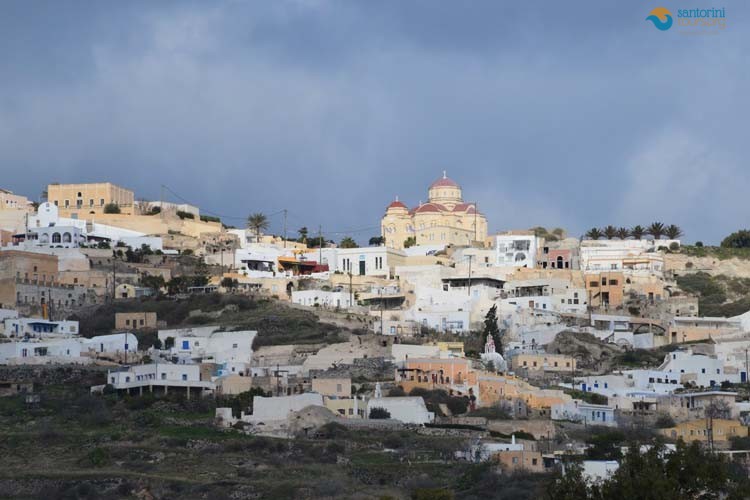
Exo Gonia Santorini Private Guided Tours
Exo Gonia Santorini is a village on Santorini island. It is located at the southeastern side of Fira next to the village of Mesa Gonia. This is a traditional Mediterranean village with only a few local people that choose to live here.
Narrow streets, beautiful small houses, a lowland place with amazing view. The villagers of Exo Gonia gather on a yard talk to each other and wave to the travelers here, you can enjoy their hospitality and kindness by strolling around.
There are no hotels or rooms in order to stay here but you are going to find some excellent taverns and taste the local food or some delicacies along with ouzo or wine.
Exo Gonia private transfers
A luxury bus is an excellent way to take an Exo Gonia private transfer and feel the warmness of the place. Additionally, you can have an experienced travel guide to share with you his knowledge about the place by booking an Exo Gonia guided private transfer.
Discover the island with a Santorini Private Transfer today!
History of Exo Gonia
The people here in Exo Gonia lead a way of live which is similar to the people that used to live here many years ago. It is a quiet place where you are not going to find a lot of people or tourists.
An old tomato paste factory has been turned into a Cultural Center which is open to everyone. Here you are going to take part in some very interesting events and festivities.
Book A Private Tour Now

Book now and discover our amazing tours in Santorini!
See more about Santorini Private Tours:
- Santorini Sightseeing Private Tour
- Santorini Exclusive Shore Private Tour
- Santorini Impressive Caldera Private Tour
- Santorini South Part Private Tour
- Santorini North Part Private Tour
- Santorini Historical Private Tour
- Santorini Sunset Private Tour
Exo Gonia Santorini: The Village on the Slope
Exo Gonia Santorini sits on the eastern flank of the island, built into the hillside below Pyrgos and above the plain that runs down to Kamari. It is roughly seven kilometres from Fira and it is one of the quietest inhabited places on Santorini. Book with Santorini Tours, a licensed local operator.
Gonia means corner. There are two of them: Mesa Gonia, the inner corner, lower down towards the plain, and Exo Gonia, the outer one, higher on the slope. They are a few minutes apart and are usually visited together.
Exo Gonia Santorini is arranged amphitheatrically along the contour, so almost every house looks east over vineyards to the sea, with the ridge of Mesa Vouno and Ancient Thera closing the view to the south. There is no caldera here and no sunset crowd. There is a church, a handful of lanes, a converted tomato factory, one of the most interesting wineries on the island and a great deal of silence.
Where it is
Seven kilometres from Fira, five minutes from Pyrgos, five from Kamari, ten from the airport, twenty-five from Oia. Exo Gonia Santorini is on the road between the plain and the hill villages, which is why most people pass it without stopping.
Why go
For the view east at the end of the day, the Art Space winery cut into the rock, the cultural centre in the old tomato factory, and a couple of tavernas that cook for people who live here.
What to See in Exo Gonia Santorini
Art Space
The reason most visitors who do stop are stopping. An old canava – a wine cellar dug into the volcanic rock – converted into a gallery that is also a working winery. Sculpture and painting stand among the barrels in vaulted tunnels at constant temperature, and the wine made on site is poured at the end. It is the most unusual room on Santorini and it is in a village almost nobody visits.
The church of Agios Charalambos
The village church, standing on the slope with a bell tower and a whitewashed courtyard, visible from the road below. The terrace beside it is the best free viewpoint in Exo Gonia Santorini.
The old tomato factory
Santorini’s small dense tomatoes were processed into paste on an industrial scale on this island until the trade collapsed. The factory here has been turned into a cultural centre that hosts exhibitions, talks and village festivals. Opening depends on what is on, and it is worth asking.
The lanes
Narrow, stepped in places, running along and across the slope. Whitewash, blue shutters, cats, and washing lines. Twenty minutes will cover them, and you will not meet a tour group.
The view
East over the vineyards to Kamari and the Aegean, south to the great rock of Mesa Vouno with Ancient Thera along its ridge. In the early morning the sun comes up out of the sea directly in front of you.
Mesa Gonia below
Five minutes down the slope, with the Byzantine church of Panagia Episkopi from around 1100 and the shells of houses abandoned after the 1956 earthquake. More on Mesa Gonia.
The History of Exo Gonia Santorini
The two corners. Mesa Gonia was the older and larger settlement, down on the edge of the plain beside the Byzantine church. Exo Gonia grew on the slope above it, out of the damp of the hollow and closer to the road.
Wine and tomatoes. Both villages lived off the eastern plain: Assyrtiko on the slopes, and from the late nineteenth century the small dense Santorini tomato, which was grown here in quantity and boiled down into paste for export. That trade supported factories across the island, and the one in Exo Gonia Santorini is now the cultural centre.
1956. The Amorgos earthquake, magnitude 7.7, changed everything on this hillside. Mesa Gonia below was so badly damaged that most of its population left and never returned; its ruined houses stood empty for decades and some still do. Exo Gonia, higher and on firmer ground, survived better and absorbed some of those families.
Emigration. As across the whole island, the decades after the earthquake emptied the villages. Tourism arrived on the caldera in the 1970s and 1980s and never really reached this side.
Now. A small resident population, a slow trickle of restoration, and a village that has stayed almost exactly as it was. That is not a marketing claim about Exo Gonia Santorini; it is simply what happens when nobody arrives.
Eating and Drinking in Exo Gonia Santorini
There are only a few places to eat in Exo Gonia Santorini, and that is the recommendation rather than the caveat. They cook for residents.
What it costs. Roughly 15€ to 25€ a head with wine, against 45€ and up for the same plates with a caldera view. Nobody on this slope is charging for scenery, although the view east is better than most people get.
What to order. Fava, the yellow split pea purée with its own protected designation, warm with raw onion and capers. Tomatokeftedes, fritters made from the tomato this hillside used to process by the ton. White aubergine, sweeter than the purple kind. Caper leaves. Chloro, the fresh goat cheese that never leaves the island. Slow-cooked rabbit and pork.
What to drink. Assyrtiko from the vines below the village, and the wine made at Art Space itself.
When. From nine. Earlier than that and you will be the only table.
Ouzo in the afternoon. With a plate of something salty, at a table on the terrace, looking at the sea. This is what Exo Gonia Santorini is actually for.
If food is why you travel, our food tour visits producers on this side of the island and finishes with a sit-down meal.
The Wine Around Exo Gonia Santorini
The slope below Exo Gonia Santorini is planted, and the vineyards here are unlike any others in Europe.
The vines are ungrafted. Phylloxera, the root louse that destroyed nearly every vineyard on the continent in the nineteenth century, cannot move through Santorini’s volcanic sand, so these vines were never replanted onto American rootstock. Some root systems below Exo Gonia Santorini are three or four centuries old, renewed by burying a cane and letting it root.
They are trained into koulara – low woven baskets at ground level with the fruit growing inside the coil. The meltemi would strip an upright vine, and there is effectively no rain from April to October, so the basket shelters the grapes and catches the night humidity that condenses out of the sea air.
Assyrtiko is the grape: dry, mineral, high in acid, faintly saline. Athiri and Aidani blend with it. Nykteri is the oak-aged dry white. Vinsanto is the sweet wine, sun-dried on mats and aged for years in barrel, that once went by the barrel to Russia.
Art Space in the village is both a gallery and a working canava, and there are serious estates within a few minutes in every direction. Do not drive between them after tasting. Our wine tour covers three estates with all tastings included and nobody driving who has been drinking.
Getting to Exo Gonia Santorini
By car. Fifteen minutes from Fira, five from Pyrgos, five from Kamari, ten from the airport, twenty-five from Oia. The village is on the hill road; park where it widens and walk in.
By bus. Services on this side of the island are thinner than the Fira–Oia and Fira–Perissa routes. Check times before relying on them, and expect a walk at one end.
By taxi. Possible, though the island’s licensed fleet is very small.
On foot from Kamari. Up the slope in about forty-five minutes, and the view improves the whole way.
On a tour. Exo Gonia Santorini sits between Pyrgos, Mesa Gonia and Ancient Thera, so it slots naturally into a private itinerary of the eastern side. The full day tour and the historical tour both work this part of the island.
By transfer. Our private transfers run from the airport and both ports from 40€ per vehicle, with flights and ferries monitored.
Staying here
There is very little accommodation in the village itself. Most people visiting Exo Gonia Santorini stay in Kamari five minutes below, Pyrgos five minutes above or Mesaria on the plain.
Walking Exo Gonia Santorini: A Route
Small enough that a route is almost unnecessary, but this is the order that works.
Park on the road and walk up. The village runs along the contour, so most of the lanes are level once you are in.
Start at the church. Agios Charalambos, with the terrace beside it and the whole eastern plain laid out below.
Take the lanes north. Whitewash, blue shutters, stepped alleys and courtyards. Fifteen minutes.
Find the old tomato factory. Now the cultural centre. If something is on, go in.
Go into Art Space. Allow an hour. The tunnels run a long way back into the rock and the tasting is at the end.
Drop down to Mesa Gonia. Five minutes by car or twenty on foot, for the Byzantine church and the earthquake ruins.
Finish in Pyrgos. Five minutes up the hill for the castle and the sunset.
Allow an hour for Exo Gonia Santorini alone, half a day for the three villages together.
Exo Gonia Compared With the Other Villages
Against Mesa Gonia. The natural pair, five minutes down the slope. Mesa Gonia has the Byzantine church and the earthquake ruins; Exo Gonia Santorini has the view, the winery and the tavernas. Do both. More on Mesa Gonia.
Against Pyrgos. Five minutes above, and a proper destination – castle, kastelli, the best all-island view. Exo Gonia is what Pyrgos would be if nobody had found it. More on Pyrgos.
Against Megalochori and Emporio. Both larger, both with far more to see, both still quiet. This village is smaller than either and emptier than both. Megalochori · Emporio.
Against Kamari. Five minutes downhill and a completely different holiday – black sand, sunbeds, bars and a promenade. Stay there, come up here for dinner. More on Kamari.
Against Oia and Fira. No comparison and no competition. Those are the caldera; this is the other side of the island, where the sun rises rather than sets. Oia · Fira.
When to Visit Exo Gonia Santorini
April and May. The best window. The slope is green, the vines are shooting out of their baskets, and it is warm enough to sit outside in the evening.
June to August. Hot, though the village catches the meltemi from the east and is usually a degree or two cooler than the plain. Late afternoon is the time.
September. Harvest on the slope below. The best month of the year here, and the village festivals fall around this period.
October. Quiet, warm and the light at its best.
November to March. Very quiet indeed. Some tavernas close and Art Space keeps shorter hours. Exo Gonia Santorini in winter is a handful of people and a great deal of weather.
Time of day
Sunrise if you can manage it – the village faces east over the sea and almost nobody on this island is awake for it. Otherwise late afternoon, when the light comes along the slope rather than down onto it.
Photographing Exo Gonia Santorini
The view east from Exo Gonia Santorini. Vineyards, the plain, Kamari and the sea, with Mesa Vouno rising to the right. Best at sunrise or in the last hour of light.
The church terrace. The bell tower against the sky, with the plain behind it.
The lanes. Whitewash and blue shutters, empty at any hour, which is not true anywhere on the caldera.
Art Space. Vaulted rock tunnels, barrels and sculpture. Very low light – brace against a wall, and ask before photographing the works.
The vines. Basket-trained and strange, two minutes below the village.
Technical. Midday blows out the whitewash; expose for the walls, not the sky. Nothing here is crowded, so take your time.
Courtesy. A small number of people live in Exo Gonia Santorini and the lanes pass their doors. The courtyards are private.
Frequently Asked Questions About Exo Gonia Santorini
How do you pronounce it? Roughly “EK-so go-NIA”. It means “outer corner”.
Where is it? On the eastern slope of the island, about seven kilometres from Fira, between Pyrgos above and Kamari below.
What is the difference between Exo Gonia and Mesa Gonia? Mesa Gonia is the inner corner, lower down, with the Byzantine church and the earthquake ruins. Exo Gonia is the outer corner, higher on the slope, with the view and the winery. Five minutes apart.
Is Exo Gonia worth visiting? Yes, if you want a village with nothing arranged for visitors. Art Space alone justifies the stop.
How long do I need? An hour for the village, half a day with Mesa Gonia and Pyrgos.
Is there a caldera view? No. The village faces east over the plain and the sea.
Can you stay there? Barely. There is very little accommodation; most people stay in Kamari, Pyrgos or Mesaria.
What is Art Space? A gallery and working winery inside an old rock-cut canava, with sculpture and painting among the barrels and a tasting at the end.
Is there a beach? Not in the village. Kamari is five minutes downhill.
Is it accessible? Partly. The main road and the church terrace are manageable; the lanes are stepped.
Is it crowded? No. Exo Gonia Santorini is one of the emptiest inhabited places on the island.
What is the old tomato factory? A processing plant from the era when Santorini exported tomato paste, now a cultural centre used for exhibitions and village events.
How do I get there without a car? Buses on this side are sparse. A tour with pickup, or a taxi, is more reliable.
What is the best time of day? Sunrise or late afternoon.
Tours That Include Exo Gonia Santorini
We are a licensed local operator with guides who live on the island year round. Prices are per vehicle rather than per person, pickup is included from anywhere including both ports, and an 80€ deposit confirms the date.
Full day tour – eight hours from 460€, the whole island with a traditional village stop.
Historical tour – the archaeology and the Byzantine churches of the eastern side, including Ancient Thera on the ridge above.
Wine tour – four and a half hours from 650€, three estates with all tastings included, on the slopes around this village.
Food tour – five hours from 556€, producers and a sit-down meal.
Personalised tour – from 220€, built around the villages if that is what you want.
Every itinerary and all prices are on the santorini tours page, and our private transfers cover the airport and both ports from 40€.
Is Exo Gonia Santorini Worth Visiting?
If you have three days on the island and have never seen the caldera, no. If you have a car, an afternoon and any curiosity about what the other side of Santorini looks like, yes.
There is one church, one converted factory, one extraordinary winery in a cave, a few lanes and a view east that almost nobody photographs. Nothing has been arranged for you and nothing is charging you for a sunset.
Come at five, walk the lanes, spend an hour underground at Art Space, eat at nine, and drive five minutes up to Pyrgos or five minutes down to Mesa Gonia depending on what you want next. That is the best use of an afternoon on the eastern side of the island.
Send us your dates and party size and we will build a day around it.
What Exo Gonia Santorini Costs
A different island from the caldera, financially.
Coffee. 2–3.50€ on a terrace with a view east, against 4–7€ on the rim.
Taverna dinner. 15–25€ a head with wine.
Wine by the glass. 3.50–5€.
Art Space. A modest entry and tasting fee, and the best hour on the eastern side of the island.
Winery tasting. 15–25€ a head at the estates below the village.
Transfer from the airport. 40€ per vehicle for one or two people, ten minutes away.
A private tour. From 220€ for the whole vehicle, pickup included wherever you are staying.
The lanes, the church terrace and the view. Free, and they are most of the reason to come to Exo Gonia Santorini.
Practical Notes for Exo Gonia Santorini
Parking. On the road where it widens. The lanes are for walking.
Shoes. Stepped lanes on a slope. Grip helps.
Opening hours. Small village, afternoon closing, and Art Space keeps its own hours – check before driving up.
Money. Carry cash. There is no reliable ATM in the village; the nearest are in Kamari and Fira.
Shops. Almost none. Buy supplies in Kamari or Mesaria.
Shade. Limited. The slope faces east and gets full sun all morning.
Buses. Sparse on this side of the island. Plan around a car or a transfer.
Respect. Very few people live in Exo Gonia Santorini and the lanes pass their front doors.
An Afternoon on the Eastern Slope
Exo Gonia Santorini is best treated as one stop in a three-village afternoon, because all three are within five minutes of each other and none of them takes a whole day.
Four o’clock – Mesa Gonia. The Byzantine church of Panagia Episkopi, built around 1100, and the houses left ruined by the 1956 earthquake.
Five o’clock – Exo Gonia. The lanes, the church terrace and an hour underground at Art Space among the barrels.
Seven o’clock – Pyrgos. Five minutes up the hill to the castle at the top for the view across both coasts, and the sunset from the ridge without the Oia crowd.
Nine o’clock – dinner. Back down to a terrace in Exo Gonia Santorini or Pyrgos, at a third of caldera prices.
That is the best-value half day on the island for anyone who has already seen the famous view once.
Everywhere We Can Reach From Exo Gonia Santorini
Any of these can be built into a private itinerary. Each has its own page with what to see and how long to allow.
Caldera villages: Fira · Firostefani · Imerovigli · Oia · Finikia · Baxedes
Inland villages: Pyrgos · Megalochori · Emporio · Mesaria · Karterados · Vothonas · Vourvoulos · Mesa Gonia · Pigadia
Beaches: Perissa · Perivolos · Kamari · Vlychada · Monolithos · Red Beach · White Beach · Agios Georgios · Agia Paraskevi
Sites and landmarks: Akrotiri · Ancient Thira · Akrotiri Lighthouse · Nea Kameni · Palia Kameni · Thirasia · Athinios Port
All our tours: All Santorini tours · Full day tour · Sightseeing tour · Personalised tour · North part tour · Horse riding · South part tour · Sunset tour · Shore excursion · Caldera tour · Food experience · Wine tour · Historical tour · Small group tour
Planning and services: Famous sights tour · Private transfers · Transfers to Oia and Finikia · Transfers to other villages · Villages of Santorini · History of Santorini · Tours near you · Languages we guide in · Food and fun tours · Gay friendly tours · Our tour buses · Daily tours · Day tours · FAQ · Gallery · Tour photo gallery · About us · Contact · Blog








Leave a Reply