
Emporio Santorini Private Guided Tours
Emporio Santorini is a village located at the center of the lowland at the southeast side of Santorini. The distance between Emporio and Fira is between 12 kilometers. Emporio is a spectacular village that nowadays is almost a united village with Perissa.
Reaching the village you are going to see how the houses are built over the hill and as you are still far away you are going to have the sight of a castle at the top of the hill but this is only because the houses in here are one right next to the other.
There are a lot of hotels here but during the summer it is very difficult to find a free room at the last moment.
Discover the island with a Santorini Private Transfer today!
Emporio private transfers
It will be a great experience to combine a Santorini island tour to Emporio, Perisa, Perivolos and to the other villages by booking an Emporio private transfer with one of luxury buses of Santorinitours. Additionally a private travel guide can usher you to the island if you book an Emporio guided private transfer.
History of Emporio
During the middle ages Emporio was fortified. The roots here are so narrow that it is very difficult for two people to walk side by side. There are only some ruins from the castle but both the two entrances are well preserved.
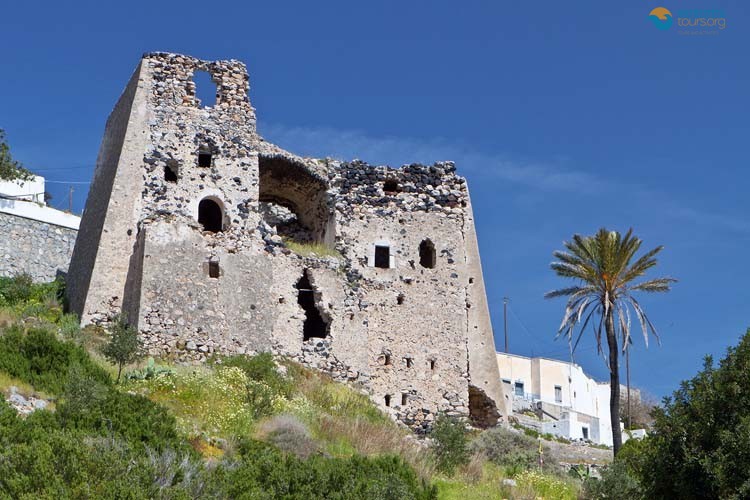
At the north side of the village you are going to find Goulas tower which was build during the ottoman empire in order to take care of the villagers when the pirates were coming and also to take care of the treasures of the monastery Monis Patmou.
Book A Private Tour Now

Book now and discover our amazing tours in Santorini!
See more about Santorini Private Tours:
- Santorini Sightseeing Private Tour
- Santorini Exclusive Shore Private Tour
- Santorini Impressive Caldera Private Tour
- Santorini South Part Private Tour
- Santorini North Part Private Tour
- Santorini Historical Private Tour
- Santorini Sunset Private Tour
Emporio Santorini: The Island’s Largest and Least Visited Village
Emporio Santorini sits inland on the flat southeastern plain, about twelve kilometres from Fira and a few minutes from the black sand at Perissa. It is the biggest village on the island by population and very close to the least visited by tourists, which is an odd combination and the reason to come. Book with Santorini Tours, a licensed local operator.
What it has that nowhere else on Santorini has is an intact kastelli – a medieval fortified settlement where the outer ring of houses forms the wall itself, with only two gates and a maze of lanes inside. Pyrgos has a partial one. Emporio Santorini has the real thing, and you can still get lost in it.
The name of Emporio Santorini means “commerce”. This was the island’s market and trading village, the place the farming plain sold through, and it has never stopped being a working settlement. People live here, farm here and shop here, and almost nobody arrives by coach.
Where it is
Twelve kilometres from Fira, five minutes from Perissa and Perivolos, ten minutes from Pyrgos and Megalochori, fifteen from the airport, and directly below the ridge that carries Ancient Thera. Emporio Santorini is the natural inland stop for anyone staying on the southeast coast.
Why go
For the kastelli, the Goulas tower, a genuinely strange third-century temple that became a church, the windmills on the ridge above, and prices that belong to a different island from the caldera.
The Kastelli of Emporio Santorini
This is the reason to make the trip, and it is worth understanding before you walk into it.
A kastelli is not a castle in the northern European sense. There is no keep and no moat. It is a defensive village: the houses on the perimeter are built wall-to-wall with no outward-facing windows on the ground floor, so the backs of the homes are the fortification. Inside, the lanes are deliberately narrow, dark and confusing, several of them vaulted over, some so tight that two people cannot pass shoulder to shoulder. There were two entrances and both could be shut.
The logic was pirates. From the thirteenth century until well into the eighteenth, the Aegean was raided by Ottoman corsairs and by anyone else with a fast ship. Coastal settlements were indefensible, so the islanders built inland, uphill and inward-facing. Emporio Santorini preserves that plan more completely than any other village on the island.
Walking it. Enter through one of the gates and simply go. You will get lost; that was the design intent. The lanes double back, dead-end into courtyards and pass under houses. Look up and you will see the vaulting, the buttresses thrown across the lane to brace one house against another after earthquakes, and doorways cut for people considerably shorter than modern visitors.
What survives. Fragments of the castle at the centre, both gates in good condition, and the residential fabric almost entirely. Some houses are restored, some are lived in as they always were, and a fair number stand empty with their doors open.
How long. Forty minutes to an hour inside the kastelli, longer if you stop.
What to See in Emporio Santorini
The Goulas tower
A square defensive tower on the northern edge of the kastelli, the strongest surviving fortification in the village. It was built to shelter villagers during raids and to guard the property of the Monastery of Saint John on Patmos, which held land here. Goulas is the most photographed structure in Emporio Santorini and the easiest to find.
Agios Nikolaos Marmaritis
The strangest building on the island and one most visitors have never heard of. It is a small church built inside a temple of the third century BC, dedicated to the goddess Basileia, with its original marble walls, marble roof slabs and marble door frame still standing. Marmaritis means “of the marble”. You are looking at a Hellenistic building that has been in continuous use for well over two thousand years.
Panagia Mesani
The main church, with a tall bell tower and a domed roof, standing where the village opens out of the kastelli.
The windmills
Eight windmills stand on the low ridge above the village, on Gavrilos hill. Walk or drive up for the view: the whole southern plain, Perissa and Perivolos below, Ancient Thera on the ridge opposite, and on a clear evening the sun going down behind the caldera rim. Most people watching a Santorini sunset are somewhere else entirely.
The lanes outside the walls
Emporio Santorini spread beyond the kastelli centuries ago. The outer village is whitewashed, ordinary and alive, with a bakery, a butcher, a couple of tavernas and a square.
The plain
Vineyards, tomato fields and low stone walls stretch out from the village. This is the agricultural heart of the island, and it looks nothing like the caldera.
The History of Emporio Santorini
Antiquity. The plain below Ancient Thera was farmed from the Hellenistic period onward, and the temple that became Agios Nikolaos Marmaritis dates to roughly the third century BC. There was a settlement here long before there was a village of this name.
The name. Emporio means trade or commerce. The village was the market for the southern half of the island – where the farms of the plain sold their wine, tomatoes, fava and barley, and where goods coming up from the coast were exchanged.
The kastelli. Built and fortified during the Venetian period, when Santorini formed part of the Duchy of Naxos. Every settlement on the island retreated inland behind walls in these centuries because the sea belonged to whoever had the fastest ship. Five kastelli were built on Santorini; the one at Emporio Santorini is the best preserved.
The Ottoman centuries. The island passed to Ottoman control in the late sixteenth century but kept substantial local autonomy and a Catholic as well as Orthodox population. The Goulas tower belongs to this period, protecting both the villagers and the holdings of the Patmos monastery.
The nineteenth century. Wine wealth transformed Santorini, though it concentrated in Megalochori and Pyrgos rather than here. Emporio stayed what it had always been: the largest working village, feeding the island rather than exporting to Russia.
1956. The Amorgos earthquake, magnitude 7.7, damaged buildings across the island. Emporio Santorini came through better than the caldera settlements, which stood on a crumbling cliff, but the kastelli lost part of its castle and many families left for Athens.
Now. Emporio Santorini is a village of roughly two thousand people, the largest on Santorini, with a functioning agricultural economy and a slowly growing number of restored houses. Tourism has arrived but it has not taken over, and there is no coach park.
Eating and Drinking in Emporio Santorini
This is a village that feeds itself, which makes it a considerably better place to eat than the caldera.
What it costs. Around 18€ to 28€ a head with wine for a full meal, against 45€ and up for the equivalent on the rim. Nobody here is charging you for a view.
What to order. Fava, the yellow split pea purée grown on this plain and carrying its own protected designation of origin – served warm with raw onion, capers and oil. Tomatokeftedes, fritters made from the small, dense, intensely sweet Santorini tomato. White aubergine, which is sweeter than the purple kind and is grown almost nowhere except here. Caper leaves, pickled, which most of Greece does not do. Chloro, the fresh soft goat cheese that never leaves the island. Rabbit and pork slow-cooked, which is what the tavernas around Emporio Santorini actually eat.
What to drink. Assyrtiko, dry and mineral and high in acid, from vineyards you can see from the village edge. The house carafe here is usually local and usually good.
When. From nine in the evening. A taverna busy at seven is a taverna full of visitors, and that is as true here as anywhere in Greece.
The bakery. Worth finding in the morning for the island’s sweet bread and for koulouria straight out of the oven.
If eating is what you travel for, our food tour visits producers on this plain and finishes with a sit-down meal.
Staying in Emporio Santorini
What you get. A real village at genuinely low prices, five minutes from the longest black sand beach on the island, central for the whole southern half, and quiet at night. Restored kastelli houses and small family hotels rather than infinity pools.
What you give up. The caldera view. Emporio Santorini is inland and looks over the plain. If waking up to the crater is the point of the holiday, stay in Firostefani or Imerovigli and come here for an afternoon instead.
Who it suits. Travellers who want a beach and a village rather than a resort strip; families, because the ground is flat and there are no cliff drops; anyone on a budget, because the saving against the rim over a week is substantial; and repeat visitors who have already done the caldera.
Practical points. Properties inside the kastelli are reached on foot through lanes no vehicle can enter, so luggage travels the last stretch by hand. Confirm with your hotel and tell us when you book a transfer. There are shops and a bakery in the village; the supermarkets are in Fira and Messaria.
Alternatives nearby. Perissa and Perivolos for the beach itself, five minutes away; Pyrgos ten minutes north for the view; Megalochori ten minutes west for the wine mansions. Perissa · Perivolos · Pyrgos.
Getting to Emporio Santorini
By car. Twenty minutes from Fira, thirty from Oia, fifteen from the airport, twenty from Athinios port, five from Perissa. Park on the outer road – nothing drives into the kastelli.
By bus. The Fira–Perissa and Fira–Emporio routes both serve the village for a couple of euro. Services are frequent in season and thin outside it.
By taxi. Possible but unreliable; Santorini’s licensed fleet is famously small and in August it is effectively fully booked.
On foot from Perissa. Around forty minutes across the plain. Flat, hot in summer, and a pleasant walk in April or October.
On a tour. The village appears on our southern itineraries, and the advantage of a guide here is that the kastelli makes no sense without someone to explain what you are walking through. The south part tour and the full day tour both include it.
By transfer. Our private transfers run from the airport and both ports from 40€ per vehicle, with flights and ferries monitored.
What to wear
Shoes with grip. The kastelli lanes are worn stone, stepped and uneven, and dark enough in places that you will not see the step.
Walking Emporio Santorini: A Route
Emporio Santorini rewards wandering, but if you would like a shape to it, this is the order we use with guests.
Park on the outer road and find the main square. Coffee first. The square is where the modern village lives – shops, a bakery, tavernas and people who are not on holiday.
Enter the kastelli through the main gate. The transition is abrupt. One moment you are in an ordinary Greek village, the next you are in a shaded stone maze with the sky reduced to a strip.
Go inward and upward. There is no correct route. Aim roughly for the centre where the castle fragments are, and accept that you will end up somewhere else. Look for the vaulted passages, the arches thrown between facing houses, and the doorways at knee height that were once ground floor and are now half-buried.
Come out at the northern side for the Goulas tower. Square, solid and unmistakable.
Walk down to Agios Nikolaos Marmaritis. Small, easy to walk past, and a Hellenistic temple. Look at the roof: those are marble slabs, not tiles.
Finish on Gavrilos hill. Drive or walk up to the windmills for the view over the plain and the coast. Late afternoon.
Allow two hours for the whole circuit at an unhurried pace, or an hour if you only do the kastelli. Nothing in Emporio Santorini needs to be rushed and nothing closes because of a coach schedule.
The Architecture of Emporio Santorini
Emporio Santorini is worth reading as well as photographing, and almost everything you see has a structural reason behind it.
The kastelli plan
A ring of houses whose outer walls form the defensive perimeter, pierced by two gates. No ground-floor windows face outward. The lanes inside are narrow and irregular on purpose: an attacker who got through the gate would be fighting in a corridor.
The vaults
Barrel-vaulted roofs of volcanic stone and lime mortar. A vault carries its load into the walls rather than across a span, which on an island with a magnitude-seven earthquake in living memory is not a decorative choice.
The buttress arches
Arches thrown across the lane from one house to the house opposite. They brace both buildings against each other, and they are the reason so many of the passages in Emporio Santorini are roofed over. Structure first, atmosphere second.
The Goulas
A tower house: thick walls, a single high entrance, and defensible floors above. The type appears across the Aegean wherever a monastery or a landowner needed to protect people and property from raiders.
Yposkafa
Rooms dug horizontally into the soft pumice rather than built. Cheap, cool, and stable in an earthquake. Common here as on the caldera rim.
The cisterns
Under almost every old house. Santorini has no rivers and very little rain, so every roof was shaped to collect winter water and drop it into a tank below. That single constraint shaped the whole vernacular.
The whitewash
Lime, which reflects heat and kills bacteria. It was a public health measure long before it was a photograph.
Emporio Compared With the Other Villages
Against Pyrgos. Pyrgos is higher, prettier from a distance and has the island’s best all-round view; its kastelli is partly built over. Emporio Santorini has the better-preserved fortified core and a fraction of the visitors. Ten minutes apart. More on Pyrgos.
Against Megalochori. Megalochori has the wine-merchant mansions, the bell towers and the more photogenic lanes. Emporio has scale, a working village economy and the medieval maze. Do both in one afternoon. More on Megalochori.
Against Oia. No comparison and no competition. Oia has the caldera and the crowd. Emporio Santorini has neither, and that is the whole proposition. More on Oia.
Against Fira. Fira is the capital: museums, transport, nightlife and cruise passengers. This is a farming village with a castle in it. More on Fira.
Against Mesa Gonia and Vothonas. Both smaller and quieter still, both worth an hour if you are already inland, neither with anything like the kastelli. Mesa Gonia · Vothonas.
Against Perissa. Five minutes away and a completely different thing – a long black sand beach with bars and sunbeds. The two pair extremely well in one day. More on Perissa.
When to Visit Emporio Santorini
April and May. The best window. The plain is green, the temperature is right for walking a stone maze, and everything is open without being busy.
June to August. Hot, and the plain has less breeze than the caldera. The compensation is that the kastelli lanes are shaded and vaulted, so Emporio Santorini is more bearable at midday than an open village would be. Go early or after five, and pair it with Perissa beach.
September. Harvest across the plain and the best month of the year here. Warm sea, working vineyards, and the light starting to lengthen.
October. Quiet, warm enough to swim, and the finest late light on the stone.
November to March. The village carries on because two thousand people live in it. Some tavernas close, the beach businesses shut entirely, and Emporio Santorini becomes simply a Greek village in winter – which is more than can be said for the caldera resorts.
Time of day
Early morning or the two hours before sunset. The kastelli is genuinely dark inside in the middle of a summer day, and the windmills on the ridge want low light.
Photographing Emporio Santorini
Emporio Santorini photographs unlike anywhere else on the island, because it is stone and shadow rather than whitewash and sky.
The vaulted lanes. The signature shot. A tunnel of stone with a bright rectangle at the far end. Expose for the light at the end and let the walls go dark, or bracket and blend.
The buttress arches. Arches springing from one house to another over your head. A wide lens, pointed up.
The Goulas tower. Best in late afternoon when the sun rakes across the stonework.
Agios Nikolaos Marmaritis. The marble roof slabs are the picture. Get low and shoot along the roofline.
The windmills on Gavrilos. Sunset, with the plain and the sea behind. This is the best sunset on Santorini that has no crowd in it at all.
The gates. Frame the ordinary village through the kastelli gate. The contrast between the two worlds is the whole story of Emporio Santorini in one frame.
Technical. The dynamic range inside the kastelli is extreme. A tripod is genuinely useful and almost nobody will be in your way. Midday sun outside blows out white walls, so expose for the walls rather than the sky.
Courtesy. These lanes pass front doors and many of the houses are lived in. Everything worth photographing here is visible from the public lane; the courtyards are not.
Frequently Asked Questions About Emporio Santorini
How do you pronounce it? Roughly “em-po-RI-o”. You will also see it spelled Emporeio and Emborio.
Where is it? Inland on the southeastern plain, twelve kilometres from Fira and five minutes from Perissa.
Is Emporio worth visiting? Yes, and more so than its reputation suggests. It has the best-preserved medieval fortified village on Santorini and almost no visitors.
How long do I need? An hour for the kastelli, two hours for the village and the windmills, half a day if you add Perissa.
What is a kastelli? A fortified village where the outer houses form the defensive wall. Five were built on Santorini; this is the best preserved.
Is there a caldera view? No. The village looks over the agricultural plain and out to the east coast.
Is there a beach? Not in the village. Perissa and Perivolos are five minutes away, and the walk across the plain takes about forty minutes.
Can you stay there? Yes, in restored kastelli houses and small hotels, at prices well below the caldera.
Is it good for families? Very. The ground is flat, there are no cliff drops, and the beach is minutes away.
Is it accessible? The outer village and the square are manageable. The kastelli lanes are stepped, uneven and narrow, and are not.
Is it crowded? No. Coaches cannot enter and most itineraries skip it entirely.
What is Agios Nikolaos Marmaritis? A third-century BC marble temple of the goddess Basileia, converted into a church and still standing.
How do I get there without a car? The Fira–Perissa bus, or a tour with pickup included.
Can I combine it with Ancient Thera? Yes. The ancient city sits on the ridge directly above and the two make an obvious pair.
What is the best time of day? Early morning, or from five o’clock onward for the lanes and the windmills.
Tours That Include Emporio Santorini
We are a licensed local operator with guides who live on the island year round. Prices are per vehicle rather than per person, pickup is included from anywhere including both ports, and an 80€ deposit confirms any date.
South part tour – five hours from 280€, covering Akrotiri, the black sand beaches and the inland villages including Emporio Santorini.
Historical tour – the archaeology of the island, with Ancient Thera on the ridge directly above this village.
Wine tour – four and a half hours from 650€ with three estates and all tastings included, across the plain and the inland villages.
Food tour – five hours from 556€ with a producer visit and a sit-down meal, on the plain that grows the island’s fava and tomatoes.
Full day tour – eight hours from 460€, the whole island with a traditional village stop.
Personalised tour – from 220€, built around the inland villages if that is what you want.
Every itinerary and all prices are on the santorini tours page. If you are staying here, our private transfers cover the airport and both ports from 40€.
Is Emporio Santorini Worth Visiting?
If you want a photograph that people will recognise, no. If you want to understand what this island was for the six hundred years before anyone came here for a sunset, there is nowhere better.
The kastelli is the real thing: a village built as a fortress because the alternative was being carried off by pirates, still standing, still lived in, and still confusing enough to get lost in. Nothing about it has been arranged for visitors, which is exactly why it works.
Add the tower, the marble temple, the windmills on the ridge and a meal at a third of caldera prices, and Emporio Santorini is the best-value half day on Santorini.
Go at five in the afternoon, walk into the maze, come out at the windmills for the sunset, and eat at nine.
What Emporio Santorini Costs
A fraction of the caldera, which is a large part of the case for coming.
Coffee. 2–3.50€ in the square, against 4–7€ on the rim.
Taverna dinner. 18–28€ a head with wine, against 45€+ for the equivalent with a caldera view.
Wine by the glass. 3.50–5€.
Hotel, shoulder season. From around 60€ for a simple room to 160€ for a restored kastelli house.
Beach sunbeds at Perissa. 10–20€ a pair, five minutes away.
Bus from Fira. A couple of euro.
Transfer from the airport. 40€ per vehicle for one or two people.
A private tour. From 220€ for the whole vehicle, pickup from Emporio Santorini included.
The kastelli, the tower, the temple and the windmills. Free, all of them, and they are the whole point.
A week based in Emporio Santorini rather than on the caldera rim saves most couples more than the cost of two private tours.
Who Emporio Santorini Is For
Anyone interested in history. There is more surviving medieval fabric here than in the rest of the island put together.
Beach holidays on a budget. Five minutes from the longest black sand beach on Santorini, at village prices.
Families. Flat ground, no cliff edges, a real square, and a beach nearby.
Repeat visitors. People who did the caldera the first time and want the island the second.
Photographers. Stone, shadow and vaulted lanes, with nobody in the frame at any hour.
Walkers. Ancient Thera sits on the ridge directly above, and the path up starts nearby.
Less suited to first-time visitors with two nights, who should see the caldera; anyone who wants a sea view from the room; and travellers who want nightlife, which is in Fira and on the Perissa beach strip rather than in the village.
If you are choosing one village on the southeastern side of the island to spend real time in, Emporio Santorini is it.
Practical Notes for Emporio Santorini
Parking. On the outer road. Nothing motorised enters the kastelli and nothing ever has.
Shoes. Worn stone, stepped and uneven, and dark in the vaulted sections. Grip matters here more than anywhere else on the island.
Light. A phone torch is genuinely useful inside the kastelli lanes.
Opening hours. Businesses close in the afternoon and reopen around six. Some shut from November to March.
Money. Cards in the tavernas, cash for the bakery. The nearest reliable ATMs are in Perissa and Fira.
Shade. Plenty inside the kastelli, none on the plain or on Gavrilos hill.
Water. Carry it in summer. The plain is hotter and stiller than the caldera.
Accessibility. The square and outer village are flat and easy; the kastelli is not.
Respect. Around two thousand people live in Emporio Santorini. The lanes pass their front doors and the open ones are not invitations.
Common Mistakes in Emporio Santorini
Driving in. Park outside. The gates were built to keep horses out.
Arriving at two in the afternoon. Everything is shut and the plain is at its hottest.
Trying to navigate. The kastelli was designed to defeat exactly that. Put the map away.
Giving it twenty minutes. Most itineraries do. An hour inside the walls is the minimum for the place to make sense.
Missing Agios Nikolaos Marmaritis. It is small, unmarked to the casual eye, and it is a Hellenistic temple.
Skipping the windmills. The best uncrowded sunset on the island is a five-minute drive from the square.
Expecting a caldera view. There is none, and Emporio Santorini has never pretended otherwise.
Eating on the rim instead. The food here is better and costs half.
Emporio Santorini in One Afternoon
If you have a car and a free half-day, this is the itinerary we would give a friend.
Half past four. Park on the outer road of Emporio Santorini and take a coffee in the square while the heat comes off the day.
Five o’clock. Into the kastelli through the main gate and straight into the maze. No map. Find the vaulted passages and the buttress arches, come out at the Goulas tower, then drop down to the marble church of Agios Nikolaos Marmaritis.
Half past six. Up to the windmills on Gavrilos hill for the view over the plain, Perissa below and Ancient Thera on the ridge opposite.
Sunset. Stay on the hill. This is the one on Santorini with no crowd in it.
Nine o’clock. Dinner back in the square at a third of what the same meal costs on the caldera, at the hour Greeks actually eat.
That afternoon costs a tank of fuel and two meals, and a good number of our guests tell us afterwards it was the part of the trip they would repeat.
Booking a Tour That Stops in Emporio Santorini
Most coach itineraries give this village fifteen minutes at a fixed point outside the walls and move on, which is close to useless. The kastelli only works if you have time to get lost in it and someone to explain what you are walking through.
Tell us when you enquire that the inland villages and the medieval fabric are what you want, and we will build the day around them – Emporio Santorini and Pyrgos, or Emporio Santorini with Ancient Thera on the ridge above, and the caldera left for another afternoon.
Prices are per vehicle rather than per person, so a family of four pays what a couple pays. Pickup is included from any hotel, the airport or either port. An 80€ deposit holds the date and the balance is paid on the day.
Send us your dates, your party size and where you are staying, and we will tell you honestly how Emporio Santorini fits into your trip – including when the answer is to hire a car for an afternoon and go on your own.
Everywhere We Can Reach From Emporio Santorini
Any of these can be built into a private itinerary. Each has its own page with what to see and how long to allow.
Caldera villages: Fira · Firostefani · Imerovigli · Oia · Finikia · Baxedes
Inland villages: Pyrgos · Megalochori · Mesaria · Karterados · Vothonas · Vourvoulos · Exo Gonia · Mesa Gonia · Pigadia
Beaches: Perissa · Perivolos · Kamari · Vlychada · Monolithos · Red Beach · White Beach · Agios Georgios · Agia Paraskevi
Sites and landmarks: Akrotiri · Ancient Thira · Akrotiri Lighthouse · Nea Kameni · Palia Kameni · Thirasia · Athinios Port
All our tours: All Santorini tours · Full day tour · Sightseeing tour · Personalised tour · North part tour · Horse riding · South part tour · Sunset tour · Shore excursion · Caldera tour · Food experience · Wine tour · Historical tour · Small group tour
Planning and services: Famous sights tour · Private transfers · Transfers to Oia and Finikia · Transfers to other villages · Villages of Santorini · History of Santorini · Tours near you · Languages we guide in · Food and fun tours · Gay friendly tours · Our tour buses · Daily tours · Day tours · FAQ · Gallery · Tour photo gallery · About us · Contact · Blog








Leave a Reply