A santorini yacht charter means hiring the whole boat with a crew, for a day or a week, from Vlychada or Ammoudi: 1,200 to 3,000 euros for a crewed catamaran day with food and drink. This page covers the vessels, the costs, the routes and what to check before you pay.

9 Things You Should Definitely Do in Santorini!
Are you preparing your luggage to Santorini? There are 9 things you should definitely do in Santorini!
Travel to Santorini! At last!
After endless conversations and a remarkable battle, you have persuaded your loved one to visit the most romantic island of the Aegean Sea!
With a shape that resembles a little croissant and a reputation spread to the most remote countries abroad, one is for sure… This island of Cyclades will surely steal your heart.
Enjoy your vacation in Santorini by booking now Santorini Tours and Santorini Transfers!

1. Try local Santorini tastes
It would be a tragic mistake to go to Santorini and not taste the delicious local dishes. It is one of the top culinary destinations in the Aegean Sea for its own food as well as for its own restaurants and taverns with its unique decoration and unique view.
There are taverns and restaurants for all pockets, but you have to be careful because you are most likely to choose the wrong tavern and pay a very expensive lunch. To be sure your money and experience will be worth, choose places with award-winning chefs.
Try the famous fava and tomato bites of the island, well-known cod, scandamacarona and known as meatballs of poor or pseudo-bite (meatballs of various herbs and legumes).
Book now a Santorini Private Tour and Food Experience
2. Tour to Akrotiri, Santorini
Akrotiri is a top destination if you are a history lover. Although not so advertised as Vergina or Mycenae, it is one of the most important archaeological sites of the whole Aegean, at a distance of 15km from Fira.
Paving streets, exceptional frescoes and finds of an ancient civilization that has remained in obscurity for more than 3,500 years will make you stand out.
Book now a Santorini Sightseeing Private Tour
3. Visit the Santorini Museum of Prehistoric Hunting
The Prehistoric Hunting Museum is definitely one of the museums to visit. It is easily accessible, with great exhibits and very important finds from excavations. Often those who visited it say that it looks like a “dive into the dangers of Aegean history“.
It can be easily combined with the visit to Akrotiri, completing it. Only for the Prehistoric Thera Museum the price is €6, while there is a combined ticket.
Book now a Santorini Historical Private Tour

4. See the Santorini sunset
The magical sunset of Santorini is by itself the main attraction of thousands of tourists every year because of the amazing color palette it creates during its set. The castle of Oia is the top choice for sunset but it is not the only place where you can admire the unique feeling of the sunset in Santorini.
At Faros in Akrotiri, the sun literally looks diving in the sea, while the world is much less than in Oia. At the beach of Vrychada the volcanic scenery creates a very special atmosphere, while the view from Imerovigli, Prophet Elias or Firostefani is equally seductive.
Book now a Santorini Sunset Private Tour
5. Go for a Santorini dive
Perhaps only diving lovers can appreciate the uniqueness of such an experience. The bottom of Santorini is far from common. You can take a tour of Santorini!
Besides its rich underwater treasures such as redfish, colorful sponges or sea slugs with its wonderful colors, you will have the chance to admire volcanic rocks, unique in the Mediterranean.
Book now a Santorini Exclusive Shore Private Tour
Alternatively you may rent a car in Santorini.
6. Stay in a Santorini cave home
Another unique experience that this magical island offers. Cave houses are essentially houses that are built in the rock. They are built by the locals in this way to protect themselves from the winds.
They offer dew in the summer and heat in the winter while the architecture gives them an unbeatable beauty in the landscape. If you are claustrophobic try it for one night. Worth!
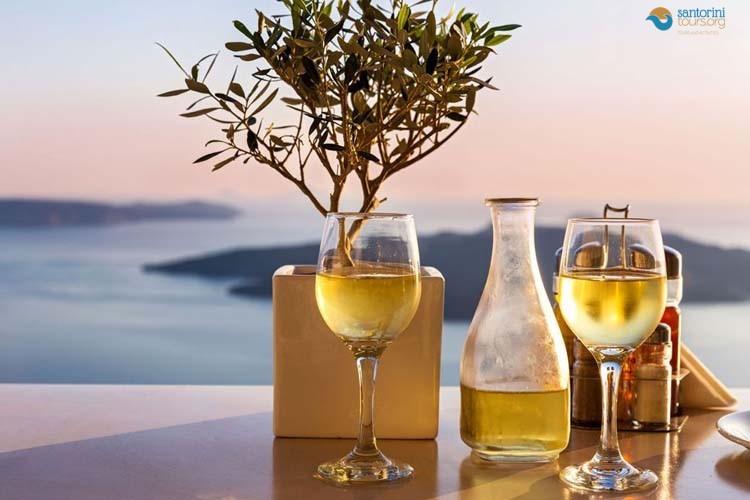
7. Try Santorini wine from a winery
Apart from the fantastic sunset and the archaeological interest of the region, the volcanic vineyards of more than 3200 years of age attract numerous wine lovers every year.
Visit some of the region’s award-winning wineries and travel to the world of senses in a different way.
Book now a Santorini Private Custom Tour

8. Have an organized Santorini tour
In case your stay allows, please visit the travel agencies of the area and choose one of the Santorini Tours that suits you. The view of the area at sea is something you will remember forever!
We recommend packages that include a visit to the Volcano, the Hot Springs and swimming in the famous beaches.
9. Visit Santorini, Emporio Thera
Emborio or Nimborios is 12 km away from Fira and is the largest village of Santorini. It was part of the sale – and probably of production – of the products during the 17th century, and often residents of the area visit the village for supplies.
The medieval Kastelli and the Tower of Goulas, located in the village, are a masterpiece of architecture and definitely worth a visit.
Book now a Santorini Full Day Private Tour
Santorini is definitely one of the top destinations and not only. The scenic and unique landscape creates unbelievable feelings, while the various activities that can be made during the tour allow the combination of romantic, active and educational activities.
See more about Santorini island:
- Santorini Summer 2019
- Top 10 Restaurants in Santorini
- Santorini: A Great Gastronomic World
- Six Things You Should Not Do In Santorini!
- Five magical shades of Santorini Tours
- The top Santorini Tours
- Santorini, the island that never rests
Santorini Yacht Charter: The Short Answer
A santorini yacht charter means hiring a boat with or without a crew, for a day or for a week, from one of two small harbours on the island. It is a different product from a shared cruise ticket: you choose the vessel, the hours, the route and the music, and you pay for the boat rather than for a seat on it.
What a santorini yacht charter can be. Sailing catamarans, monohull sailing yachts, motor yachts, RIBs and a small number of crewed luxury yachts.
Santorini yacht charter day rates. Roughly 1,200 to 3,000 euros for a sailing catamaran for five to eight hours with crew, food and drink. 2,000 to 5,000 for a motor yacht. 600 to 1,400 for a RIB or speedboat.
Santorini yacht charter weekly rates. Roughly 5,000 to 15,000 euros a week for a crewed catamaran, and considerably more at the luxury end.
Per head. A santorini yacht charter for eight to twelve people on a catamaran lands at roughly 120 to 300 euros each, which overlaps the price of a shared cruise ticket.
Where a santorini yacht charter boards. The marina at Vlychada on the south coast for almost everything, and Ammoudi below Oia for a handful of smaller vessels.
Crewed or bareboat. Almost all Santorini charters are crewed or skippered. Bareboat is rare here because there is no large marina and the caldera anchorages are deep.
Santorini yacht charter season. April to early November, with the best conditions in June, September and early October.
The wind. The meltemi blows June to September and it is the single largest variable in any santorini yacht charter, affecting the route more often than the departure.
Booking a santorini yacht charter. Four to eight weeks ahead for a day charter in July and August, and three to six months for a crewed week.
The honest summary. For six or more people a private charter costs about what the shared tickets would and delivers a completely different day. For two people it is a luxury rather than a value decision.
Crewed, Skippered or Bareboat
The first decision, and on this island it is largely made for you.
Crewed. The standard arrangement: a skipper, a hostess or deckhand, food cooked on board, drinks, and nothing for you to do. Almost every catamaran sold here is crewed.
Skippered. A skipper and nobody else, with you handling the rest. Available on smaller yachts and less common, because the economics of a day charter here assume catering.
Bareboat. You take the boat yourself. Genuinely rare from Santorini, for three reasons: there is no large charter base on the island, the caldera is too deep for casual anchoring, and the meltemi makes the surrounding water unforgiving for a crew without local knowledge.
Where bareboat does work. From Athens, Paros, Lavrion or Kos, sailing down to Santorini over a week or two. That is a Cyclades charter that includes Santorini rather than a santorini yacht charter.
Licences. A bareboat charter in Greece requires a recognised skipper’s certificate plus a VHF licence, and a declared second competent crew member. Crewed and skippered charters require nothing from you.
What the skipper actually knows. Where the swell is on a north wind, which swim stops are sheltered that day, which cave is enterable at that state of the sea, and when to abandon the Red Beach and go east instead. This is most of what you are paying for.
The hostess. Cooks, serves, clears, and on the better boats is the reason the day feels like a holiday rather than a boat trip.
Which to choose. Crewed, on any santorini yacht charter of a day or less. Skippered only if somebody in the party wants to sail the boat.
Catamaran, Monohull, Motor Yacht or RIB
The santorini yacht charter catamaran. The default and the right answer for most people. Two hulls, so almost no heel and very little roll at anchor. A large flat foredeck with nets, a shaded cockpit, two to four cabins with heads, a proper galley and a swim ladder. Twelve to sixteen metres is the common size for a day charter.
Monohull sailing yacht. Prettier under sail and considerably more heel. Less deck space, fewer bathrooms and a wetter ride. Good for sailors and harder for a mixed group.
Motor yacht. Faster, so more stops in the same hours, with air conditioning and a flybridge. No sailing, higher fuel cost, and the most expensive santorini yacht charter per hour.
RIB or speedboat. Six to twelve people, very fast, wet and exciting. Gets into the sea caves and the small coves the larger boats cannot enter. Short on shade and short on comfort.
The luxury santorini yacht charter. A small number operate out of the island or come in for a booking, with a chef, a full crew and a price to match.
Gulet. Occasionally offered for larger groups, traditional wooden motor-sailers with cabins, more common in the Dodecanese than here.
Size and capacity. Day charters are typically licensed for eight to twenty passengers depending on the vessel, and the comfortable number is usually well below the licensed maximum.
Shade. The detail that decides a July day. Look for a bimini over the cockpit in the photographs, because five hours of Santorini sun with nowhere to sit out of it is a long charter.
Which to choose. A sailing catamaran for a group, a RIB for six people who want the caves, and a motor yacht if the schedule is tight or somebody needs air conditioning.
What It Costs
Sailing catamaran, five hours. Roughly 1,200 to 2,200 euros for the vessel with crew, food and drink. The standard santorini yacht charter.
Sailing catamaran, eight hours. Roughly 1,800 to 3,000 euros, which buys Thirasia and a much slower pace.
Larger or newer catamaran. 2,500 to 4,000 euros for a day, with more space rather than a different route.
Motor yacht, day charter. 2,000 to 5,000 euros depending on size, with fuel frequently charged separately.
RIB or speedboat, three to four hours. 600 to 1,400 euros for six to twelve people.
Crewed catamaran, one week. Roughly 5,000 to 12,000 euros plus provisioning, for eight to ten guests.
Crewed luxury yacht, one week. From around 20,000 euros and with no ceiling worth quoting.
Per head on a day charter. Divide by the group. Eight people on a 1,800 euro catamaran is 225 each, which is more than a shared ticket at 90 to 190 and buys the whole boat.
Where the santorini yacht charter crossover is. Six people. Below that a shared cruise is better value; above it a santorini yacht charter costs roughly the same and is a different experience.
What moves the price. The month first, then the vessel, then the hours. July and August run thirty to fifty per cent above May and October for the same boat.
Santorini yacht charter deposits. Typically thirty to fifty per cent to confirm, with the balance before or on the day.
What Is Included and What Is Not
Normally included on a santorini yacht charter. The crew, fuel for the standard route, a meal cooked on board, wine, beer and soft drinks, snorkelling gear, towels and insurance.
Normally extra on a santorini yacht charter. Transfers to and from the marina, port fees in some cases, spirits and champagne, and tips.
The meal. On a good santorini yacht charter this is a barbecue or a full Greek spread cooked on board and served at anchor: chicken, pork or fish, Greek salad, fava, tzatziki, bread, fruit and local wine. Confirm whether it is cooked or delivered, because the difference is substantial.
Drinks. Unlimited house wine, beer and soft drinks is standard. Spirits are almost never included and are frequently permitted if you bring your own.
Transfers. Some operators include hotel pickup and some charge 15 to 25 euros a head. Given that a sunset charter returns to Vlychada at around ten at night, this line is worth checking before comparing two quotes.
Fuel. Included on sailing charters for the agreed route and frequently charged at cost on motor yachts.
Tips on a santorini yacht charter. Not obligatory and normal. Five to ten per cent of the charter, or fifty to a hundred euros to the crew on a day charter.
On a multi-day charter. Provisioning, berthing fees, fuel and the crew’s food are usually separate, sometimes as an advance provisioning allowance of thirty to forty per cent of the charter fee.
What to ask before signing. The passenger maximum, whether food is cooked on board, whether transfers are included, and what happens if the weather changes the route.
Where You Board
Vlychada marina. The main base for almost every santorini yacht charter. A small modern marina on the south coast, fifteen minutes from the airport, twenty from Fira and thirty-five from Oia, with two or three fish tavernas on the quay and free parking.
Ammoudi. The old fishing harbour below Oia, three hundred steps down from the village or a short drive on a narrow road. A handful of smaller vessels leave from here, and it puts you straight into the caldera.
The Old Port below Fira. Mostly the large volcano excursion boats rather than charters, reached by cable car or 588 steps.
Perissa and Kamari. A few RIBs and small boats in high season.
Which to choose. Vlychada for the full south-coast and caldera route, which is the standard santorini yacht charter. Ammoudi if you are staying in Oia and want to skip the coast.
Getting there. There are three bus departures a day to Vlychada and none of them help at ten at night. Either the charter includes a transfer or you book a vehicle.
Santorini yacht charter check-in. Thirty minutes before departure. The quay is narrow and the boats board one at a time.
Parking. Free and adequate at Vlychada, tight in August.
What the marina is like. Working rather than glamorous: fishing boats alongside charter catamarans, a chandlery, and the pumice cliffs behind.
The one thing to arrange. The return journey. A sunset santorini yacht charter docks at ten at night on an island with around thirty taxis, and that is the part people forget.
Day Charter Itineraries
The standard five-hour route. Out of Vlychada west along the pumice cliffs, past the lighthouse, the Red Beach and the White Beach, a swim stop, Indian Rock and the sea caves, the hot springs at Palia Kameni, a meal at anchor, then north into the caldera and a hold off Oia for the sunset. This is what almost every santorini yacht charter sells.
The eight-hour santorini yacht charter. The same plus Thirasia, with a stop at Korfos or Riva, and considerably more time in the water.
The morning santorini yacht charter. Identical coast, calmer water, empty swim stops and no sunset, at twenty to thirty per cent less.
The caves and coves route. A RIB itinerary: the sea caves, Mesa Pigadia, Balos and the small western coves that the catamarans cannot enter. Three to four hours and the most active version.
The caldera-only route. From Ammoudi: Nea Kameni’s crater, the hot springs, Thirasia and back. Shorter, and it skips the south coast entirely.
The sunset-only santorini yacht charter. Two to three hours from Ammoudi or Vlychada, positioning off Oia for the light and coming back in the dark. The cheapest private option.
What a charter can add that a shared boat cannot. An earlier departure to reach the hot springs before the fleet, a longer stop at the White Beach, a detour to a cove the crew likes, and dinner on board at anchor rather than a barbecue at two in the afternoon.
What it cannot change. The wind. On a hard meltemi the route reverses or the south coast is dropped, and no amount of money alters that.
The swim stops. Two or three on a five-hour santorini yacht charter, and four or five on an eight-hour one.
The hot springs note. Iron-rich water reached by swimming fifty to eighty metres from the anchorage, and it stains swimwear permanently orange. Wear something old.
Multi-Day Charters From Santorini
Why it is unusual. Santorini is not a charter base in the way Athens, Paros or Kos are, so a week on a yacht here normally means a boat that has been positioned for you or one that starts elsewhere.
The classic santorini yacht charter week. Santorini, Ios, Folegandros, Sikinos and back, which is the tightest and most dramatic circuit available from the island. Four to six hours of sailing a day at most.
The northern week. Santorini, Ios, Naxos, Koufonisia, Amorgos, which is the small Cyclades and the best anchorages in the group.
The one-way week. Santorini to Paros or Athens, dropping down through Ios, Naxos and Paros. Frequently cheaper because it repositions the boat.
Anchorages. The caldera is too deep to anchor casually, so nights are spent at Vlychada, Ammoudi or off the neighbouring islands. This surprises people who imagine sleeping at anchor under Oia.
Provisioning. Done at Vlychada or in Fira before departure, or handled by the crew against an advance allowance.
Weekly santorini yacht charter cost. 5,000 to 15,000 euros for a crewed catamaran sleeping eight to ten, plus provisioning, fuel and berthing.
Per head. For ten people that is 500 to 1,500 each for a week including accommodation, which against Santorini hotel prices is genuinely competitive.
Booking window. Three to six months for July and August on a crewed week, and longer for the better crews.
Who it suits. Groups of eight to twelve, families with older children, and anybody who would rather see six islands than one. A multi-day santorini yacht charter is the best-value luxury in the Cyclades for a large group.
Season, Wind and Cancellations
April. The fleet goes in the water. Cool, quiet and cheap, with a sea too cold for most people to swim.
May. Good. Eighteen to twenty degree water, light crowds at the swim stops, and prices well below peak.
June. One of the two best months for a santorini yacht charter: warm sea, long light, and the meltemi only beginning.
July and August. Peak prices and the strongest wind of the year. Charters still run and the route changes more often.
September. The best santorini yacht charter month. The warmest sea of the year, the wind easing and the swim stops thinning out.
October. Excellent into the third week, with falling prices and the fleet coming out from the end of the month.
November to March. No charters. The boats are ashore.
The meltemi. A dry northerly blowing two to four days at a stretch from June to September. It reroutes more charters than it cancels, because a catamaran can work the sheltered side of the island.
What happens if it blows. The skipper reverses the route, drops the exposed southern stretch, or skips the hot springs. On a private santorini yacht charter you are told in advance and offered a reschedule.
Santorini yacht charter cancellation policy. Most operators reschedule or refund for weather and hold you to the terms otherwise. Free cancellation to twenty-four or forty-eight hours is common and worth having.
The planning rule. Book the charter for early in your stay. A santorini yacht charter on the last afternoon has nowhere to move to.
How to Book and What to Check
The santorini yacht charter passenger maximum. The single most important number on any charter listing, and the one most often omitted. A sixteen-metre catamaran licensed for forty is a different boat from the same hull sold for twelve.
The hours, and whether boarding counts. A five-hour charter that starts the clock at check-in is a four-hour trip.
Santorini yacht charter crew size. Two on a small catamaran, three or four on a larger one, and it correlates almost exactly with how well the food and the swim stops are run.
Whether food is cooked on board. Ask directly. A barbecue cooked at anchor and a tray of sandwiches delivered to the quay are sold in similar language.
Shade. A bimini over the cockpit, visible in the photographs.
Bathrooms. Two on a catamaran, one on most monohulls.
Transfers. Included, extra, or not offered.
The route, in writing. Which stops, in which order, and what the alternative is in wind.
Insurance and licensing. Every legitimate santorini yacht charter operates under a Greek professional licence with passenger insurance. Ask for the licence number if anything about the listing feels informal.
The cancellation and weather policy. In writing, before the deposit.
Reviews, searched for one word. Crowded, if it is a shared boat, and crew, if it is a charter. Those two tell you more than the rest combined.
Santorini yacht charter booking window. Four to eight weeks for a day charter in July and August, three to six months for a crewed week, and a few days in May or October.
Who a Charter Suits, and Who Should Not Bother
A santorini yacht charter for eight to sixteen. The clearest case: it costs roughly what the shared tickets would and delivers the whole boat.
Families. Excellent, with a morning departure rather than a sunset one, because five hours ending at ten at night is long with children.
A honeymoon santorini yacht charter. A small crewed catamaran or a sunset charter, and one of the few splurges on this island that nobody regrets.
Proposals. A private charter timed to hold off Oia at sunset, which the crew will arrange without being asked twice.
Anybody celebrating anything. The crew will take a cake, a bottle and a playlist.
People who dislike group activities. The entire point.
Photographers. A charter buys the one thing a shared boat cannot: position and timing.
Two people on a budget. A shared catamaran at 90 to 190 euros a head is the better answer, and it visits the same places.
Anybody prone to seasickness. A catamaran rather than a monohull, and a morning departure if the forecast is windy.
Anybody with mobility difficulties. Boarding is over a stern gangway onto a moving deck and the swim ladder is a ladder. Some crews manage it very well; ask directly rather than hoping.
Who should genuinely skip it. Almost nobody with a group. A santorini yacht charter is the best day the island sells, and the only real objections are money and a toddler.
Charter or Shared: The Arithmetic
The decision that matters most, laid out with numbers rather than adjectives.
Two people. A shared catamaran at 90 to 190 euros each, total 180 to 380. A santorini yacht charter at 1,200 to 2,200. The shared ticket wins by a factor of five.
Four people. Shared 360 to 760. Charter 1,200 to 2,200. Shared still wins comfortably.
Six people. Shared 540 to 1,140. Charter 1,200 to 2,200. The gap narrows to the point where a semi-private boat or a small charter becomes a real question.
Eight people. Shared 720 to 1,520. Charter 1,200 to 2,200. Broadly level at the upper end of shared and the lower end of private.
Ten people. Shared 900 to 1,900. Charter 1,400 to 2,600 for a larger catamaran. A santorini yacht charter now costs roughly the same and gives you the boat.
Twelve or more. Charter, clearly, and the per-head cost falls below a shared ticket.
What the charter buys at the same price. The departure time, which means reaching the hot springs before the fleet. The music. The swim-stop lengths. No strangers. And a crew cooking for your group rather than for twenty.
What it does not buy. A different coastline or better weather.
The semi-private middle. A catamaran capped at eight or ten rather than twenty, at roughly a third above the standard shared price. For four to six people this is frequently the best value on the island.
The conclusion. Under six people take a shared boat and spend the difference on dinner. Over eight, take a santorini yacht charter, because it costs what the tickets would and it is a better day by a wide margin.
Santorini Yacht Charter: Frequently Asked Questions
How much does a santorini yacht charter cost? Roughly 1,200 to 3,000 euros for a crewed sailing catamaran for five to eight hours including food and drink, 2,000 to 5,000 for a motor yacht, and 600 to 1,400 for a RIB.
Is it cheaper than a shared cruise? Not per head below about six people. From six upwards the per-head cost converges with a shared ticket at 90 to 190 euros.
Where does it leave from? Vlychada marina on the south coast for almost everything, and Ammoudi below Oia for some smaller vessels.
What is included? Crew, fuel for the route, a meal cooked on board, wine, beer and soft drinks, snorkelling gear and towels. Transfers and spirits are usually extra.
Can I charter without a licence? Yes, on any crewed or skippered charter, which is almost all of them here. Bareboat requires a recognised skipper’s certificate and a VHF licence.
How many people fit? Day charters are typically licensed for eight to twenty depending on the vessel, and comfortable well below that maximum.
How long is a day charter? Five hours is standard, eight hours adds Thirasia, and two to three hours covers a sunset only.
What is the route? The pumice cliffs, the lighthouse, the Red and White beaches, the sea caves, the hot springs at Palia Kameni, and the caldera wall at sunset.
Can I charter for a week? Yes. 5,000 to 15,000 euros for a crewed catamaran sleeping eight to ten, plus provisioning, and the classic circuit is Ios, Folegandros and Sikinos.
Does the wind cancel charters? It reroutes more than it cancels, because a catamaran can work the sheltered side. Book early in your stay so a bad day can be moved.
What is the best month? September first, then June, then May and early October.
How far ahead should I book? Four to eight weeks for a day charter in high season, and three to six months for a crewed week.
Do I tip the crew? Not obligatory and normal. Fifty to a hundred euros on a day charter, or five to ten per cent on a longer one.
Can we sleep on board in the caldera? Not usually. The caldera is too deep to anchor casually, so nights are spent at Vlychada, Ammoudi or off a neighbouring island.
We Get You to the Boat and Home Again
We are a local operator on Santorini with our own vehicles and our own drivers. Charters leave from Vlychada and Ammoudi, neither of which is straightforward to reach on a schedule, and a sunset departure puts you back on the quay at around ten at night when the buses have finished.
Tell us your boarding time and where you are staying and we will have you at the marina with time to spare and a vehicle waiting when you step off. We can put Akrotiri, an inland village or a winery into the same day beforehand.
Prices are per vehicle rather than per person, hotel pickup anywhere on the island is included, we guide in twelve languages, and an 80 EUR deposit confirms a date.
See the personalised tour, the private transfers, or contact us.
Every Village and Site on the Island
Any of these can be built into a private day. Each has its own page with what to see and how long to allow.
Caldera villages: Fira · Firostefani · Imerovigli · Oia · Finikia · Baxedes
Inland villages: Pyrgos · Megalochori · Emporio · Mesaria · Karterados · Vothonas · Vourvoulos · Exo Gonia · Mesa Gonia · Pigadia
Beaches: Perissa · Perivolos · Kamari · Vlychada · Monolithos · Red Beach · White Beach · Agios Georgios · Agia Paraskevi
Sites and landmarks: Akrotiri · Ancient Thira · Akrotiri Lighthouse · Nea Kameni · Palia Kameni · Thirasia · Athinios Port
All our tours: All Santorini tours · Full day tour · Sightseeing tour · Personalised tour · North part tour · Horse riding · South part tour · Sunset tour · Shore excursion · Caldera tour · Food experience · Wine tour · Historical tour · Small group tour
Planning and services: Famous sights tour · Private transfers · Transfers to Oia and Finikia · Transfers to other villages · Villages of Santorini · History of Santorini · Tours near you · Languages we guide in · Food and fun tours · Gay friendly tours · Our tour buses · Daily tours · Day tours · FAQ · Gallery · Tour photo gallery · About us · Contact · Blog