
Santorini wine means Assyrtiko: bone dry, high acid, saline and mineral, grown on ungrafted vines in volcanic ash and trained into baskets that lie on the ground. Add the sun-dried Vinsanto and the barrel-aged Nykteri, and taste at three estates in an afternoon.

Gastronomy of Santorini
You can “taste” Santorini by Santorini Tours!
Until the 1960’s, since the island of Santorini had electrical power and before its’ development as a touristic attraction, the islands and Santorini in particular needed to live in self-sufficiency so their nutritional habits remain the same as they were for centuries before.
A historical view in gastronomy of Santorini
Fishing, bird hunting, pig and sheep raising and making good use of tomato, kapari and fava. The volcanic ground endowed Santorini with a great variety of vegetables (white aubergines, small zucchinies, local dry cucumbers), kapari and fava that all have in common the very intense and exquisite flavor.
A challenge for local people was the perservation of food through the year, which was achieved by making salty food, cheese, rusk and tomato paste. The hard part for the households was to produce something tasteful with the limited materials that they had and their imagination.
Until that time the locals were basically fed with barleybread which were kneaded and baked once a month due to lack of firewood in the island.
Nowadays, in Santorini you can find unique agricultural products, original restaurants with both national and international awards, cosy taverns with local delicacies, wineries open to the public with amazing winetastings, cooking lessons and gastronomic sites to visit make up an unforgettable scenery of unique gastronomic experience.
Book now a Santorini full day private tour and learn everything about the living in that unique Greek island.
Traditional recipes of Santorini
Santorini island is a great opportunity for you to taste some unique Mediterranean dishes made with passion from people who love their place and its local products. We have some suggestions for you to order during your vacations in Santorini:
Kopania: cookies made from barley and raisins
Koyfeto: roasted almond with honey, it is a usual wedding treat in Greece.
Melitina: a traditional Easter treat, it is made from mizithra, sugar and mastic.
Mpakaliaros Xelouristos: non cooked haddock i little pieces. It is usually served with Greek salad.
Santorini’s Pudding: a sweet made of semolina and milk.
Skordomakaronada: past with garlic and fresh tomato.
Sfougato: omellete with potatoes and pumpkin.
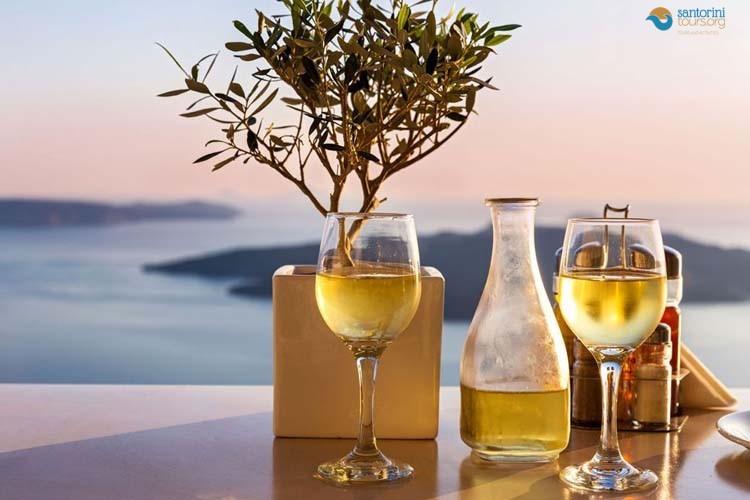
Traditional products of Santorini
Wine of Santorini:
Santorini has a long tradition in viticulture, at least 3500 years. Its unique climate combined with the composition of soil has as a result some great wine varieties that are wide known around the world.
You can taste the famous Santorini island by booking a private tour in Santorini.
Split peas of Santorini:
The split peas of Santorini or fava is famous for its uniqueness to Santorini. Fava is one of the oldest products of Santorini along with the grape and ancient remains have been found in archaeological excavations. The size of the Fava is like a tall chalice in bright yellow color.
Cherry tomatoes of Santorini:
Santorini’s cherry tomato is a special agricultural product with a special history. Its variety comes from Egypt and found in Santorini the ideal anhydrous environment to grow. The way he first came to Santorini is lost in the legend. Some people want the Santorini tomato to be given to a monk and quickly spread among the growers of the island.
See more about vacations in Santorini island:
- Traditional Greek Easter in Santorini
- Wine tourism in Santorini
- Family vacation ideas: Santorini is the ideal destination for kids
- Santorini Museums: Tribute to the history of the Greek island
Santorini Wine: The Short Answer
Assyrtiko, grown ungrafted in volcanic ash on vines trained into baskets that lie on the ground. Santorini wine is bone dry, high in acid, saline and mineral, and it is one of the few white wines in the Mediterranean that improves for a decade in bottle.
Santorini wine is not a holiday curiosity. The island exports to serious lists in London, New York and Tokyo, and its vineyards are among the oldest continuously worked in Europe. Fifteen or so estates take visitors, most of them in the south, most with a terrace over the caldera.
If you drink one santorini wine, make it a straight Assyrtiko from a good producer. If you drink two, add the sun-dried Vinsanto at the end of dinner.
Why the Vines Grow Like That
The kouloura is the first thing anybody notices about santorini wine and the thing that explains everything else.
Growers train each vine’s canes into a coiled basket that lies flat on the ground, with the fruit hanging inside it. The wreath shelters the grapes from the meltemi, which blows salt across the island all summer, and from a sun that would otherwise scorch them. It also traps the night humidity the plant lives on.
Why not a trellis. A trellised vine on this island would be stripped by the wind and burnt by the sun within a season, and there would be no santorini wine at all.
The labour. Every basket is woven by hand, re-formed each year, and cannot be machine-harvested. That is a real cost, and it is part of why santorini wine is priced above other Greek whites.
The lifespan. A kouloura is rebuilt from the base every seventy or eighty years while the root system continues, so the roots under santorini wine are counted in centuries.
Yields. Very low, frequently a fraction of what the same grape gives on the mainland, which concentrates everything in the fruit and is half of why santorini wine tastes the way it does.
The Soil, or the Absence of It
There is no soil under santorini wine in the ordinary sense.
The vines grow in aspa, a mix of pumice, volcanic ash and pozzolana laid down by the eruption of around 1600 BC and by the ones before it. It has almost no organic content, no clay and no nitrogen worth mentioning. On paper it should grow nothing, least of all santorini wine.
Water. The island receives 350 to 400 millimetres of rain a year, almost all of it between November and March, and there is no irrigation in the traditional vineyards. The ash absorbs humidity from the night air and releases it to the roots during the day. That is the whole water supply.
Minerality. The salinity and the flinty edge that people describe in santorini wine come from that substrate and from the sea air rather than from anything a winemaker does.
Drainage. Pumice drains instantly, so the roots go deep, in some cases many metres, which is why the vines survive summers with no rain at all.
The colour. Black ground, grey-green leaves and a white village on the horizon. The vineyards behind santorini wine look like nowhere else in Europe and they photograph best in May and in late September.
Assyrtiko
The grape that carries santorini wine, and one of the great white varieties of the Mediterranean.
What it tastes like. Bone dry, high acid, citrus and stone fruit, a distinct saline edge and a flinty, almost smoky finish. Alcohol is naturally high, frequently 13.5 or 14 per cent, and the acidity carries it without the wine feeling heavy.
Why it is unusual. Most white grapes lose acidity as sugar rises in a hot climate. Assyrtiko holds its acid through ripening, which is why it can be picked fully ripe on a volcanic island in August and still taste taut.
Ageing. A good bottle drinks well at two years and is often better at six or eight, developing a waxy, honeyed weight while keeping the mineral spine. Very few Greek whites do this, which is the technical case for santorini wine.
Styles. Stainless steel for purity, old barrel or amphora for texture, and lees ageing for weight. All three appear in santorini wine.
Where else it grows. Increasingly across Greece and now in Australia and California, and the consensus is that it is good elsewhere and singular here. That distinction is the whole commercial case for santorini wine.
Nykteri, Vinsanto and the Rest
Nykteri. The traditional barrel-aged santorini wine, and the name means working through the night, because the grapes were picked at dawn and pressed the same night before the heat could spoil them. Minimum 13.5 per cent alcohol under the rules, aged in oak, and richer and rounder than a straight Assyrtiko without losing the acid.
Vinsanto. The sweet santorini wine, and the island’s oldest export. Grapes are laid out in the sun for up to two weeks to raisin, then pressed and aged in barrel for at least two years and frequently for ten or twenty. Amber, dense, figgy and caramelised, with acidity that stops it cloying. It was shipped to Russia by the barrel in the nineteenth century for the Orthodox liturgy.
Athiri and Aidani. The two blending partners in white santorini wine, softer and more floral, permitted in small proportions in the PDO white.
Mavrotragano. The red worth seeking out. Nearly extinct thirty years ago, revived by a handful of growers, dark and structured with real tannin.
Mandilaria. The other red, firmer and more rustic.
Anybody working through santorini wine properly should taste a steel Assyrtiko, a Nykteri, a Mavrotragano and a Vinsanto, in that order.
The Rules Behind the Label
PDO Santorini. The protected designation covers dry santorini wine made from at least 75 per cent Assyrtiko, with Athiri and Aidani permitted for the rest. In practice a great many producers bottle 100 per cent Assyrtiko.
PDO Nykteri. Requires barrel ageing and a minimum alcohol level.
PDO Vinsanto. Requires sun-drying of the grapes and a minimum of two years in barrel, with older bottlings labelled by their ageing.
Reds and everything else. Sold under the regional designation rather than the PDO, which is why an excellent Mavrotragano may not say Santorini in large letters on the front.
What to look for. The producer’s name, the vintage, and whether it says barrel or steel. Most santorini wine sold on the island is honest and well made; the variation in santorini wine is in style rather than quality.
Santorini Wine and Phylloxera
Santorini wine comes from one of the few places in Europe where the vines were never grafted, and the reason matters.
Phylloxera destroyed most of the vineyards of Europe from the 1860s onwards, and almost everywhere the answer was to graft European vines onto American rootstock. The louse cannot establish itself in the sandy, ash-rich substrate here, so the vines were left alone.
What that means in practice. The plants are on their own roots, propagated by layering a cane from an existing vine into the ground rather than by planting a new one. The genetic material in some of these vineyards has been continuous for a very long time, and estimates for the oldest root systems run into several centuries.
Does it change the taste? Growers here believe it does, and the honest scientific position is that it is difficult to isolate. What is certain is that the vines behind santorini wine are old, the yields tiny and the fruit concentrated.
Why it is fragile. Ungrafted, unirrigated, hand-worked vineyards on land worth a fortune to a hotel developer is not a robust business model, which is the central problem facing santorini wine today.
The Harvest
The santorini wine harvest is one of the earliest in Europe, and it surprises visitors who expect an autumn scene.
When. From early August into September, depending on the vineyard and the vintage. In a hot year the whites can start in the last days of July.
How. Entirely by hand, because a basket vine cannot be machine-picked, and frequently at first light so the fruit reaches the winery cool.
Yields. Very low, and falling. A vineyard here may produce a fraction of what the same area yields on the mainland.
What visitors see. In August, activity in the cellars and empty terraces. In October, fermentation finishing and the new vintage tasted from tank. In winter and early spring, pruning and the baskets being re-formed by hand.
The best month to visit an estate. Late September and October, once the rush is over and the people pouring the santorini wine are the people who made it.
The Wineries to Visit
Around fifteen santorini wine estates open their doors, and they differ more in style than in quality.
The big terraces. Santo Wines and Venetsanos, both above Athinios on the caldera slope, with the largest views and the most organised tasting operations. Book a table before sunset.
The historic cellars. Koutsoyannopoulos, which also runs the underground wine museum, and Gavalas at Megalochori, one of the oldest families on the island.
The serious small producers. Domaine Sigalas near Oia, Hatzidakis at Pyrgos Kallistis, Argyros at Episkopi and Vassaltis in the north. These are the santorini wine names on international lists, and the tastings are quieter and more technical.
Art Space at Exo Gonia. A working winery in old pumice tunnels doubling as a contemporary art gallery, and unlike anywhere else.
The wine museum. Eight metres underground at Koutsoyannopoulos, with an audio guide and a tasting at the end. See the wine museum.
How many. Three in an afternoon is right. Four is too many to remember and two is not enough to compare.
See the wine tour for how we usually put a santorini wine afternoon together.
What a Tasting Costs and How to Plan the Day
Standard tasting. 15 to 30 euros a head for four to six wines, frequently with something to eat alongside.
Premium flights. 35 to 60 euros for older vintages, verticals or a Vinsanto flight.
Bottles at the cellar. 12 to 25 euros for a good straight Assyrtiko, 25 to 45 for a Nykteri or a serious single vineyard, and 30 upwards for Vinsanto in a half bottle.
Timing. Start at four. The light is better, the heat has gone and you will finish in time for a nine o’clock dinner.
Order. Taste santorini wine in order: steel Assyrtiko first, then barrel-aged, then reds, then Vinsanto. Never the reverse.
Booking. Essential in July and August at the big terraces, sensible everywhere else, and in winter always ring first.
The driver. The single most important detail. Three estates means both of you tasting properly, and the roads between them are narrow. Priced per vehicle rather than per person. See transfers.
What to bring. Water, a hat for the terraces and a note of what you liked, because by the third estate the memory is unreliable.
Santorini Wine With Food
The pairing is unusually easy because santorini wine and the food grew in the same ground.
Fava. The yellow split-pea puree, which the acidity cuts perfectly.
Tomatokeftedes. Tomato fritters from the local cherry tomato.
White aubergine. Grilled, sweeter than the purple kind.
Grilled fish and octopus. The classic match, and the saline edge in the wine meets the sea directly.
Chloro cheese. Fresh, soft and local.
Capers and caper leaves. Picked off the walls.
Vinsanto. With walnut cake, dried figs or a hard cheese at the end of dinner. Not with chocolate.
Away from the island. Assyrtiko handles oysters, sushi, hard cheeses, lemon-heavy dishes and anything grilled with olive oil. Santorini wine is one of the more versatile whites on any list.
Half the pleasure of santorini wine is drinking it fifteen metres from where it grew, with the fish that was landed that morning.
Buying, Shipping and Cellaring
At the estate. Cellar prices for santorini wine, and most producers will ship a case internationally. Ask about duty and courier costs before committing, because they can exceed the wine.
In a supermarket. The larger Fira supermarkets carry a decent range at fair prices, and it is the cheapest way to drink well on your own terrace.
Luggage. Wine travels in hold baggage in a padded sleeve. Airlines will not take it in the cabin.
Ageing a straight Assyrtiko. Three to eight years rewards patience, and some bottles go further.
Ageing Vinsanto. Effectively indefinite. Opened, it keeps for weeks.
Serving. Serve santorini wine at ten to twelve degrees, not fridge-cold, or you lose the texture. Vinsanto lightly chilled.
Glassware. Anything with a bowl. This is not a wine that needs ceremony.
What to take home. One young Assyrtiko to drink soon, one older or barrel-aged bottle to keep, and a half of Vinsanto. That is the santorini wine starter kit and it fits in a suitcase.
A History of Santorini Wine
The island has been making santorini wine for a very long time, and the record is unusually physical.
Bronze Age. Storage jars, pressing installations and grape pips have been found at Akrotiri, buried under the ash of the eruption around 1600 BC. Santorini wine was being made and stored here before the island had its present shape.
Antiquity. Ancient Thira on its ridge above Kamari traded across the eastern Mediterranean, and wine was part of what moved.
The Venetians. From 1204 the island was a Venetian possession, and the sweet wine of Santorini entered European trade under a name the Venetians recognised. The link between Vinsanto and Italian vin santo is a matter of long argument on both sides.
The nineteenth century. The island’s great commercial era. Vinsanto was shipped by the barrel to Russia for the Orthodox liturgy, and Oia’s fleet grew rich carrying it. The captains’ mansions in Oia were built on wine and shipping.
The twentieth century. Decline. The 1956 earthquake emptied villages, the Russian trade had gone, and by the 1970s a great deal of vineyard was abandoned.
The modern revival. From the 1990s a handful of producers rebuilt the reputation of santorini wine on quality rather than volume, and within twenty years the island was on serious lists worldwide.
Standing in a vineyard here you are looking at a farming method that is, in its essentials, three and a half thousand years old.
Reading a Label
Producer. The most useful thing on a bottle of santorini wine. The estates named on this page are all reliable.
Vintage. Matters more here than people expect, because yields swing with the rain.
PDO Santorini. A dry white, at least 75 per cent Assyrtiko.
Nykteri. Barrel-aged, higher minimum alcohol.
Vinsanto. Sun-dried and barrel-aged, with the years often stated.
Single vineyard. Increasingly common and usually the producer’s best work.
Assyrtiko without the PDO. Frequently the same grape grown elsewhere in Greece. Good wine, and not santorini wine.
Alcohol. 13.5 to 14.5 per cent is normal and not a warning sign.
Knowing those eight lines is enough to buy santorini wine confidently anywhere in the world.
What to Drink on the Island, Day by Day
With lunch on a beach. A young steel santorini wine, cold, with grilled fish.
On a terrace before dinner. The same, or a glass of the lighter Aidani-influenced blends.
With dinner inland. A barrel-aged Nykteri, which stands up to slow-cooked meat and to fava with onion.
On a boat. Whatever is coldest, and no serious taster minds.
After dinner. Vinsanto, in a small glass, with walnut cake or a hard cheese.
With the volcanic cherry tomatoes. Anything with acid, which is to say anything from this island.
The one to seek out. A Mavrotragano, if a taverna has one open. Very few do, and it is the most interesting glass of red in the Cyclades.
Five days here is enough to work through the whole santorini wine range without ever repeating a bottle, which is not true of many wine regions of this size.
Visiting the Vineyards Themselves
Most visitors taste in a room and never walk into a vineyard, which is a waste, because the vineyard is the interesting part of santorini wine.
Where to see them. The plateau between Pyrgos, Exo Gonia and Mesa Gonia; the fields around Akrotiri and Megalochori; the slopes below Profitis Ilias; and the north around Vourvoulos and Vassaltis.
What you are looking at. Low coiled baskets of cane lying on black ash, spaced widely, with bare ground between them and no trellis, no wire and no irrigation line anywhere.
When they look best. May, when they break into leaf and the ground is still green; and late September, heavy with fruit or freshly picked.
Winter. Bare, coiled and strange, under a low sun. The most photogenic version and almost nobody sees it.
Manners. These are working farms. Walk the tracks, not the rows, and do not pick anything.
Ask. Most estates will walk you out into the vines if you ask when you book, and ten minutes standing in one changes how santorini wine tastes afterwards.
That walk is the part of a santorini wine day that people remember a year later, rather than any particular bottle.
Where the Wine Fits in a Trip
On four nights. One wine afternoon, on the day you also do Akrotiri, because Akrotiri and the santorini wine estates are both in the south, twenty minutes apart.
On a week. Two: one at the big terraces for the view, one at the serious small producers for the wine.
On a cruise day. One estate, forty-five minutes, between Akrotiri and the port. It fits comfortably and almost nobody does it.
With children. The wine museum underground at Koutsoyannopoulos, which they enjoy far more than a tasting room.
In winter. Ring ahead, and expect the winemaker rather than a summer employee.
In the shoulder months. The best of all, because the estates have time and the vineyards look their best.
With dinner. Buy at the cellar and drink it inland at Pyrgos or Megalochori, where corkage is not a concept and the mark-up on the same bottle is a third of what the caldera charges.
Common Questions Visitors Ask on the Tour
Why is it so dry? Because the Assyrtiko behind santorini wine holds acid through ripening, and because nobody here has any reason to leave sugar in it.
Why does it taste salty? The sea air, the volcanic substrate and low yields, in some combination nobody has fully separated.
Why is it more expensive than other Greek wine? Hand-worked basket vines, tiny yields, no irrigation, and a shrinking vineyard area on land that hotels want.
Is the volcano in the wine? Not in any literal sense. The ash under santorini wine is the growing medium, not a flavour.
Can you drink the reds? Yes, and Mavrotragano is worth going out of your way for.
Is Vinsanto related to Italian vin santo? Both names exist, the history is tangled, and the Greek producers make a strong case for precedence. Nobody has settled it.
Should I buy the oldest Vinsanto they have? Taste two. The twenty-year is not automatically better than the eight for your palate.
What do locals drink? Whatever the taverna has open, usually by the half litre, and it is frequently excellent.
Those eight come up on every santorini wine afternoon we run, in roughly that order, usually before the second glass.
Vintages and What the Weather Does
Vintage variation here is real, and it comes from rain rather than heat.
What decides a year. Winter rainfall, because there is no irrigation. A dry winter means a small crop and concentrated fruit; a wet one means volume and slightly softer wines.
The meltemi. A hard summer wind can strip leaves and stress the vines, which cuts yield further.
Heat spikes. Less damaging than elsewhere, because Assyrtiko holds acid, but they can push alcohol up.
Recent pattern. Several low-yield years in succession have tightened supply, which is the main reason bottle prices have risen faster than inflation.
Does it matter to a visitor? Less than in Burgundy. Almost every santorini wine on sale in a good shop or estate is well made, and the differences between years are of texture rather than of quality.
What to ask at a tasting. How the winter rain was. Every grower on the island will have an opinion and most will talk for ten minutes about it.
The People Behind the Bottles
This is a small industry made by a small number of people, and it is worth knowing whose names are on the labels.
Cooperatives and old houses. Santo Wines is the island’s cooperative, representing a large share of the growers, which is why its terrace is the most visited and its range is the broadest. Koutsoyannopoulos, Gavalas, Boutari and Roussos are the older established names.
The modern quality wave. From the 1990s onwards a handful of producers pushed santorini wine towards single vineyards, lower yields and international lists. Paris Sigalas, working near Oia, and the late Haridimos Hatzidakis at Pyrgos Kallistis are the two names most often credited with the turn.
The newer estates. Vassaltis in the north and a small group of others have arrived in the last decade with careful, site-specific wines.
The growers. Behind all of them are farming families working a few hectares of basket vines by hand, many of them selling fruit rather than bottling it. They are the part of santorini wine that the land-price problem threatens first.
Why it matters at a tasting. Ask who farms the vineyard the wine came from. On this island the answer is frequently a name and a village rather than a company.
Where to Drink It Away From the Estates
Inland tavernas. Pyrgos, Megalochori, Emporio, Exo Gonia and Vothonas. Good lists, fair mark-ups, and staff who know the producers personally.
Caldera-rim restaurants. The best glassware and the highest mark-ups on the island. Worth it once.
Wine bars in Fira. Several serious ones, with flights by the glass, which is the cheapest way to compare producers without visiting five estates.
Ammoudi. Fish on the quay below Oia with a cold Assyrtiko is one of the better hours available anywhere in Greece.
Supermarkets. The larger ones in Fira carry a genuinely good range at retail prices. Buy a bottle and drink it on your own terrace at sunset for a tenth of what the same view costs in a restaurant.
The airport. A last resort, with a limited range and no advantage on price.
Drinking santorini wine well is mostly a matter of moving twenty minutes inland, which is also true of eating here.
Santorini Wine for Beginners
If you know nothing about wine and want to get this right, five sentences will do it.
Order the house white in a village taverna. It will be local, it will cost 12 to 20 euros for half a litre, and it will be better than the equivalent almost anywhere else in Greece.
Then buy one named bottle. Any of the producers listed on this page, from a supermarket or a cellar, for 12 to 25 euros.
Do one tasting. Three estates, four o’clock, somebody else driving. That single afternoon teaches more than any amount of reading.
Try the Vinsanto once. Even if you do not like sweet wine. It is the oldest thing the island makes.
Take two bottles home. One to open soon and one to forget about for five years.
Nobody needs vocabulary to enjoy santorini wine. It is dry, cold, salty and sharp, it goes with everything the island eats, and the only real mistake is drinking it too cold or not drinking it at all.
Santorini Wine Compared With Other Greek Regions
Against Naoussa. Xinomavro from northern Greece is the country’s great red and no rival to santorini wine, tannic and ageworthy, and it is the counterpart rather than the competitor.
Against Nemea. Agiorgitiko makes softer, fruitier reds in the Peloponnese, and a great deal more of them.
Against Crete. Vidiano, Vilana and Liatiko, improving quickly, far cheaper, and with a fraction of the reputation santorini wine has built.
Against other Assyrtiko. The grape now grows across Greece and abroad. Almost everybody who has tasted them side by side says the mainland versions are good and the island ones are singular.
Against the Mediterranean generally. Very few dry whites from a hot climate age the way this one does, which is the technical reason santorini wine sits on lists alongside Chablis and Riesling rather than alongside other Greek whites.
Price. Santorini wine is dearer than any other Greek white and still cheaper than the northern European wines it is compared with.
The Threats to Santorini Wine
Worth stating, because the santorini wine vineyards are shrinking and most visitors have no idea.
Land value. A hectare of vineyard is worth vastly more with a hotel on it. That single fact has removed a large share of the island’s planted area over three decades.
Labour. Basket vines are hand-worked and hand-picked. Finding people to do it, on an island where a summer job in hospitality pays better, is increasingly difficult.
Water. Rainfall has been low in several recent years and the vines are unirrigated by tradition and by rule.
Yields. Falling, in some years dramatically, which pushes prices up and makes the wine look expensive to people who do not know why.
Age. The vines are old, which is the quality and also the risk.
What helps. Buying it. Visiting the estates, paying for the tasting and taking a case home is the most direct support any visitor can give santorini wine, and it costs less than one dinner on the caldera rim.
Mistakes People Make
Drinking it too cold. Santorini wine straight from a hotel fridge tastes of nothing. Give it ten minutes.
Only tasting at the big terraces. The views are the best and the wines are not always.
Four estates in an afternoon. Three, with food.
Driving yourself. One of you will not be tasting.
Turning up in winter. Ring first; several are appointment-only out of season.
Skipping Vinsanto because it is sweet. It is the oldest santorini wine there is and the most distinctive.
Buying only at the airport. Cellar prices are better and the range is wider.
Assuming all of it is expensive. A very good bottle at a supermarket in Fira costs less than two cocktails on the rim.
Santorini Wine: Frequently Asked Questions
What is Santorini wine known for? Assyrtiko: a bone-dry, high-acid, saline white grown on ungrafted vines in volcanic ash, trained into ground-level baskets against the wind.
What does Assyrtiko taste like? Citrus and stone fruit, very high acidity, a distinct salinity and a flinty finish, with naturally high alcohol carried by the acid.
What is Vinsanto? The island’s sweet wine, made from sun-dried grapes and aged in barrel for a minimum of two years and often far longer. Amber, figgy and intense.
What is Nykteri? The barrel-aged dry style, named for the tradition of pressing through the night after a dawn harvest.
Why are the vines grown in baskets? The kouloura shelters the fruit from the meltemi wind, the salt and the sun, and traps night humidity on an island with almost no rain.
Are the vines really ungrafted? Yes. Phylloxera never established itself in the volcanic substrate, so the vines are on their own roots and some root systems are centuries old.
How much is a tasting? Fifteen to 30 euros a head for four to six wines, and 35 to 60 for premium or older flights.
Which wineries should I visit? Santo Wines or Venetsanos for the view, Sigalas, Argyros, Hatzidakis or Vassaltis for the wine, and Koutsoyannopoulos for the underground museum.
Can I visit without a car? Better with a driver, so both of you can taste. Buses do not serve most estates usefully.
Can I ship bottles home? Most estates will arrange it. Check duty and courier costs first.
Does Assyrtiko age? Yes, unusually well for a Mediterranean white. Three to eight years is the sweet spot and good bottles go further.
When is the harvest? Early August into September, one of the earliest in Europe, and always by hand.
Three Estates, One Afternoon, Someone Else Driving
We are a local operator running private tours and transfers in our own vehicles, and a wine afternoon is the single thing we are asked for most often after Akrotiri.
Three estates from four o’clock, chosen to contrast rather than repeat, with the caldera terrace at the end and dinner booked inland afterwards. Both of you taste, nobody drives, and nobody looks for a parking space.
Prices are per vehicle rather than per person, hotel pickup anywhere on the island is included, we guide in twelve languages, and an 80 EUR deposit confirms a date.
See the wine tour, the food experience, or contact us.
Every Village and Site on the Island
Any of these can be built into a private day. Each has its own page with what to see and how long to allow.
Caldera villages: Fira · Firostefani · Imerovigli · Oia · Finikia · Baxedes
Inland villages: Pyrgos · Megalochori · Emporio · Mesaria · Karterados · Vothonas · Vourvoulos · Exo Gonia · Mesa Gonia · Pigadia
Beaches: Perissa · Perivolos · Kamari · Vlychada · Monolithos · Red Beach · White Beach · Agios Georgios · Agia Paraskevi
Sites and landmarks: Akrotiri · Ancient Thira · Akrotiri Lighthouse · Nea Kameni · Palia Kameni · Thirasia · Athinios Port
All our tours: All Santorini tours · Full day tour · Sightseeing tour · Personalised tour · North part tour · Horse riding · South part tour · Sunset tour · Shore excursion · Caldera tour · Food experience · Wine tour · Historical tour · Small group tour
Planning and services: Famous sights tour · Private transfers · Transfers to Oia and Finikia · Transfers to other villages · Villages of Santorini · History of Santorini · Tours near you · Languages we guide in · Food and fun tours · Gay friendly tours · Our tour buses · Daily tours · Day tours · FAQ · Gallery · Tour photo gallery · About us · Contact · Blog