
Traditional Greek Easter in Santorini
Meet the Greek Easter in Santorini by Santorini tours!
Easter in Santorini is a spectacular experience! Passing by through the fields with the white dirt, you come across the medieval village where the carrying around of the epitaph fills you with religious feelings.
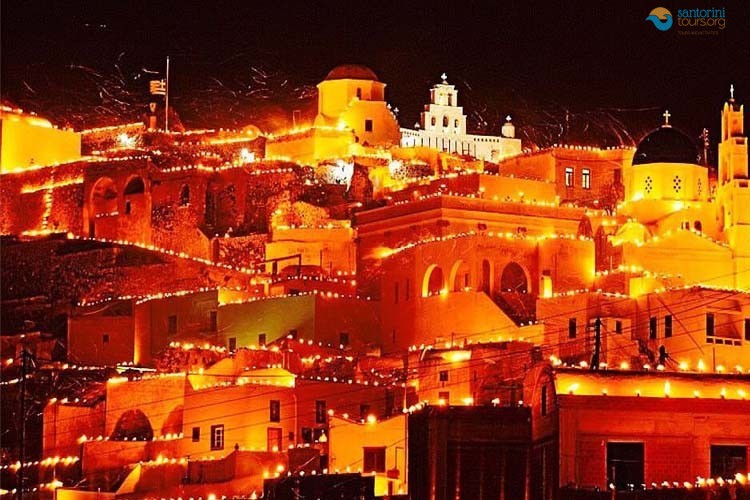
As you walk the road you can see on your left and right, tin oil lamps which form a river of shimmering fire, the women are chanting and the smell of spring flowers is sweetly mixed with the incense.
Holy Week in Santorini
At the monastery of Prophet Ilias located at the highest point of the island, on the night of Resurrection you have a clear view of the fireworks lighting up the whole island of Santorini.
During the Holy Week the place is filled with smells and tastes. The bakeries are making continuously Easter breads, cookies and melitinia, the traditional Easter sweet of Santorini.
Another significant Easter meal is the sgardoumia, the soup that locals eat at the night of Resurrection. The ceremony for welcoming spring is concluded with cocooning at private swimming pools above the breathtaking edge of the cliff and following the nightlife of Fira.
Good Friday in Santorini
Do not miss the as the astonishing Good Friday in Pyrgos. The area is located in the hinterland shines from afar on Good Friday night.
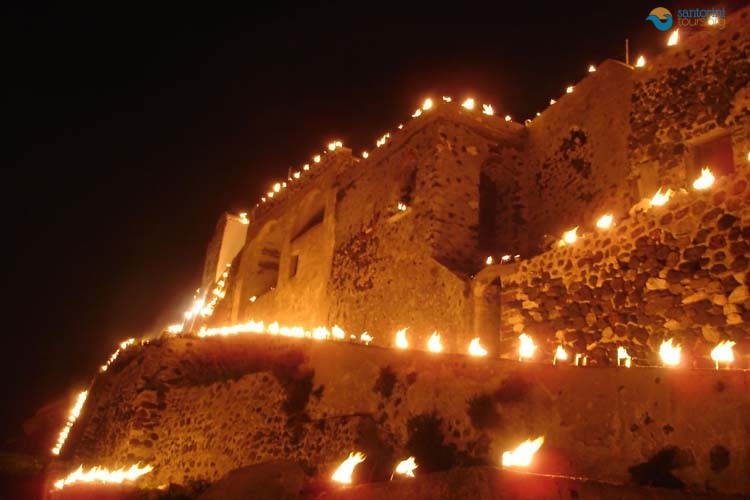
The Tower is high with a unique spectacular view during the day. Especially on Good Friday night, candles make something very special. They enlighten the whole village. From the beginning of the morning, every route and corner of the village, its inhabitants are filled with canes that revive with mineral oil and all together while the Epitaph comes out of the church, creating a river of light that flickers.
In just a few minutes the medieval castle “gets fire”!
Book now Santorini private transfers or especially a Pyrgos private transfer!
Hotels in Santorini for Easter
If you would like to experience something different, the Greek Orthodox Easter in Santorini will give you some unforgettable moments and you can take a private tour in Santorini. The only thing you need to do is to find the right hotel in Santorini and book a room!
5 Things you should during the Easter in Santorini
- Experience the most religious epitaph of the whole Cyclades, at the medieval tower. The locals light up torches and the whole place smells of myrrh, candles and incense.
- Experience the night of Resurrection from the monastery of Prophet Ilias, at the highest ground of Santorini and watch the fireworks cover the whole island.
- Watch the first sunset of your vacation in peace by booking a Santorini sunset private tour.
- Walk the path that connects Imerovigli with Oia. The spring sweetens the rough sight of caldera, filling it with wildflowers. Book now a Santorini north part private tour.
- Supply yourself with melitinia from local bakeries, traditional Easter sweet with mizithra cheese and sugar.
Why Greek Easter Is the Best Week to Be Here
Easter is the largest festival in the Greek calendar by a distance, bigger than Christmas, and it is the one week when the island belongs to the people who live on it. Greek Easter in Santorini is not a tourist event that residents tolerate; it is the year’s centre of gravity, and visitors are simply present for it.
The date of Greek Easter in Santorini moves. Orthodox Easter follows the Julian calculation and usually falls one to five weeks after the Western date, though occasionally they coincide. Check the year before booking, because Greek Easter in Santorini is a moving target.
When Greek Easter in Santorini usually falls. Somewhere between early April and early May. That puts it in the shoulder season, with wild flowers on the hillsides and the sea still cold.
What the island is like that week. Open, busy with Greeks rather than foreigners, and warmer in atmosphere than in temperature. Athenians come home, families reopen village houses, and the rim hotels are not the point.
Why it is different from August. In August the island performs for visitors. During Greek Easter in Santorini the island is doing something for itself, and you are welcome to stand in it.
The centre of Greek Easter in Santorini is inland. Pyrgos, Megalochori, Emporio, Mesa Gonia and Messaria. The caldera rim is where the hotels are; the villages are where the week happens.
The single most famous night. Good Friday at Pyrgos, when the whole village and the medieval kastelli are lit by thousands of tin oil lamps. It is the image of Greek Easter in Santorini and it is genuinely extraordinary.
The second night of Greek Easter in Santorini. The Anastasi at midnight on Holy Saturday, with fireworks visible across the island and the monastery of Profitis Ilias on the summit above it all.
Who it suits. Anybody who would rather see a place than photograph it, and anybody interested in food, since the whole week is organised around what may and may not be eaten.
Who should think twice. Anybody expecting a beach week. The sea is cold in April, and a good deal of Greek Easter in Santorini happens after dark.
The practical warning about Greek Easter in Santorini. It is the busiest Greek domestic weekend of the year. Rooms, flights and ferries go early, and many sites and shops close on the Sunday.
What this page covers. Holy Week day by day, Good Friday at Pyrgos, the Resurrection night, the food, and what to book. Everything below is what we tell people who ask whether Greek Easter in Santorini is worth arranging a trip around. It is.
Holy Week, Day by Day
The week builds. Understanding the shape of it is the difference between witnessing Greek Easter in Santorini and wandering into a church at the wrong hour.
Lazarus Saturday. The day before Palm Sunday. Children go round the villages singing, and the first of the week’s baking begins.
Palm Sunday of Greek Easter in Santorini. Woven palm and myrtle in the churches, and the last day fish is eaten before the strict fast of Holy Week.
Holy Monday and Tuesday. Evening services, quiet, and the villages beginning to prepare. The best two days to walk Pyrgos or Emporio with nobody about.
Holy Wednesday. The service of Holy Unction, with anointing offered to the congregation. Visitors are welcome and nobody will mind you being there.
Holy Thursday of Greek Easter in Santorini. The day the eggs are dyed red, the tsoureki is plaited, and in the evening the twelve Gospels are read. The Epitaph, the flower-decked bier, is decorated overnight by the women of each parish.
Holy Thursday, the detail worth knowing. Every village decorates its own Epitaph and they compete quietly. Walking between two or three churches that evening is one of the best hours of Greek Easter in Santorini.
Good Friday, daytime. Bells toll slowly all day. Nothing much is cooked, the villages are subdued, and the preparation for the evening is going on out of sight.
Good Friday evening, the peak of Greek Easter in Santorini. The Epitaph procession leaves each church and goes through the village. In Pyrgos the whole hill is lit and this is the night everybody comes for.
Holy Saturday, daytime. Calm. Shops shut early, families gather, and the magiritsa is prepared for after midnight.
Holy Saturday, the turning point of Greek Easter in Santorini. Everyone converges on a church with an unlit candle. At midnight the priest brings out the Holy Light, the bells go, and the fireworks start.
The Anastasi. “Christos Anesti”, the candles pass flame from hand to hand, and the whole island cracks and flashes. It is the loudest and best moment of Greek Easter in Santorini.
After midnight. Families go home to break the fast with magiritsa soup and red eggs, cracked against each other. The person whose egg survives has luck for the year.
Easter Sunday of Greek Easter in Santorini. Lamb on the spit from mid-morning, long tables, wine and music through the afternoon. Almost everything else on the island is shut.
Easter Monday, the end of Greek Easter in Santorini. Quiet, hungover, and a public holiday. A good day for a beach or a drive and a poor day for museums.
Good Friday at Pyrgos
This is the night that makes Greek Easter in Santorini famous, and it deserves the reputation. The whole village and its medieval kastelli are lit by thousands of open flames, and from a distance the hill appears to be burning.
What actually happens on Good Friday of Greek Easter in Santorini. From late afternoon the residents place tin oil lamps and cans of burning mineral oil along every lane, wall, rooftop and step of the village.
The scale. Thousands of them, on a village of about a thousand people, arranged so the whole spiral of lanes up to the castle is outlined in fire.
The Epitaph of Greek Easter in Santorini. The flower-covered bier comes out of the church and is carried through the lit lanes, with the congregation following and chanting behind it.
The view from below. From the road approaching Pyrgos the hill reads as a single burning cone. This is the photograph everybody has seen of Greek Easter in Santorini.
The view from inside. Better. Narrow lanes, smoke, myrrh and incense, candles in every hand, and the chanting coming round a corner before the procession does.
Where to stand for Greek Easter in Santorini. The kastelli at the top, or the terrace by the church of Theotokaki. Both fill early.
When to arrive for Greek Easter in Santorini. By seven at the latest, and earlier if you want to park. The lamps are lit around dusk and the procession follows the evening service.
Parking. The single biggest practical problem of Greek Easter in Santorini. Pyrgos has limited space and the approach roads fill completely.
What to wear for Greek Easter in Santorini. Dark, modest clothing, and shoes for cobbles and steps. April evenings here are cold and windy.
What not to do. Use flash during the procession, talk through the chanting, or climb on walls to photograph. This is a religious service, not a display.
Are visitors welcome at Greek Easter in Santorini. Completely. Nobody will ask what your faith is, and standing quietly at the back is exactly right.
The other villages. Emporio, Megalochori and Mesa Gonia all process the same night, on a smaller scale and with almost no visitors. If Pyrgos looks impossible, these are the better option and they are the real Greek Easter in Santorini.
Oia and Fira. Both have processions too, along the caldera path, with the sea below and the lights of the villages opposite.
Afterwards. The village empties slowly and the roads out of Pyrgos are slow for an hour. Build that into the evening rather than being surprised by it.
Our advice. Be dropped off and collected. It removes the parking problem entirely and it is the one night of Greek Easter in Santorini where that matters most.
The Resurrection Night
Midnight on Holy Saturday is the point the whole week has been building towards, and it is the loudest night of the year. If you see one thing of Greek Easter in Santorini, see this.
Before midnight at Greek Easter in Santorini. Everyone walks to a church holding an unlit white candle. The churches fill and the overflow stands outside in the square.
The lights go out, the quietest minute of Greek Easter in Santorini. Shortly before midnight every light in the church is extinguished. It is completely dark and completely silent.
The Holy Light. The priest emerges with a single flame and passes it to the nearest candles. It spreads hand to hand through the whole crowd in about a minute, and it is the best image of Greek Easter in Santorini there is.
Christos Anesti, the words of Greek Easter in Santorini. “Christ is risen.” The response is “Alithos Anesti”, truly He is risen. Say it back; everyone will.
The fireworks of Greek Easter in Santorini. The bells go, and every village lets off fireworks at once. From anywhere with a view you can see the whole island flashing at the same moment.
Profitis Ilias. The monastery on the summit at five hundred and sixty-seven metres. From up there the fireworks of every village on Santorini are visible below you simultaneously, and it is the single best vantage point of Greek Easter in Santorini.
The caldera rim as an alternative. Imerovigli or Firostefani, where you see Fira, Oia and the inland villages going off across the water.
Carrying the flame home. People walk home shielding the candle, and mark a cross in soot above the door with it. If it survives the walk it is meant to be luck for the year.
The noise of Greek Easter in Santorini. Genuinely loud, with firecrackers thrown in the streets. Not the night for anyone nervous of bangs, and worth knowing before you bring small children.
Then the fast breaks. Straight home, or to a taverna, for magiritsa soup at about one in the morning.
The red eggs. Dyed on Holy Thursday, cracked point to point against somebody else’s. The unbroken egg wins, and this small ritual is where every table of Greek Easter in Santorini starts.
What time it finishes. Three or four in the morning, comfortably.
Where to be for Greek Easter in Santorini. A village church rather than a cathedral. Smaller, warmer, and you will be spoken to.
What to bring. A candle, which is sold everywhere that week, and a coat. Standing outside a church at midnight in April on this island is cold.
What You Eat
The whole week is organised around food, first by what is forbidden and then by what is finally allowed. Greek Easter in Santorini is as much a culinary calendar as a religious one, and the island has its own additions to it.
The fast that shapes Greek Easter in Santorini. Forty days of Lent, strictest in Holy Week, with no meat, dairy, eggs, fish or oil on the hardest days. This is why the Sunday tastes the way it does.
Melitinia. The Santorini Easter sweet: small open cheese pastries made with fresh mizithra, sugar and mastic, baked in every village kitchen that week. They are the one thing to eat during Greek Easter in Santorini that you will not find elsewhere.
Where to get melitinia. Village bakeries in Pyrgos, Megalochori, Emporio and Karterados, from about Holy Thursday. They sell out.
Tsoureki, the bread of Greek Easter in Santorini. The plaited sweet bread flavoured with mahlepi and mastic, often with a red egg baked into the top.
Red eggs, the game of Greek Easter in Santorini. Dyed on Holy Thursday. Cracked after midnight and again on Sunday, point against point.
Magiritsa, the soup that ends the fast at Greek Easter in Santorini. Eaten at one in the morning after the Anastasi, made from lamb offal, dill, spring onion and lemon. Better than that description suggests.
Sgardoumia. The island’s own version of that soup, and the one local families actually make. Asking for it by name is the fastest way to be taken seriously during Greek Easter in Santorini.
The lamb of Greek Easter in Santorini. Sunday from mid-morning, on a spit, turned for hours, with the whole family standing around it drinking. Kokoretsi, the wrapped offal, goes on alongside.
Where to eat it. If you are invited to a table, go. Otherwise village tavernas serve it all Sunday and many need booking that day specifically.
The wine of Greek Easter in Santorini. Assyrtiko, and a great deal of it, usually from somebody’s own barrels rather than a bottle.
Vinsanto. Sun-dried Assyrtiko and Aidani aged in barrel for years, and the traditional end of the Sunday table.
Fava and the rest. The island’s Lenten staples are fava, capers, wild greens and the barley rusk, all of them permitted through the fast and all of them genuinely good.
The white aubergine and the tomato. Not in season in April, so this is the one thing Greek Easter in Santorini does not offer. They come in summer.
Booking Sunday lunch. Many tavernas close entirely because the staff are with their families. Ask on Thursday, not on Sunday morning.
What to buy to take home. Melitinia will not last the journey. Vinsanto, capers and fava will.
Planning the Trip
The practical side matters more this week than any other, because half the island is closed and the other half is full of Greeks. Getting Greek Easter in Santorini right is mostly a booking problem.
Book Greek Easter in Santorini early. It is the busiest Greek domestic weekend of the year. Flights from Athens, ferries and village rooms all go months ahead.
Where to stay for Greek Easter in Santorini. Inland, near the processions: Pyrgos, Megalochori, Emporio, Messaria or Karterados. The caldera rim is the wrong place for this particular week.
The weather at Greek Easter in Santorini. April on this island is green, windy and cool, roughly the high teens by day and considerably colder at night. Bring a coat for standing outside churches.
The sea. Cold. Nobody local swims at Easter, whatever the sunshine suggests.
The wild flowers. The one week the island is genuinely green, with poppies and camomile across the fields. Greek Easter in Santorini is the only time you see it like this.
What is open during Greek Easter in Santorini. Most restaurants and shops through the week, with reduced hours on Friday and widespread closure on Sunday.
What is closed during Greek Easter in Santorini. Archaeological sites and museums on Easter Sunday, and often Good Friday morning. Plan Akrotiri and Ancient Thera for earlier in the week.
Banks and supermarkets. Shut Friday, Sunday and Monday. Buy what you need on Thursday.
Boats. The volcano trips generally run by Easter, weather permitting, though not on the Sunday.
Transport during Greek Easter in Santorini. The bus timetable thins out and the thirty island taxis are entirely spoken for. This is the week a driver is least optional.
Parking at Pyrgos. Effectively impossible on Good Friday evening. Be dropped off.
How many nights. Arrive by Holy Wednesday and leave on Easter Monday or after. Five nights covers Greek Easter in Santorini properly; two catches only the end of it.
Dress. Modest for churches, dark for Good Friday, and warm for everything after dark.
Photography at Greek Easter in Santorini. Fine, discreetly, without flash during services. Nobody minds a camera; people mind an interruption.
Greek Easter in Santorini with children. Good, with the caveat of the midnight fireworks and firecrackers. The daytime of Easter Sunday is entirely child-friendly.
The date. Confirm the Orthodox date for your year before booking anything. It is the single most common planning error people make about Greek Easter in Santorini.
Greek Easter in Santorini: The Questions We Are Asked
When is it? Orthodox Easter follows the Julian calculation, usually one to five weeks after the Western date, somewhere between early April and early May. Check your year.
Is it worth planning a trip around? Yes. It is the one week the island is doing something for itself rather than for visitors.
Can non-Orthodox visitors attend? Completely. Nobody will ask about your faith, and standing quietly at the back is exactly right.
What is the single best night? Good Friday at Pyrgos, with the whole village lit by oil lamps. The Anastasi at midnight on Saturday is the close second.
Where should we watch the fireworks? Profitis Ilias, where the whole island is visible below, or the caldera rim at Imerovigli.
How many nights do we need? Arrive by Holy Wednesday and stay through Easter Monday. Five nights covers Greek Easter in Santorini; two does not.
Where should we stay? Inland, near the villages where the processions happen, not on the caldera rim.
Will things be closed? Sites and museums on Easter Sunday, banks and supermarkets Friday, Sunday and Monday. Most tavernas open, many booked.
Is it crowded? Busy with Greek visitors rather than international ones, which is a completely different kind of crowd.
Can we swim? The sea is cold in April. Nobody local does.
What should we eat? Melitinia from a village bakery, sgardoumia after midnight, and lamb on Sunday.
Is it suitable for children? Yes in the daytime. The midnight firecrackers are genuinely loud.
What should we wear? Modest and dark for the Friday procession, and warm. April nights here are cold and windy.
Can we take photographs? Discreetly and without flash during services.
Do we need a car? Yes or a driver. The bus thins out and the island’s thirty taxis are fully booked that week.
Doing It With Us
Good Friday at Pyrgos, the night of Greek Easter in Santorini. Dropped at the village before the lamps are lit and collected afterwards, which removes the one genuine problem of the night.
The Anastasi run of Greek Easter in Santorini. Up to Profitis Ilias before midnight for the fireworks across the whole island, and back down afterwards.
The quiet villages. Emporio, Megalochori and Mesa Gonia process the same nights with almost no visitors, and they are the truest Greek Easter in Santorini of all.
Earlier in the week of Greek Easter in Santorini. Akrotiri, Ancient Thera and the wineries, all open and empty before the weekend closes things down.
The spring walk during Greek Easter in Santorini. Imerovigli to Oia along the rim, with the caldera full of wild flowers, which happens only in these few weeks.
Transfers for Greek Easter in Santorini. The airport and Athinios are both busy that week with Greek families arriving. Booking ahead matters more than usual.
Tell us your dates. Send them with the year’s Orthodox Easter date and we will build the week around the processions rather than around the sights. Greek Easter in Santorini rewards being in the right village at the right hour, and that is the whole thing we can arrange for you. The full range of private tours is here, and the wine estates are open all week.








Leave a Reply