The santorini to naxos ferry is the easiest crossing in the Cyclades: ninety minutes to two hours by fast catamaran or under three and a half by conventional ship, 25 to 80 euros, and it docks five minutes from Naxos town. This page covers the boats, fares, ports and the wind.

Fall in love with Santorini this Autumn
You hear Santorini and immediately the following wonderful things come to mind: magical view, volcano, picturesque alleys, unique sunsets, fava beans and delicious cuisine. September and October are warm months and are suitable for trips to Santorini with Santorini Tours which become even more enjoyable as the visitors are significantly less. And at this time of year the sea is warm for swimming and water sports, while the afternoons when the sun does not burn so much are ideal for sightseeing.
Get to know all aspects of Santorini
Santorini does not only mean caldera and sunset, it is not only for holidays. We pull the curtain, follow its paths and discover that it has unique contrasts, incomparable colors, and hospitable people. It has beautiful villages, unimaginably beautiful landscape, paths and dry stones made of petrified lava, vast vineyards, Venetian castles and Frankish ruins. It has Ancient Thira, which hangs high in the Aegean, above the blue of the sea and under the blue sky.
Akrotiri is a magical prehistoric state which was buried for centuries under the whitish silence of volcanic ash. It has the Museum of Prehistoric Thira with the elegant works of prehistoric ceramics but also with the unique murals, so delicate and free that we understand that the people of Santorini were, from the Bronze Age, in harmony with art. It has an arid but fertile ecosystem, with products unique in their kind and taste: small-fruited tomatoes, white eggplant, fava beans.
It has wines from separate, ancient varieties: Aidani, Assyrtiko, Athiri, Mavrotragano, Mantilaria. It has Finikia, one of the most untouched by mass tourism villages, which was the neighborhood of the farmers of Oia. Oia is at the eyebrow of the caldera and is characterized by the imposing captain’s houses and below them, on the cliffs, the cave houses of the crews.
See Akrotiri with Santorini Tours
You will have the opportunity to walk from the village to the Red Beach and visit the prehistoric settlement of Akrotiri. The red beach, on the one hand, is really exactly what its name implies: red, impressive rocks that form steep cliffs, red sand and a deep blue sea, which also reflects such intense red. A truly extraterrestrial landscape that scientists may have encountered only on Mars, the Red Planet.
The archeological site of Akrotiri on the other hand is the most important archaeological site of the island and at the same time the most important archaeological discovery of the Eastern Mediterranean. It came to light after the systematic excavations that began in 1967 and revealed a world buried under volcanic ash, which was first inhabited around 4500 BC. and disappeared after the eruption of the volcano in 1613 B.C. There we will understand how fire froze time and we will be able to feel the life of the first civilization of Europe.
Visit Pyrgos with Santorini Tours
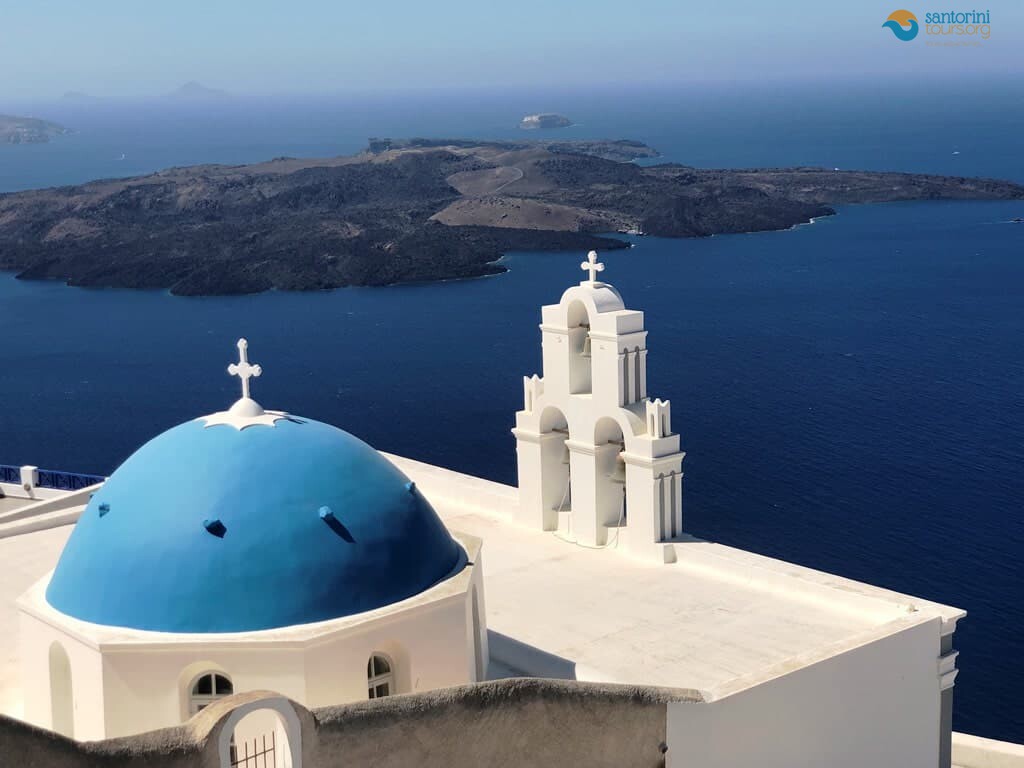
Pyrgos Kallistis, as it is called, is the highest village of Santorini and one of its five castles. After touring the alleys and the castle, we will start hiking on a path to the prophet Elijah, which is the highest point of the island. From this panoramic position you will be able to see the island from end to end, as well as the islands of Nea and old Kameni, Thirasia and even the summits of the mountains of Crete. You can have a tour to the villages of Santorini with us.
From there you will continue the path to Ancient Thira, the ancient city located at the top of Mesa Vouno in Santorini. The city was founded in the 8th century BC. from the Lacedaemonians and was inhabited until the early Byzantine times. In its current form it has strong elements of the Hellenistic and Roman eras, given that due to the continuous habitation there are not many traces left from the first centuries of existence of the city. In its current form it has strong elements of the Hellenistic and Roman eras, given that due to the continuous habitation there are not many traces left from the first centuries of existence of the city.
Sit down for a morning coffee at the caldera
And after you get enough of the view from above, you can start going down the 587 cobbled stairs to the old port of Fira. The small port of Fira is located 900 feet below the town of Fira and just below the caldera. The view during the descent is amazing, as you can observe the island from another angle. You can take a tour of Santorini!
Hiking on a stunning route from Fira to Oia
Words cannot describe the uniqueness of this route, since for the most part you will walk on the edge of the caldera through alleys, paths and streets, you will get to know the great architecture of Santorini, combined with the awe that one feels when one realizes how this unique beauty of Santorini .When you reach the traditional settlement of Oia with the captain’s houses, built on standards of neoclassical architecture, the cave houses with the painted walls and the colorful doors and windows, you can sit for food and coffee. So, you can enjoy this unique architecture and the colors of the sunset, when blue becomes orange and orange red.
Read more about Santorini Tours:
- Santorini Sightseeing Private Tour
- Exclusive Shore Santorini Private Tour
- Impressive Caldera Santorini Private Tour
- South Part Santorini Private Tour
- North Part Santorini Private Tour
- Santorini Historical Private Tour
- Santorini Sunset Private Tour
Santorini to Naxos Ferry: The Short Answer
The santorini to naxos ferry is the easiest crossing in the Cyclades. It is short, it runs several times a day all summer, it lands you in the middle of a town rather than at a remote quay, and it costs less than most people expect. If you are pairing two islands on one trip, this is the pairing that gives the least trouble.
Crossing time. The santorini to naxos ferry takes roughly 1 hour 30 to 2 hours on a high-speed catamaran. Roughly 2 hours 45 to 3 hours 30 on a conventional ferry, which usually calls at Ios and sometimes Paros.
Santorini to naxos ferry fares. Roughly 45 to 80 euros a person one way on the fast boats, and roughly 25 to 45 on the conventional ferries.
Frequency. The santorini to naxos ferry runs four to eight sailings a day through high summer, two to four in the shoulder months, and a thin service in winter.
Santorini to naxos ferry operators. Blue Star Ferries on the conventional service, with Seajets, Golden Star Ferries and Minoan Lines running high-speed vessels in various combinations across the season.
Santorini to naxos ferry ports. Athinios on Santorini, at the bottom of a hairpin road below the caldera, and Naxos town, where the boat docks a five-minute walk from the old quarter.
Distance. About 50 nautical miles north, with Ios in between, which is why this crossing is calmer than the runs to Crete or Athens.
The wind. The meltemi blows June to September and cancels high-speed craft first. The santorini to naxos ferry is less exposed than most Cyclades routes because Ios and Paros break the fetch.
Booking the santorini to naxos ferry. Two to four weeks ahead for July and August. Economy on the conventional boats rarely sells out.
The arrival. Unusually good. You step off into the town, with the Portara on the headland in front of you and the old quarter behind the waterfront.
The honest summary. Take the conventional ferry if you want deck space and the cheapest fare, and the fast boat if the day is short. Either way this is the simplest island transfer in the Cyclades.
Fast Catamaran or Conventional Ferry
On a ninety-minute to three-hour crossing the difference matters less than it does on the Athens run, and it still decides the day.
The high-speed catamaran. Ninety minutes to two hours, air-conditioned, assigned aircraft-style seats and usually no open deck. The quick way to do the santorini to naxos ferry and the less pleasant one.
The conventional ferry. Two and three quarter to three and a half hours on a large Blue Star ship, with open decks, a cafeteria, a bar and lounges. Slower, cheaper and far more comfortable.
Motion. The big ships barely move. The catamarans slam in a northerly, although this route is more sheltered than most.
Cancellations. Fast craft are restricted at a lower wind threshold. In a hard meltemi the catamaran goes and the conventional santorini to naxos ferry sails.
Price. A fast santorini to naxos ferry costs roughly double.
Stops. Conventional sailings usually call at Ios, and sometimes Paros, which adds half an hour and is a pleasant part of the journey.
Vehicles. Only the conventional ferries carry cars.
Deck space. The reason to choose Blue Star. Three hours with a rail and the Cyclades going past is better than ninety minutes watching a window.
Luggage. Free on both, handled by you, on racks near the doors.
Which we would take. The conventional ferry on a daytime sailing, unless you are landing in Santorini and leaving the same day.
Fares, Tickets and Booking
The santorini to naxos ferry in conventional economy. Roughly 25 to 45 euros a person one way. The cheapest way to cross and the most comfortable per euro.
High-speed economy. Roughly 45 to 80 euros a person one way.
Business and VIP. On most fast boats, at a thirty to eighty per cent premium. On a ninety-minute santorini to naxos ferry it is not necessary.
Children and infants. Reduced fares for children, and infants generally free without a seat.
Vehicles. Conventional ferries only, at roughly the cost of two extra passenger fares, booked well ahead in August.
Where to book. Direct with the operator or through an aggregator covering every line, which is easier for comparing a fast boat against a Blue Star sailing on the same day.
How far ahead. Two to four weeks for July and August, and a few days in the shoulder months. This route has more daily departures than the Crete one, so a sold-out boat costs you hours rather than a day.
Paper tickets. Some operators still require collection from a port kiosk or an agency in Fira. Check when you book.
Changes and refunds. Changeable for a fee up to a cut-off, then non-refundable, with weather cancellations handled separately.
Santorini to naxos ferry boarding. Thirty to sixty minutes before departure, and longer with a vehicle.
One-way or return. No meaningful saving on a return. Book the legs separately.
Sailing Times and Frequency
Schedules are published a few months ahead and revised without notice, so treat this as the pattern and check the date you actually want.
Morning santorini to naxos ferry departures. Roughly seven to ten. The calmest water of the day, and the santorini to naxos ferry that gives you an afternoon on the other island.
Midday. A mix of fast and conventional, arriving mid-afternoon.
Afternoon and early evening. High-speed mostly, and the departures most affected by the afternoon wind.
July and August. The santorini to naxos ferry runs four to eight sailings a day across all operators, with a real choice of vessel on most dates.
June and September. Three to five a day, lower fares, and September is the calmest month on the water.
May and October. Two to four a day, with the santorini to naxos ferry timetable changing week by week at the edges of the season.
April. Building, and worth checking rather than assuming.
November to March. A few sailings a week, almost all conventional, on the Piraeus line that serves both islands year-round.
Which santorini to naxos ferry to choose. The first conventional sailing of the morning: the cheapest fare, the calmest crossing, deck space, and an arrival with the day still ahead of you.
Delays. Knock-on rather than original, and more likely later in the day.
Athinios: Leaving Santorini
Where it is. Athinios, on the caldera side about ten kilometres south of Fira, at the bottom of a road of hairpin bends cut into the cliff.
Journey times. Twenty minutes from Fira, twenty-two from Firostefani, twenty-five from Imerovigli, twelve from Megalochori, twenty-five from Kamari or Perissa, thirty-five from Oia. Add half again in August.
The port itself. A narrow quay with a handful of agencies and cafes, no shade, and chaos when several boats load at once.
When to reach the santorini to naxos ferry. Forty-five minutes to an hour for a high-speed sailing in peak season, thirty otherwise.
By bus. 2.30 euros and twenty-five minutes, timed against the ferry schedule rather than a clock, and it fills early.
By taxi. Around thirty taxis serve the whole island. Not a plan for a boat with a fixed departure.
To the santorini to naxos ferry by private transfer. Booked, door to quay, priced per vehicle. The sensible answer with luggage and essential for an early sailing.
Luggage. Uneven quay, steep ramps, no trolleys.
Finding your boat. Vessels go by name and berth wherever there is space. Watch the hull and ask staff.
Early departures. A seven o’clock santorini to naxos ferry means leaving Fira around six, before the buses run.
Naxos: Arriving
This is where the route earns its reputation, because the arrival is the easiest in the Cyclades.
The santorini to naxos ferry arrival port. Naxos town, on the western side of the island, with the quay a five-minute walk from the old quarter and the waterfront restaurants.
The Portara. The enormous marble doorway of an unfinished temple of Apollo, standing on the islet at the harbour entrance. It is the first thing you see off the santorini to naxos ferry and the last thing you see leaving.
Walking. Almost everything in Chora is on foot from the quay: the Venetian kastro, the market lanes, the waterfront and the town beach at Agios Georgios.
Taxis and buses. Both at the port, with a far better supply than Santorini has. The bus network reaches the beaches and the mountain villages.
Car hire off the santorini to naxos ferry. Desks at the port and in town, at well below Santorini prices. Naxos is large enough to need one for two or three days.
Luggage. Flat, paved and easy.
Where to stay. Chora for the town, Agios Prokopios and Agia Anna for the beaches five minutes away, Plaka for a long quiet strand, and the mountain villages for something else entirely.
The contrast. The santorini to naxos ferry starts at one of the most awkward ports in Greece and ends at one of the most convenient.
The Wind and Cancellations
The meltemi. A dry northerly that blows for two to four days at a stretch from June to September, strongest in July and August.
Why this route copes better. Ios sits between the two islands and Paros beyond it, so the fetch is broken and the crossing is more sheltered than the runs to Crete or Athens.
What still gets cancelled. High-speed craft, at a lower wind threshold than the conventional ships. Blue Star sails in almost anything.
Santorini to naxos ferry cancellation notice. Frequently the same morning.
What the operator does. Rebooks or refunds. With four to eight sailings a day in summer there is usually another boat within hours.
The defence. Book the conventional santorini to naxos ferry rather than the catamaran if the forecast is windy. It is slower and it will sail.
Seasickness. Unlikely on a big ship, possible on a catamaran in wind. Tablets an hour before boarding.
Winter. Cancellations happen on a service that is already thin. Leave a spare day either side.
The rule. Do not make the crossing the last link before an international flight out of either island.
Crossing Day, Hour by Hour
The santorini to naxos ferry takes half a day if you plan it and a whole one if you do not. This is the morning conventional sailing done properly.
The night before. Confirm the sailing on the operator’s site, because timetables are revised without notice, and collect any paper ticket from an agency in Fira.
06:45, if the boat is at 08:00. Leave the hotel. No buses run that early and the island has around thirty taxis, so this is a booked vehicle. Allow thirty-five minutes from Fira and an hour from Oia.
07:20. At Athinios. Narrow quay, no shade, and already busy if two boats are loading. Find the vessel by name.
07:40. Boarding. Luggage on the racks or in the hold, and on a conventional santorini to naxos ferry there is far more room than on a catamaran.
08:00. Departure. The ship clears the caldera with the cliff and the villages above you, which is the best view of Santorini there is.
08:45. Ios, forty-five minutes north and a short call. Worth being on deck for the approach into the harbour.
10:30 to 11:15. Naxos. The Portara appears on the headland before the town does, and the boat docks a five-minute walk from the old quarter.
11:30. Car hire collected at the port, or a taxi, or simply walk into Chora with your bags.
12:00. Lunch on the waterfront, and the afternoon on a beach five minutes out of town.
The point. A morning santorini to naxos ferry costs you four hours and leaves an entire afternoon on the other island. The afternoon sailing costs you the day.
If the boat is cancelled. You will know by about seven. With four to eight sailings a day in summer there is usually another within hours, which is why this crossing is the least stressful in the Cyclades.
Continuing Beyond Naxos
Naxos sits in the middle of the main Cyclades line, which makes the santorini to naxos ferry the first leg of several sensible longer trips rather than an end in itself.
Paros. Half an hour beyond Naxos, several sailings a day, and a good pairing: a proper harbour town at Naoussa, good beaches and prices below Santorini.
Antiparos. A ten-minute ferry from Paros, small, quiet and easy.
Mykonos. About an hour beyond Naxos on the same line, with the airport for flights home.
Ios. Forty-five minutes back towards Santorini and directly on the route, with a good beach at Mylopotas and a reputation for nightlife.
Amorgos. East of Naxos on a separate and thinner line, dramatic and empty, and the best walking in the Cyclades.
The small Cyclades. Koufonisia, Schinoussa and Iraklia, reached from Naxos on a local boat, and the quietest islands in the group.
Piraeus. Three and a half to five and a half hours from Naxos, so a santorini to naxos ferry plus a Naxos to Athens leg is a comfortable way to work back towards a flight home.
The classic ten-day route. Santorini, Naxos, Paros, Mykonos, all on the same line, each hop between thirty minutes and two hours.
The quieter version. Santorini, Naxos, Koufonisia, Amorgos, which is the same region with a tenth of the people.
Booking the chain. Book each leg separately and leave a night either side of anything that has to connect with a flight, because the meltemi does not care about itineraries.
Which Island First, and How Long on Each
Most people taking the santorini to naxos ferry are doing both on one trip, and the split matters more than the boat does.
Santorini first. The usual and the better order. Santorini is a three to four day island of staircases and early starts; Naxos is a five to seven day island of beaches, villages and space. Do the intense one first.
Naxos first. Works if you are flying home from Santorini, which is the more expensive airport to leave from anyway.
A santorini to naxos ferry split of three nights and four. The best split for a week: the caldera villages, a boat and Akrotiri, then Naxos town, two beaches and a day in the mountains.
Three and three. Comfortable, with Naxos limited to the coast.
Two and two. Tight, and the santorini to naxos ferry is short enough that it still works if both boats are morning departures.
Ten days. Four Santorini, five Naxos and a night on Ios in between, which is forty-five minutes from Santorini and directly on the line.
Adding Paros. Half an hour beyond Naxos and on the same sailings. Three islands in ten days is comfortable here in a way it is not further out.
Flights around the santorini to naxos ferry. Naxos has a small airport with flights via Athens only. Most people fly into Santorini and out of Santorini, or out of Mykonos, which is a further hour by boat.
Day trips. A santorini to naxos ferry day trip is possible on a fast boat and not really worth it: three to four hours of travel for five hours ashore. Stay a night.
Santorini and Naxos: What You Are Swapping
Two islands two hours apart with almost nothing in common, which is exactly why the pairing works.
Landscape. Santorini is a flooded volcano with a cliff. Naxos is a proper island with a thousand-metre mountain, green valleys, streams and villages.
Beaches. Worth the santorini to naxos ferry on their own: Naxos, decisively. Kilometres of pale sand and shallow turquoise water at Agios Prokopios, Agia Anna, Plaka and Mikri Vigla, against black volcanic sand on one Santorini coast.
Spectacle. Santorini. Nothing in Naxos looks like the caldera.
Price. Naxos is a third to a half cheaper for rooms, food and car hire. This is the single most common reason people take the santorini to naxos ferry rather than staying put.
Food. Naxos, on the strength of its own potatoes, cheese, citron and meat. Santorini has assyrtiko and its own tomatoes, capers and fava.
Walking. Naxos, with Mount Zas, marble villages, old mule paths and shade. Santorini has one outstanding rim path.
Archaeology. Santorini has Akrotiri and Ancient Thera. Naxos has the Portara, the kouroi lying in the hillsides where they cracked, and Venetian towers.
Crowds. Naxos is busy in August and never approaches Santorini’s density.
Families. Take the santorini to naxos ferry: Naxos, without argument. Flat ground, shallow sand and space.
Which to give more days to. Naxos, on almost any itinerary. The santorini to naxos ferry is the short half leading to the long half.
Santorini to Naxos Ferry: Frequently Asked Questions
How long is the santorini to naxos ferry? About 1 hour 30 to 2 hours on a high-speed catamaran, and 2 hours 45 to 3 hours 30 on a conventional ferry calling at Ios.
How much does it cost? Roughly 45 to 80 euros a person one way on the fast boats, and 25 to 45 on the conventional ferries.
How often does it run? Four to eight sailings a day in July and August, three to five in June and September, and fewer at the edges of the season.
Where does it arrive? Naxos town, with the quay a five-minute walk from the old quarter and the Portara on the headland in front of you.
Which operators run it? Blue Star Ferries on the conventional service, with Seajets, Golden Star Ferries and Minoan Lines on the high-speed sailings.
Do I need to book ahead? Two to four weeks for July and August. Economy on the conventional boats rarely sells out.
Can I take a car? Yes, on the conventional ferries, at roughly the cost of two extra passenger fares. Hire cars usually may not leave the island they were rented on.
Will I get seasick? Less likely than on the Crete or Athens routes, because Ios and Paros shelter the crossing. Still possible on a catamaran in a hard meltemi.
Does the santorini to naxos ferry get cancelled? The fast boats occasionally, in strong wind. The large conventional ships almost always sail.
Which island should I visit first? Santorini, then Naxos, and give Naxos more nights.
Is a day trip worth it? Not really. Three to four hours of travel for five hours ashore. Stay at least one night.
Can I continue to Paros or Mykonos? Yes. Both are on the same line, Paros about half an hour beyond Naxos and Mykonos about an hour.
We Handle the Santorini End
We are a local operator on Santorini with our own vehicles and our own drivers, and Athinios is the part of this journey that goes wrong: a single-lane hairpin road, a narrow quay, and a boat that leaves on time.
Tell us your sailing time and where you are staying and we will have you at the quay with margin, including the six in the morning starts that the buses do not cover, and we will meet the boat in the other direction.
Prices are per vehicle rather than per person, hotel pickup anywhere on the island is included, we guide in twelve languages, and an 80 EUR deposit confirms a date.
See the personalised tour, the private transfers, or contact us.
Every Village and Site on the Island
Any of these can be built into a private day. Each has its own page with what to see and how long to allow.
Caldera villages: Fira · Firostefani · Imerovigli · Oia · Finikia · Baxedes
Inland villages: Pyrgos · Megalochori · Emporio · Mesaria · Karterados · Vothonas · Vourvoulos · Exo Gonia · Mesa Gonia · Pigadia
Beaches: Perissa · Perivolos · Kamari · Vlychada · Monolithos · Red Beach · White Beach · Agios Georgios · Agia Paraskevi
Sites and landmarks: Akrotiri · Ancient Thira · Akrotiri Lighthouse · Nea Kameni · Palia Kameni · Thirasia · Athinios Port
All our tours: All Santorini tours · Full day tour · Sightseeing tour · Personalised tour · North part tour · Horse riding · South part tour · Sunset tour · Shore excursion · Caldera tour · Food experience · Wine tour · Historical tour · Small group tour
Planning and services: Famous sights tour · Private transfers · Transfers to Oia and Finikia · Transfers to other villages · Villages of Santorini · History of Santorini · Tours near you · Languages we guide in · Food and fun tours · Gay friendly tours · Our tour buses · Daily tours · Day tours · FAQ · Gallery · Tour photo gallery · About us · Contact · Blog