
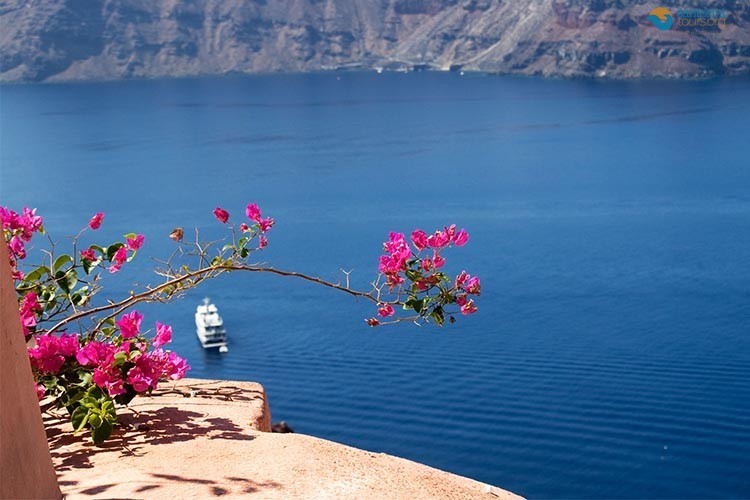
Santorini summer tours
Plato and some stubborn archaeologists may be right and, yes, here was the “lost Atlantis”. Many trumps are making Santorini ideal and Santorini Tours is the ideal way to explore them. Even when there are 5,000 people on the same rock to see the sunset, even then the island does not lose its energy.
From the crowds of Fira to the metaphysical breeze of Finikia and from the healing waters of Old and New Kameni to the sophisticated groups of Oia, the theatrical land hides miracles: if you walk barefoot, you will see and believe them.
Get to know the old Fira
Τhe vineyards and the top of the house, a goula (defensive tower-observatory, from the Turkish word “kulees”) belonging to the Botsi family. Even when tourism is at its peak, there are quiet, memory-filled corners, such as Frangomahalas with its mansions, Gyzis Megaro, Catholic Cathedral, Lazariston Monastery, the Dominican Monastery of the Monks and the Brothers of Mercy.
For those who seek serenity, it is ideal to take a stroll down to the quiet Kato Fira and then walk a passage from the “bouti” (low wall), the most central street of Fira, with a breathtaking view. You can use Santorini transfers in order to meet all the corners of the island.
Visit the unique excavation in Akrotiri
Akrotiri dates back to the Late Neolithic Era, 4000 BC, so it is definitely a monumental settlement and it has a lot to tell us. Fortunately, the excavations started again. The findings testify to the cosmopolitan character of the area.
The close diplomatic and commercial relations with the Mediterranean ports made Akrotiri a sturdy economic harbor, which is also reflected in eating habits: a popular delicacy was the garos, a fine fish sauce that was celebrated by Sophocles and Plato.
Also, souvlaki originates from the Aegean Sea, baked in straws in Santorini 6,500 years ago. Gastronomy has always been another advantage (dry tomatoes, white aubergines, beans: three famous local specialties).
If you would like to have a full Akrotiri private tour you need to make your reservations now!
Experience the vintage experience in its ancient vineyards
The study of DNA grapes found in Minoan jars demonstrates that Asyrtiko is an avid Mediterranean variety. The vineyard of Santorini is one of the most important of Europe – here wine tourism is in its peak, especially from mid-August onwards, when the harvest begins.
The winemakers of the island welcome us and teach us everything about Mandilaria, Mavrotragano, Aidani, Athiri and, of course, Asyrtiko.
Santorini cave houses
You will understand better if you enter one of the Santorini caves. They are not houses, they are architecture courses – even Le Corbusier put them in the eye.
Tholos, dug in the rock without foundations, the caves are carved on the vertical front of the white (volcanic matter). It is also bioclimatic: warm in winter, cool in the summer (the Theraine land has insulating properties).
Wander into a landscape of science fiction
It is not only the Caldera, the volcanic volumes, the Aegean blue and the light that is “like nowhere”. The whole of Santorini is a cinematic scenery. In Emborios, the largest village on the island, the irregular, rounded shapes of the houses remind the settlements of the “Star Wars”.
In Finikia, like another Indiana Jones, you are walking in other worlds: half-broken canvases-souvenirs of a glorious wine age, prickly pearls, infinite alleyways, faded blue and red colors, broken door and courtyard lockings all secret.
Discover four beaches-treasures
-
- Columbo
- Pori
- Aspri and
- Thermi (or Christ),
Enjoying them by swimming is a precious experience, away from countless umbrellas-sunbeds. In fact, you will not have difficulty finding them; ask the habitats of the island, who will clearly reveal other golden secrets. You can take a tour of Santorini!
What Summer Does to a Tour on Santorini
The places described above are the same all year. What changes in summer is everything around them: the heat, the light, the wind, the crowds and the hours when each place is worth visiting. Santorini summer tours succeed or fail on timing far more than on the list of stops.
Santorini summer tours: The heat. From late June to early September, daytime temperatures in the high twenties and thirties are normal, and on the hottest days much higher. There is almost no shade outdoors on the island.
Santorini summer tours: The light. Summer light is intense from mid-morning to late afternoon. The soft light that makes the caldera glow in photographs belongs to the first two hours of the day and the last two.
Santorini summer tours: The wind. The meltemi, the northerly summer wind, blows hardest in July and August. It cools the island, but it can make boat trips rough and occasionally cancel them.
Santorini summer tours: The crowds. Summer brings the highest visitor numbers of the year, with cruise ships adding thousands of day visitors to Fira and Oia between late morning and late afternoon.
The long days. Sunset comes late in June and July, which stretches the evening and changes when dinner and sunset tours happen.
Santorini summer tours: The sea. Warm enough to swim properly from mid-June to early October, which makes beach stops and boat swims a real part of Santorini summer tours.
The harvest. Grape picking begins around late July or August, earlier than on the Greek mainland, and wineries are at their busiest and most interesting.
What this means for planning. Outdoor caldera villages early, roofed or indoor sites at midday, the sea or a winery in the afternoon, and a sunset spot chosen for space rather than fame.
Why private tours suit summer. Flexible start times, air-conditioned vehicles and the ability to change the order around the heat and the ships make a large difference in this season.
What follows. Month by month advice, then each type of tour described above as it works in summer, and finally the practical details that decide how comfortable Santorini summer tours really are.
Summer Weather at a Glance
A quick reference to the conditions that shape Santorini summer tours from June to early October. Figures are typical ranges and vary from year to year.
June. Warm days, usually in the mid to high twenties, comfortable evenings, and a sea that warms through the month into the low twenties. Rain is rare.
July. Hot, often around thirty degrees by day, with strong sun and the meltemi picking up. The sea is warm and pleasant for swimming.
August. The hottest and windiest month in most years, with occasional heatwaves well above thirty. Sea temperatures are at or near their peak.
September. Still hot at first, easing through the month, with the warmest sea of the year and calmer winds.
Early October. Warm days, cooler nights, the first chance of rain, and a sea still warm enough for swimming.
Sunshine. Long, cloudless days are the norm throughout summer.
Humidity. Generally moderate, with the wind making the heat feel less oppressive than on the mainland.
UV. Very high from late spring through summer. Sun protection is essential on every outdoor tour.
Wind days. When the meltemi is strong, boats may be delayed or cancelled and the northeast beaches become rough, while sheltered southern beaches stay calmer.
What it means for planning. Warm, dry, bright and sometimes windy: ideal for sea, wine and sightseeing, provided the hottest hours are avoided. That is the basic rule behind all our Santorini summer tours.
Month by Month Through the Summer
Summer on Santorini is not one season but four quite different months. The same itinerary feels completely different in June and in August, and good Santorini summer tours are adjusted to the month.
June: the gentlest summer month. Long days, warm but manageable heat, and a sea that becomes comfortable for swimming from around the middle of the month. Crowds build steadily but are lighter than in July and August.
Santorini summer tours: What to do in June. The longest days of the year allow a full caldera morning, Akrotiri, a winery and a late sunset without rushing. June is the easiest month for walking tours, including the rim path.
July: hot, busy and windy. School holidays begin across Europe, visitor numbers climb, and the meltemi strengthens. Afternoons are hot and exposed sites are uncomfortable after late morning.
Santorini summer tours: What to do in July. Start at seven, keep outdoor walking to the early hours, use the sea and the wineries in the afternoon, and book boats early in your stay in case the wind cancels a day.
August: the peak. The hottest, busiest and most expensive month. Oia at sunset is at its most crowded, parking disappears and cruise days are intense.
Santorini summer tours: What to do in August. Treat the middle of the day as off limits outdoors. Caldera villages at dawn, Akrotiri and museums at midday, the beach or a winery after lunch, and a quieter sunset point in the evening. The grape harvest usually begins in August and makes winery visits especially lively.
September: late summer at its best. The sea is at its warmest, the heat eases, crowds thin after the first week or two, and the light softens. Many locals consider September the finest month for Santorini summer tours.
Santorini summer tours: What to do in September. Everything. Walking, boats, beaches, archaeology and wine all work well, with more flexibility over timing than in July and August.
Early October. Still warm enough for swimming and outdoor tours, with shorter days and a quieter island.
Our recommendation. June or September for the most comfortable Santorini summer tours; July and August work well with early starts and a plan built around the heat.
Old Fira and the Caldera Villages in Summer
The quiet corners of Fira described above are the key to enjoying the caldera villages in high season. Santorini summer tours that know where those corners are, and when to visit them, avoid most of the crowds.
Santorini summer tours: Fira before ten. The capital is calm early, before cruise passengers arrive by cable car. The caldera path, the churches and the view over the old port are at their best.
Santorini summer tours: Frangomahalas, the Catholic quarter. Mansions, the Catholic Cathedral, the Dominican convent and the Lazarist monastery sit a few minutes from the busiest lanes and stay peaceful even in August.
Megaro Gyzi. A seventeenth-century mansion in the old quarter, now a cultural centre, and a cool indoor stop in the middle of a hot morning.
Kato Fira. The lower lanes towards the caldera, quieter than the main streets and with some of the best views in town.
Firostefani. A short walk north along the rim, calmer than Fira, with the classic view back over the capital.
Santorini summer tours: Imerovigli. The highest point of the caldera rim, with Skaros Rock below. Best early morning or late afternoon in summer.
Oia at dawn. The most important timing decision in all Santorini summer tours. At seven the lanes are nearly empty; by eleven they are full.
Santorini summer tours: Oia at sunset. Spectacular and extremely crowded in July and August, with limited parking and a slow departure afterwards.
Amoudi Bay. The fishing harbour below Oia, reached by steps. Good for a swim off the rocks and seafood, but the climb back up is hard in the afternoon heat.
The cable car. Useful between Fira and the old port, but queues on busy cruise days can be long in the late afternoon.
How we time it. Oia at seven, Imerovigli and Firostefani at nine, Fira’s old quarter before the ships, and back to the rim for the evening light. That sequence is the backbone of our caldera Santorini summer tours.
Akrotiri and the Archaeological Sites in Summer
The excavation described above is the perfect midday stop in summer, because it is roofed. Archaeology fits naturally into Santorini summer tours when it is placed at the right hour.
Santorini summer tours: Why Akrotiri works at midday. The Bronze Age settlement is protected by a large bioclimatic roof, so visitors walk on raised paths in shade while the rest of the island bakes.
What you see. Streets, squares, drainage channels and buildings up to three storeys high, preserved under volcanic ash from the great eruption around 1600 BC.
How long to allow. About an hour to an hour and a half with a guide, which explains the town far better than the signs alone.
Santorini summer tours: Crowds in summer. Coach groups tend to arrive mid-morning. Early opening or early afternoon is often calmer.
The Museum of Prehistoric Thera. In Fira, air-conditioned, and home to finds from Akrotiri including painted pottery and wall-painting fragments. An ideal pairing on a hot day.
The Archaeological Museum of Thera. Also in Fira, covering later periods, and another cool indoor stop.
Santorini summer tours: Ancient Thera. The hilltop city on Mesa Vouno is exposed, with no shade and a steep approach. In summer it is a first-thing-in-the-morning visit only, and it keeps shorter opening hours than Akrotiri.
The combined ticket. A single ticket covers several archaeological sites and museums over a few days, which suits a summer programme split into cool mornings and midday indoor visits.
Children and archaeology. Akrotiri’s covered walkways and the idea of a buried town make it one of the most popular stops with families on Santorini summer tours.
Santorini summer tours: What to bring. Water, a hat for the walk from the car park, and comfortable shoes.
How we time it. Akrotiri between late morning and early afternoon, a museum in Fira if the day is very hot, and Ancient Thera only at the start of the day.
Vineyards and the Harvest
Wine is one of the best reasons to join Santorini summer tours, because summer is when the island’s vineyards are most alive and the harvest begins.
Santorini summer tours: The vineyards. Low basket-shaped vines, called kouloura, are woven close to the ground to protect the grapes from wind and sun and to catch night moisture. There is no irrigation; the vines survive on dew and volcanic soil.
Ungrafted roots. Phylloxera never took hold in Santorini’s volcanic soil, so many vines grow on their own roots, some from root systems centuries old.
Santorini summer tours: Assyrtiko. The island’s signature white grape: dry, mineral and high in acidity, the wine most visitors taste first.
Other varieties. Aidani and Athiri among the whites, and Mandilaria and Mavrotragano among the reds, as mentioned above.
Vinsanto and Nykteri. Vinsanto is made from sun-dried grapes and aged for years; Nykteri is a traditional white fermented and aged with extended contact with oak.
Santorini summer tours: The harvest. Picking usually begins in late July or August, earlier than most of Greece, and continues into early September depending on the vineyard and the year.
Visiting during the harvest. Wineries are busy but often at their most interesting, with grapes arriving and pressing under way.
Why wineries suit summer afternoons. Tastings are often held in shaded terraces or cool cellars, making them ideal when the villages are too hot to walk.
Santorini summer tours: Sunset tastings. Several estates have terraces with views towards the caldera or the sea, and evening tastings are popular in summer.
Driving. Greek drink-driving limits are strict, and roads are narrow and busy in summer. Having a driver is the practical reason many guests book winery Santorini summer tours.
Learn more. Our page on wine tourism in Santorini covers the estates, and the wine museum explains the vineyard year in a cool underground setting.
Cave Houses and the Inland Villages
The cave houses and the “science fiction” villages mentioned above are where Santorini summer tours find calm, shade and character away from the caldera crowds.
Why cave houses stay cool. Dug into volcanic rock, they are naturally insulated: warm in winter and noticeably cooler inside in summer. Many are now hotels, restaurants and wine cellars.
Santorini summer tours: Emporio. The largest village on the island, with a medieval castle quarter of narrow, winding lanes and rounded houses. The lanes are narrow enough to keep some shade even in summer.
Santorini summer tours: Finikia. A small village near Oia, quiet and colourful, with old houses, courtyards and lanes that are almost empty compared with its famous neighbour.
Santorini summer tours: Pyrgos. The former capital, climbing to a Venetian castle with views over the island. Best early morning or in the evening in summer.
Santorini summer tours: Megalochori. Arched passages, bell towers, old wineries and a village square that comes alive after sunset.
Vothonas. A village built partly in a ravine, with cave houses cut into the rock walls.
Karterados and Messaria. Close to Fira, with captains’ mansions and cave houses, and far fewer visitors.
Mesa Gonia. A village partly abandoned after the 1956 earthquake, below the Byzantine church of Panagia Episkopi.
Why villages suit summer tours. They are less crowded, often cooler in their narrow lanes, and give visitors a sense of everyday island life that the caldera rim cannot.
Village festivals. Summer is the season of panigiria, religious feast days celebrated with food, music and dancing. If one falls during your stay, it can become the highlight of your Santorini summer tours.
How we time it. Inland villages in the late afternoon or early evening, when the light softens and residents return to the squares.
The Summer Landscape: Geology on Tour
The “landscape of science fiction” described above has a real geological story, and understanding it turns a scenic drive into something far more memorable. Geology is one of the most rewarding themes for Santorini summer tours.
Santorini summer tours: The caldera. A flooded volcanic depression formed largely by the great Minoan eruption around 1600 BC, with cliffs rising around three hundred metres above the sea.
The cliff layers. Bands of red, black, grey and white in the caldera walls record lava flows, ash falls and pumice from different eruptions.
Nea and Palea Kameni. Younger volcanic islands formed by eruptions within the caldera, the most recent in the twentieth century.
Pumice and ash. The pale material covering much of the island, still visible in quarries and road cuttings, came from the Bronze Age eruption.
The Red Beach. Red and black volcanic cliffs near Akrotiri.
Santorini summer tours: Vlychada. Soft pumice cliffs sculpted by wind into shapes that look almost lunar.
Mesa Vouno and Profitis Ilias. Limestone mountains older than the volcano, the ancient island around which the volcanic landscape formed.
Cave houses. Built into the soft volcanic layers, which are easy to dig and naturally insulating.
The vineyards. Growing in volcanic soil that holds night moisture and resisted the phylloxera plague.
Monitoring. The volcanic system is continuously monitored by scientific institutions, and visits to the volcano continue under normal conditions.
Why summer suits geology tours. Clear skies, calm mornings on the water and long days make it possible to see the caldera from above, from sea level and from the crater in one or two days.
Our approach. Geological Santorini summer tours combine the volcano boat in the cool of the morning with the cliffs, beaches and villages later in the day.
Beaches and Swimming in Summer
The four quieter beaches named above are part of what makes Santorini summer tours different from a standard sightseeing day. Summer is when the sea is warm enough to make swimming a real part of the plan.
Santorini summer tours: Koloumbo. A secluded beach on the northeast coast below Cape Koloumbo, near Oia, with dark sand and clear water. Access is by a rough track and there are few facilities.
Pori. A small, quiet beach on the east coast with a fishing-harbour atmosphere, well away from the busy organised strips.
Aspri (White Beach). On the southern coast near Akrotiri, below pale cliffs, usually reached by small boat.
Thermi. On the caldera side below Megalochori, reached by a steep path, with naturally warm water near the shore. The walk back up is demanding in the heat.
Santorini summer tours: Kamari. A long, organised black-sand beach with a promenade, tavernas and full facilities. The easiest beach for families.
Perissa and Perivolos. Long organised beaches on the southeast coast with beach bars, sunbeds and water sports.
Vlychada. Beneath dramatic wind-carved cliffs on the south coast, quieter than Perissa.
The Red Beach. Spectacular red cliffs near Akrotiri. Access has been restricted at times because of rockfall risk; many visitors view it from the path or by boat.
Santorini summer tours: The hot sand warning. Volcanic sand absorbs heat and becomes very hot by late morning. Beach shoes help.
Santorini summer tours: When to swim. Mornings before noon and late afternoons are the most comfortable. The meltemi can make the northeast and east coasts choppy on windy days.
Combining beaches with sightseeing. Beach stops fit well after Akrotiri or a morning in the villages, turning the hottest hours of the day into the most pleasant.
Our approach. A swim is built into most of our Santorini summer tours when guests ask for it, chosen according to the wind direction that day.
The Volcano and Caldera Boats in Summer
The “healing waters of Old and New Kameni” mentioned above are the heart of the boat trips that many visitors consider essential. Summer is the main season for them, with a few conditions worth knowing.
Santorini summer tours: Nea Kameni. The young volcanic island at the centre of the caldera. A walk of around thirty minutes each way over loose lava leads to the crater area, with steam vents and wide views.
Santorini summer tours: Heat on the volcano. The black lava absorbs sun and there is no shade. Morning departures are far more comfortable in July and August than midday trips.
Palea Kameni and the hot springs. Boats anchor near a small bay where warm, iron-rich water colours the sea orange. Visitors swim from the boat to the springs.
Thirasia. Many trips continue to the island across the caldera for lunch and a quieter village atmosphere.
Santorini summer tours: Sunset cruises. Catamarans and traditional boats sail the caldera in the late afternoon, with swimming stops and dinner on board, and watch the sun set from the water.
Private charters. A private boat allows a flexible route and pace, and avoids the largest shared boats.
Santorini summer tours: The meltemi. Strong northerly winds in July and August can make crossings rougher and sometimes lead to cancellations. Booking a boat early in a stay leaves room to reschedule.
What to bring. Closed shoes for the lava paths, water, a hat, sun protection and swimwear you do not mind staining in the iron-rich springs.
The park fee. Nea Kameni is a protected geological site with an entrance charge that is usually separate from the boat ticket.
Where boats depart. Mainly from the old port below Fira, Athinios and Ammoudi, depending on the trip.
Why boats belong on Santorini summer tours. Seeing the caldera cliffs from the water explains the island in a way no viewpoint can, and the warm summer sea makes the swim part of the pleasure.
More detail. Our page on the walk to the volcano describes the crater walk step by step.
Sunset Tours in Summer
The sunset is the most requested stop on Santorini summer tours, and the one most easily spoiled by crowds. The “5,000 people on the same rock” described above is not an exaggeration in August.
Santorini summer tours: Oia. The most famous sunset viewpoint on the island. In July and August, crowds gather an hour or more before sunset around the castle ruins, and parking fills early.
Imerovigli. High on the caldera rim with Skaros Rock in the foreground, and noticeably calmer than Oia.
Firostefani. Walkable from Fira, with open views across the caldera.
Pyrgos. Inland and elevated, with views across the island towards the sea, and far fewer visitors.
Santorini summer tours: The Akrotiri lighthouse. At the southwestern tip, with open sea and space to spread out. A favourite alternative to Oia.
Profitis Ilias. The island’s highest point, near Pyrgos, with sweeping views in every direction.
From the water. A sunset cruise shows the cliffs and villages from below as the light fades.
A winery terrace. Several estates offer evening tastings with sunset views, combining two highlights of Santorini summer tours.
Santorini summer tours: Timing. Sunset in June and July is late, around half past eight, and earlier as summer turns to September. Check the exact time for your dates.
Getting away afterwards. Roads out of Oia are slow after sunset in high season. Having a driver waiting avoids the search for a taxi.
Photography. The golden hour before sunset often gives better pictures than the moment the sun touches the horizon.
Our approach. We usually recommend Imerovigli, Pyrgos or the lighthouse for summer sunsets, and Oia at dawn instead of dusk.
Walking Tours in Summer
Walking is the best way to experience the caldera, and the most dangerous way to get the timing wrong. Walking Santorini summer tours start early or not at all.
Santorini summer tours: Fira to Oia. The classic caldera rim walk, roughly ten kilometres, taking three to four hours depending on pace and stops. It follows paths, steps and some unpaved sections with a short climb near Imerovigli.
Santorini summer tours: When to start. Soon after sunrise in July and August. By late morning the path is fully exposed to the sun with very little shade.
Santorini summer tours: Water. Carry at least one and a half to two litres per person. Refill points are limited on the stretch between Imerovigli and Oia.
Footwear. Proper walking shoes or trail shoes. Loose gravel and polished marble steps are both common.
Skaros Rock. A short detour from Imerovigli to the rocky headland and the chapel of Theoskepasti, best early in the day.
Ancient Thera path. Footpaths climb from Kamari or Perissa to the ancient city on Mesa Vouno. Steep and exposed; early morning only in summer.
Pyrgos to Profitis Ilias. A shorter uphill walk from the old capital to the island’s highest point.
Village walks. Emporio, Megalochori and Pyrgos are ideal for gentle evening walks when the heat drops.
Guided walking. A guide adds history and geology, and a driver waiting at the end removes the need to walk back or find a taxi.
Santorini summer tours: Heat safety. Rest in shade where possible, wear a hat, and stop if feeling dizzy or unwell. Heat exhaustion is a real risk on exposed summer walks.
Our recommendation. The rim walk at dawn in June or September, and in July or August only with a very early start and a pick-up arranged in Oia. That is how walking fits into Santorini summer tours safely.
Photography Tours in Summer
Santorini is one of the most photographed places in Europe, and summer light is both a gift and a problem. Photography-focused Santorini summer tours are really a question of being in the right place at the right minute.
Santorini summer tours: The golden hours. Roughly the first hour after sunrise and the hour before sunset. Midday light in summer is harsh, flattens the whitewashed walls and creates strong shadows.
Santorini summer tours: Oia at sunrise. Empty lanes, the blue domes lit from the east, and the caldera still calm. The best time for the island’s most famous images.
Imerovigli and Skaros Rock. Dramatic early and late, with the rock headland projecting into the caldera.
Firostefani. The classic wide view back over Fira along the rim.
Fira’s old quarter. Bell towers, domes and narrow lanes, quiet before the cruise crowds arrive.
The Three Bells of Fira. A much-photographed church with blue domes on the caldera path, best early in the morning.
Inland villages. Pyrgos rooftops, Emporio’s castle lanes and Megalochori’s bell towers give quieter scenes without crowds.
Santorini summer tours: The vineyards. Basket vines on black volcanic soil photograph beautifully in low evening light.
Coastal landscapes. The cliffs at Vlychada, the Red Beach viewpoint and the Akrotiri lighthouse suit late afternoon.
From the water. A boat trip gives the only view of the full height of the caldera cliffs.
Etiquette. Many famous rooftops and terraces are private property. Ask permission, avoid blocking narrow paths, and respect residents.
Drones. Restrictions apply around the airport, archaeological sites and populated areas. Check current rules before flying.
Our approach. Photography Santorini summer tours built around sunrise and sunset, with the midday hours used for travel between locations.
Eating Well on a Summer Tour
Summer is when the island’s produce is at its peak, and a good lunch is part of every successful day. The gastronomy mentioned above becomes a practical highlight on Santorini summer tours.
Santorini summer tours: Summer produce. The small Santorini cherry tomato, white aubergines, capers and courgettes are all in season.
Tomatokeftedes. Tomato fritters, one of the island’s signature dishes, best in summer when the tomatoes are ripe.
Fava. The island’s yellow split-pea purée, served with onion, capers and olive oil, available all year.
Fresh fish. Harbour tavernas at Amoudi, Vlychada and the old port serve the day’s catch.
Santorini summer tours: Village tavernas. Pyrgos, Megalochori, Emporio and Karterados offer shaded terraces, local cooking and better value than the caldera rim.
Santorini summer tours: Lunch timing. A long lunch between about one and three fits perfectly into the hottest part of a summer day.
Winery lunches. Several estates serve food with tastings, combining shade, wine and island dishes.
Cooking classes. Indoor classes preparing local dishes are a good afternoon choice in the heat.
Staying hydrated. Water alongside wine, especially before an afternoon of sightseeing.
Dietary needs. Greek cooking includes many vegetable and legume dishes. Tell your guide about allergies in advance so restaurants can be chosen accordingly.
Booking. Popular caldera restaurants, especially at sunset, need reservations in summer. Village tavernas are more flexible.
More detail. Our page on the gastronomy of Santorini covers the island’s traditional dishes and their history.
Our approach. Lunch on our Santorini summer tours is chosen by location and shade as much as by menu, so the meal becomes a rest in the heat rather than another stop in the sun.
Summer Tours for Couples
Summer is honeymoon and anniversary season on Santorini. Couples’ Santorini summer tours are usually slower, more private and planned around the light.
Santorini summer tours: Sunrise in Oia. The most romantic hour on the island, with almost nobody else in the lanes.
Breakfast with a view. A caldera terrace in Imerovigli or Firostefani before the day warms up.
A winery afternoon. Tastings in shaded terraces or cellars, with a driver so both of you can enjoy the wine.
Santorini summer tours: A private boat. The caldera, the hot springs and quiet swimming coves without a crowded catamaran.
A quieter sunset. Imerovigli, Pyrgos or the Akrotiri lighthouse rather than the Oia crowds.
Dinner. A caldera restaurant booked for sunset, or a candlelit village taverna for a more local evening.
Photography. Many couples book a photographer for an early morning session before the heat and crowds.
Proposals and anniversaries. Summer is peak season for proposals and vow renewals on the island, and discreet planning with a private driver helps a great deal.
Santorini summer tours: Pace. Fewer stops, more time at each. A couple’s day works best with three or four experiences rather than seven.
Where to stay. A night or two on the caldera rim for the view, and quieter villages or beaches for the rest of the stay.
More ideas. Our page on a honeymoon at Santorini covers the season, stays and sunsets in more detail, and vow renewals are covered separately.
Our approach. Couples’ Santorini summer tours built around dawn, shade, wine and a sunset with room to breathe.
Summer Tours for Families and Older Travellers
Children and older travellers feel the heat and the steps first. Santorini summer tours for them need shorter days, cooler stops and careful routes.
Santorini summer tours: Start early, finish early. A morning of sightseeing and back to the hotel pool or beach before the hottest hours.
Choose roofed sites. Akrotiri and the Fira museums are cool and shaded.
The volcano with children. A morning boat, closed shoes, water and hats. Most children enjoy walking on the crater, but it is hot by late morning.
Santorini summer tours: Beach breaks. Kamari and Perissa have organised beaches with facilities and shallow entry.
Private transport. An air-conditioned vehicle, child seats arranged in advance, and flexible stops for rest and snacks.
Steps and mobility. The caldera villages involve many steps and uneven marble paths. Viewpoints with easy access can be chosen for older travellers.
Avoiding the steepest routes. The Fira steps to the old port, Amoudi Bay and Skaros Rock are demanding in summer heat and can be skipped.
Rest in the middle of the day. A long, shaded lunch or a return to the hotel between about one and four.
Santorini summer tours: Evenings. Village squares, the Kamari promenade and an early sunset spot suit families better than crowded Oia.
Health. Watch for signs of heat exhaustion, carry water, and plan shade at every stop.
More detail. Our page on a Santorini family vacation covers where to stay, beaches and safety with children.
Our approach. Family and senior Santorini summer tours shaped around shade, short walks and comfortable transport, with the day ending before anyone is tired.
Summer Evenings and Village Festivals
Summer evenings are when Santorini cools down and comes back to life. Evening plans are an important part of Santorini summer tours, especially for anyone who has spent the hot afternoon resting.
Santorini summer tours: Panigiria. Village feast days honouring a local saint, celebrated with a church service followed by food, wine, music and traditional dancing. Many take place between July and September.
Visiting a panigiri. Visitors are generally welcome. Dates follow the church calendar, so ask locally during your stay.
Village squares. Megalochori, Pyrgos and Emporio fill with residents in the evening, with children playing and tavernas busy.
Santorini summer tours: Fira at night. The caldera path glows with lights after sunset, with bars and restaurants overlooking the dark caldera.
Kamari promenade. A relaxed evening walk by the sea, with tavernas, cafés and an open-air cinema in summer.
Oia after sunset. Once the sunset crowds leave, the village becomes calm again and the lanes are pleasant to walk.
Night views of the caldera. From Imerovigli or Firostefani, the lights of Fira, Oia and ships at anchor are striking after dark.
Wine evenings. Some wineries host evening tastings and events in summer.
Cultural events. Concerts and exhibitions are held in summer at venues including the cultural centre in Fira.
Santorini summer tours: Getting back. Taxis are scarce late in the evening in summer. Arranging a driver for the return is the simplest solution.
Our approach. Evening Santorini summer tours end the day in a village square or a quiet caldera terrace, after the heat and the crowds have gone.
Private, Small Group or Coach in Summer
How you travel around the island matters more in summer than at any other time. The type of tour changes how much of the heat, the queues and the crowds you actually experience.
Santorini summer tours: Private tours. Your own vehicle and driver, a start time you choose, and a route that can change during the day. In summer this flexibility is the main advantage: early starts, midday shade, and no waiting for other passengers.
Air-conditioning. Moving between stops in a cool vehicle makes a real difference in July and August, especially for children and older travellers.
Santorini summer tours: Small-group tours. A shared minibus with a limited number of guests, lower cost per person than private, and a fixed but manageable schedule.
Santorini summer tours: Coach tours. The lowest cost, but larger groups, fixed timing, more waiting at stops and less flexibility to avoid crowded hours.
Self-drive. Possible, but narrow roads, summer traffic, ATVs and very limited parking in Oia and Fira make it stressful in high season.
Public buses. Inexpensive and useful for simple journeys, but crowded in summer and routed through Fira, which adds time.
Taxis. Scarce relative to demand in summer, especially after sunset and when ferries arrive.
Cruise passengers. A private shore tour meeting you at the top of the cable car or at the port avoids queues and keeps to the ship’s schedule.
Families. Private Santorini summer tours allow stops for rest, swimming and snacks, and child seats can be arranged in advance.
Couples. Private tours make sunrise in Oia, a winery lunch and a quiet sunset possible in one relaxed day.
The honest summary. In spring or autumn, any type of tour works. In July and August, the flexibility of a private tour is worth more than at any other time of year.
Our tours. The full list is on our private tours and activities page.
Cruise Days in Summer
Summer is also cruise season, and cruise days change the island. Anyone joining Santorini summer tours, whether arriving by ship or not, should know how they work.
How cruise ships arrive. Ships anchor in the caldera and passengers are carried by tender boats to the old port below Fira.
Getting up to Fira. By cable car, by the long stepped path on foot, or by donkey. The cable car is the fastest; queues can be long when several ships are in port.
Santorini summer tours: The busiest hours. Roughly late morning to late afternoon, when cruise visitors fill Fira and Oia.
Santorini summer tours: Checking the schedule. Cruise schedules are published in advance. On days with several large ships, plan Fira and Oia for early morning or evening.
Visiting on a cruise. With limited hours ashore, a private shore tour avoids waiting for buses and can combine Oia with one more highlight such as Akrotiri or a winery.
Returning to the ship. Leave generous time for the cable car queue and the tender back. Missing the last tender is not an option.
Santorini summer tours: What fits in a typical call. Oia plus one other stop is realistic. Trying to add the volcano boat to a short call rarely works.
Donkeys on the steps. Welfare concerns about working donkeys on the Fira steps are widely reported. We recommend the cable car or walking instead.
For visitors staying on the island. Use heavy cruise days for inland villages, beaches, wineries and Akrotiri, and return to the caldera villages once the ships leave.
Our approach. Every summer itinerary we build checks the day’s ships first, so that Santorini summer tours avoid the caldera villages at their busiest.
Arriving and Leaving in Summer
Summer arrivals and departures are the moments when Santorini is most stressful. Good Santorini summer tours start with a smooth arrival and end with a relaxed departure.
The airport. Santorini’s airport on the east of the island is busy in summer, with many international and domestic flights arriving close together.
Santorini summer tours: Athinios port. Most ferries arrive at Athinios, below the cliffs, reached by a steep road with hairpin bends. When several ferries arrive at once, the port and the road become very congested.
Taxis. Demand in summer often far exceeds the number of taxis available at the airport and port.
Buses. Public buses connect the port and airport with Fira, but can be crowded and require changes for other villages.
Santorini summer tours: Booking a transfer. A driver waiting with your name at arrivals or at the port removes the uncertainty and the wait in the sun.
Caldera hotels. Many rim hotels have no road access to the door. Vehicles stop at the nearest point and luggage is carried down, which is worth knowing before arrival.
Santorini summer tours: Departure timing. Allow extra time for summer traffic, especially on the road down to Athinios and near the airport.
Last-day tours. A late checkout day can include a short tour with luggage in the vehicle and a drop-off at the port or airport.
Ferry delays and wind. Strong meltemi winds occasionally delay or cancel ferries. Leave a buffer before international flights if travelling by sea.
More detail. Our page on Santorini’s port explains arriving at Athinios.
Our approach. Transfers timed to your flight or ferry, with Santorini summer tours that can begin straight from arrival or end at departure.
Sample Summer Days
These are the day plans we use most often for Santorini summer tours. Each one follows the same rule: outdoor caldera villages early, shade or sea at midday, and a calm spot for the evening.
Santorini summer tours: The classic full day. Oia at seven, breakfast in Imerovigli, Akrotiri at midday, lunch in Megalochori, a winery in the afternoon, and sunset at the Akrotiri lighthouse.
The caldera and sea day. Fira’s old quarter early, a morning boat to the volcano and hot springs, lunch on Thirasia, and back for an evening in Firostefani.
Santorini summer tours: The villages and wine day. Pyrgos in the morning, Emporio’s castle lanes, a long winery lunch, a swim at Perissa, and Megalochori in the evening.
The beach and history day. Ancient Thera at opening, Kamari beach and lunch, the Museum of Prehistoric Thera in the afternoon heat, and sunset in Pyrgos.
The walker’s day. The Fira to Oia rim walk from sunrise, brunch in Oia, a rest, and Amoudi Bay for a swim and seafood as the heat eases.
The half-day morning. Oia at dawn, Imerovigli and Skaros Rock, and back before eleven.
The half-day afternoon. Akrotiri, the Red Beach viewpoint, a winery and a sunset stop.
Santorini summer tours: The family day. Oia early, a beach morning at Kamari, lunch, the hotel pool through the hottest hours, and an evening walk with ice cream.
The cruise day. Met at the top of the cable car, Oia, one further stop, and back to the port with time to spare.
Adjusting on the day. Wind, ship numbers and temperature can all change the order. Private Santorini summer tours can adapt; fixed group tours usually cannot.
How long a full day lasts. Usually six to eight hours, with breaks built in so that nobody spends the afternoon in the sun.
How Many Days for Summer Touring
The number of days you have decides which Santorini summer tours make sense. In summer, fewer activities per day means more days are needed to see the island comfortably.
Santorini summer tours: One day. Oia at dawn, Akrotiri at midday, a winery, and a quieter sunset. Enough for the highlights with a private driver.
Two days. Add the volcano and hot springs boat on the second morning, with Thirasia or a beach in the afternoon.
Santorini summer tours: Three days. Add the inland villages, a beach day, and the caldera walk from Fira to Oia at sunrise.
Four or five days. Enough for Ancient Thera, more beaches, a cooking class, a relaxed rest day and a second sunset spot.
A week. Time to repeat favourite places at different hours, explore Vlychada and the south coast, and slow down properly.
Santorini summer tours: Rest days. In July and August, a rest day with only a pool or beach helps prevent fatigue from heat and early starts.
Splitting the stay. Some visitors spend a few nights on the caldera rim and a few near a beach, which changes the starting point for daily tours.
Weather flexibility. Extra days allow boat trips to be moved if the wind cancels one.
Cruise visitors. A single call allows a focused half-day or short full day only.
Combining islands. Longer summer holidays often pair Santorini with another Cycladic island by ferry.
Our recommendation. Three to five days is ideal for Santorini summer tours, allowing early mornings, shaded afternoons and relaxed evenings without rushing.
Planning further. Our page on Santorini tour itineraries sets out detailed day-by-day plans.
Practical Advice for a Hot Island
The details below make the difference between comfortable Santorini summer tours and exhausting ones.
Water. Drink regularly, even without feeling thirsty. Tap water on the island is not recommended for drinking; bottled water is widely available.
Santorini summer tours: Sun protection. High-factor sunscreen, reapplied often, plus sunglasses. White walls and the sea reflect strong light.
Santorini summer tours: Hats. Essential on the volcano, the rim walk and at archaeological sites.
Clothing. Light, loose, breathable fabrics. Cover shoulders and knees for churches and monasteries.
Footwear. Comfortable shoes with grip for marble steps and volcanic gravel; beach shoes for hot black sand.
Timing. Plan outdoor sightseeing before about eleven and after about five in July and August.
Heat warning signs. Dizziness, headache, nausea or unusual tiredness mean stopping, finding shade and drinking water.
Pharmacies. Available in Fira, Kamari, Perissa, Oia and other villages, with pharmacists who give practical advice.
Santorini summer tours: Booking ahead. Boats, sunset restaurants, winery tastings and private tours fill up in summer. Book before arrival.
Transport. Arrange transfers in advance, especially from the port and airport when ferries and flights arrive together.
Cash and cards. Cards are widely accepted, but some small tavernas and beach kiosks prefer cash.
Earthquake awareness. The island has an active volcanic system and monitoring. Follow official guidance if any is issued; normal visits continue as usual.
Respect local life. Keep noise down in residential lanes, avoid climbing on private rooftops for photographs, and respect church services.
The summary. Early starts, shade at midday, water always, and bookings made in advance. Follow those four rules and Santorini summer tours are a pleasure rather than an endurance test.
Santorini Summer Tours: The Questions We Are Asked
Is summer a good time for tours on Santorini? Yes, with the right timing. Early mornings, shaded midday stops and calm evening viewpoints make even August enjoyable.
What is the best summer month? June or September for comfort. July and August are hotter, windier and busier.
How hot does it get? Usually high twenties to mid-thirties in July and August, sometimes higher, with little shade outdoors.
What time should tours start? Around seven in high summer for caldera villages and walks.
Are boat trips cancelled in summer? Sometimes, when the meltemi wind is strong, mostly in July and August.
Can we swim on a tour? Yes. Beaches, the hot springs and Amoudi Bay can all be included.
Is Akrotiri too hot in summer? No. It is roofed, which makes it one of the best midday stops.
Where is the best summer sunset? Oia is the most famous but very crowded. Imerovigli, Pyrgos and the Akrotiri lighthouse are calmer.
Are wineries open in summer? Yes, and summer includes the start of the grape harvest.
Should we walk from Fira to Oia in August? Only from sunrise, with plenty of water and a pick-up arranged at the end.
How far ahead should we book? Several weeks for June and September, and earlier for July and August.
Are Santorini summer tours suitable for children? Yes, with private transport, early starts and swimming breaks.
Can a cruise passenger join a tour? Yes. Private shore tours are built around the ship’s times.
How long is a full-day tour? Usually six to eight hours.
What should we bring? Water, sunscreen, a hat, comfortable shoes, swimwear and a light layer for windy evenings.
Summer Tours With Us
We run private tours on Santorini through every summer, and our whole approach is built around the heat, the wind and the crowds rather than a fixed timetable.
Full-day private tours. The caldera villages at dawn, Akrotiri at midday, inland villages, a winery and a sunset point chosen for space.
Half-day tours. A cool morning on the caldera, or an afternoon of archaeology, wine and sunset.
Wine tours. Two or three estates, including harvest-season visits from late summer.
Historical tours. Akrotiri, the Fira museums and Ancient Thera timed around opening hours and heat.
Sunset tours. Imerovigli, Pyrgos or the Akrotiri lighthouse, with a driver waiting afterwards.
Shore excursions. Built around cruise schedules, with pick-up near the cable car or port.
Transfers. Airport and port arrivals and departures, including busy summer ferry times.
Families and groups. Air-conditioned vehicles, child seats on request and flexible stops.
Local knowledge. We check the ships, the wind and the temperature each morning and adjust the order of the day accordingly.
Recognition. Santorini Tours was named in the Tripadvisor Travellers’ Choice Awards 2025, based on guest reviews.
Plan your summer. Send us your dates, the size of your group and what matters most to you, and we will build Santorini summer tours that fit the season and the island. See all options on our private tours and activities page.








Leave a Reply