
Skaros rock santorini is the headland below Imerovigli that held the island’s Venetian capital until earthquakes shook it down. The walk is twenty minutes down and twenty-five back up, it is free, and the chapel behind the rock gives the one view of the caldera cliff that nobody standing on the rim ever sees. Santorini Tours is a local operator running private tours and transfers on the island.
Skaros Rock Santorini: The Short Answer
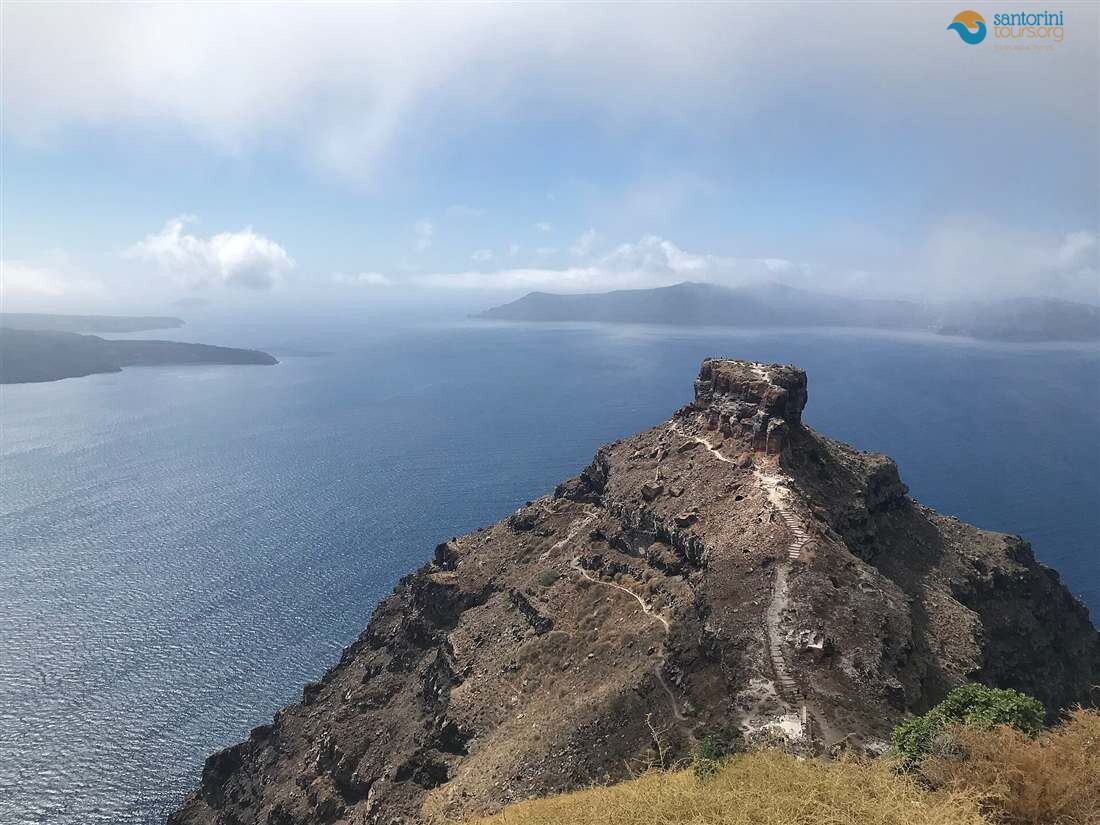
Skaros rock santorini is the headland below Imerovigli that carried the island’s Venetian capital for six hundred years. The castle is gone, shaken off the rock by earthquakes, and what remains is a bare promontory with a path down to it, a chapel tucked behind it, and the best view of the caldera cliff on the island.
The walk to skaros rock santorini is twenty minutes down from Imerovigli and twenty-five back up, on a stepped and then loose path. It is free, it is unmarked beyond the start, and it is the single best short walk in Santorini.
Go in the morning or after five. There is no shade anywhere on the route, the last section is loose gravel, and the climb back up in August at three in the afternoon is the part people underestimate.
What It Actually Is
A volcanic promontory, which is all skaros rock santorini physically is. A lump of rock jutting into the caldera below Imerovigli, joined to the island by a narrow neck of land.
The medieval capital. From the thirteenth century until the early 1800s, skaros rock santorini held Skaros castle, the seat of the Venetian lords of the island and the safest place to be when pirates arrived.
Why nothing is left. Repeated earthquakes, particularly in the eighteenth century, brought most of it down. The rest was abandoned when the population moved up to Fira and Imerovigli.
What survives. Fragments of wall, cisterns cut into the rock, and the shape of the settlement if you know what you are looking at.
Theoskepasti. The small blue-and-white chapel of Panagia Theoskepasti, tucked behind the rock on the caldera side and invisible from the village above.
The name. From skaros, a lookout, which is exactly what it was.
See Imerovigli.
Where It Is and How to Get There
The start of the skaros rock santorini path. Imerovigli, at the northern end of the village near the Anastasi church, where a signed path leaves the rim and drops towards the sea.
The descent. Stepped for the first few minutes, then a rough track cut into the slope, then loose red gravel as you approach the neck.
Time. Twenty minutes down at a steady pace, twenty-five to thirty back up.
Distance. Around 700 metres each way with roughly 100 metres of descent and ascent.
Getting to the start. Imerovigli is ten minutes on foot from Firostefani along the level rim path, twenty from Fira, or a short drive with parking at the top of the village.
Buses. The Fira–Oia bus stops on the main road above Imerovigli, five minutes’ walk from the path to skaros rock santorini.
Where it is not. Not in Oia, not reachable by car, and not accessible with a pushchair or a wheelchair at any point past the first fifty metres.
The Walk, Step by Step
0 to 5 minutes. The skaros rock santorini path begins with stone steps down from the Imerovigli rim path, past the last hotels, with the rock ahead of you the whole way.
5 to 12 minutes. A cut path across the slope, exposed, with the caldera 250 metres below on your right. Wide enough to be comfortable and with no barrier.
12 to 18 minutes. Loose red gravel down to the saddle that joins skaros rock santorini to the island. This is the section where footwear matters.
18 to 20 minutes. The neck itself, and the decision point: left and round the base of the rock to Theoskepasti chapel, or up onto the rock.
The chapel path. Five minutes further, level, and it ends at the chapel with the cliff of Imerovigli behind you. This is the postcard.
Coming back up from skaros rock santorini. The same route, and it is a genuine climb. Allow half an hour and take water.
Total. An hour and a quarter with photographs, or two hours if you sit at the chapel for a while, which everybody does.
Climbing the Rock Itself
Two different walks get confused constantly, and only one of them is for everybody.
The path to the base and the chapel. Straightforward, walked by hundreds of people a week in season, and the version described above.
The scramble to the top. Unmarked, steep, over crumbling volcanic rock with loose footing and unprotected drops. There is no maintained route to the summit of skaros rock santorini and no barriers of any kind.
Should you? Only with proper shoes, dry conditions, no wind and a head for exposure. People are injured up there and rescue involves a boat or a helicopter.
What is at the top. Cistern remains, wall fragments and a view. It is interesting rather than spectacular; the best views are from the saddle and the chapel.
With children. The path yes, the summit no.
Our position. Walk to the chapel, look up at the rock, and leave the scramble alone. Nothing at the top of skaros rock santorini is worth a broken ankle on a cliff with no road.
What to Take
Shoes with grip for skaros rock santorini. Trainers or light walking shoes. The loose gravel on the last descent is the single most common cause of a fall here.
Water. Half a litre each in the shoulder months and a litre in summer. There is nothing to buy past the last hotel.
A hat and sun cream. There is no shade at any point on the route.
A layer in winter. The neck is exposed and the wind funnels across it.
A camera. Obviously, and a wide lens rather than a long one.
What not to take. Sandals, a pushchair, a suitcase, or a dog without water. Skaros rock santorini is a short walk and it is a real one.
The Best Time of Day
07:00 to 09:30. Cool, empty, and the cliff of Imerovigli lit from the side. The best hour to walk to skaros rock santorini, and you will meet perhaps five people.
09:30 to 11:00. Busier and still comfortable outside high summer.
11:00 to 16:00. Avoid from June to September. No shade, loose ground, and a climb back at the end of it.
17:00 to sunset. The other good window: the light goes gold on the rock, the sea turns, and the whole caldera opens up.
Sunset itself. Superb, and remember the walk back is in fading light on a loose path. Take a torch or leave twenty minutes before the sun goes.
After dark. No. The path is unlit and unfenced.
Season by Season
April, May, October and November. The best months for skaros rock santorini. 18 to 25 degrees, green slopes in spring, and the path in good condition.
June and September. Very good before ten in the morning and after five.
July and August. Mornings only, and early. Skaros rock santorini in the middle of an August afternoon is where people get into trouble with the heat.
December to March. Empty, dramatic under cloud, and occasionally too windy to be pleasant on the neck. The path can be muddy after rain.
Wind. A strong meltemi makes the exposed section unpleasant rather than dangerous, and it will blow grit into everything.
See the weather month by month.
Theoskepasti Chapel
What the chapel at skaros rock santorini is. Panagia Theoskepasti, a tiny blue-domed chapel on a ledge behind the rock, facing the open caldera.
Why it matters. It is the one place on this island where you stand below the villages rather than in them, with 250 metres of cliff above you and nothing but water in front.
The photograph. The chapel small in the frame with the Imerovigli cliff behind it is the shot that everybody who walks to skaros rock santorini comes back with.
Inside. Usually locked, opened for its feast day, and worth respecting either way.
The ledge. Wide enough to sit on for half an hour, which is exactly what it is for.
The swim. There is water access below for confident swimmers off the rocks, and no facilities of any kind.
Photographing Skaros
From the Imerovigli rim. The classic skaros rock santorini view, looking down on the rock with the caldera behind. Best in the morning and at blue hour.
From the descent. Halfway down, with the path snaking ahead and the rock filling the frame.
From the neck. Looking back up at the cliff and the village hanging on the edge of it.
From the chapel ledge. The best frame on the walk, and the reason to go past the base of the rock rather than stopping at it.
From a boat. Every caldera cruise passes below skaros rock santorini, and from the water the scale finally makes sense.
Light. Morning for detail on the cliff, late afternoon for colour on the rock, blue hour from above for the village lights.
What You See From the Path
The walk is short and the view changes completely three times, which is why it repays going slowly.
From the top of the skaros rock santorini path. Imerovigli spilling down the rim, the rock below you, and the two volcanic islets sitting in the middle of the bay.
From the cut path. The full sweep of the caldera opens on your right: Fira in the distance, Thirasia opposite, and the cliff banded red and black by successive eruptions.
From the saddle. The view most people come for on skaros rock santorini: the village 250 metres above, hanging over a drop, with the whole crater behind you.
From the chapel ledge. Nothing but water and the far rim. This is the only easily reached point on the caldera side where the island is above you rather than under you.
Looking north. Oia strung along the far end of the rim, which is where the ten-kilometre path finishes.
Looking down. Deep water immediately below, dark blue and clear, with the occasional boat working the cliff.
Safety, Honestly
The skaros rock santorini path itself is fine. Hundreds of people walk it every week in season, in trainers, without difficulty.
The gravel is the risk. The last section down to the neck is loose red scoria on a slope, and it is where ankles go.
The edges are unfenced. As they are everywhere on this island. Stay on the path and away from the lip, particularly in wind.
The summit scramble is a different thing. Crumbling rock, no route, no protection, and a rescue that involves a boat. Every year somebody needs help off skaros rock santorini and it is almost always from up there.
Heat. The genuine hazard in July and August. No shade, no water, and a climb at the end.
Phone signal. Good throughout, and 112 is the emergency number.
Alone. Perfectly normal in daylight, and tell somebody if you are going late.
Who Should and Should Not Go
Go if. You can walk half an hour uphill, you have shoes with grip, and you want the one view of this island that a terrace cannot give you.
Go if. You are a photographer. Skaros rock santorini at seven in the morning or six in the evening is the best hour of the trip.
Think twice if. Your knees dislike loose descents, or you are travelling in the middle of an August afternoon.
Do not go if. Steps and uneven ground are a problem. Walk the level rim path from Fira to Imerovigli instead and look down at the rock from above, which is a fine view in itself.
Do not go at night. Unlit, unfenced, loose underfoot.
Do not take the summit route with children. Or in flip-flops, or after wine at the sunset bar above.
The Version We Would Do
Late October, half past five, having walked the rim from Firostefani in twenty level minutes.
17:45. Start down to skaros rock santorini from Imerovigli with the light already going gold on the rock.
18:05. The saddle, and ten minutes of standing still looking back at the cliff.
18:20. The chapel, sitting on the ledge with the caldera in front and nobody else there.
18:50. Start back up so the loose section is done in good light.
19:20. A drink on the rim at Imerovigli, watching the sun finish from a chair.
21:00. Dinner inland at Vothonas or Pyrgos, at a third of the caldera price.
An hour and a half of walking, the best free view on Santorini, and the legs earned the dinner. That is skaros rock santorini done properly.
Where to Stay for It
Imerovigli. The path starts at the end of the village, so you can walk down to skaros rock santorini before breakfast and be back before the coaches arrive. The finest view on the island and a great many steps to your room.
Firostefani. Ten level minutes along the rim from the trailhead, with road access and lower prices. Our usual recommendation. See Firostefani.
Fira. Twenty minutes along the paved rim path, on every bus route, and the cheapest caldera base.
Oia. Twenty-five minutes by road, and the walk is worth the drive.
Anywhere inland or on a beach. A car or a driver and half an hour. Nothing about skaros rock santorini requires sleeping on the rim.
See where to stay for the full village comparison.
What It Costs
The walk. Nothing. No ticket, no gate, no guide required.
Water and a hat. A few euros, and not optional in summer.
Getting to Imerovigli. A couple of euros by bus from Fira, or ten to fifteen by taxi if you can find one.
A drink on the rim afterwards. 8 to 15 euros, and worth it for the chair.
A guided version. Priced per vehicle with the history included, which for four people costs less per head than a seat on a group tour.
Of everything free on this island, skaros rock santorini is second only to the rim path from Fira to Oia, and it takes a quarter of the time.
Other Short Walks on the Rim
If this one suits you, four more are worth an hour each, and all of them start on the same stretch of cliff.
Fira to Firostefani. Twenty minutes, paved, level, and the classic view back at Fira spilling down the cliff. Doable after dinner in sandals.
Firostefani to Imerovigli. Another twenty minutes, gently uphill, ending at the highest point of the rim and the trailhead for skaros rock santorini.
Imerovigli to Oia. The wild two-thirds of the ten-kilometre rim path, on gravel and dirt, two and a half hours, and the best long walk in the Cyclades.
The Akrotiri lighthouse. A short flat walk from the road end to the southern tip, with the caldera on one side and open sea on the other.
Ancient Thira from Kamari. Forty-five steep minutes up Mesa Vouno to a whole Hellenistic town on a ridge, at opening or not at all.
Between them these five cover almost everything worth walking here, and skaros rock santorini is the one that takes the least time for the most view.
What People Ask Us on the Path
“Is that the whole castle?” Yes. Two earthquakes and two centuries removed the rest, and what looks like ruins from above is mostly natural rock.
“Can we get down to the water?” Below the chapel, off the rocks, for confident swimmers only, and there is no ladder and no lifeguard.
“How do people live up there?” Imerovigli’s hotels are built into the cliff on terraces, and everything arrives on somebody’s back or by trolley on rails.
“Why is the rock red?” Oxidised volcanic scoria, thrown out of a vent on this side of the island, which is why skaros rock santorini is a different colour from the pale pumice cliffs south of Fira.
“Is it busy at sunset?” Far less than Oia. Twenty or thirty people rather than several thousand, and most of them are at the chapel rather than on the neck.
“Do we need a guide?” For the walking, no. For the history, it helps, because there is not a single interpretation board on the whole route.
A Note on the Sunset
Everybody on this island is told to watch the sunset in Oia. A few hundred people a night watch it instead from the rim above skaros rock santorini, and they get a better evening.
Why it works. The sun sets across the caldera from the whole western rim, so Imerovigli sees exactly the same sun as Oia does, from a village with a fraction of the crowd.
Where to stand. The rim path above the trailhead, or on the neck itself if you have walked down in time.
The catch. Walking back up a loose path in fading light. Leave the saddle twenty minutes before the sun goes, or carry a torch.
The alternative. Watch from a terrace on the rim with a drink, which costs the price of a glass of wine and involves no gravel at all.
What to avoid. Attempting the summit scramble for the sunset. Coming down that rock in the dark is how the rescue boat gets called.
See where to watch the sunset.
The History, Briefly
1207. The Venetians take the Cyclades after the Fourth Crusade, and the Duchy of Naxos installs a lord on Santorini.
The castle. Skaros rock santorini becomes the kastelli, the fortified capital, because a rock joined to the island by one narrow neck is defensible against pirates in a way that an open village is not.
Life on the rock. Several hundred people at its height, with houses, cisterns cut into the stone, a Catholic church and the lord’s residence.
1650 and after. The eruption of Kolumbo and a series of earthquakes crack the rock and bring down parts of the settlement.
The eighteenth century. Repeated quakes finish the job. Families move up to Imerovigli and Fira, and skaros rock santorini is progressively abandoned.
By 1800. Effectively empty. What the earthquakes left, the sea and two more centuries of weather took.
Today. A bare headland, a chapel, and one of the best short walks in the Aegean.
See the island’s history and volcano.
Combining It With Everything Else
With the rim path. Fira to Firostefani to Imerovigli is level and paved and takes forty minutes, and skaros rock santorini is the natural end of it. See the Fira to Oia walk.
Skaros rock santorini with sunset. Walk down at five, sit at the chapel, come back up before the light goes and eat in Imerovigli or Firostefani.
With a boat day. Not the same day. Both are on your legs and in the sun.
With Oia at dawn. Perfect pairing: Oia at seven, breakfast, and the walk down to skaros rock santorini at half past nine before the heat arrives.
With Akrotiri. The best half-day combination on the island: the buried city in the morning, this walk in the late afternoon. See Akrotiri.
On a cruise day. Possible but tight: the tender, the cable car and the drive leave little room, and there are better uses of six hours.
Skaros Rock Santorini: Frequently Asked Questions
Where is skaros rock santorini? Directly below Imerovigli on the caldera side, reached by a signed path from the northern end of the village.
How long is the walk? Twenty minutes down and twenty-five to thirty back up, around 700 metres each way with 100 metres of height.
Is it difficult? Moderate. Stepped at first, then a cut path, then loose gravel. Nothing technical, and shoes with grip are essential.
Is there an entrance fee? No. The path and the chapel are free and open at all hours.
Can you climb to the top of the rock? There is an unmarked scramble, over crumbling rock with unprotected drops. We do not recommend it.
Is it safe for children? The path to the chapel, yes, with supervision near the edges. The summit, no.
What is the chapel? Panagia Theoskepasti, a small blue-domed chapel behind the rock, usually locked and beautifully sited.
When should you go? Before ten in the morning or after five in the afternoon. Never in the middle of a summer day.
Is there shade or water? Neither. Carry your own.
Can you swim there? Off the rocks below the chapel, for confident swimmers, with no facilities at all.
Is it accessible? No. The path is stepped, loose and unfenced.
Is it worth it? It is the best free hour on the island after the rim path, and the view of the Imerovigli cliff from the chapel is one nobody who stays on the rim ever sees.
We Will Get You There at the Right Hour
We are a local operator running private tours and transfers in our own vehicles, and this walk is entirely about timing and footwear: on the path before the heat, off it before the light goes, and the vehicle waiting at the top of Imerovigli rather than a bus stop on the main road.
Tell us your dates and we will build skaros rock santorini into the day properly, with the history explained at the neck and dinner booked inland afterwards.
Prices are per vehicle rather than per person, hotel pickup anywhere on the island is included, we guide in twelve languages, and an 80 EUR deposit confirms a date.
See the personalised tour, the full day tour, or contact us.
Every Village and Site on the Island
Any of these can be built into a private day. Each has its own page with what to see and how long to allow.
Caldera villages: Fira · Firostefani · Imerovigli · Oia · Finikia · Baxedes
Inland villages: Pyrgos · Megalochori · Emporio · Mesaria · Karterados · Vothonas · Vourvoulos · Exo Gonia · Mesa Gonia · Pigadia
Beaches: Perissa · Perivolos · Kamari · Vlychada · Monolithos · Red Beach · White Beach · Agios Georgios · Agia Paraskevi
Sites and landmarks: Akrotiri · Ancient Thira · Akrotiri Lighthouse · Nea Kameni · Palia Kameni · Thirasia · Athinios Port
All our tours: All Santorini tours · Full day tour · Sightseeing tour · Personalised tour · North part tour · Horse riding · South part tour · Sunset tour · Shore excursion · Caldera tour · Food experience · Wine tour · Historical tour · Small group tour
Planning and services: Famous sights tour · Private transfers · Transfers to Oia and Finikia · Transfers to other villages · Villages of Santorini · History of Santorini · Tours near you · Languages we guide in · Food and fun tours · Gay friendly tours · Our tour buses · Daily tours · Day tours · FAQ · Gallery · Tour photo gallery · About us · Contact · Blog








Leave a Reply