
Vothonas Santorini Private Guided Tours
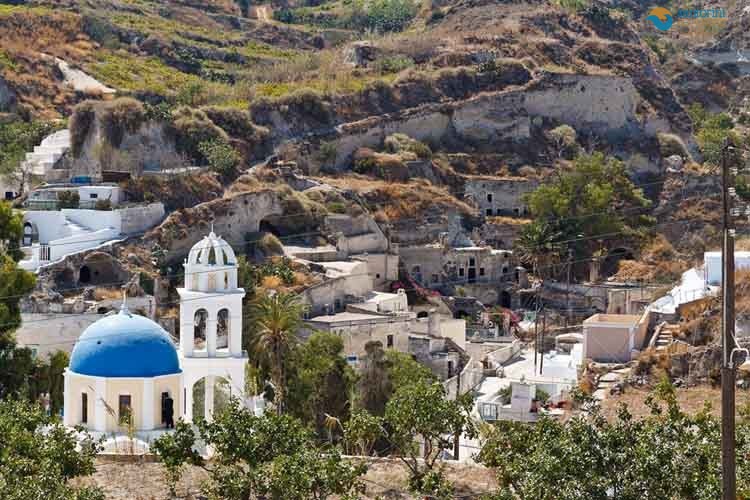
Vothonas Santorini is one of the most interesting villages on Santorini island. It is located at the southeast of Oia of Santorini and is only 6 kilometers far from Fira and it is next to Mesaria. It is an agricultural village where the houses are built over the sides of the cleavage and a part of them is under the earth.
There are only a few people living here and the main sight, except for the unique architecture of the housing development, is the church into the rock, Panagia of Sergina or Panagia of Trypa.
Discover the island with a Santorini Taxi today!
Vothonas private transfers
Vothonas has a lot of interesting things to see so you definitely have to pay a visit to that place. Book now Vothonas private transfers or even better book a Vothonas guided private transfer now. Because you will have the opportunity to learn everything about Santorini by travelling around the island .
History of Vothonas
You can learn about the history of Vothonas by inscriptions of the 18th century. Olivier, a French man who visited Santorini mentioned this place in 1801 and after that a lot of European people visited Santorini and wrote about Vothona.
The church of Panagia Sergena or Panagia Trypa is one of the most beautiful historical churches in Santorini. It is actually built inside the volcano rocks. During the Ottoman Empire people used to find shelter into that church. The name Panagia Trypa (Trypa means hole) came from a hole that used to be the entrance door.
Book A Private Tour Now

Book now and discover our amazing Santorini private tours!
See more about Santorini Private Tours:
- Santorini Sightseeing Private Tour
- Santorini Exclusive Shore Private Tour
- Santorini Impressive Caldera Private Tour
- Santorini Wine and History Private Tour
- Santorini South Part Private Tour
- Santorini North Part Private Tour
- Santorini Private Wine Private Tour
- Santorini Historical Private Tour
- Santorini Sunset Private Tour
- Santorini Sunset & Wine Tasting Private Tour
Vothonas Santorini: The Village in the Ravine
Vothonas Santorini is built into a ravine on the road between Fira and Kamari, about five kilometres from the capital and a few minutes from Mesaria. Most people drive past the top of it without realising there is a village underneath. Book with Santorini Tours, a licensed local operator.
That is the point. The houses of Vothonas Santorini are cut into the walls of the gorge rather than built on top of the ground – whitewashed façades on the rock face, with the rooms running back inside it. From the road above you see chimneys and terraces. From the lane below you see a village.
Vothonas Santorini was built that way for the same reason every old settlement on this island was built inland: pirates. A village invisible from the sea and hidden in a fold of the land is a village nobody bothers to raid. The volcanic ash made it easy – soft enough to dig with hand tools, stable enough to hold a roof, and cool through August without a fan.
Where it is
Five kilometres from Fira, five minutes from Mesaria, ten from Kamari, five from the airport, twenty-five from Oia.
Why go
For the ravine lanes and the cave houses, for the rock-cut church of Panagia Sergena, and for the Koutsoyannopoulos wine museum eight metres underground at the edge of the village.
What to See in Vothonas Santorini
Panagia Sergena, the church in the rock
The landmark of Vothonas Santorini, and one of the strangest churches on Santorini. It is built inside the volcanic rock itself, not against it. Locally it is also called Panagia Trypa – trypa means hole, after the opening that once served as its entrance. During the Ottoman centuries villagers sheltered inside it. A church you enter through a hole in a cliff is not something the caldera villages can offer.
The cave houses
The whole village is yposkafa: rooms excavated horizontally into the ravine walls, with only the front built. Some are restored and lived in, some are used as stores, and some stand open. Walking the lanes of Vothonas Santorini you are walking along the floor of a gorge with houses on both sides of you and above you.
The Koutsoyannopoulos wine museum
At the edge of the village, in a natural cave eight metres below ground and around three hundred metres long. It sets out the history of Santorini winemaking from the seventeenth century with the original presses, tools and cellars, and finishes with a tasting. It is the best wet-weather hour on the island and it is minutes from Fira.
The lanes and terraces
Narrow, stepped, running along the ravine and over it. Twenty minutes covers them. You will not meet a tour group.
The chapels
Several small ones, whitewashed, tucked into the rock at the turns of the lanes.
The vineyards above
The ravine is cut through the middle of Santorini’s wine country. Climb out at either end and the basket-trained vines start immediately.
The History of Vothonas Santorini
Why Vothonas Santorini is here. The ravine is the whole explanation. From the medieval period until the eighteenth century the Aegean was raided continuously, and coastal settlements were indefensible. A village dug into a gorge is invisible from the sea, hard to find on foot and easy to leave quietly.
The rock. Santorini’s pumice and ash can be cut with hand tools and will hold an unsupported vault. That made cave dwellings the cheapest form of housing on the island, and in Vothonas Santorini it made them the only form.
The eighteenth century. Inscriptions in the village date from this period, and it appears in the accounts of European travellers from around 1800 onwards – the French naturalist Olivier among the first – after which a steady stream of visitors wrote about it.
The church. Panagia Sergena served as a refuge as well as a place of worship during the Ottoman centuries, which is a common story on this island and rarely as literal as it is here.
1956. The Amorgos earthquake, magnitude 7.7, damaged buildings across Santorini. Cave dwellings came through comparatively well – there is little structure to collapse when the room is a hole in solid rock – but emigration followed here as everywhere.
Now. A small resident population, some restored houses let to visitors, the wine museum bringing a steady trickle of people to the edge of the village, and lanes that remain almost entirely empty. Vothonas Santorini has not been tidied up for anyone.
Cave Houses: How Vothonas Santorini Was Built
Vothonas Santorini is worth understanding rather than only photographing, because almost nothing about it is decorative.
Yposkafa
The rooms are dug, not built. A face is cut flat in the ravine wall, a doorway is opened, and the room is excavated horizontally back into the rock. Only the façade – the door, the window, the whitewash – is masonry. Everything else is the hillside.
Why it works
The volcanic ash is soft enough to cut with hand tools but binds hard enough to hold a vaulted ceiling without support. It insulates: a cave room in Vothonas Santorini sits around twenty degrees in August and the same in February, with no heating and no air conditioning. And it is earthquake-resistant, because there is no structure to fall down.
The vault
Where rooms were built out rather than dug in, they were barrel-vaulted in volcanic stone and lime. A vault throws its load sideways into the walls instead of spanning across, which on this island is a structural necessity rather than a style.
The cisterns
Under almost every house, catching winter rain off the roof and the terrace. Santorini has no rivers and very little rainfall, and until the desalination plants that tank was the entire water supply of the household.
The whitewash
Lime, which reflects heat and kills bacteria. A public health measure long before it was a photograph.
The terraces
The roof of one house is the terrace of the one above. That is why Vothonas Santorini reads as a jumble from the road and makes perfect sense from inside the ravine.
The Wine Museum at Vothonas Santorini
The Koutsoyannopoulos wine museum sits at the edge of Vothonas Santorini and is the single most visited thing here by a wide margin.
What it is. A museum inside a natural cave, eight metres underground and roughly three hundred metres long, laid out along the length of the tunnel.
What is in it. The history of winemaking on Santorini from the seventeenth century onward, told with original presses, barrels, tools and reconstructed working cellars. The equipment is the real thing, taken out of use rather than made for display.
Why it matters. Santorini’s wine trade is the reason half the villages on this island exist, and this is the only place that sets the whole story out end to end.
The tasting. At the end, in the estate’s own cellars – typically Assyrtiko, Nykteri and Vinsanto.
Practical. Audio guides in many languages, a fixed entry price including tasting, and it is comfortably cool at any hour. If the meltemi is blowing or it is thirty-eight degrees outside, this is where to be.
Getting there. Five minutes from Fira, on the Kamari road at the edge of Vothonas Santorini, with parking.
Our wine tour covers three working estates with all tastings included, and the museum pairs naturally with it.
Getting to Vothonas Santorini
By car. Ten minutes from Fira, five from Mesaria, ten from Kamari, five from the airport, twenty-five from Oia. Park on the road above – nothing drives into the ravine.
By bus. The Fira–Kamari and Fira–Perissa routes pass the village for a couple of euro. Frequent in season.
By taxi. Possible, though the island’s licensed fleet is very small and effectively fully booked in August.
On foot from Fira. About an hour along the road. Flat enough, but it is a road rather than a path.
On a tour. Vothonas Santorini sits between Fira, Mesaria and Kamari, so it slots into almost any itinerary on this side of the island. The full day tour and the wine tour both work this ground.
By transfer. Our private transfers run from the airport and both ports from 40€ per vehicle, with flights and ferries monitored.
Staying here
A handful of restored cave houses are let to visitors, and staying in one is a genuinely different experience from a hotel room. Otherwise Mesaria, Karterados and Kamari are all within ten minutes.
Walking Vothonas Santorini: A Route
Half an hour in Vothonas Santorini, and the whole thing happens below the level of the road.
Park above and find the steps down. They are easy to miss. The village opens up as soon as you are in the ravine.
Follow the floor of the gorge. Houses on both sides, terraces overhead, and the occasional bridge across. Look at the doorways cut straight into the rock face.
Find Panagia Sergena. The rock-cut church, also called Panagia Trypa. Small, dim and unlike anything else you will see on Santorini.
Look up. The best view of Vothonas Santorini is from the middle of the ravine looking at the layers of terraces above you.
Come out at the far end. The vineyards start immediately, basket-trained and at ground level.
Finish at the wine museum. An hour underground at the edge of the village, with a tasting at the end.
Vothonas Compared With the Other Villages
Against Karterados. The closest comparison – another village built into a gorge, five minutes north. Karterados is larger, has more services and is walkable from Fira. Vothonas Santorini is smaller, deeper in its ravine and considerably emptier. More on Karterados.
Against Mesaria. Five minutes away on the plain, flat, larger and full of services. This one has the cave architecture. More on Mesaria.
Against Megalochori and Emporio. Both far bigger, with much more to see and proper tavernas. Vothonas is a twenty-minute stop rather than an afternoon. Megalochori · Emporio.
Against Mesa Gonia. Both are villages most people have never heard of and both reward a stop. Mesa Gonia has the Byzantine church and the earthquake ruins; Vothonas Santorini has the ravine and the rock-cut church. More on Mesa Gonia.
Against Fira and Oia. No comparison and no competition. Those are the caldera; this is a gorge nobody photographs. Fira · Oia.
When to Visit Vothonas Santorini
April and May. The best window for Vothonas Santorini. Capers and wildflowers out of the ravine walls, comfortable walking, and everything open.
June to August. Hot above and noticeably cooler down in the gorge, which is precisely why the village is where it is. The wine museum is cold at any hour.
September. Harvest in the vineyards on either side. The best month here.
October. Quiet, warm, and the light down in the ravine at its softest.
November to March. Very quiet. The wine museum stays open through most of the winter, which makes Vothonas Santorini one of the few places on the island with something to do in February.
Time of day
Late morning or mid-afternoon. The gorge is narrow, so at either end of the day the whole village is in shadow and there is nothing to photograph.
Bad weather
This is the wet-weather stop on Santorini. An hour eight metres underground with a tasting at the end beats anything else on the island when it rains.
Photographing Vothonas Santorini
Looking up from the floor of the Vothonas Santorini ravine. The signature frame – layers of whitewashed terraces stacked above you against a strip of sky.
The cave façades. A blue door set flat into a rock face, with nothing behind it that you can see.
Panagia Sergena. The rock-cut church. Ask before photographing inside and never use flash.
The lanes. Narrow, stepped and empty at any hour, which is not true anywhere on the caldera.
The vines above. Basket-trained and at ground level, starting where the ravine ends.
Technical. The gorge is high contrast – bright rim, dark floor. Expose for the whitewash and let the shadows go, or bracket. Midday is the only time the floor gets direct light.
Courtesy. People live in these houses. The lanes of Vothonas Santorini pass their front doors and the terraces overhead are private.
Frequently Asked Questions About Vothonas Santorini
How do you pronounce it? Roughly “vo-THO-nas”. You will also see Vothon and Vothonas Thiras.
Where is it? In a ravine on the road between Fira and Kamari, about five kilometres from Fira and five minutes from Mesaria.
Why is the village in a gorge? Concealment. Coastal settlements were raided from the sea for centuries, so villages were built inland and out of sight, and the soft volcanic rock made digging into a ravine the cheapest way to build.
What is Panagia Sergena? A church built inside the volcanic rock, also called Panagia Trypa after the hole that served as its entrance. Villagers sheltered in it during the Ottoman period.
Is Vothonas worth visiting? Yes, for half an hour, and longer with the wine museum. It is one of the least changed villages on the island.
What is the wine museum? The Koutsoyannopoulos museum, in a natural cave eight metres underground and three hundred metres long, covering Santorini winemaking from the seventeenth century, with a tasting at the end.
How long do I need? Half an hour for the village, two hours with the museum.
Is there a caldera view? No. The village is inland and below ground level for much of its length.
Can you stay there? A few restored cave houses are let to visitors. Otherwise stay in Mesaria, Karterados or Kamari, all within ten minutes.
Is there a beach? Not in the village. Kamari is ten minutes away.
Is it accessible? Not really. Getting into the ravine means steps, and the lanes are narrow and uneven. The wine museum is far more accessible than the village.
Is it crowded? No. The museum has visitors; the lanes of Vothonas Santorini almost never do.
What is a cave house? A dwelling excavated horizontally into the rock, with only its façade built. Cool in summer, warm in winter, and highly earthquake-resistant.
How do I get there without a car? The Fira–Kamari bus passes the village, or take a tour with pickup included.
Tours That Include Vothonas Santorini
We are a licensed local operator with guides who live on the island year round. Prices are per vehicle rather than per person, pickup is included from anywhere including both ports, and an 80€ deposit confirms the date.
Wine tour – four and a half hours from 650€, three estates with all tastings included, in the vineyards on either side of this ravine.
Full day tour – eight hours from 460€, the whole island with a traditional village stop.
Historical tour – the archaeology and the old churches, including the rock-cut chapels of this side of the island.
Food tour – five hours from 556€, producers and a sit-down meal.
Personalised tour – from 220€, built around the villages and the wine if that is what you want.
Every itinerary and all prices are on the santorini tours page, and our private transfers cover the airport and both ports from 40€.
Is Vothonas Santorini Worth Visiting?
Vothonas Santorini is not a destination in itself – there is no taverna terrace with a view and nothing that takes a whole afternoon. As a twenty-minute stop on the way to somewhere else, it is one of the most rewarding on the island.
You go down a flight of steps off an ordinary road and find a village in a gorge, with houses dug into the walls, terraces stacked above you and a church inside a rock. Nothing has been arranged, signposted or lit for visitors, and almost nobody is there.
Add the wine museum at the edge of the village and you have two hours that explain more about how this island actually worked than a day on the caldera will.
Send us your dates and party size and we will fit Vothonas Santorini into a day that suits you.
Everywhere We Can Reach From Vothonas Santorini
Any of these can be built into a private itinerary. Each has its own page with what to see and how long to allow.
Caldera villages: Fira · Firostefani · Imerovigli · Oia · Finikia · Baxedes
Inland villages: Pyrgos · Megalochori · Emporio · Mesaria · Karterados · Vourvoulos · Exo Gonia · Mesa Gonia · Pigadia
Beaches: Perissa · Perivolos · Kamari · Vlychada · Monolithos · Red Beach · White Beach · Agios Georgios · Agia Paraskevi
Sites and landmarks: Akrotiri · Ancient Thira · Akrotiri Lighthouse · Nea Kameni · Palia Kameni · Thirasia · Athinios Port
All our tours: All Santorini tours · Full day tour · Sightseeing tour · Personalised tour · North part tour · Horse riding · South part tour · Sunset tour · Shore excursion · Caldera tour · Food experience · Wine tour · Historical tour · Small group tour
Planning and services: Famous sights tour · Private transfers · Transfers to Oia and Finikia · Transfers to other villages · Villages of Santorini · History of Santorini · Tours near you · Languages we guide in · Food and fun tours · Gay friendly tours · Our tour buses · Daily tours · Day tours · FAQ · Gallery · Tour photo gallery · About us · Contact · Blog








Leave a Reply