
The idyllic greek islands are best understood as six separate groups rather than one destination: the Cyclades for whitewashed villages and blue water, the Dodecanese for medieval towns, the Ionian for green hills, the Sporades and Saronic for easy access from the mainland, and Crete for everything at once. For a first trip, two islands in a week beats four, and Santorini plus Naxos is the pairing that works most often.
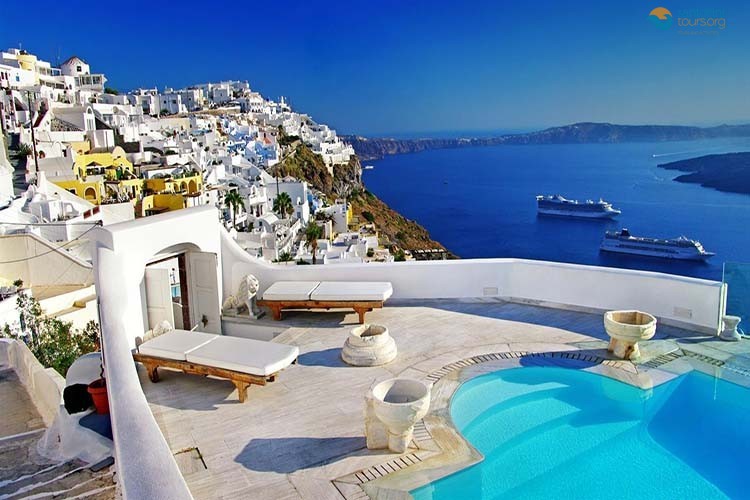
Idyllic isles of Greece
The maritime country of Greece has more than 6,000 islands and islets scattered throughout the Aegean Sea and the Ionian Sea, of which only 227 islands are inhabited – indeed a unique phenomenon for the European continent.
Two of idyllic isles of Greece these remarkable islands provided unforgettable memories as we traveled through the archipelago that for many travelers like us, captures the very essence of the isles of Greece.
Santorini
The archetype of the idyllic Greek island must be Santorini. A Greek friend once told me that Santorini is enchanting. It makes people fall in love again. Being romantic, this comment alone was enough to show my interest.
The island’s official name is Thira. The island of Santorini can actually be the home of the lost city of Atlantis, the legendary capital of a prosperous, advanced culture of Plato, described as a paradise that disappeared without a trace, sunk into the sea by its anger Gods. Whether the myth is true or not, it is a fact that Santorini is widely regarded as one of the most beautiful, idyllic islands in the world.
There are few travel destinations that combine beautiful beaches, spectacular landscapes, ancient cities, amazing restaurants, some of the best wines in the world and an active volcano. And even less they can completely conquer the imagination, even before they put a foot on its mystical ground.
At the Lithos Restaurant, we were correctly introduced into an authentic Greek salad, a delicious lettuce dish consisting entirely of fresh, bold pieces of tomato, feta and, of course, crisp Greek olives.
The village of Oia is located on an impressive rock, with stunning views of the volcano, the Old and the nearby island of Thirasia. The beautiful dazzling white houses, narrow streets, blue vaulted churches and sunlit terraces offer only postcard views – but no card was as beautiful as the stunning view we liked and stamped forever in memory.
You can Find more about Santorini Tourshere.
Thirasia
Thirasia or Thirasia is a small island in the Aegean Sea and belongs to the Cyclades. Until the Minoan eruption of the prehistoric times that created the caldera, it was part of the Stroggylis Island, which now completes the circular outline along with the islands of Thira and Aspronisi, which belong to the same island complex. Thirassia was separated from Strongyli during the catastrophic eruption of the volcano in 1600 BC.
It is located west of Santorini and is about a mile from Ammoudi of Oia. It has an area of 9,246 km2. And a population of 319 inhabitants at the 2011 census. According to the Kallikratis Program, it is administratively owned by the Municipality of Thira. The capital of the island is Manolaz and Port of Riva.
Anafi
Anafi is a Cycladic island in the Aegean Sea. It is located east of Santorini with which it is the southeastern islands of the Cyclades, and is 150 miles from Piraeus. The capital of the island is Anafi, the seat of the homonymous community that has been designated a traditional settlement and is located in the southern part of the island. The port and main port of the island is Agios Nikolaos.
Mykonos
One of the favorite destinations of the Greek island and one of the favorites with cruise ships, with Mykonos island.
The windmills, built by the Venetians in the 16th century, though these are no longer functional, are a living testimony of the use of innovation from the island when the huge wind power was used to grind the grain. The windmills are open to the public and two are now part of a museum.
The western part of the city meets the sea in Alefanta or Little Venice, an 18th-century seaboard housing estate, which climbs to the edge of the sea with colorful windows and balconies overlooking the blue water.
Wooden balconies hang from white cubic houses, outdoor stairs are covered with geranium pots, and oleanders and hibiscus smell the air. The lack of motorized traffic in this area makes the experience even better as we follow the paved stone surfaces engraved with whitewashed wallpapers, passing through the expensive boutiques leading from the square to the old quarter of the city.
Find more about Mykonos hotels here.
See more about Santorini and how to explore Santorini:
Idyllic Greek Islands: The Short Answer
There are around two hundred inhabited Greek islands and perhaps fifteen that most travellers should actually consider. The idyllic greek islands people picture — whitewashed cubes, blue domes, a windmill on a headland — are the Cyclades, and Santorini is the most extreme of them because it is a flooded volcano rather than a hill in the sea.
Pick by what you want rather than by the photograph. Santorini for landscape and wine, Naxos for beaches and family, Milos for geology, Paros for balance, Folegandros for quiet, Crete for a country rather than an island, Rhodes and Corfu for history and green.
Two islands in a week, three at the very most. The ferries take longer than the map suggests and the meltemi cancels the fast ones.
The Idyllic Greek Islands by Group
The Cyclades. The postcard: whitewash, bare rock, blue sea, strong wind. Santorini, Mykonos, Naxos, Paros, Milos, Ios, Folegandros, Sifnos, Amorgos. The idyllic greek islands of everybody’s imagination.
The Dodecanese. Off the Turkish coast, greener, with medieval and Ottoman layers. Rhodes, Kos, Symi, Patmos, Karpathos.
The Ionian. West of the mainland, lush, Venetian, wetter. Corfu, Kefalonia, Zakynthos, Lefkada, Paxos.
Crete. Effectively its own country: mountains, gorges, cities, four thousand years of continuous history and a food culture of its own.
The Sporades. Green, wooded, north Aegean. Skiathos, Skopelos, Alonissos.
The North Aegean. Large, agricultural and little visited. Lesbos, Chios, Samos, Ikaria.
The Saronic. An hour from Athens: Hydra, Aegina, Spetses, Poros. The easiest weekend islands in Greece.
Santorini
What it is. The rim of a volcano that blew its centre out around 1600 BC, with villages strung along a three-hundred-metre cliff above a flooded crater.
Why it tops every list. No other island in Greece has that geology, and no photograph of the Cyclades is more recognisable than the caldera at sunset.
The beaches. Black, red and white volcanic sand on the south and east coasts. Dramatic rather than soft.
The wine. Assyrtiko from ungrafted vines woven into baskets on volcanic ash, and Vinsanto. Among the most distinctive whites in Europe.
The archaeology. Akrotiri, a Bronze Age town buried by the eruption and excavated under a roof.
The catch. Crowds and prices at the top of the Greek range in July and August.
Best for. Couples, honeymoons, geology, wine, and anybody who wants the single most spectacular landscape of the idyllic greek islands.
The Cyclades Beyond Santorini
Naxos
What it is. The largest of the Cyclades and the most self-sufficient: a mountainous interior with real villages, a fertile plain, and the longest sandy beaches in the group.
The beaches. Agios Prokopios, Plaka, Mikri Vigla — kilometres of shallow white sand, which Santorini does not have and cannot have.
The interior. Halki, Apeiranthos and Filoti, marble villages on the slopes of Mount Zas, and Byzantine churches nobody visits.
The Portara. An unfinished sixth-century BC temple doorway on an islet by the port, and the best sunset in the Cyclades after Santorini’s.
Prices. Well below Santorini and Mykonos for the same standard of room.
Best for. Families, longer stays, walkers, and anybody who wants the idyllic greek islands without the price tag.
Getting there. Two hours from Santorini by fast ferry, an hour from Mykonos.
Paros, the Hub of the Idyllic Greek Islands
What it is. The balanced Cycladic island: pretty enough for the postcards, big enough to have a life of its own, and a natural hub for ferries.
Naoussa. A fishing harbour turned into the most attractive small town in the group, with a Venetian ruin in the water.
Parikia. The port town, with the Panagia Ekatontapyliani — one of the oldest continuously used churches in Christendom.
The beaches. Golden Beach and New Golden Beach for wind sports, Kolymbithres for the sculpted granite, Santa Maria for the sand.
Antiparos. Ten minutes away by ferry, smaller, quieter, with a cave you climb into.
Best for. A first Cycladic island, a family that wants variety, and anybody island-hopping who needs connections.
The catch. Increasingly popular, and August prices are climbing towards Mykonos levels.
Milos, the Strangest of the Idyllic Greek Islands
What it is. A volcanic island like Santorini and geologically stranger, with more than seventy beaches and coastline that looks synthetic.
Sarakiniko. White volcanic rock eroded into smooth lunar forms above turquoise water. The most photographed non-village landscape in Greece.
Kleftiko. Sea caves and stacks reachable only by boat, and the best day out on the island.
Plaka and the fishing villages. Klima and Mandrakia, with syrmata — boat garages painted in primary colours at the water’s edge.
The Venus de Milo. Found here in 1820 and now in the Louvre, which the islanders mention regularly.
Best for. Photographers, boat trips, and travellers who found Santorini too busy.
The catch. You need a car, and the good beaches are spread around the whole island.
Folegandros and Sifnos
Folegandros. A cliff, a village on top of it and almost nothing else. Chora is arguably the most beautiful village in the Cyclades and the island has perhaps eight hundred residents.
The Panagia church. A zigzag path up from Chora to a white church on the summit, walked at sunset by everybody on the island.
Sifnos. The food island: a tradition of pottery and slow-cooked chickpeas, three hundred and sixty churches, and a network of restored walking paths.
Kastro on Sifnos. A medieval settlement built as a ring of houses on a headland, still inhabited.
The walking. Sifnos has the best-marked trail network in the Cyclades, and it is genuinely why people return.
Best for. Second or third trips to Greece, walkers, and anybody who wants the idyllic greek islands without other visitors in the frame.
The catch. Fewer connections and smaller ferries, which the meltemi affects more.
Mykonos, Ios and Amorgos
These three are the loudest, the youngest and the quietest of the idyllic greek islands respectively, and they sit within an hour of each other.
Mykonos. The most expensive island in Greece and the one with the strongest nightlife and beach-club scene. Little Venice, the windmills and a genuinely beautiful town underneath the commerce.
Who it suits. Anybody who came for that scene, and nobody who did not. It is the least representative of the idyllic greek islands and the most photographed after Santorini.
Delos. Thirty minutes from Mykonos by boat: an entire uninhabited ancient city, sacred to Apollo, and one of the great archaeological sites of the Mediterranean.
Ios. A young island with one enormous sandy bay at Mylopotas, a hilltop chora with windmills, and a reputation for nightlife concentrated in about four streets.
Ios by day. Empty beaches, a good walking network and a village that is quiet until ten at night. Far gentler than its reputation.
Amorgos. Long, thin and mountainous, with the Hozoviotissa monastery built into a vertical cliff three hundred metres above the sea.
Who Amorgos suits. Walkers, divers and anybody who saw The Big Blue. It is a long way from everywhere and that is the point.
Crete, the Largest of the Idyllic Greek Islands
What it is. Not really an island holiday. Two hundred and sixty kilometres long, with mountains over two thousand metres, four cities and a population of six hundred thousand.
Knossos and Phaistos. The Minoan palaces — the civilisation whose outpost at Akrotiri on Santorini was buried by the eruption.
The Samaria Gorge. Sixteen kilometres downhill through a national park, and the best-known day walk in Greece.
The beaches. Elafonissi and Balos in the west, pink sand and lagoons, both spectacular and both crowded in season.
The food. The strongest regional cuisine in Greece, and the reason a lot of people go back.
Best for. Two weeks rather than three days, road trips, walkers, and anybody who wants history at scale.
From Santorini. Two hours by fast ferry to Heraklion, which makes it the easiest large island to add.
Rhodes, Corfu and the Green Islands
Rhodes. A walled medieval city that is still lived in, Lindos on its acropolis, and long beaches on both coasts. The Dodecanese at its most historic.
Symi. An hour from Rhodes: a harbour of neoclassical mansions in ochre and pink stacked around a bay, and one of the loveliest arrivals in Greece.
Patmos. Where Revelation was written, with a fortified monastery above a white chora and a quiet, serious atmosphere quite unlike the Cyclades.
Corfu. Green, Venetian, Ionian: an old town of arcades and shutters, olive groves, and a wetter climate that keeps it lush.
Kefalonia and Zakynthos. Myrtos and Navagio, two of the most photographed beaches in the country, and mountains behind them.
Paxos. Small, olive-covered and Italianate, with three harbours and no airport.
Why they differ. These are not the whitewashed idyllic greek islands of the Cyclades; they are greener, older in a different way, and better for anybody who finds bare rock austere.
Choosing by What You Actually Want
The landscape. Santorini first, Milos second, Amorgos third. Nothing else in Greece looks like a flooded volcano.
Sandy beaches. Naxos, Paros, Crete, Rhodes. The Cycladic volcanic islands have dramatic beaches rather than soft ones.
Families. Naxos above all, then Paros, Kefalonia and the flatter parts of Crete.
Couples. Santorini, Folegandros, Symi, Hydra.
Walking. Sifnos, Amorgos, Crete, Andros, Tinos. Marked trail networks and real gradients.
Food. Crete, Sifnos, Naxos, Lesbos.
Wine. Santorini by a distance, then Crete, Paros and Limnos.
Archaeology. Crete, Delos from Mykonos, Rhodes, and Akrotiri on Santorini.
Nightlife. Mykonos, Ios, parts of Crete and Rhodes.
Quiet. Folegandros, Sifnos, Kythnos, Ikaria, Karpathos, almost anywhere in the North Aegean.
How Island Hopping Actually Works
The map lies about distances. Islands that look adjacent are frequently on different ferry routes, and the connection that appears obvious may run twice a week or not at all outside July and August. Route planning in Greece follows the ferry companies’ lines rather than geography, and the practical unit is the group: hopping within the Cyclades is easy, hopping from the Cyclades to the Dodecanese is a day of travel or a flight through Athens.
There are two kinds of boat. Conventional ferries are large, slow, cheap and stable — four to eight hours between the Cyclades, and they sail in weather that stops everything else. Fast catamarans halve the time, cost roughly double, and are the first to cancel in a meltemi. In July and August book both in advance; in the shoulder season you can usually buy on the day.
The rule that matters most: never plan a ferry on the day you fly home. A cancelled sailing in a hard northerly is a normal event in August, and the airport at the other end will not wait. Put a night in Athens or on the departure island between the last hop and the flight.
And do less than you think. Two islands in a week is comfortable, three is a lot of packing, and four is a travel itinerary rather than a holiday. Every hop costs half a day once you count checkout, port time, crossing and finding the next room, which is time not spent on any of the idyllic greek islands you came to see.
Pairings of the Idyllic Greek Islands That Work From Santorini
Santorini and Naxos. The best pairing available: volcano and mountains, cliff and sand, expensive and reasonable. Two hours apart.
Santorini and Paros. Similar logic with better ferry connections onward, and a livelier town.
Santorini and Milos. Two volcanic islands, two entirely different results. For anybody interested in landscape.
Santorini and Ios. Forty minutes, and the cheapest way to add a beach island to a caldera week.
Santorini and Folegandros. Under an hour, and the quietest contrast to the busiest island.
Santorini and Crete. Two hours to Heraklion, and a second week rather than a second stop.
Santorini and Athens. Forty-five minutes by air, and the museum that holds the frescoes excavated at Akrotiri.
The Quieter Idyllic Greek Islands
Tinos, Andros and Syros
Tinos. The pilgrimage island: the church of Panagia Evangelistria draws Greeks from everywhere on 15 August, and the rest of the year it is one of the quietest and most interesting of the idyllic greek islands.
What Tinos has. Forty villages, a marble-carving tradition that produced most of Greece’s sculptors, hundreds of ornate dovecotes across the hillsides, and a food scene now rated among the best in the Cyclades.
Andros. Green by Cycladic standards, with running water, walking trails restored to a professional standard, and two good museums in a handsome neoclassical town.
Who Andros suits. Walkers and Athenians. It is an hour and a half from Rafina and almost unknown internationally.
Syros. The administrative capital of the Cyclades and a real working town: Ermoupoli, built in the nineteenth century on shipping money, with a marble square, an opera house and neoclassical mansions.
Why Syros is different. It is not a resort. It has a year-round population, a Catholic quarter on one hill and an Orthodox one on the other, and it functions in February exactly as it does in July.
Best idyllic greek islands for. Second and third trips, architecture, food, and travellers who want the Cyclades without a single blue dome in the frame.
Hydra, Aegina and the Saronic
These are the idyllic greek islands you can reach without a flight, and they are the reason a spare weekend in Athens does not have to be spent in Athens.
Hydra. No cars at all — none, anywhere on the island. Goods move by mule and everything else is walked. A stone harbour of captains’ mansions in a natural amphitheatre, ninety minutes from Athens.
Why it matters. Hydra is the easiest demonstration of what a Greek island town is like without traffic, and it is a day trip from Athens rather than a journey.
Aegina. Forty minutes from Piraeus, with the Temple of Aphaia — one of the best-preserved Doric temples in Greece — and pistachio orchards.
Spetses. Wooded, wealthy, largely car-free in the centre, with horse carriages and a maritime museum.
Poros. A narrow channel from the mainland, a clock tower, lemon groves opposite, and the shortest crossing of any island in Greece.
Best for. Anybody with two or three spare days in Athens who wants an island without a flight or a long ferry.
The catch. They are the closest of the idyllic greek islands to a city of four million, and they are busy at weekends.
The North Aegean and the Idyllic Greek Islands Nobody Books
Lesbos. The third-largest Greek island, with an ouzo industry, a petrified forest, and olive groves that run for kilometres. Almost no international tourism.
Chios. The only place in the world where mastic is produced, in medieval villages built as fortified grids in the south of the island.
Samos. Green, mountainous, with wine, a UNESCO-listed ancient tunnel and the birthplace of Pythagoras.
Ikaria. Famous for longevity and for a genuinely different pace: village festivals that start at midnight and shops that open when they feel like it.
Limnos. Flat, agricultural, with sand dunes and empty beaches, and one of the least-visited islands of its size in Greece.
Karpathos. Between Crete and Rhodes, with Olympos — a mountain village where traditional dress is still worn — and serious wind for kitesurfers.
Who these suit. Anybody on a fourth or fifth trip to Greece who has done the Cyclades and wants the idyllic greek islands without a single other visitor in the photograph.
When to Visit the Idyllic Greek Islands
Season matters more than island choice on the idyllic greek islands, and the difference between August and September is larger than the difference between any two islands.
April and May. Green, cool, wild flowers, everything opening, and prices at their lowest. The sea is cold. The best months for walking any of the idyllic greek islands.
June. Warm sea, long days, the crowd not yet arrived. Arguably the best all-round month.
July and August. Hot, full and windy, with the meltemi at its strongest. Book everything in advance and invert the day.
September. The warmest sea of the year, the harvest, and the crowd thinning from the second week. The other best month.
October. Quiet, still warm to mid-month, with the season winding down and ferries reducing at the end.
November to March. Most islands largely close. The exceptions are Crete, Rhodes, Corfu and the Saronic islands, which have year-round populations and functioning towns.
Greek Easter on the idyllic greek islands. Movable, usually April, and the most interesting week of the year on any island with a village in it.
The Meltemi and What It Means for Planning
The single climatic fact that shapes a Cycladic summer is a strong northerly wind that blows for two to four days at a time through July and August, and understanding it changes how you plan.
What it does: cancels fast ferries and small boats, closes water sports on exposed beaches, blows sand and hats around, and occasionally diverts flights. What it also does, and nobody mentions: drops the perceived temperature by several degrees and makes an otherwise unbearable August afternoon pleasant.
How to plan around it. Choose accommodation on the sheltered side of whichever island you are on — on Santorini that means the south coast, on Naxos the south-west, on Paros the east. Book boat trips for early in your stay so a cancellation can be moved. Take the conventional ferry rather than the catamaran if the forecast is bad, because it sails when the fast boat does not. And never schedule a crossing on the day of your flight.
The wind is also the reason the idyllic greek islands look the way they do. Vines grown in baskets on the ground, villages built as tight defensive rings, windmills on every ridge, and low whitewashed cubes with tiny windows are all responses to it, on every island in the group.
What the Photographs Do Not Show
Seven things about the idyllic greek islands that no photograph has ever communicated, all of which are easy to plan around once known.
Steps. Cycladic villages are staircases. Buggies, wheeled luggage and heels do not work in any of them.
Water. Tap water is not for drinking on most islands, and several depend on desalination or tankers.
Distance. The islands are small and the roads are not fast. Twenty kilometres can be forty minutes.
Transport. Taxis are scarce almost everywhere, buses are hub-and-spoke, and August rental cars book out weeks ahead.
Shade. There is almost none in the Cyclades. The green islands are the Ionian and the Sporades.
Seasonality. A large share of businesses on the smaller idyllic greek islands close entirely from November to March.
The crowd. Concentrated by hour and place rather than constant, which is precisely what makes it avoidable.
Sample Itineraries Across the Idyllic Greek Islands
Every itinerary below assumes two islands rather than four, because the idyllic greek islands reward staying still more than they reward moving.
One week, first trip. Four nights Santorini, three nights Naxos. Volcano, Akrotiri, a winery and a sunset on one; beaches, mountain villages and the Portara on the other. Two hours between them.
One week, second trip. Four nights Milos, three nights Folegandros or Sifnos. Landscape and quiet, almost no crowds, and the version of the idyllic greek islands that people describe when they say they want the real thing.
Ten days with children. Five nights Naxos, four nights Paros, one night Athens before the flight. Sand, shallow water, short crossings and a city day at the end.
Ten days, honeymoon. Four nights Santorini, three nights Folegandros, three nights Milos. Spectacle, then silence, then landscape.
Two weeks, one island. Crete, west to east or east to west by car. Knossos, a gorge, four cities and a different beach every day.
Long weekend from Athens. Hydra or Aegina, no flight required, and a genuine island for three days.
Off-season idyllic greek islands. Crete, Rhodes or Corfu, all of which have year-round towns and full winter populations.
Budgeting a Trip to the Idyllic Greek Islands
Costs vary more between islands than between seasons, and the gap is wider than most people expect. Santorini and Mykonos operate at roughly double the price of Naxos, Paros or Milos for the same standard of accommodation, and three times the price of the North Aegean.
The figures below are what the idyllic greek islands actually cost in 2026, in euros, for two people travelling comfortably rather than cheaply.
Accommodation. 90 to 180 euros a night for a good double in the mid-range Cyclades in June or September; 150 to 400 on Santorini and Mykonos in the same months; 300 to 900 for a caldera-view suite in August.
Food. 25 to 45 a head for a proper dinner with wine at a local taverna anywhere in the country. A view doubles it. A caldera view triples it.
Ferries. 30 to 60 euros a person for a fast catamaran between Cycladic islands, 20 to 40 for a conventional ferry, and eight to nine hours from Piraeus for the cheapest crossings.
Car hire. 35 to 60 a day in season on the larger islands, and worth it on Naxos, Milos and Crete.
Activities. A shared boat trip 100 to 200, an archaeological site 12 to 20, a wine tasting 20 to 45.
The realistic figure. Two people, one week, two mid-range islands, eating well and doing a boat trip on each: 1,800 to 2,600 euros excluding flights.
The saving that works on the idyllic greek islands. Travel in June or September rather than August, and stay inland rather than on a cliff. Those two decisions together cut a Cycladic week roughly in half.
Mistakes First-Time Visitors to the Idyllic Greek Islands Make
Nearly every one of these is made by somebody who has read a lot about the idyllic greek islands and not yet stood on one.
Too many islands. Four in ten days is a packing schedule. Two is a holiday.
A ferry on the flight day. The single most expensive mistake available in the Aegean in August.
Assuming the map. Adjacent islands are frequently on different routes and may have no direct connection at all.
Booking August by default. June and September are better in every respect except school terms.
Wheeled luggage in a stepped village. Every one of the idyllic greek islands has staircases where a suitcase has to be carried.
Expecting Mykonos everywhere. Most islands are quiet, agricultural and asleep by midnight.
Expecting Santorini’s sunset alone. Every island in the Cyclades faces west somewhere, and most of them have nobody standing on that spot.
Beaches of the Idyllic Greek Islands, Compared Honestly
Beaches are the reason most people come and the thing most often misjudged, because the idyllic greek islands do not all have the same kind of coast and the differences are geological rather than a matter of quality.
There are four broad coastal types across the idyllic greek islands, and knowing which one you are booking matters more than any beach ranking.
Volcanic islands. Santorini, Milos, Nisyros. Black, red and white sand, dramatic cliffs, deep water close in, and shores that shelve steeply. Spectacular to look at, less comfortable to lie on, and hot underfoot by mid-morning.
Granite and marble islands. Naxos, Paros, Ios, Mykonos. Pale sand, shallow entries, long shallow bays. These are the islands to choose if what you actually want is a beach holiday.
Limestone islands. Kefalonia, Zakynthos, Crete’s west. White pebbles, impossibly blue water and steep drops. Myrtos and Navagio are the famous examples and both are viewpoints as much as beaches.
Organised against wild beaches. Almost every island has both. An organised beach means sunbeds at 15 to 30 euros a pair, a bar and often a lifeguard; a wild one means bring water, shade and everything else.
The wind factor. Every island has a sheltered side, and in July and August it matters more than the sand. On Santorini that is the south, on Naxos the south-west, on Paros the east.
Blue Flag beaches. Greece has over five hundred, the second highest count in the world, and the designation covers water quality and facilities rather than beauty.
The rule. If sand matters to you, go to Naxos or Paros and take Santorini as the spectacle rather than the swim.
Food Across the Idyllic Greek Islands
Greek island food is regional to a degree that surprises people, and the differences between islands are the most rewarding part of hopping between them.
Santorini grows what a rock without rain can support: fava, the yellow split-pea purée; white aubergine; capers off the cliffs; the small dense tomato; and chloro, a fresh sharp goat’s cheese. The wines are bone-dry assyrtiko and sweet Vinsanto, both from ungrafted vines trained into baskets on the ground.
Naxos, with water and pasture, produces the opposite: graviera cheese, potatoes with a protected designation, citrus, and kitro, a liqueur made from citron leaves. Sifnos built a reputation on slow-cooked chickpeas and lamb baked overnight in clay, and on the pottery those dishes are cooked in. Crete has an entire cuisine of its own — wild greens, snails, rusks, cheeses and olive oil in quantities that startle visitors. Chios has mastic, produced nowhere else on earth. Lesbos has ouzo and sardines. Tinos, unexpectedly, has become one of the best places to eat in the country.
The practical advice is the same everywhere in the idyllic greek islands: eat inland rather than on the waterfront, ask what is on rather than reading the menu, order two or three dishes to share rather than a plate each, and eat at nine rather than seven. The food improves with every step away from a view.
Getting Between the Islands in Practice
Movement between the idyllic greek islands is by ferry far more often than by plane, and the networks are separate rather than continuous.
The Cyclades from Athens. Piraeus for everything, Rafina for Andros, Tinos, Mykonos and the northern route. Rafina is closer to the airport.
Within the Cyclades. Frequent connections in season along the main lines, thinning sharply in the west and the small islands.
The Dodecanese. A separate network based on Rhodes and Kos, reachable from the Cyclades by a long crossing or a flight through Athens.
The Ionian. Not connected to the Aegean at all in practice. Fly or drive to the west coast of the mainland.
Crete. Two hours from Santorini by fast ferry, or an overnight from Piraeus, or a flight from anywhere.
Domestic flights. Athens connects to about twenty islands, and inter-island flights are rare outside a few routes.
The booking rule for the idyllic greek islands. July and August need tickets in advance; the shoulder season rarely does; and no crossing should ever be booked for the day of an international flight.
Idyllic Greek Islands: Choosing Between the Big Five
Most trips come down to a choice between five islands, and the honest comparison below is the one we give visitors who ask which of the idyllic greek islands they should book first.
Santorini against Mykonos. The two most famous. Santorini is landscape, archaeology and wine, with a caldera that has no equivalent anywhere in the Mediterranean; Mykonos is nightlife, beach clubs and a beautiful town. Both are expensive. Santorini rewards early mornings, Mykonos rewards late nights, and among the idyllic greek islands they are the two that most reliably divide opinion.
Santorini against Naxos. Spectacle against comfort. Santorini has the view; Naxos has the sand, the food, the mountains and half the price. Couples who want one photograph take Santorini. Families who want a fortnight take Naxos.
Naxos against Paros. Naxos is bigger, greener and better for beaches and villages; Paros has the better town in Naoussa and the better nightlife. They are forty minutes apart and pair perfectly.
Milos against everything. Milos wins on landscape and loses on convenience. Sarakiniko and Kleftiko are the two most distinctive coastal sights in the Cyclades, and the island needs a car and a boat day to work at all.
Crete against the Cyclades. Crete is a country. It has cities, mountains, gorges, four thousand years of continuous history and a year-round population. Choose it if you want variety and a car; choose the Cyclades if you want the idyllic greek islands of the postcard.
The short answer for the idyllic greek islands. First trip, Santorini plus Naxos. Second trip, Milos plus Sifnos. Third trip, Crete or the Dodecanese.
Accessibility, Families and Slower Travel
The romantic image of a cliff village is also a warning, and the practical reality of the idyllic greek islands varies enormously depending on who is travelling.
Wheelchairs and limited mobility. Difficult in the old villages, which are stepped by design, and manageable in the flat modern towns. Naxos town’s waterfront, Paros’s Parikia, Crete’s Chania promenade and Rhodes New Town are all workable. Oia and Fira are not, and Santorini’s caldera path is a staircase. Several beaches now have Seatrac ramps, including on Crete, Rhodes and Kos.
Small children. Naxos and Paros, for the shallow water and the flat towns. Avoid cliff-edge accommodation entirely. Buggies do not work in a Cycladic village and a carrier does.
Teenagers. Ios, Paros, Mykonos or Crete, where there is something to do after dark that does not involve a view.
Older travellers. Crete, Rhodes and Corfu, where the towns are flat, the roads are good and there is a hospital.
Solo travellers. Naxos, Paros and Ios have the easiest social scenes; the smaller islands are quiet in the best and worst senses.
Long stays on the idyllic greek islands. Syros, Tinos and the North Aegean, which have year-round populations, real supermarkets and normal prices.
What a Week Actually Feels Like
A description of the rhythm is more useful than a list, because the pace is the point of the idyllic greek islands and it takes about two days to adjust to it.
The first morning is the shock: it is already hot at nine, the light is harder than you expected, and the sea is a colour you assumed was edited. By the second day you have worked out the shape of the day — swim early, eat at two, sleep or read through the flat white heat of the afternoon, walk at six when the shadows return, eat again at nine, and stay out until midnight because it is finally comfortable.
Around day three the island stops being a set of sights and becomes a place. You have a bakery. The taverna owner knows what you drink. You have stopped photographing every doorway. This is the point most people are actually chasing when they book, and it is the reason two islands in a week beats four.
The last morning is the other constant: everyone swims before the ferry, nobody wants to leave, and half of the people on the boat are already planning the return. That is as accurate a description of a week in the idyllic greek islands as anything else that can be written down.
Islands by What You Photograph
If the trip is being planned around photographs, these are the specific idyllic greek islands that produce each of the images people have in mind.
The caldera. Santorini. There is no substitute and no rival; the drowned volcano is unique in the Mediterranean.
White rock. Milos, at Sarakiniko, which looks like a moonscape and photographs unlike anywhere else in the idyllic greek islands.
The classic windmill line. Mykonos, and Santorini above Oia.
A perfect harbour. Hydra and Symi, both amphitheatres of mansions around a bay.
Turquoise water. Zakynthos and Kefalonia in the Ionian, where the limestone makes the colour.
Medieval streets. Rhodes Old Town, the largest inhabited medieval town in Europe.
Mountain villages. Naxos, in the Tragea and at Apiranthos.
Empty. Folegandros, Sifnos, Amorgos and anything in the North Aegean.
How Santorini Fits Into the Rest
Almost every itinerary through the idyllic greek islands touches Santorini, because it is the transport hub of the southern Cyclades as well as the headline sight. Two hours to Crete, two to Naxos, three to Mykonos, and a direct European flight in summer.
What that means in practice is that Santorini is usually the first or the last island of a trip, and both work. First is better if you want the spectacle while you are still fresh and the ferry timetable is still open to you. Last is better if you want to end on the view and fly home directly rather than backtracking through Athens.
Three days is the honest minimum. That covers the caldera villages at sunrise and sunset, the excavation at Akrotiri, a winery in the late afternoon, one black-sand beach and a boat to the volcano. Four or five days lets you add the south, the Venetian castles at Emporio and Pyrgos, and a day with nothing scheduled.
The single change that improves a Santorini stay more than any other is inverting the clock. Oia at eight in the morning is empty and gold; Oia at seven in the evening holds several thousand people. Akrotiri at opening is silent. The wineries are best at five. Nothing about the island needs to be crowded, and among the idyllic greek islands it is the one where the hour of the day matters most.
The Islands Are Not Interchangeable
The most common mistake in planning is treating the archipelago as one destination with different accommodation options. It is not. Six thousand islands across four distinct seas produced six thousand different answers to the same problems, and the differences between them are geological, historical and linguistic as much as visual.
The Cyclades were Venetian, then Ottoman on paper and Catholic in places, and they are dry, treeless and built in white cubes. The Dodecanese were Ottoman until 1912 and Italian until 1947, which is why Rhodes has an Italian quarter and Kos has fascist-era civic architecture. The Ionian was never Ottoman at all — it was Venetian, then French, then British until 1864 — so it has cricket, ginger beer, campaniles and pitched tile roofs. The North Aegean sat on the Anatolian trade routes and looks it.
That history is the reason a week on Corfu and a week on Naxos are genuinely different holidays rather than the same holiday in two locations, and it is the best argument for choosing carefully among the idyllic greek islands rather than booking whatever is cheapest in the month you are free.
A Short History of the Idyllic Greek Islands
Everything a visitor notices on the idyllic greek islands — the shape of the villages, the language of the churches, the food, the names on the map — comes out of a specific sequence of events, and a paragraph on each makes the archipelago far more legible.
The Cycladic period. From around 3200 BC, a Bronze Age culture across the central islands produced the flat marble figurines now in every museum in Greece. They are four and a half thousand years old and look modern, which is why they are the single most reproduced object in the country.
The Minoans and the eruption. Crete built Europe’s first palace civilisation. Around 1600 BC the volcano at Santorini erupted with a force that buried the town at Akrotiri under metres of ash and preserved it — frescoes, staircases, drainage and all. The eruption removed the centre of the island and created the caldera that makes Santorini the most recognisable of the idyllic greek islands.
Classical and Hellenistic. Delos, a tiny island beside Mykonos, became the sacred centre of the Aegean and later one of the great slave markets of the Mediterranean. It is now uninhabited and open as a site.
Byzantine and Venetian. After 1204 the Venetians took the Cyclades and ran them as the Duchy of Naxos for three centuries. The kastelia, the Catholic minorities on Syros and Tinos, and the castle towns on Naxos, Sifnos and Santorini all date from then.
Ottoman and the pirates. Four centuries in which the sea was dangerous, which is why the old villages of the idyllic greek islands sit inland, uphill and out of sight of the water.
Independence and after. The idyllic greek islands did not all join the country at once. They joined the Greek state at different dates — the Cyclades in 1832, the Ionian in 1864, Crete in 1913, the Dodecanese only in 1947 — and each of those dates left a visible mark.
Emigration and return. Through the twentieth century the small islands emptied towards Athens, America and Australia. Tourism from the 1970s onwards reversed it, and the population of many of the idyllic greek islands is higher now than it was in 1970.
What Locals Wish Visitors Knew
None of this is enforced and all of it is noticed, and it is the fastest way to be treated as a guest rather than a tourist on any of the idyllic greek islands.
Say kalimera. Greeting people when you enter a shop or a taverna changes the whole interaction, everywhere in the country.
Nobody is rushing you. The bill does not come until you ask, because sending it is a hint to leave.
Order fewer dishes than you think. Portions are large and sharing is the norm.
Paper goes in the bin. Island plumbing is narrow and old, and this is not negotiable anywhere in the idyllic greek islands.
Churches want covered shoulders. Monasteries in particular, and several keep wraps at the door.
Do not swim off the ferry quay. It looks fine and it is not.
The afternoon is real. Between two and five, keep the noise down in a residential street.
Tipping is light. Rounding up, or five to ten per cent for good service. Nobody expects twenty.
Take the rubbish off the beach. Including the wild ones, where there is no collection at all.
Learn two more words. Efharisto and parakalo carry an extraordinary amount of goodwill across all of the idyllic greek islands.
Why the Cyclades Look Like That
The whitewashed cube village is not a design choice and it is not ancient either, and knowing why it exists changes how you look at every one of the idyllic greek islands.
Start with the material. These islands are rock — granite, marble, schist, and on Santorini volcanic ash and pumice. There is very little timber, so roofs are vaults or flat slabs on beams rather than pitched, walls are thick, and rooms are small because the spans are short. On Santorini the houses are dug into the cliff because the compacted ash is soft enough to cut and holds a stable temperature all year.
Then the whitewash. Lime wash is cheap, waterproof, reflects heat and is mildly antiseptic — it was applied to walls and steps for hygiene as much as appearance, particularly during cholera outbreaks. The blue is partly a laundry bluing agent that was in every household, and partly a twentieth-century tourist-board standardisation. The uniform blue-and-white you see today was encouraged by regulation in the 1960s and 70s.
Then the shape of the settlements. Most old villages sit inland and on high ground, out of sight of the sea, because for four centuries the Aegean was a pirate coast. Emporio on Santorini, Kastro on Sifnos and dozens of others are kastelia — fortified rings where the outer houses form the wall and there is one gate. Coastal towns are a recent, post-piracy development.
And the windmills. Every ridge has one because the meltemi is the most reliable energy source in the Aegean, and grain had to be milled where the wind was steadiest. They stopped working in the mid-twentieth century and survive as the most recognisable silhouette in the idyllic greek islands.
Once you can read that, a Cycladic village stops being a backdrop and becomes a set of solutions to wind, rock, piracy and drought — which is a considerably more interesting thing to walk through.
Practical Notes for a First Trip
A first trip to the idyllic greek islands runs more smoothly with seven decisions made in advance.
Fly into Athens. Almost every route works through it, and the connections to the islands are frequent and short.
Or fly direct in season. Santorini, Mykonos, Crete, Rhodes and Corfu take direct European flights from roughly May to October.
Ferries from Piraeus or Rafina. Rafina is closer to the airport and serves the northern Cyclades; Piraeus serves everything.
Book the first and last nights carefully. Arrival and departure days are half-days, so put them somewhere easy rather than somewhere remote.
Cash. Cards are accepted almost everywhere now, and small tavernas and kiosks on the smaller islands still prefer cash.
Shoes. The single most useful thing to get right. Stone steps, polished by centuries, are slippery.
Time. Dinner is at nine, shops reopen at five, and nothing happens between two and five. Adjust rather than resist.
Idyllic Greek Islands: Frequently Asked Questions
Which are the most idyllic greek islands? Santorini for landscape, Naxos for beaches, Milos for geology, Folegandros and Sifnos for quiet, Crete for scale.
How many idyllic greek islands should you visit in one trip? Two in a week, three at most. Every hop costs half a day.
Which of the idyllic greek islands is best for a first visit? Santorini or Naxos, and Paros if you want both a town and beaches.
Which of the idyllic greek islands is best for families? Naxos, for the long shallow sandy beaches and the flat town.
Which of the idyllic greek islands is cheapest? Naxos, Ios and the North Aegean islands. Mykonos and Santorini are the most expensive.
When should you visit the idyllic greek islands? June or September for the best balance of weather, sea temperature and crowds.
Do you need a car on the idyllic greek islands? On Naxos, Milos and Crete yes. On Santorini a driver is easier than parking.
Are ferries between the idyllic greek islands reliable? Conventional ferries yes, fast catamarans less so in a meltemi. Never book one on a flight day.
Which of the idyllic greek islands has the best food? Crete, then Sifnos and Naxos.
Which of the idyllic greek islands has the best wine? Santorini, by a distance.
Can you visit the idyllic greek islands in winter? Crete, Rhodes, Corfu and the Saronic islands function year-round. Most of the small Cyclades largely close.
Which of the idyllic greek islands is the most photographed? Santorini, followed by Mykonos and Milos.
Start With the Volcano
We are a local operator running private tours and transfers in our own vehicles on Santorini, which is where most people begin a tour of the idyllic greek islands and where the ferries and the flights connect.
Tell us your dates and we will handle this island properly — the caldera villages at the right hour, Akrotiri before the coaches, the wineries at five, and the port or the airport when it is time to move on to the next one.
Prices are per vehicle rather than per person, hotel pickup anywhere on the island is included, we guide in twelve languages, and an 80 EUR deposit confirms a date.
See the personalised tour, the private transfers, or contact us.
Every Village and Site on the Island
Any of these can be built into a private day. Each has its own page with what to see and how long to allow.
Caldera villages: Fira · Firostefani · Imerovigli · Oia · Finikia · Baxedes
Inland villages: Pyrgos · Megalochori · Emporio · Mesaria · Karterados · Vothonas · Vourvoulos · Exo Gonia · Mesa Gonia · Pigadia
Beaches: Perissa · Perivolos · Kamari · Vlychada · Monolithos · Red Beach · White Beach · Agios Georgios · Agia Paraskevi
Sites and landmarks: Akrotiri · Ancient Thira · Akrotiri Lighthouse · Nea Kameni · Palia Kameni · Thirasia · Athinios Port
All our tours: All Santorini tours · Full day tour · Sightseeing tour · Personalised tour · North part tour · Horse riding · South part tour · Sunset tour · Shore excursion · Caldera tour · Food experience · Wine tour · Historical tour · Small group tour
Planning and services: Famous sights tour · Private transfers · Transfers to Oia and Finikia · Transfers to other villages · Villages of Santorini · History of Santorini · Tours near you · Languages we guide in · Food and fun tours · Gay friendly tours · Our tour buses · Daily tours · Day tours · FAQ · Gallery · Tour photo gallery · About us · Contact · Blog