
There are four kinds of santorini walking tours and they are not interchangeable: the Fira to Oia caldera rim path at ten to eleven kilometres, the village walks at Pyrgos, Emporio and Megalochori, the archaeological walks at Akrotiri and Ancient Thera, and the food and wine walks. Guided groups run 45 to 90 euros a head, a private guide 200 to 400, and the rim path costs nothing if you walk it yourself. Santorini Tours is a local operator running private tours and transfers on the island.
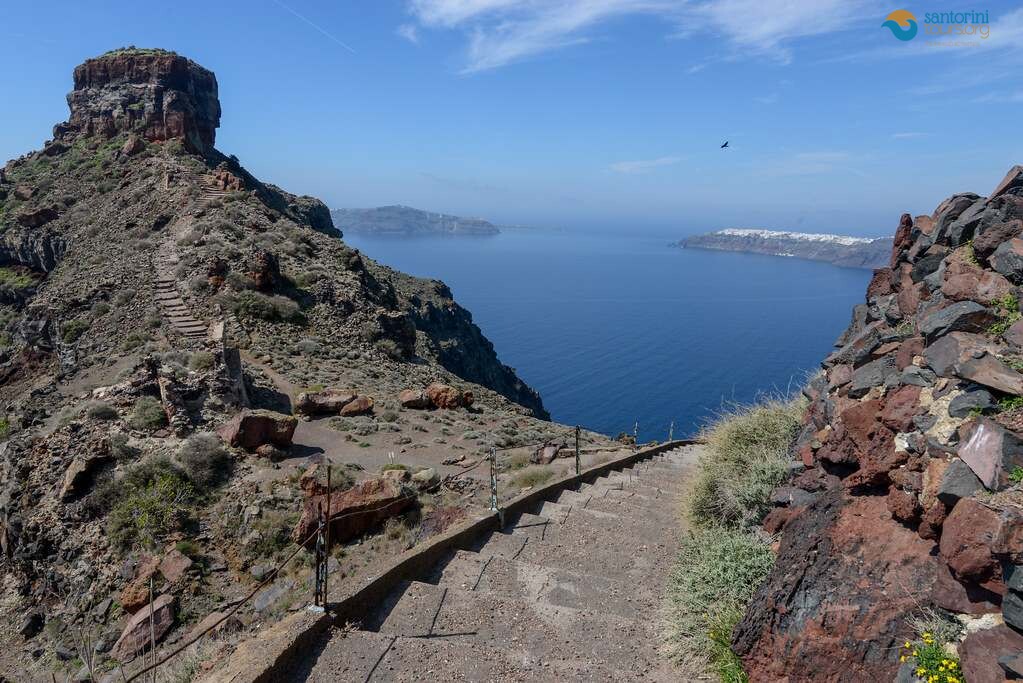
Santorini Walking Tours: The Short Answer
There are four kinds of santorini walking tours on this island and they are not interchangeable. The caldera rim path from Fira to Oia, ten to eleven kilometres of clifftop with the crater on your left the entire way. The village walks — Pyrgos, Emporio, Megalochori, Oia — which are an hour or two of lanes, churches and history. The archaeological walks at Akrotiri and Ancient Thera. And the food and wine walks, which are a route through Fira or a village with five stops and a glass at each.
Guided group walks run from about 45 to 90 euros a head; private guided walks from 200 to 400 for the group; and the rim path costs nothing at all if you walk it yourself, which most people do.
Whichever you book, the answer to when is the same: start at seven in the morning or four in the afternoon, and never in between from June to September.
Santorini Walking Tours: The Fira to Oia Rim Path
The route. The best known of all santorini walking tours: Fira, Firostefani, Imerovigli, past Skaros Rock, along the ridge above the caldera, then down into Oia from the high ground behind it.
Distance and time on santorini walking tours. Ten to eleven kilometres, three to four hours at a walking pace, longer with photographs.
Climb. Around three hundred metres of cumulative ascent, in three separate uphill sections rather than one long climb.
Surface. Paved through the villages, then dirt and volcanic scree along the ridge. The middle third needs proper shoes rather than sandals.
Water. Two litres a head in summer. There is nothing to buy between Imerovigli and the outskirts of Oia.
Direction. Fira to Oia, so the light is behind you in the afternoon and Oia is the reward at the end.
Getting back from santorini walking tours. The bus from Oia to Fira takes about twenty-five minutes and fills before sunset, which is the argument for a driver meeting you.
See Oia.
What Guided Santorini Walking Tours Cost
Group santorini walking tours in a village. 45 to 90 euros a head, two to three hours, eight to fifteen people.
Private santorini walking tours. 200 to 400 for the group rather than per person, two to three hours.
Guided santorini walking tours on the rim path. 80 to 150 a head in a group, with transfers usually included at one end.
Food or wine walking tour. 90 to 160 a head, with five to seven tastings included.
Archaeological guided walk. 60 to 120 a head plus the site entry, which is 20 euros at Akrotiri.
Free santorini walking tours. Tip-based, usually in Fira, and genuinely useful for orientation on a first afternoon.
Self-guided. Nothing, plus a bus ticket. Most of the best santorini walking tours are ones you do alone.
The Village Santorini Walking Tours
Pyrgos, the best of the village santorini walking tours. The highest of the old villages, built in concentric rings around a Venetian castle, with a walk to the top that takes twenty minutes and looks over both coasts at once.
Emporio. The largest medieval settlement on the island, a genuine kasteli of covered lanes and blind corners built to confuse pirates, and the least visited good thing here.
Megalochori, the flattest of the santorini walking tours. Bell towers, captains’ houses, a shaded square and a walk of about forty minutes with no climb in it.
Oia in the morning. The same lanes that hold four hundred people at sunset are empty at eight, and this is the version of Oia worth walking.
Fira to Firostefani. Twenty minutes along the rim, mostly level, with the whole caldera on one side. The easiest walk on the island.
Vothonas and Karterados. Cave villages in a ravine, cool in August, with almost no visitors and several rock-cut churches.
Akrotiri village. The medieval castle above the excavation, ruined and open, with a view down to the red cliffs.
See Pyrgos.
The Harder Santorini Walking Tours
Skaros Rock, the shortest hard walk. Down from Imerovigli onto the promontory, then a scramble round the back to the chapel of Theoskepasti. Forty minutes each way, steep, loose, and worth every step.
Ancient Thera. The old road up Mesa Vouno from Kamari or Perissa, four hundred metres of climb on switchbacks, an hour up in full sun. Start at eight.
Profitis Ilias, the highest of the santorini walking tours. The highest point on the island, walkable from Pyrgos in about an hour, with the monastery and a view of the whole caldera.
The Kamari to Perissa path. Over the shoulder of Mesa Vouno between the two black beaches, ninety minutes, and the best short coastal walk here.
Vlychada to Red Beach. Along the south coast under carved white cliffs, unmarked in places, and the emptiest of the santorini walking tours you can do alone.
The whole rim, Akrotiri to Oia. Twenty-five kilometres in a day for anybody who genuinely walks. Very few people do it and it is the best walk in the Cyclades.
Thirasia. The island across the water, reached by boat, with a stepped path from the port up to Manolas and a walk across farmland to Riva.
What to Wear on Santorini Walking Tours
Shoes with grip for santorini walking tours. Trainers at minimum, walking shoes if you have them. Volcanic scree on a slope destroys sandals and ankles.
A hat and sunglasses on santorini walking tours. There is no shade on the rim path at all, from end to end.
Two litres of water. Three in July and August. Nothing is sold on the ridge.
Sun cream reapplied. The wind hides the burn until it is done.
A layer for the evening. The rim gets cold quickly after the sun goes, even in July.
A phone with the route saved offline. The path is obvious for most of the way and vague in two places.
Not a large bag. Everything you carry on santorini walking tours you carry uphill in the heat.
Doing the Rim Path Properly
The Fira to Oia path is the most photographed walk in the Aegean and the one most often done badly. The classic mistake is to start it at one in the afternoon in July, in sandals, with a half-litre of water, because it looked short on a map. Ten kilometres on this island is not ten kilometres on a flat road: it is three separate climbs, an exposed ridge with no shade whatsoever, a stretch of loose volcanic gravel on a slope, and thirty-two degrees with a wind that dries the sweat off you before you notice you are losing it. People are helped off this path every summer, and almost all of them made the same three decisions.
Done properly, santorini walking tours on this ridge are a different day entirely. Leave Fira between six and seven in the morning and you walk the first hour in cool air with the light coming up over the villages behind you and nobody else on the path. The alternative is to leave at four in the afternoon and arrive in Oia for the last of the light, which is more dramatic and considerably busier. Both work; the hours between ten and four do not.
The route on these santorini walking tours divides into three parts. The first, Fira through Firostefani to Imerovigli, is paved, level and lined with hotels — twenty-five minutes of easy walking with the caldera beside you the whole way. The second, from Imerovigli around the back of Skaros and up onto the ridge, is where the walk becomes a walk: dirt and stone, a real climb, and the point at which most of the day-trippers turn back. The third runs along the open ridge with the sea on your right and the crater on your left, dips through a saddle, and climbs again before dropping into Oia past the first houses.
Three practical notes that matter more than the map. There is nothing to buy between Imerovigli and Oia, a distance of about seven kilometres, so carry everything. The path is unfenced above serious drops in several places and is not suitable for small children who run. And the return leg is a real logistics problem: the Oia bus is full before sunset, taxis are effectively unobtainable, and the walk back is not something anybody does. Arrange the return before you set off, which is what most of the guided santorini walking tours are actually selling.
Guided Santorini Walking Tours or On Your Own?
The honest answer is that of all santorini walking tours the rim path needs no guide. It is signposted, obvious for nine tenths of its length, and thousands of people walk it unaccompanied every week in season. What a guide adds on that particular route is company, water management, transport at both ends and somebody who knows which section to skip when the wind is up — useful, but not essential.
Where a guide changes santorini walking tours completely is in the villages and at the archaeological sites. Emporio’s kasteli is a maze of covered lanes with no signage, no ticket office and no explanation of what you are looking at; walked alone it is a pretty warren, and walked with somebody who can explain the pirate defences, the collapsed towers and the church built into the wall, it becomes the most interesting hour on the island. The same is true at Akrotiri, where the excavation is extraordinary and the labelling is minimal, and at Ancient Thera, where without a guide most people see a hot hillside of foundations.
Food and wine walks fall somewhere in between. What you are buying is access — a bakery that opens the back room, a producer who pours something not on the list, a taverna kitchen that shows you what fava actually is — rather than information. In a village where nobody speaks your language and nothing is signposted, that access is worth the money.
The best compromise, and the way most of our guests end up doing it, is to walk the rim path alone at your own pace and to take a guide for one village morning and one archaeological site. That splits the week correctly: the walking is yours, and the explaining is somebody else’s.
When to Book Santorini Walking Tours
April and May. The best months for santorini walking tours by a distance. Fifteen to twenty-two degrees, wild flowers on the caldera, the grass still green, and the paths empty.
June. Warm but manageable before eleven, with long evenings and a sunset late enough to finish the rim path in daylight.
July and August. Only at dawn or after five. The middle of the day on an unshaded ridge at thirty-two degrees is genuinely dangerous rather than merely unpleasant.
September. The heat breaks in the second half of the month and the walking becomes excellent again.
October. Warm, quiet, clear and the best light of the year. The second-best month for santorini walking tours.
November to March. Cool, green, occasionally wet, and completely empty. The rim path in February with nobody on it is a remarkable thing.
The meltemi. A hard northerly makes the exposed ridge unpleasant and, in gusts, unsafe near the edge. Walk the villages instead that day.
Santorini Walking Tours With Children and Accessibility
Small children. The village santorini walking tours work. The rim path does not: it is unfenced above long drops for much of its length.
Older children. Fira to Imerovigli and back is a good introduction, about an hour, paved throughout.
Teenagers. The full rim path is well within range and usually the part of the holiday they remember.
Pushchairs. Firostefani and Megalochori only. Everywhere else has steps.
Wheelchairs. The main streets of Fira, Firostefani and central Oia are largely level and paved; the caldera path and every kasteli are not.
Limited mobility. The Fira to Firostefani stretch, the Oia main street and the Megalochori square give you most of the view with almost no gradient.
Dogs. Fine on the paths, and there is no water and no shade for them either.
A Santorini Walking Tours Day That Works
06:30. Start the santorini walking tours ridge from Fira in the cool, with the caldera below you and the sun behind.
08:00. Imerovigli and the climb onto the ridge, still shaded on the eastern side.
09:30. The open ridge, the emptiest stretch, and the best views of the walk.
10:30. Into Oia from the top, coffee and a second breakfast in a village not yet full.
11:30. Collected by car, back to the hotel, and the rest of the day belongs to a pool.
17:00. A village — Pyrgos or Emporio — for an hour of flat walking in the late light.
20:30. Dinner inland, having walked eleven kilometres and still had a whole afternoon.
That is the version of santorini walking tours that leaves you with the day intact, and it depends entirely on being collected in Oia rather than queueing for the bus.
See the private transfers.
Emporio, the Santorini Walking Tours Route Nobody Takes
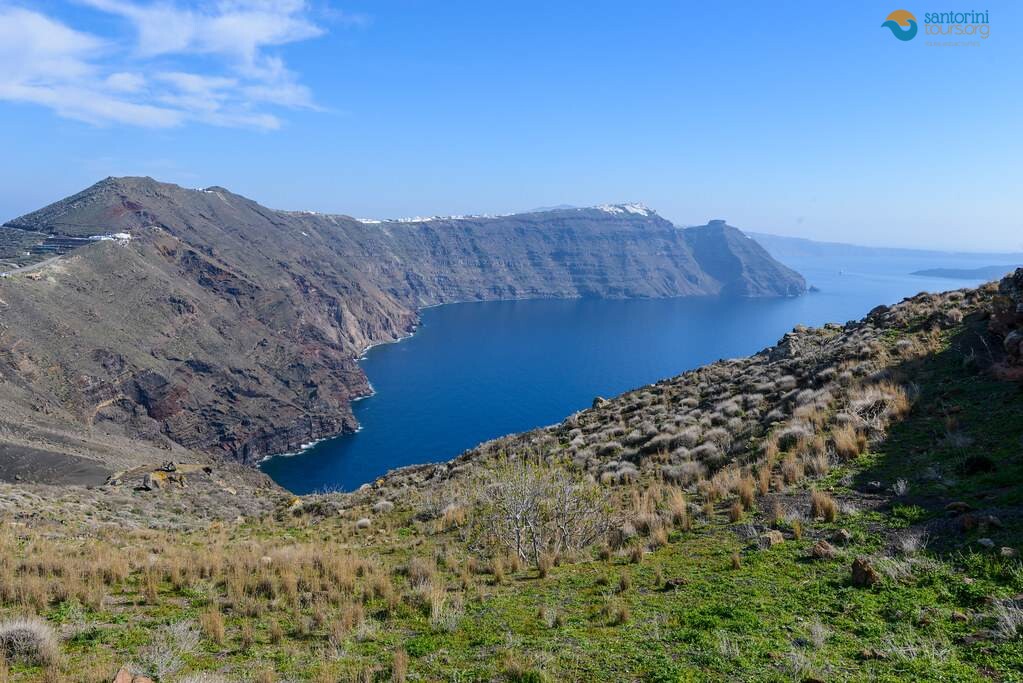
If you do one of the guided village santorini walking tours, make it Emporio. It sits inland on the flat southern plain, ten minutes from Perissa and twenty-five from Fira, and it holds the largest and best-preserved medieval settlement in the Cyclades — a kasteli built in the fifteenth century as a single defensive structure rather than as a village of separate houses.
The logic of it becomes obvious as soon as you are inside. The outer houses have no windows facing outward; their back walls are the town wall. There is one narrow entrance, and the lanes behind it were built deliberately confusing, covered in places, doubling back on themselves, so that raiders who got through the gate could be trapped and stoned from above. At the centre stands the Goulas, a square tower that was the last refuge, and the church of Panagia Mesani is built into the fabric of the wall itself. Around eight hundred people lived inside this thing when pirates were a fact of Aegean life rather than a story.
What makes it worth a guide is that none of that is signposted. Walk in alone and you find a pretty warren of whitewashed lanes with washing hanging across them and cats on the steps, which is agreeable and tells you nothing. Walk in with somebody who can point at a blocked doorway, an arrow slit, the line where the wall was raised, and the whole structure resolves into what it is: a piece of defensive architecture that people have been living inside continuously for six hundred years.
Above the village, on the bare hill, stand the windmills — five stone towers on the ridge, unrestored, free to walk around, with a view over the plain to the sea. The walk up takes ten minutes on a dirt track with no shade. Between the kasteli, the mills and the church, Emporio is ninety minutes, costs nothing to enter, and sees a fraction of the traffic of any caldera village. It is the single most underrated stop on the island and it appears on almost none of the standard santorini walking tours.
Akrotiri and Ancient Thera: Santorini Walking Tours With Archaeology
The two archaeological sites are walks of completely different character, and most visitors do one and skip the other, usually the wrong way round.
Of the two archaeological santorini walking tours, Akrotiri is the easy one and the extraordinary one. A Bronze Age town buried by the eruption of about 1600 BC, excavated since 1967, and now roofed over so you walk through it on raised walkways in shade at a comfortable temperature. Streets, drains, three-storey houses, storage jars still standing where they were left, and a sophistication that is genuinely startling — indoor plumbing, hot and cold water, wall paintings in ordinary rooms. It takes an hour to walk, entry is around 20 euros, and it is the best thing to do on this island between eleven and four when everywhere else is unbearable. Go in the first hour after opening and you will have it to yourself.
Ancient Thera is the hardest of the santorini walking tours and the emptiest. The Hellenistic and Roman city sits on the ridge of Mesa Vouno at nearly four hundred metres, above Kamari and Perissa, and getting there on foot means a switchback climb up the old road in full sun. It is an hour up from Kamari, steep, exposed, and best started by eight in the morning. What you get at the top is a long stone spine of a town — an agora, a theatre carved into the slope with the Aegean underneath it, a gymnasium, temples, houses — and a view down onto both black beaches at once. There is no shade and no water up there, and the ruins are more ruined than Akrotiri, but standing in the theatre with nobody else on the mountain is a different order of experience from queueing for a photograph in Oia.
Do both, on different days, and take a guide for at least one of them. Together they cover three and a half thousand years and they are the reason this island is more than a view.
Food and Wine Santorini Walking Tours
The food walk is the newest category of santorini walking tours and, for a certain kind of visitor, the most useful. The format is consistent: a guide, a group of six to twelve, two to three hours on foot in Fira or a village, and five to seven stops at places you would not have found and would not have ordered correctly in if you had.
What gets tasted on these santorini walking tours is the island’s own larder rather than a generic Greek menu. Fava, the yellow split-pea purée made from Santorini’s own legume, served warm with raw onion, capers and a spoonful of oil. Tomatokeftedes, fritters made from the small dense island tomato that used to be canned here by the shipload. White aubergine, sweeter than the purple kind and grown almost nowhere else. Chloro, the fresh sharp goat’s cheese. Capers and caper leaves picked off the caldera cliffs. Bread, rusks, honey, and an assyrtiko poured at some point in the middle.
The wine version of these santorini walking tours does the same thing across two or three estates, usually with a vehicle between them because the wineries are spread across the inland plain rather than clustered in one village. That is not really a walk, and any operator selling it as one is stretching the word — but the tasting itself is worth doing, and doing in the late afternoon rather than at eleven in the morning.
Prices run 90 to 160 euros a head with everything included, which sounds a lot until you total up what the same food and drink would cost ordered separately in a caldera restaurant. The value is not the calories; it is that after two hours you know what to order for the rest of the week, which is worth more than the meal.
Where the Santorini Walking Tours Paths Came From
Almost every route used by santorini walking tours is older than tourism, and most of them are older than the roads. Until the middle of the twentieth century Santorini had no proper road network and no vehicles to speak of; the island moved on foot and on the backs of mules, and the paths that carried that traffic are the paths people now walk for pleasure.
The rim route existed because the villages along the crater edge — Fira, Firostefani, Imerovigli, Oia — were strung along the only line of habitable ground and had to be connected. The stepped path from the old port up to Fira, five hundred and eighty steps of it, existed because everything arriving on the island arrived by sea at the bottom of a cliff and had to come up somehow, which is what the mules were for and, unfortunately, still are. The switchbacks up Mesa Vouno to Ancient Thera are a genuine ancient road, cut and maintained when the city at the top was inhabited. And the tracks across the inland plain between Emporio, Megalochori, Akrotiri and Pyrgos were farm routes, connecting the vineyards, the threshing floors and the windmills on the ridges above each village.
Two things follow from that history and both are visible on the ground. The first is that the paths go where people needed to go rather than where the view is best, which is why the most spectacular stretch of the rim path — the open ridge between Imerovigli and Oia — is also the roughest and least built up; nobody lived there, so nobody paved it. The second is that the network is much denser than the marked routes suggest. Between the villages of the southern plain there are dozens of walkable farm tracks and old donkey paths that appear on no tourist map, are used by nobody, and lead past chapels, threshing circles, ruined mills and vineyards laid out in the low woven baskets that only this island uses.
That is where the best of the santorini walking tours actually are, and it is the reason a local guide is worth more inland than on the caldera rim. On the ridge, the route is obvious and the view does the work. On the plain, without somebody who grew up here, you will drive past all of it at fifty kilometres an hour on the way to a beach.
What Santorini Walking Tours Are Actually Walking Through
The reason the rim path is extraordinary is not the hotels along it. It is that you are walking around the inside edge of an active volcano, along the top of a cliff that was made in a few days about three and a half thousand years ago, and the whole geological event is written on the rock beside you in bands you can read as you go.
Look at the cliff face across the water from anywhere on the ridge. The pale band at the top, thirty to sixty metres of white and pink pumice and ash, is the Minoan eruption of around 1600 BC — the one that removed the centre of the island and dropped it into the sea. The darker bands beneath it are earlier eruptions and lava flows going back hundreds of thousands of years, each one a separate island-building event. The red and rust patches, which are strongest around Ammoudi and the northern cliffs, are oxidised scoria from vents on this side. And the two black islets in the middle of the bay, Nea Kameni and Palia Kameni, have been built up out of the water by eruptions since 197 BC and are still growing.
The path itself passes several things worth stopping for. Skaros Rock, below Imerovigli, held the island’s medieval capital and its Venetian fortress until earthquakes and landslides emptied it in the eighteenth century; almost nothing is left, and the outline of what was there is still visible from the path above. The chapel of Theoskepasti sits on the far side of it, out on the promontory, and is one of the few places on this island where you can be entirely alone with the view. Further along, the small church of Prophet Elias marks the top of the second climb, and the saddle beyond it is the point where Oia first appears in the distance.
Underfoot, the surface is telling you the same story as the cliff. The white-grey dust you are walking on for much of the ridge is pumice, light enough to float, and the reason the vines on this island survive without rain: it is porous, so it pulls moisture out of the night air and holds it. The black gravel in the dips is older lava, ground down. None of it is soil in the ordinary sense, which is why the terraces beside the path grow vines, capers and very little else.
Knowing that changes the walk. Most santorini walking tours sell the view; the geology is what makes the view mean anything, and it is free, permanently on display, and legible from any point along the ridge.
Mistakes That Ruin Santorini Walking Tours
The first mistake on santorini walking tours is timing, and it accounts for most of the rest. Setting off at midday in July puts you on an unshaded ridge in the hottest three hours of the day with the wind hiding how much water you are losing. Every problem on this path — heat exhaustion, blistered feet, a group that splits up because one person cannot continue — starts with that decision. Dawn or late afternoon, always.
The second mistake on santorini walking tours is footwear. The path looks like a promenade in the photographs taken in Firostefani, and for the first twenty-five minutes it is one. The middle third is loose volcanic gravel on a slope with a drop beside it, and flip-flops on that surface are how ankles get turned five kilometres from the nearest road.
The third is water. There is no tap, no shop and no kiosk between Imerovigli and the outskirts of Oia. Two litres a head is the minimum in summer and three is sensible, and the weight of it is the whole argument for not carrying anything else.
The fourth is the return leg of santorini walking tours. The bus from Oia to Fira is full from six o’clock, there are around thirty taxis on the entire island, and walking back after eleven kilometres is not a plan. Book the return leg before you set off — and if you are doing the walk in the afternoon, book it for after the sunset crowd has cleared rather than into the middle of it.
The fifth is booking santorini walking tours on the wrong day of the trip. The rim path is the most physically demanding thing most visitors do here, and putting it the day before a flight, or the day after a catamaran, wastes both. Give it a day with nothing else in it, and give the following morning to a pool.
Santorini Walking Tours: Frequently Asked Questions
How long is the Fira to Oia walk? Ten to eleven kilometres and three to four hours, with about three hundred metres of cumulative climb.
Are santorini walking tours on the rim path difficult? Moderate. Paved for the first section, then dirt and volcanic gravel with three real climbs and no shade.
Do you need a guide? Not for the rim path. Yes, if you want the villages and the archaeological sites to mean anything.
What do santorini walking tours cost? 45 to 90 euros a head in a group, 200 to 400 for a private guide, and nothing at all if you walk it yourself.
What is the best time of day? Start at six or seven in the morning, or after four in the afternoon. Never between ten and four in summer.
Which direction should santorini walking tours go? Fira to Oia, so the light is behind you and the village is the reward at the end.
How do you get back from Oia? Bus in about twenty-five minutes, and it fills before sunset. A car meeting you is the reliable option.
How much water do you need? Two litres a head, three in July and August. Nothing is sold on the ridge.
Can children do the walk? Older children yes. The path is unfenced above long drops, so it is not for small children who run.
Is it wheelchair accessible? The Fira to Firostefani stretch and the main streets of Oia largely are. The rest of the path is not.
What shoes do you need? Trainers at minimum. Sandals and flip-flops are the commonest cause of a turned ankle on the loose middle section.
What is the best village walk? Emporio’s kasteli, the largest medieval settlement on the island and the least visited.
Can you walk from Kamari to Perissa? Yes, over the shoulder of Mesa Vouno, in about ninety minutes.
Are there free walking tours? Tip-based orientation walks run in Fira and are genuinely useful on a first afternoon.
Is the walk safe in the meltemi? The exposed ridge is unpleasant and, in strong gusts near the edge, best avoided. Walk the villages that day.
What is the hardest walk on the island? Ancient Thera from Kamari, four hundred metres of climb in full sun, or the whole rim from Akrotiri to Oia in a day.
Santorini Walking Tours: We Will Meet You at the Other End
We are a local operator running private tours and transfers in our own vehicles, and the part of a walking day that goes wrong here is never the walking. It is the two hours afterwards, standing at the Oia bus station with eleven kilometres in your legs while three full buses go past.
Tell us your dates and we will build the day around it: dropped in Fira at first light, met in Oia when you arrive, and back at the hotel before the island gets hot. Or the afternoon version, walked into the sunset and collected at nine once the crowd has cleared out of the village.
Prices are per vehicle rather than per person, hotel pickup anywhere on the island is included, we guide in twelve languages, and an 80 EUR deposit confirms a date.
See the personalised tour, the historical tour, or contact us.
Every Village and Site on the Island
Any of these can be built into a private day. Each has its own page with what to see and how long to allow.
Caldera villages: Fira · Firostefani · Imerovigli · Oia · Finikia · Baxedes
Inland villages: Pyrgos · Megalochori · Emporio · Mesaria · Karterados · Vothonas · Vourvoulos · Exo Gonia · Mesa Gonia · Pigadia
Beaches: Perissa · Perivolos · Kamari · Vlychada · Monolithos · Red Beach · White Beach · Agios Georgios · Agia Paraskevi
Sites and landmarks: Akrotiri · Ancient Thira · Akrotiri Lighthouse · Nea Kameni · Palia Kameni · Thirasia · Athinios Port
All our tours: All Santorini tours · Full day tour · Sightseeing tour · Personalised tour · North part tour · Horse riding · South part tour · Sunset tour · Shore excursion · Caldera tour · Food experience · Wine tour · Historical tour · Small group tour
Planning and services: Famous sights tour · Private transfers · Transfers to Oia and Finikia · Transfers to other villages · Villages of Santorini · History of Santorini · Tours near you · Languages we guide in · Food and fun tours · Gay friendly tours · Our tour buses · Daily tours · Day tours · FAQ · Gallery · Tour photo gallery · About us · Contact · Blog








Leave a Reply