
Santorini scuba diving means diving inside a flooded volcanic crater: walls that drop hundreds of metres, black volcanic rock, a small wreck and warm water at the springs, with twenty to thirty metres of visibility because there is no river silt anywhere near this island. A try dive is 70 to 110 euros, a two-tank boat dive 90 to 150, and the fish life is modest while the geology is not. Santorini Tours is a local operator running private tours and transfers on the island.
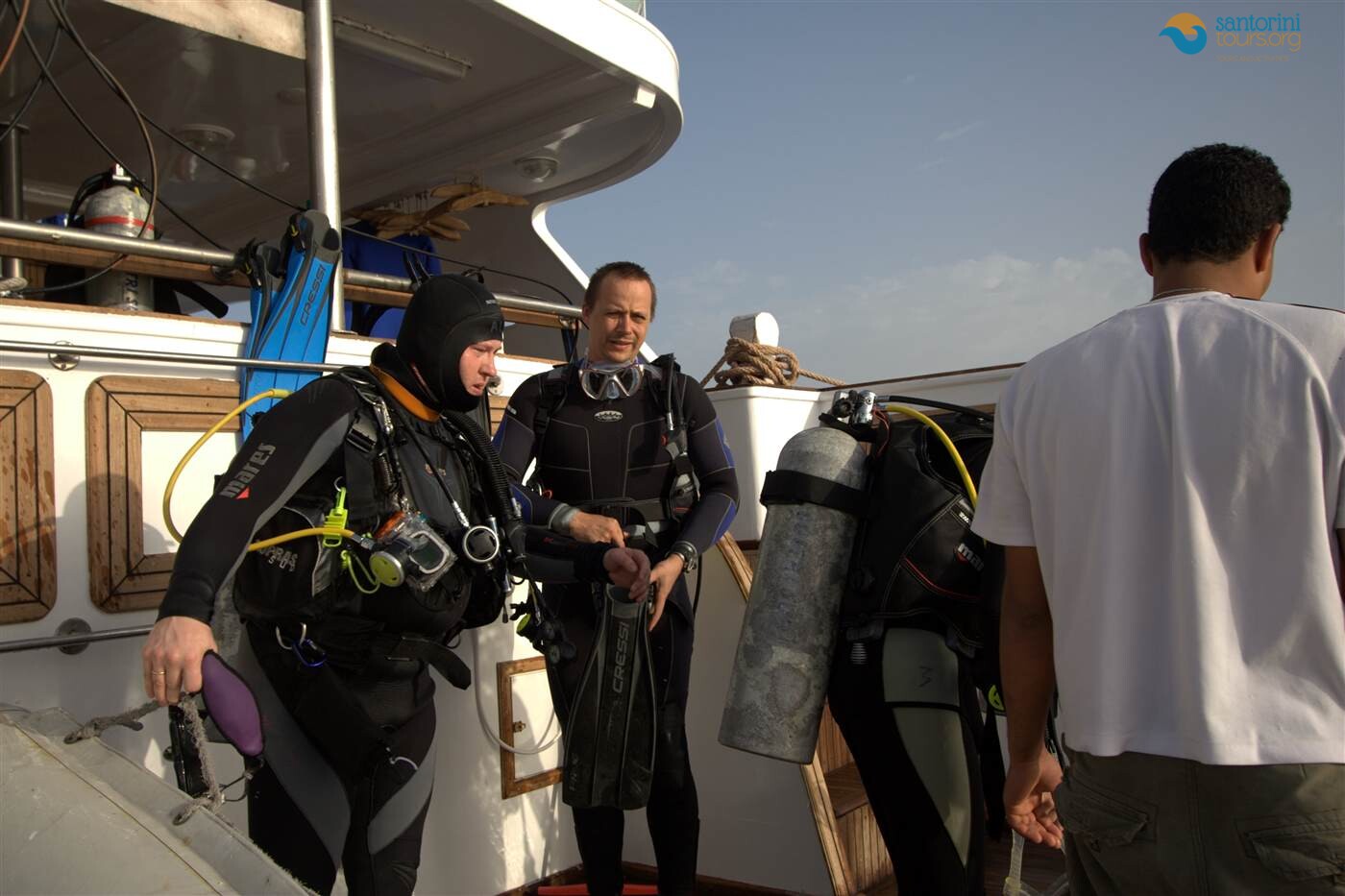
Santorini Scuba Diving: The Short Answer
Santorini scuba diving means diving inside a flooded volcanic crater: walls that drop hundreds of metres, black volcanic rock, a small wreck, warm water at the springs, and visibility of twenty to thirty metres because there is no river silt anywhere near this island. The fish life is modest and the geology is not.
A try dive for beginners runs 70 to 110 euros, a two-tank boat dive for certified divers 90 to 150, and an open water course 450 to 600 over three to four days. Four or five centres operate here, mostly from Vlychada, Perissa and Kamari.
The season is May to October, the water is 18 degrees in May and 25 to 26 in September, and the best month for both temperature and visibility is September.
Santorini Scuba Diving Sites
The Caldera wall, the signature santorini scuba diving site. Black volcanic rock dropping vertically into blue, with the wall on one side and nothing on the other.
Adiavatos wreck, the only wreck in santorini scuba diving. A small cargo vessel in eighteen to twenty-four metres off the north coast, broken up, easy and the island’s only real wreck dive.
Palia Kameni. Warm water where the springs vent, yellow and rust-stained rock, and the strangest sensation in santorini scuba diving.
Nea Kameni. Fresh lava fields underwater, black and sharp, with arches and swim-throughs.
Indian Rock and Tavern Reef. Reef dives off the south and east coasts, shallower and better for the fish that are here.
The Lighthouse. Deep, exposed and for experienced divers, at the southern tip of the island.
Kamari and Perissa shore entries. Where most try dives and course training happens, shallow and sheltered.
What Santorini Scuba Diving Costs
Discover santorini scuba diving, no certification. 70 to 110 euros for a briefing, a shallow dive and an instructor at arm’s length.
Two-tank boat santorini scuba diving, certified. 90 to 150 including tanks, weights and the boat.
Single guided dive. 60 to 90.
Full equipment rental. 25 to 40 a day if not included.
PADI Open Water course. 450 to 600 over three to four days, with materials and certification.
Advanced Open Water. 350 to 450 over two days.
Snorkelling trip. 40 to 70, and the alternative for anybody who does not want to do santorini scuba diving properly.
What Santorini Scuba Diving Is Actually Like
Set the expectation correctly and you will enjoy it. Anybody arriving from the Red Sea, the Maldives or the Caribbean and expecting coral and clouds of fish will be disappointed, and the honest dive centres on this island say so on the phone. The eastern Mediterranean is oligotrophic — nutrient-poor — and it has been fished hard for three thousand years. What you get here is not biomass.
What you get instead is landscape. Santorini scuba diving takes place inside the walls of a volcano that erupted around 1600 BC and dropped its own centre into the sea. The rock is black, sharp and geologically young; the caldera wall falls away below you further than your torch will reach; there are lava arches, boulder fields and, at Palia Kameni, water that is genuinely warm and stained yellow where the springs vent through the seabed. Nowhere else in Europe offers that combination at recreational depths.
The visibility is the other thing about santorini scuba diving that surprises people. Twenty to thirty metres is normal and forty happens, because there is no river anywhere on this island, no agricultural runoff to speak of and no sand to stir up — the bottom is rock and volcanic gravel. On a clear day at the caldera wall you can see the surface from twenty-five metres down.
The life that is here is small and worth looking for: octopus in the rock, moray and conger, scorpionfish, damselfish and sea bream, the occasional barracuda in late summer, and nudibranchs for anybody who dives with their nose an inch off the rock. Bring a torch and a slow pace rather than a wide-angle lens and a hope of turtles.
Santorini Scuba Diving for Beginners, Courses and Certification
Discover scuba. A pool or shallow-water briefing followed by one dive to about six metres with an instructor holding your gear. No certification, no prerequisites beyond basic health.
Minimum age. Ten for a try dive on most centres, and children of that age do it every week here.
Open Water course. Three to four days, theory plus four open-water dives, and you leave with a certification valid for life anywhere in the world.
Where the training happens. Kamari and Perissa, where the entry is shallow and sheltered and the bottom is flat.
Refresher dives. Standard for anybody who has not dived in a year or more, and worth doing rather than skipping.
Medical questionnaire. Everybody completes one. Asthma, heart conditions and recent surgery need a doctor’s sign-off before santorini scuba diving.
Flying afterwards. Eighteen hours after your last dive before boarding a plane, and this catches people out on the last day of a trip.
When to Book Santorini Scuba Diving
May. Santorini scuba diving starts with water around 18 degrees, cool in a 5 mm suit, and the island is empty.
June. Warming through the low twenties with good visibility.
July and August. Warm and busy, with the meltemi cancelling boat dives for two to four days at a stretch.
September. The best month for santorini scuba diving: 25 to 26 degrees, the clearest water of the year and thinning crowds.
October. Still warm to mid-month and very quiet, with the first weather systems arriving late.
November to April. Most centres close. A couple run year-round for locals in drysuits.
The wind. Boat dives move to sheltered sites or cancel in a hard meltemi; shore dives at Kamari and Perissa usually still run.
Santorini Scuba Diving Inside a Volcano
The geology is the reason to get in the water here, so it is worth understanding what is under you. Santorini is what remains of a much larger circular island that destroyed its own centre in an eruption around 1600 BC — one of the largest of the last ten thousand years, several times the size of Krakatoa. The centre collapsed, the sea poured in through the breach on the western side, and what was left is the crescent you are standing on, the smaller island of Thirasia opposite, and the bare rock of Aspronisi between them.
Santorini scuba diving therefore happens in an underwater landscape unlike anywhere else in the Mediterranean at recreational depth. The caldera wall continues below the surface at the same angle it has above it, dropping past three hundred metres in the middle of the crater; you dive the top thirty of that with nothing but blue underneath you, which is a sensation people either love or find deeply uncomfortable on the first attempt. The rock is black basalt and grey pumice, sharp-edged and geologically young, with none of the softening that limestone coastlines have.
Then there are the two islets in the middle. Nea Kameni and Palia Kameni are not fragments of the old island — they have been built up out of the water by eruptions since 197 BC, and the most recent activity was in 1950. Diving off them means swimming over lava flows a few centuries old, through arches and boulder fields, in water that is measurably warmer where the springs vent through the seabed. The rock there is stained yellow and rust with iron and sulphur, and the santorini scuba diving guides will show you a hand-sized patch where bubbles come up through the sand.
None of this is dramatic in the way a coral wall is dramatic. It is quieter, stranger and considerably more interesting once somebody has explained what you are looking at, which is the argument for diving here with a guide who talks about geology rather than fish.
What to Bring on a Santorini Scuba Diving Day

Certification card and logbook. Digital is accepted almost everywhere now, but bring the card if you have it.
Your own mask for santorini scuba diving. The one piece of kit worth carrying. Rental masks leak and a leaking mask ruins a dive.
A 5 mm wetsuit in May and October. 3 mm from July to September. Centres supply it; ask what thickness before you commit.
A dive computer if you own one. Rental is 5 to 10 euros a day and you should be diving with one.
Water and something to eat. A two-tank boat morning runs three to four hours and there is nothing to buy on board.
Sun protection for the surface interval. Sitting wet on an open boat in August burns faster than lying on a beach does.
Realistic expectations. Santorini scuba diving delivers landscape and clarity rather than biomass, and the centres that say so honestly are the ones to book.
Snorkelling as the Santorini Scuba Diving Alternative
Not everybody wants a tank on their back, and the honest answer is that a good proportion of what makes santorini scuba diving interesting is visible from the surface if you pick the right spot. The volcanic rock at the ends of the beaches — the far end of Kamari under Mesa Vouno, the northern end of Perissa, the coves around Vlychada and the water off Ammoudi — is shallow, clear and full of the same black basalt and the same twenty-metre visibility.
What you miss is the wall. Everything that makes the caldera extraordinary underwater happens below fifteen metres, on the vertical face where the crater drops away, and there is no way to see that with a mask and a pair of fins. You also miss the hot springs vents and the wreck, both of which are dives rather than swims.
A guided snorkelling trip, the cheap alternative to santorini scuba diving, runs 40 to 70 euros for two or three hours from a small boat, usually taking in the sea caves and the coloured cliffs on the south coast that no road reaches. That is genuinely good value and a better use of a morning than a shared catamaran for anybody who mainly wants to be in the water rather than on it.
The practical rule: if you have never dived and are curious, spend 90 euros on a discover scuba dive rather than 60 on a snorkel trip, because the first will tell you whether you want to do this properly and the second will not. If you have snorkelled all your life and just want clear water and volcanic rock, the beaches here give you that for nothing.
Fitting Santorini Scuba Diving Into the Week
Morning santorini scuba diving, always. Boats leave between eight and nine, the water is flattest and the visibility is at its best before the day’s traffic stirs the shallows.
Not the day you fly. Eighteen hours between the last dive and the aircraft, and the island’s flights leave in the afternoon and evening.
Not the same day as the catamaran. Two boats, six hours of sun and a lot of salt.
Good with an inland afternoon. Back at the quay by one, Emporio or a winery at five, dinner at nine.
The windy-day plan. A hard meltemi moves boat dives to sheltered sites or cancels them; shore diving at Kamari and Perissa usually still runs.
Courses need consecutive days. An Open Water is three to four mornings in a row, so it has to be booked at the start of a trip rather than the end.
Where the centres are. Vlychada, Perissa and Kamari, twenty-five to thirty-five minutes from the caldera villages, with a briefing that starts before the first bus runs.
Choosing a Santorini Scuba Diving Centre
Certification body. PADI or SSI, both recognised worldwide, and the difference between them matters far less than the instructor.
Group size on santorini scuba diving trips. Four divers to one guide is good, eight is a lot, and on a try dive you want one instructor to one or two people.
The boat or the shore. Boat dives reach the caldera wall and the wreck; shore dives are cheaper and shallower. Ask which you are buying.
Santorini scuba diving equipment condition. Look at the regulators and the BCDs rather than the shopfront. Salt and five months of daily use show.
Language. Briefings here run in several languages. Confirm yours is one of them before you pay.
Insurance. Dive-specific cover is not included in most travel policies. Ask the centre what they carry and check your own.
Honesty about the fish. A centre that tells you the marine life is modest is a centre that will not oversell the santorini scuba diving either.
Santorini Scuba Diving: Frequently Asked Questions
Is santorini scuba diving worth it? For the volcanic landscape, the caldera wall and the visibility, yes. For fish life, no — that is not what this island offers.
What does it cost? 70 to 110 euros for a try dive, 90 to 150 for a two-tank boat dive, and 450 to 600 for an Open Water course.
Do you need a certification? Not for a discover scuba dive. Yes for anything beyond about six metres.
How is the visibility? Twenty to thirty metres normally, sometimes forty. There is no river on the island and no silt.
How warm is the water? Around 18 degrees in May, 22 to 24 in July, and 25 to 26 in September.
Is there a wreck? Yes, the Adiavatos in eighteen to twenty-four metres off the north coast.
Can you dive in the hot springs? You dive near the vents at Palia Kameni, where the water is noticeably warm and the rock stained yellow.
What is the minimum age? Usually ten for a try dive and children do it regularly here.
How long before flying? Eighteen hours after the last dive. Plan the last day of your trip around it.
When is the best month? September, for the warmest water and the clearest visibility of the year.
Does the wind stop diving? A hard meltemi cancels boat dives for a few days at a time. Shore dives at Kamari and Perissa usually continue.
Is snorkelling a reasonable alternative? Yes on the volcanic rock at the ends of the beaches, though you miss the wall, which is the whole point.
Santorini Scuba Diving: We Will Get You to the Dive Centre
We are a local operator running private tours and transfers in our own vehicles, and the dive centres are at Vlychada, Perissa and Kamari rather than in the caldera villages where almost everybody stays — twenty-five to thirty-five minutes away, with an eight o’clock briefing and a bus system that does not start early enough for it.
Tell us your dates and we will build the day around the dive: at the centre for the briefing, collected at the quay afterwards, and a village and a winery in the afternoon while the eighteen-hour clock runs down before your flight.
Prices are per vehicle rather than per person, hotel pickup anywhere on the island is included, we guide in twelve languages, and an 80 EUR deposit confirms a date.
See the personalised tour, the private transfers, or contact us.
Every Village and Site on the Island
Any of these can be built into a private day. Each has its own page with what to see and how long to allow.
Caldera villages: Fira · Firostefani · Imerovigli · Oia · Finikia · Baxedes
Inland villages: Pyrgos · Megalochori · Emporio · Mesaria · Karterados · Vothonas · Vourvoulos · Exo Gonia · Mesa Gonia · Pigadia
Beaches: Perissa · Perivolos · Kamari · Vlychada · Monolithos · Red Beach · White Beach · Agios Georgios · Agia Paraskevi
Sites and landmarks: Akrotiri · Ancient Thira · Akrotiri Lighthouse · Nea Kameni · Palia Kameni · Thirasia · Athinios Port
All our tours: All Santorini tours · Full day tour · Sightseeing tour · Personalised tour · North part tour · Horse riding · South part tour · Sunset tour · Shore excursion · Caldera tour · Food experience · Wine tour · Historical tour · Small group tour
Planning and services: Famous sights tour · Private transfers · Transfers to Oia and Finikia · Transfers to other villages · Villages of Santorini · History of Santorini · Tours near you · Languages we guide in · Food and fun tours · Gay friendly tours · Our tour buses · Daily tours · Day tours · FAQ · Gallery · Tour photo gallery · About us · Contact · Blog








Leave a Reply