
A santorini olive oil tasting is a structured hour in which you are taught to judge extra virgin oil the way a panel does, on fruitiness, bitterness and pungency, and then given the island food it was made for. The most established is the Santo Roots tasting at Pyrgos, poured from oils grown, harvested, extracted and bottled on Santorini itself, and independent tastings pairing oil with honey run in Fira. Expect 20 to 45 euros a head for forty-five to ninety minutes. Santorini Tours is a local operator running private tours and transfers on the island.
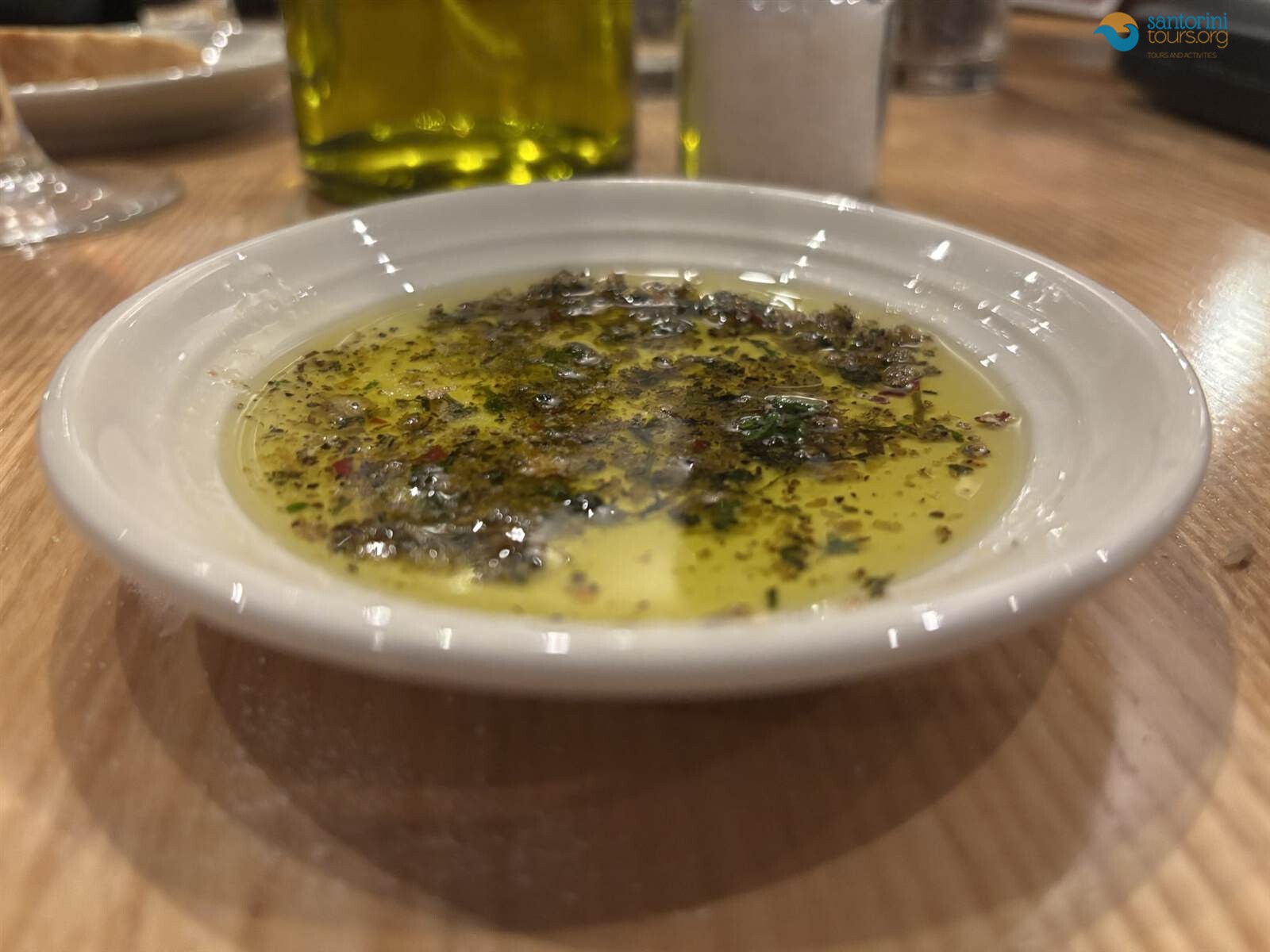
Santorini Olive Oil Tasting: The Short Answer
A santorini olive oil tasting is a structured hour in which you are taught to judge extra virgin olive oil the way a panel does — fruitiness, bitterness and pungency — and then given local food to prove why it matters. The most established one is Santo Wines’ Santo Roots tasting at Pyrgos, poured from oils grown, harvested, pressed and bottled on Santorini itself.
Independent tastings run in Fira and at Stoa, usually pairing oil with honey, and several wine tours now add an oil flight to the afternoon. Expect 20 to 45 euros a head for forty-five to ninety minutes, with bread, tomatoes, cheese and often honey alongside.
It is the best-value food experience on the island, it happens indoors, and it works on the windy day when the boat has been cancelled.
Where to Do a Santorini Olive Oil Tasting
Santo Wines, Pyrgos. The cooperative’s Santo Roots olive oil tasting, on the terrace above the caldera, guided and structured, and the one santorini olive oil tasting that pours oil produced entirely on the island.
Stoa, Fira. A santorini olive oil tasting paired with honey in town, short, informal and easy to fit around anything else.
Private santorini olive oil tasting sessions in Fira. Small operators run guided tastings for two to eight people, often in a shop or a courtyard, with a wider Greek range.
Combined wine and oil tours. Several tour companies build an oil flight into a winery afternoon, which is the most efficient way to do both.
At a taverna. Not a tasting, but every good inland kitchen will tell you which oil they cook with and which they finish with, and most will let you try both.
In a shop. The delicatessens in Fira and Oia pour samples across the counter, free, with no structure and no obligation.
See the private wine tours.
What Actually Happens in a Santorini Olive Oil Tasting
The glasses. Every santorini olive oil tasting uses small blue glasses, so the colour of the oil cannot bias you. Colour tells you almost nothing about quality.
Warming. You cup the glass in one hand and cover it with the other for thirty seconds, to bring the oil to about 28 degrees and release the volatiles.
Smelling. Cut grass, tomato leaf, green almond, artichoke, banana. Anything that smells like crayons, vinegar or wet cardboard is a defect.
The sip and the slurp. A small amount, then air drawn across it noisily. It aerates the oil and drives the aroma up the back of the nose, and everybody feels ridiculous doing it.
The cough. Good oil catches at the back of the throat. That is oleocanthal, an anti-inflammatory compound, and in a santorini olive oil tasting the guide will make you cough on purpose to prove the point.
The three santorini olive oil tasting scores. Fruitiness, bitterness and pungency, each rated on a scale. A balanced oil has all three; a flat one has none.
The food. Bread, cherry tomatoes, chloro cheese, fava, and honey if it is that kind of tasting. Oil is a condiment, not a drink, and this is the part that makes it obvious.
Does Santorini Actually Produce Olive Oil?
Yes, but not much, and not for long. This is a vine island rather than an olive island: the agriculture that made Santorini famous is assyrtiko, fava, white aubergine, capers and the small dense tomato that used to be canned here by the shipload. Olives were always a secondary crop on a rock with barely any summer rain and a wind that strips leaves off anything tall.
What has changed is deliberate replanting. Santo Wines, the island’s growers’ cooperative, now produces the Santo Roots range from olives grown, harvested, extracted and bottled entirely on Santorini, and its santorini olive oil tasting is built around that. The volumes are small and the oils are treated the way the estate treats its wine: single origin, traceable, and sold as a product of a specific place rather than a commodity.
Elsewhere on the island you will find oils that are Greek but not Santorinian — from Crete, Messenia, Lakonia, Halkidiki and Lesbos — poured in tastings and sold in the delicatessens. That is not a swindle, and a good guide will say so plainly: Greece is the third-largest olive oil producer in the world and roughly four fifths of its output is extra virgin, a higher proportion than Spain or Italy, so a Greek oil from anywhere is worth drinking.
The honest framing is this. Come to a santorini olive oil tasting to learn how to taste oil, to compare a volcanic island oil against a Cretan koroneiki, and to eat the local food it was made for. Do not come expecting centuries of olive tradition, because that is Crete’s story and not this island’s.
The Greek Varieties in a Santorini Olive Oil Tasting
Koroneiki, the backbone of any santorini olive oil tasting. The workhorse of Greek oil, from the Peloponnese and Crete, small-fruited and high in polyphenols. Peppery, green, and the benchmark against which everything else is judged.
Athinolia. Lakonian, softer and rounder, often blended with koroneiki to take the edge off.
Kolovi. From Lesbos, mild and buttery, the oil for people who find koroneiki aggressive.
Manaki. Delicate, floral, low bitterness, and the one that disappears fastest on a salad.
Tsounati. Cretan and mountain-grown, herbal and slightly bitter.
Throumba. Better known as a table olive than an oil, and worth ordering if you see it.
The island oils. Small-batch and volcanic, and the reason to do the santorini olive oil tasting here rather than in Athens.
What a Santorini Olive Oil Tasting Costs
A guided santorini olive oil tasting. Roughly 20 to 45 euros a head for forty-five to ninety minutes with food.
An oil and honey pairing. 15 to 30, shorter, and usually in town.
A combined wine and olive oil afternoon. 60 to 120 a head depending on the estates.
A private santorini olive oil tasting. 150 to 350 for a small group, arranged in advance.
A bottle to take home. 12 to 30 euros for 500 ml of a serious single-estate oil, and considerably less for a decent everyday one.
What the price includes. Glasses, guiding, three to five oils and the food alongside them.
A santorini olive oil tasting against a wine tasting. Half the price, half as busy, and you learn something you will use in your own kitchen every week.
The Santo Roots Santorini Olive Oil Tasting at Pyrgos
Santo Wines is the island’s growers’ cooperative, founded in 1947 and representing the great majority of Santorini’s farmers, and its terrace above the caldera at Pyrgos is the most visited tasting room on the island. Most people go for the assyrtiko and the view. The olive oil tasting is the quieter half of the operation and, for anybody who cooks, the more useful one.
The Santo Roots range is the cooperative’s own oil, and the claim it makes is unusually specific: the olives are grown on Santorini, harvested on Santorini, extracted on Santorini and bottled on Santorini, with every stage of the process taking place on the island. On a rock this dry, that is a considerable undertaking, and it is the reason a santorini olive oil tasting here is different from one anywhere else in Greece — you are tasting the same volcanic soil, the same absent rainfall and the same wind that produce the wine you have just been drinking.
The santorini olive oil tasting itself is structured rather than casual. A host takes you through the principles of quality extra virgin oil, teaches you to identify fruitiness, bitterness and pungency, and explains how cultivation, harvest timing and extraction method change the character of what ends up in the glass. Then the Greek delicacies come out, chosen to show what the oils do to food rather than to fill you up, and the point of the whole hour lands: oil is an ingredient with a range as wide as wine, and most people have spent their lives cooking with one blunt end of it.
Booking a santorini olive oil tasting is online and sensible in high season. The terrace is busiest between six and eight in the evening when the sunset crowd arrives, so an afternoon slot is quieter and, for tasting anything at all, considerably better.
Why the Produce in a Santorini Olive Oil Tasting Tastes Like That
Every santorini olive oil tasting eventually arrives at the same explanation, because it is the explanation for everything grown here. This island receives somewhere around 350 millimetres of rain a year, almost all of it between November and March, and effectively none at all in the five months when things are ripening. There is no river, no spring and no water table worth the name. There is no soil either, in the ordinary sense — what plants grow in is volcanic ash, pumice and lava debris left by the eruption of 1600 BC and the ones before it.
What should be a disaster turns out to be a technique. The pumice is porous, so it draws moisture out of the humid night air and holds it against the roots, which is how a vine survives here without irrigation. The plants are permanently short of water, so they put their energy into small, concentrated fruit rather than volume. The volcanic ash is free of phylloxera, which is why Santorini’s vines are ungrafted and some of them are two hundred years old. And the wind, which strips anything that grows tall, is the reason the vines are woven into low baskets on the ground and the reason olive trees here are stunted and slow.
The result is an island whose entire agricultural output is small in quantity and unusually intense in flavour: tomatoes with almost no water in them, fava with a nutty depth that the mainland version lacks, capers that grow out of a cliff, white aubergines that are sweet, and oils and wines with a salinity that people who have tasted a great deal of both find hard to describe and impossible to mistake.
That is the actual content of a good santorini olive oil tasting. The oil is the excuse; the lesson is how a place with no water made food worth crossing the Aegean for.
Santorini Olive Oil Tasting: How to Judge an Oil Yourself

Ignore the colour. Green does not mean fresh and gold does not mean old. Professional panels taste from opaque glasses for exactly this reason.
Read the harvest date, as any santorini olive oil tasting will tell you. Oil is a fruit juice. It is at its best within twelve to eighteen months of pressing, and a bottle with no harvest date on it is hiding something.
Look for “extra virgin” and an acidity figure. Under 0.8 per cent is the legal ceiling; the good oils are under 0.3.
Look for a place. A single estate, a village, a PDO or PGI zone. “Bottled in Italy” is an address, not an origin.
Dark glass or tin. Light destroys oil faster than air does. A clear bottle on a sunny shelf is already damaged.
The three defects to name. Fusty, musty and rancid. Once a santorini olive oil tasting has shown you a rancid sample deliberately, you will never buy one by accident again.
The kitchen test. Good oil should make you want to eat plain bread. If it does not, it is a cooking oil rather than a finishing one.
Fitting a Santorini Olive Oil Tasting Into the Day
10:00. Akrotiri, which is roofed, cool and empty in the first hour.
11:30. Emporio and its kasteli, ten minutes inland.
13:00. Lunch at Exo Gonia or Megalochori, where the oil you have been reading about is on the table.
15:00. The santorini olive oil tasting at Pyrgos, indoors and out of the worst of the heat.
16:30. A winery, because oil and assyrtiko belong to the same afternoon.
18:30. The sunset from Imerovigli or the Akrotiri lighthouse rather than the Oia crowd.
20:30. Dinner inland, ordering everything the tasting taught you to notice.
The Best Time for a Santorini Olive Oil Tasting
Harvest. Late October to December, when the new oil is unfiltered, cloudy and at its most aggressive. The best month to taste is November.
Spring. April and May, with the previous autumn’s oil at about six months and the island empty.
Summer. A santorini olive oil tasting runs every day, all season, and booked a day or two ahead in July and August.
The meltemi. When the wind cancels the catamaran, a santorini olive oil tasting is the indoor thing that saves the afternoon.
Rain. Rare between May and October, and a reason to have this on the reserve list rather than the beach.
Cruise days. Six hours ashore is enough for Akrotiri and one tasting, and not enough for a winery circuit as well.
Winter. Reduced hours and fewer operators, so confirm before making the trip to Pyrgos in January.
Cooking With What a Santorini Olive Oil Tasting Teaches You
The practical value of an hour spent tasting oil is that it changes what you do with the bottle when you get home, and almost every visitor leaves with the same three corrections.
The first is that there are two oils in a working kitchen, not one. A cheap, clean, neutral oil for frying and roasting, where anything delicate is destroyed by the heat anyway, and an expensive single-estate oil that never touches a hot pan and goes on at the end. Buying one bottle and using it for both is why most people find good oil an extravagance: they are burning off the part they paid for.
The second is that oil is a seasoning with a range, and matching it matters. A peppery koroneiki over a bean soup, grilled meat or anything with tomato in it. A soft kolovi or manaki on fish, on a salad with delicate leaves, or over fresh cheese. A grassy young oil on bread, plain, where there is nothing else to hide behind. The mistake is treating them as interchangeable, which is like cooking with one wine.
The third is that oil dies. Not dramatically, but steadily, from light, air and heat, and a bottle open on a windowsill next to the hob is being killed by all three at once. Buy the quantity you will use in a few months rather than the value five-litre tin, keep it closed and dark, and check the harvest date on the label rather than the best-before, which is a manufacturing convention rather than a guide.
Do those three things and the money spent on a santorini olive oil tasting is repaid over the following year in every meal you cook, which is a return you do not get from most of what a holiday sells you.
Santorini Olive Oil Tasting: Mistakes People Make
Doing the santorini olive oil tasting after the wine. Four glasses of assyrtiko and your palate is gone. Oil first, wine second, always.
Booking it at six in the evening. The tasting rooms fill with the sunset crowd and the hour becomes a queue with a view.
Eating first. Arrive hungry. A tasting is easier and more enjoyable on an empty stomach.
Assuming green means good. No santorini olive oil tasting will back you up: It means chlorophyll, and nothing else.
Buying at the airport. Worse choice, higher price, and no chance to taste before you pay.
Packing it in the cabin bag. A 500 ml tin will be confiscated at security and the hold costs nothing extra on most fares.
Skipping it because it sounds dull. The commonest mistake of all, and the reason a santorini olive oil tasting is still the least crowded hour on this island.
Santorini Olive Oil Tasting, Honey and the Island Pantry
Most tastings on this island pair oil with honey, and the pairing is not a gimmick. Santorini honey is thyme-dominated, made by bees working wild thyme, oregano, caper flowers and, at the end of the summer, the grapes left out in the sun by the Vinsanto producers. That last one — grape honey — exists almost nowhere else, and a spoonful of it next to a peppery koroneiki is the single most instructive thing on the table, because the sweetness switches off the bitterness and you suddenly taste the fruit underneath.
The rest of what turns up alongside is the island’s actual larder rather than a hotel breakfast buffet. Fava, the yellow split-pea purée from Santorini’s own legume, served warm with raw onion and capers and finished with a spoonful of oil at the table. Chloro, the fresh sharp goat’s cheese, which is wet enough to need oil rather than butter. The small dense Santorini tomato, still grown in tiny volumes and concentrated to the point of sweetness by the lack of water. White aubergine, sweeter and less bitter than the purple kind, grown here and almost nowhere else. Capers and caper leaves, pickled, which grow wild on the caldera cliffs. And the dry rusks — paximadia — that turn a tasting into something you can build a meal on.
All of that is why a santorini olive oil tasting is more useful than it sounds. The oil is the vehicle, but what you actually walk out with is a map of the island’s food: what grows on a rock with no rain, why it tastes so concentrated, and what to order for the rest of the week. Every guide here will tell you the same thing, which is that the reason Santorini’s produce is intense is that the plants are permanently stressed. Almost no rainfall, no groundwater, volcanic ash instead of soil, and moisture drawn out of the night air by the pumice. That is a terrible way to farm and a very good way to make flavour.
Take home the oil if you want the lesson, the Vinsanto if you want the island, and the fava if you want to cook something on a Tuesday in February that tastes like this place.
Buying Oil After a Santorini Olive Oil Tasting
Size. A 500 ml tin travels better than a 750 ml bottle and survives being packed badly.
Tin over glass. Lighter, unbreakable, and it protects the oil from light.
Hold luggage. Always. Oil is a liquid and 100 ml is not a useful quantity of it.
Wrapping. Two bags and a towel. Airline handling and olive oil is a combination with a poor record.
Where to buy. At the santorini olive oil tasting itself or a delicatessen, not at the airport, where the choice is worse and the price is higher.
What to pay. 12 to 30 euros for 500 ml of something serious. Under eight euros for a litre is a blended cooking oil.
Storing it at home. Cupboard, not windowsill; cool, dark, closed, and used within a year of the harvest date.
Santorini Olive Oil Tasting: Frequently Asked Questions
Where can you do a santorini olive oil tasting? At Santo Wines in Pyrgos, at Stoa and other small operators in Fira, and as part of several combined wine and food tours.
Does Santorini produce its own olive oil? Yes, in small quantities. Santo Wines’ Santo Roots range is grown, harvested, extracted and bottled on the island.
How much does it cost? Roughly 20 to 45 euros a head for a guided tasting with food, and less for a short oil-and-honey pairing.
How long does it take? Forty-five to ninety minutes, depending on how many oils are poured.
Do you need to book? A day or two ahead in July, August and September. Walk-up is usually fine in spring and autumn.
How many oils do you taste? Three to five, tasted from small blue glasses so the colour cannot influence you.
Why blue glasses? Because colour tells you nothing about quality and everything about your expectations.
Why does good oil make you cough? Oleocanthal, a natural anti-inflammatory in fresh oil. The cough is a quality signal, not a fault.
What food comes with it? Bread or rusks, tomatoes, fava, chloro cheese and often thyme or grape honey.
Is it suitable for children? Yes, and children are usually better at spotting the defects than adults are.
What is the best month? November, with the new harvest in. April and May are the next best and much quieter.
Can it be combined with a winery? Yes, and it should be: oil at three, wine at five, dinner at nine.
Can we take oil home on the plane? In hold luggage only. Buy a tin rather than a bottle.
Santorini Olive Oil Tasting: We Will Build the Afternoon Around It
We are a local operator running private tours and transfers in our own vehicles, and an olive oil hour is one of the few things on this island that is genuinely better inland, indoors and away from the caldera.
Tell us your dates and we will put it where it belongs in the day: Akrotiri in the morning, lunch in a village, the santorini olive oil tasting in the heat of the afternoon, a winery at five and the sunset from somewhere with room to stand.
Prices are per vehicle rather than per person, hotel pickup anywhere on the island is included, we guide in twelve languages, and an 80 EUR deposit confirms a date.
See the personalised tour, the food experience, or contact us.
Every Village and Site on the Island
Any of these can be built into a private day. Each has its own page with what to see and how long to allow.
Caldera villages: Fira · Firostefani · Imerovigli · Oia · Finikia · Baxedes
Inland villages: Pyrgos · Megalochori · Emporio · Mesaria · Karterados · Vothonas · Vourvoulos · Exo Gonia · Mesa Gonia · Pigadia
Beaches: Perissa · Perivolos · Kamari · Vlychada · Monolithos · Red Beach · White Beach · Agios Georgios · Agia Paraskevi
Sites and landmarks: Akrotiri · Ancient Thira · Akrotiri Lighthouse · Nea Kameni · Palia Kameni · Thirasia · Athinios Port
All our tours: All Santorini tours · Full day tour · Sightseeing tour · Personalised tour · North part tour · Horse riding · South part tour · Sunset tour · Shore excursion · Caldera tour · Food experience · Wine tour · Historical tour · Small group tour
Planning and services: Famous sights tour · Private transfers · Transfers to Oia and Finikia · Transfers to other villages · Villages of Santorini · History of Santorini · Tours near you · Languages we guide in · Food and fun tours · Gay friendly tours · Our tour buses · Daily tours · Day tours · FAQ · Gallery · Tour photo gallery · About us · Contact · Blog








Leave a Reply