
Megalochori Santorini Private Guided Tours
Megalochori Santorini is a village full of vineyards. It is located at the southwestern side of Santorini and its region reaches the Caldera location from the west and the traditional housing development in the east. Here, the archaeologists have found belongings from the first cycladic period.
There are two beaches where you can enjoy the sun but there is quite a distance until them and they can not be reached by car. The beach of Plaka and the beach of Thermi borrow their names from the near churches and they are known for the thermal waters of the sea.
At the center of the village there is a wonderful traditional square where you will have the opportunity to enjoy food, coffee or a drink under the trees. The square is the heart of Megalochori where the villagers are gather in order to meet each other and spend their free time with friends.
Discover the island with a Santorini Transfer today!
Megalohori private transfers
Travelling around Megalochori village is very difficult especially for a tourist who has no idea about the place, the roads and the footpaths. If you want to visit this traditional and historical place, the best way to do it is to book a Megalochori transfer or even better book a Megalochori private guided transfer. Santorini private tours offer all the necessary means and qualified people to serve you all times.
History of Megalohori
In Megalochori, the traveler will find a lot of historical manor houses and old traditional buildings, pirate dens and vine galleries. Rich landholders and traders who sold the popular Santorini’s wine Visanto, lived here. The most common characteristic of Megalochori’s buildings is the enormous wooden doors which were prople’s protections against pirates.
The local people of Megalochori try to preserve the traditional beauty of the village by restoring the damage of the old and historical buildings.
Book A Private Tour Now

Book now and discover our amazing tours in Santorini!
See more about Santorini Private Tours:
- Santorini Sightseeing Private Tour
- Santorini Exclusive Shore Private Tour
- Santorini Impressive Caldera Private Tour
- Santorini South Part Private Tour
- Santorini North Part Private Tour
- Santorini Historical Private Tour
- Santorini Sunset Private Tour
Megalochori Santorini: The Wine Merchants’ Village
Megalochori Santorini sits inland in the south of the island, about ten minutes from Pyrgos and fifteen from Fira, surrounded by the vineyards that made it rich. It is the most intact traditional village on Santorini after Emporio, and it is quiet because the coaches cannot get into it. Book with Santorini Tours, a licensed local operator.
The name means “big village”, which it no longer is – a few hundred people live here. What it has instead is a concentration of vaulted mansion houses, free-standing bell towers and narrow lanes that survived the twentieth century largely because nobody had a reason to rebuild them.
The money came from Vinsanto. In the eighteenth and nineteenth centuries Santorini exported its sun-dried sweet wine by the barrel to the Russian Orthodox Church, which used it as communion wine. The merchants who ran that trade lived here, and their houses are what you walk past.
Where it is
Fifteen minutes from Fira, ten from Pyrgos, twenty from Oia, ten from the airport, fifteen from Athinios port and the black sand beaches. Megalochori Santorini is central without being on the caldera, which is the trade it offers.
Why go
Because it is a working village rather than a viewpoint. There is no caldera panorama here and no sunset crowd. There are lanes, arches, bell towers, wineries within walking distance, and tavernas that cost half what the rim charges.
What to See in Megalochori Santorini
The central square
Small, shaded by trees, with tavernas and cafés around it and the main church on one side. This is where the village actually gathers, and sitting here for an hour is a legitimate way to spend a morning.
The bell towers
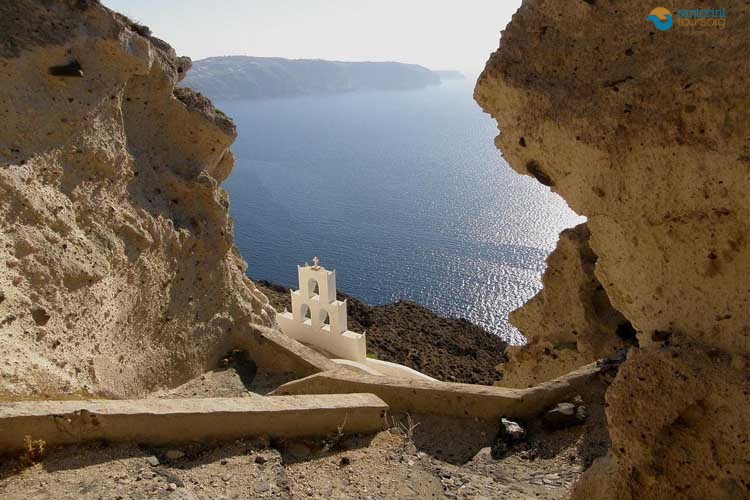
Megalochori Santorini is known for them. The Cycladic form – a free-standing wall pierced with arches for the bells rather than a tower attached to the church – appears throughout the village, and two of them stand over the lanes as gateways. They are among the most photographed structures on the island outside Oia.
The mansion houses
The archontika built by the Vinsanto merchants: high walls, arched gateways, internal courtyards and vaulted rooms. Most are private and several are now small hotels. What you see from the lanes is the outside, and the outside is the point – blank defensive walls with a single ornate door.
Panagia Eisodion
The main church, with a domed roof and a bell tower, standing over the square.
The canavas
Underground vaulted cellars cut into the pumice, used for making and storing wine. Several survive in and around Megalochori Santorini, and some are open as wineries or restaurants.
The lanes
The main activity. Narrow, stepped in places, arched over in others, and almost empty at any hour. Allow an hour to wander without a plan.
The Wine Around Megalochori Santorini
The village sits in the heart of the island’s wine country, and the vineyards are unlike vineyards anywhere else in Europe.
The vines here are ungrafted. Phylloxera, the root louse that destroyed almost every European vineyard in the nineteenth century, never established itself in Santorini’s volcanic sand. Some root systems around Megalochori Santorini are estimated at three or four hundred years old, propagated continuously by layering rather than replanting.
They are trained into koulara – low woven baskets, the vine coiled around itself close to the ground with the fruit growing inside. It shelters the grapes from the meltemi and traps the morning humidity that condenses out of the sea air, which is effectively the only water they get. Santorini has no rivers and very little rain.
Assyrtiko is the grape: bone dry, high acid, mineral and faintly saline. Athiri and Aidani blend alongside it. Nykteri is the oak-aged dry white. Vinsanto is the sweet wine that built this village – grapes sun-dried on mats for up to two weeks, pressed, then aged for years in oak.
Several estates sit within a few minutes of Megalochori Santorini and most take visitors. Do not drive between them after tasting; the roads are narrow and the island’s drivers are not gentle. Our wine tour covers three estates with all tastings included and nobody driving.
The History of Megalochori Santorini
The kastelli period. Like every settlement on this island, Megalochori grew inland and defensively. Through the Venetian and Ottoman periods the population lived away from the coast because pirates operated freely in the Aegean, and the village’s high blank walls and single-entrance courtyards are that logic in stone.
The Vinsanto trade. From the seventeenth century onward Santorini’s sweet wine found a market in Russia, shipped as communion wine for the Orthodox Church. Megalochori Santorini was one of the centres of that trade. The merchants built the archontika – vaulted mansions with courtyards and their own canavas beneath – and the village became, briefly, one of the wealthiest on the island.
Collapse. The Russian Revolution ended the export market. Steam shipping and the Corinth Canal had already redrawn the trade routes. By the early twentieth century the wine money was gone.
1956. The Amorgos earthquake, magnitude 7.7, damaged the village, though far less than the caldera settlements where houses stood on the crumbling rim. Emigration followed as it did everywhere.
Neglect, then rediscovery. For decades Megalochori Santorini was simply a farming village that tourism ignored. That neglect is why it survives intact. Since the 2000s the mansions have been restored as small hotels and the village has appeared on itineraries – still, notably, without the crowds.
Walking here you are walking through a wine fortune that ended a century ago and a village that was too poor to modernise, which is a more interesting thing to look at than a restoration.
Eating and Drinking in Megalochori Santorini
This is one of the genuine reasons to come. The tavernas around the square cook for locals as much as for visitors, and the bill reflects the food rather than a view.
What it costs. Roughly 20€ to 30€ a head with wine for a proper meal, against 45€ and upward for the equivalent on the caldera. That gap is the single most useful piece of practical advice about eating on Santorini.
What to order. The island’s own dishes: tomatokeftedes, fritters from the small sweet PDO tomatoes; fava, the yellow split pea purée with its own protected designation, served warm with raw onion and capers; white aubergine, sweeter than the purple kind and grown almost nowhere else; caper leaves as well as buds; chloro, the fresh goat cheese that does not leave the island.
What to drink. Assyrtiko from the estates you can see from the village edge. A carafe of the house white in Megalochori Santorini is usually local and usually good.
When. Greeks eat from nine. A taverna full at seven is a taverna full of visitors.
Cave restaurants. Several of the old canavas now operate as restaurants – vaulted, cool, and a genuinely unusual room to eat in.
If food is what you travel for, our food tour visits producers in exactly this part of the island and finishes with a sit-down meal.
Staying in Megalochori Santorini
What you get. Restored mansion houses and cave suites, many with plunge pools and courtyards, in a real village with a square and shops. Quiet at night. Prices well below the caldera villages for the same standard. Central for the whole island – ten minutes from the airport, fifteen from Fira and the beaches.
What you give up. The caldera view. Megalochori Santorini is inland and looks over vineyards rather than the crater. If waking up to the caldera is the point of your trip, stay in Firostefani or Imerovigli and come here for an afternoon.
Who it suits. Repeat visitors, travellers who want a village rather than a resort strip, families who want space, couples on a budget, and anyone who intends to spend time on the wine.
Practical points. Some properties sit inside the pedestrian lanes, so luggage travels the last stretch on foot. Confirm with the hotel and tell us when you book a transfer. There is a small shop or two; the supermarkets are in Fira.
Alternatives nearby. Pyrgos is ten minutes away, higher, with a castle and the island’s best all-round view. Emporio is ten minutes south, cheaper and even less visited. Pyrgos · Emporio.
Getting to Megalochori Santorini
By car. Fifteen minutes from Fira, twenty from Oia, ten from the airport, fifteen from Athinios. Park at the edge – the village lanes are pedestrian and always have been.
By bus. The Fira–Akrotiri route passes Megalochori Santorini and costs a couple of euro. Services are regular in season and sparse outside it.
By taxi. Possible, though Santorini’s licensed fleet is famously small.
On a tour. The village appears on several of our itineraries, and the advantage is a guide who can explain what the walled mansions and bell towers actually were. The south part tour and the full day tour both include it.
By transfer. Our private transfers run from the airport and both ports from 40€ per vehicle, with flights and ferries monitored.
What to wear
Shoes with grip. The lanes are cobbles and worn marble, stepped in places. There is more shade here than in the caldera villages, but not much.
Walking Megalochori Santorini: A Route
The village is small enough that wandering is the right approach, but if you would like a shape to it, this is the one we use with guests.
Start at the square. Park at the edge of the village and walk in. The square is shaded, has the cafés and tavernas, and the main church stands over it.
Take the lane north-west from the square. Within thirty metres the noise stops. The lanes here are narrow, occasionally arched over, and the walls on either side are the backs of the merchant houses.
Find the bell towers. Two stand over the lanes as gateways. They are the most photographed things in Megalochori Santorini and they are hard to find deliberately, which is part of the pleasure.
Look at the doors. The mansion gateways are the whole architectural story: high blank walls with a single ornate arched door, built when a wall facing the lane was a defence rather than a façade.
Walk out to the vineyard edge. The southern side of the village opens onto the basket-trained vines. From here you see how close the wine country actually is.
Circle back through the eastern lanes. A different set, more residential, with washing lines and cats and very few visitors.
Allow an hour at an unhurried pace. Nobody hurries in Megalochori Santorini and there is nothing to hurry for.
The Architecture of Megalochori Santorini
The village is worth reading rather than only photographing.
The archontika
The merchant mansions. High enclosing walls, an arched gateway, an internal courtyard, and vaulted rooms behind. The vault is structural – a barrel-vaulted roof of volcanic stone and lime survives an earthquake far better than a flat span, which on this island is not a theoretical concern.
The canava
The winery cellar, dug into the pumice beneath the house or into the hillside. Cool year-round without any mechanism, and the reason wine could be aged here at all. Several around Megalochori Santorini are now restaurants or tasting rooms.
Yposkafa
Cave dwellings excavated horizontally into the soft ash, as on the caldera rim. Cheap to make, thermally stable and earthquake-resistant.
The free-standing bell tower
A wall pierced with arches, holding the bells, standing separate from the church. A Cycladic form you will not see on the mainland, and Megalochori Santorini has some of the finest examples on the island.
The whitewash
Lime, which is antibacterial and reflects heat. The colours that appear on some doors and domes came from whatever pigment was cheap – often shipped in as ballast.
The cisterns
Every traditional house has one beneath it, collecting winter rain from the roof. With no rivers and almost no rainfall, that determined the shape of the roofs themselves.
Megalochori Compared With the Other Villages
Against Pyrgos. The closest comparison and ten minutes away. Pyrgos is higher, has a Venetian castle and the best all-island view; Megalochori Santorini is flatter, more intact at street level, and has the mansion architecture and the bell towers. Do both – they are a natural pair for one afternoon. More on Pyrgos.
Against Emporio. Emporio has the island’s best-preserved kastelli – a genuine defensive maze – and is even less visited. Megalochori is prettier and has the better tavernas. More on Emporio.
Against Oia. No comparison and no competition. Oia has the caldera and the crowds; Megalochori Santorini has neither. Most visitors should see both and will remember different things about each. More on Oia.
Against Fira. Fira is the capital, with museums, transport and nightlife. This is a village with a square. More on Fira.
Against Mesa Gonia and Vothonas. Both smaller, both quieter still, both worth an hour if you are already inland. Mesa Gonia · Vothonas.
If you have one afternoon for the inland south, Megalochori Santorini and Pyrgos together are the best use of it.
When to Visit Megalochori Santorini
April and May. The best window. The vines are pruned back into their baskets and shooting, the slopes are green, and the village is comfortable to walk at any hour.
June to August. Hot. Megalochori Santorini fares better than the caldera villages in high summer because the lanes are narrow and shaded in places, and because no coaches come. Go early or after five.
September. Harvest. Grapes coming in around the village, the wineries working, and the best month of the year to be here.
October. The quiet after the harvest, warm, and the light on the white walls in the late afternoon is the finest of the year.
November to March. Many businesses close but the village keeps functioning because people live here year-round. Megalochori Santorini in winter is a working village rather than a closed resort, which is more than can be said for the rim.
Time of day
Early morning and the two hours before sunset. In the middle of the day in August the lanes are hot and the tavernas are shut between lunch and dinner.
Photographing Megalochori Santorini
The village photographs quite differently from the caldera, and better than most visitors expect.
The bell towers. The signature shot. Free-standing arched walls over the lanes, best with a plain sky behind and the light raking across in late afternoon.
The gateways. Ornate arched doors set into blank white walls. The contrast is the picture.
The lanes. Narrow, occasionally vaulted overhead, and – unusually for Santorini – empty enough to photograph without waiting for someone to walk out of frame. This is the practical advantage Megalochori Santorini has over Oia for photography.
The square. Trees, tavernas, the church, and actual village life.
The vineyards. Walk to the southern edge. The basket-trained vines are strange enough to be worth photographing in their own right, especially in low light.
Blue hour. Twenty minutes after sunset the whitewash holds the last light and the lanes light up. Nobody is here at all.
Technical. Midday sun blows out white walls – expose for the walls rather than the sky. A wide lens for the lanes, something longer for the towers.
Courtesy. These are homes. The lanes pass front doors, and photographing into open courtyards is not welcome. Everything worth taking in Megalochori Santorini is visible from the public lane.
Frequently Asked Questions About Megalochori Santorini
How do you pronounce it? Roughly “me-ga-lo-KHO-ree”. It means “big village”.
Where is it? Inland in the south of the island, fifteen minutes from Fira and ten from Pyrgos.
Is Megalochori worth visiting? Yes. It is one of the two most intact traditional villages on Santorini and it is genuinely quiet.
How long do I need? An hour to walk it, half a day with a winery and a meal.
Is there a caldera view? No. The village is inland and looks over vineyards.
Can you stay there? Yes, in restored mansions and cave houses, at prices well below the rim.
Is it good for families? Better than the caldera villages – flatter, fewer drops, and space in the square.
Is it accessible? Partly. The square and main lanes are reasonably flat; the narrower lanes are stepped and uneven.
Are there wineries nearby? Several within minutes. Do not drive between them after tasting.
Is there a beach? No. The black sand beaches are fifteen minutes away at Perissa and Perivolos.
Is it crowded? Rarely. Coaches cannot enter the lanes and most itineraries skip it.
What is Vinsanto? The island’s sun-dried sweet wine, aged in oak, and the trade that built this village.
How do I get there without a car? The Fira–Akrotiri bus, or a tour with pickup included.
What is the best time of day? Early morning or the two hours before sunset.
Tours That Include Megalochori Santorini
We are a licensed local operator with guides who live on the island. Prices are per vehicle rather than per person, pickup is included from anywhere including both ports, and an 80€ deposit confirms any date.
South part tour – five hours from 280€, covering Akrotiri, the beaches and the inland villages including Megalochori Santorini.
Wine tour – four and a half hours from 650€ with three estates and all tastings included, in the country around this village and Pyrgos.
Food tour – five hours from 556€ with a producer visit and a sit-down meal.
Full day tour – eight hours from 460€, the whole island with a traditional village stop.
Personalised tour – from 220€, built around the inland villages if that is what you want.
Every itinerary and all prices are on the santorini tours page. If you are staying in Megalochori Santorini, our private transfers cover the airport and both ports from 40€.
Is Megalochori Santorini Worth Visiting?
Megalochori is the village people mean when they say they want to see “the real Santorini” and then go to Oia anyway. It has no view to queue for and nothing that appears on a list of the island’s top attractions, which is exactly why it still looks like itself.
Go in the late afternoon. Walk the lanes without a map, find the bell towers, look at the doors, sit in the square, and eat at nine for half what the caldera charges. Add a winery if you have the time and someone else to drive.
An hour here and an hour in Pyrgos ten minutes away is, in our view, the best afternoon on Santorini that costs almost nothing. Megalochori Santorini will not be the photograph you show people when you get home, and it may well be the part of the island you remember.
Send us your dates and party size and we will tell you honestly how it fits into your trip – including when the answer is that you should hire a car for an afternoon and go on your own.
Day Trips From Megalochori Santorini
The village sits almost exactly in the middle of the island’s southern half, which makes it an unusually efficient base.
Pyrgos – 10 minutes. The Venetian castle village at the island’s highest inhabited point, with a view over both coasts. The natural pairing with an afternoon here. More on Pyrgos.
Emporio – 10 minutes. The largest village on Santorini and the least visited, with the best-preserved medieval kastelli on the island. More on Emporio.
Akrotiri – 15 minutes. The Bronze Age town buried under ash and preserved, roofed so it works in any weather. More on Akrotiri.
The black sand beaches – 15 minutes. Perissa, Perivolos and Vlychada, with the strangest coastline on the island at the last of them. Perissa · Vlychada.
Fira – 15 minutes. Museums, the bus station, the cable car and the caldera path. More on Fira.
Ancient Thera – 25 minutes. The Hellenistic and Roman city on the ridge above Kamari. More on Ancient Thera.
Oia – 25 minutes. The far northern tip. Go early or stay for the evening. More on Oia.
Staying in Megalochori Santorini puts all of that within half an hour, which is not true of Oia at the other end of the island.
What Megalochori Santorini Costs
Substantially less than the caldera, which is a large part of the case for coming here.
Coffee. 2.50–4€ in the square, against 4–7€ on the rim.
Wine by the glass. 4–6€.
Taverna dinner. 20–30€ a head with wine, against 45€+ for the equivalent with a caldera view.
Hotel, shoulder season. From around 90€ for a simple room to 250€ for a restored mansion suite with a plunge pool.
Hotel, August. Higher, but nothing like the rim.
Winery tasting. 15–25€ a head, paid at the estate.
Bus from Fira. A couple of euro.
Transfer from the airport. 40€ per vehicle for one or two people.
A private tour. From 220€ for the whole vehicle for four hours, pickup from Megalochori Santorini included.
Walking the lanes. Free, and the main thing to do.
A couple staying inland and eating in the square rather than on the caldera will save more over a week than the cost of a private tour, which is worth knowing when you plan the trip.
Who Megalochori Santorini Is For
Repeat visitors. People who did the caldera on their first trip and want the island on their second. This is the most common case.
Anyone interested in wine. The estates are minutes away and the village is the reason they exist.
Travellers who want to eat well cheaply. The tavernas here are better and half the price of the rim.
Families. Flatter than the caldera villages, with a proper square and far fewer unfenced drops.
Photographers. Empty lanes at any hour, which Oia cannot offer at any price.
Anyone based centrally. Everything in the southern half of the island is within fifteen minutes.
Less suited to first-time visitors with only two nights, who should see the caldera; anyone who wants a sea view from their room; and travellers relying entirely on buses, since the inland services are thinner than the Oia and Perissa routes.
If you are choosing one inland village to spend real time in, Megalochori Santorini and Pyrgos are the two, and they are ten minutes apart.
Practical Notes for Megalochori Santorini
Parking. At the edge of the village. The lanes are pedestrian and were built for donkeys.
Shoes. Cobbles and worn marble, stepped in places. Grip matters more than in Fira.
Shade. More than the caldera villages – the lanes are narrow and some are vaulted – but the square and the vineyard edges have none.
Opening hours. Many businesses close in the afternoon and reopen around six. Some shut entirely from November to March.
Money. Cards accepted in the tavernas; carry cash for the bakery and smaller places. The nearest reliable ATMs are in Fira.
Shops. A small grocery or two. The supermarkets are in Fira and Messaria.
Noise. Almost none. Megalochori Santorini is one of the quietest places to sleep on the island.
Accessibility. The square and the wider lanes are manageable; the narrow stepped sections are not.
Respect. People live here year-round. Voices carry in the lanes and the courtyards are private.
Megalochori Santorini Month by Month
January and February. The village keeps working because people live here, unlike the caldera resorts. Some tavernas stay open. Cold by Greek standards, wet in short bursts, and the vines cut back to stumps.
March. Pruning finished, the first shoots appearing, and the slopes green after the winter rain.
April. One of the two best months. Comfortable walking, everything reopening, and wildflowers between the vine baskets.
May. Warm without heat, long evenings, and the vineyards at their greenest.
June. Hot from mid-month. The narrow lanes of Megalochori Santorini hold shade better than the open caldera rim.
July and August. Peak heat. Go early or after five. The advantage here is that no coaches enter the village at any hour.
September. Harvest, and the best month to be in this part of the island. Grapes coming in, presses running, and growers willing to talk.
October. The quiet afterwards, with the new wine in tank and the finest late light of the year on the white walls.
November and December. Shutting down, though never entirely. Megalochori Santorini in winter is a village rather than a closed season.
Common Mistakes in Megalochori Santorini
Driving into the village. The lanes are pedestrian and were built for donkeys. Park at the edge.
Coming at two in the afternoon. Businesses close and reopen around six, and in August the lanes are hot.
Expecting a caldera view. There is none. That is not what this village is.
Eating on the rim instead. The tavernas here are better and half the price.
Driving between wineries after tasting. The roads are narrow and unlit in places.
Buying wine in a Fira gift shop. Buy it at the estate outside Megalochori Santorini, where the same bottle costs considerably less.
Treating it as a fifteen-minute photo stop. Most itineraries do exactly that. An hour in the lanes and a meal in the square is a different experience entirely.
Missing Pyrgos. Ten minutes away, and the two together make the best inland afternoon on the island.
Weddings, Photography and Special Occasions
Megalochori Santorini has quietly become an alternative to Oia for couples who want the Cycladic look without the crowd.
Weddings. Several restored mansions and courtyards take small weddings, and the bell towers and arched gateways give the photographs a setting that is recognisably Santorini without being the caldera.
Photography sessions. Early morning in the lanes, with nobody in the frame. This is the practical advantage over Oia, where a photographer works around a crowd from mid-morning onward.
Proposals. Quieter and more private than any caldera viewpoint. We arrange these on the personalised tour – tell us in advance and the guide stays out of the way.
Group meals. The tavernas around the square handle larger tables far more comfortably, and more cheaply, than the rim restaurants.
Practical. Vehicles cannot enter the lanes, so guests in formal dress walk the last stretch on cobbles. Worth planning for rather than discovering.
A Final Word on Megalochori Santorini
Megalochori is one of two or three places on this island where you can still see what Santorini was before the caldera became a product. The wealth that built it came from wine shipped to Russia, the trade collapsed a century ago, and the village survived intact precisely because nobody had the money to change it.
There is no view to queue for here and nothing that appears on a list of the island’s ten best things. There are lanes, bell towers, arched doors, a shaded square, vineyards on three sides and food at half the price of the rim.
Go late in the afternoon, walk without a map, and eat at nine. Add Pyrgos ten minutes away and you have the best inland afternoon Santorini offers.
We are a licensed operator with guides who live on the island year round. Pickup is included from anywhere, prices are per vehicle rather than per person, and an 80€ deposit confirms any date. Send your dates and party size and we will give you an honest answer about how Megalochori Santorini fits your trip – including when the answer is to hire a car for an afternoon and go alone.
Megalochori Santorini With Children
Of all the villages on this island, Megalochori Santorini is the easiest one to bring children to, and that is not a small point on Santorini.
The ground is flat. The caldera villages are built down a cliff face. Fira, Firostefani, Imerovigli and Oia all involve long flights of steps with unfenced drops beside them. This village is built on the plateau, and while the lanes are cobbled and stepped in places, nothing about it is dangerous.
There is a square. A proper one, with trees, shade, benches and tavernas around the edge. Children can be children in it while the adults sit. There is no equivalent space anywhere on the caldera rim.
No traffic. Vehicles do not enter the lanes. You can let a child walk ahead without watching for scooters, which you cannot do in Fira.
The food is normal. Taverna cooking rather than tasting menus, served early enough if you ask, and at a price that makes a family meal out an ordinary event rather than a decision.
It is quiet at night. No bars, no music, no cruise crowd. Children sleep, and so do their parents.
What it does not have. A beach, a playground, or anything organised for children. The black sand at Perissa and Perivolos is fifteen minutes away and that is where families end up in the afternoon. Megalochori Santorini is a morning and an evening place.
Pushchairs. Manageable in the square and the wider lanes, awkward in the stepped ones. A carrier is easier.
The Vineyards You Can Walk To
One of the genuine pleasures here is that the wine country is not somewhere you drive to. It starts at the edge of the village.
Walk south or west out of the lanes and within two hundred metres the houses stop and the vines begin. What you are looking at will not resemble any vineyard you have seen before. There are no rows, no trellises and no wires. The vines lie on the ground, coiled into low woven baskets a metre or so across, with the fruit hidden inside the coil.
This is koulara, and it exists because of the wind and the water. The meltemi comes off the sea hard enough to strip an upright vine, so the plant is trained horizontally. There is no rain worth counting between April and October and no river on the island, so the basket is shaped to catch the morning humidity that condenses out of the sea air and drip it down to the root. The grapes sit inside, shaded by the vine’s own leaves.
The soil is volcanic ash and pumice over lava. It holds almost no organic matter, which is why yields here are among the lowest in Europe – and why phylloxera never took hold. The louse cannot move through that sand. Every European vineyard outside a handful of pockets was replanted onto American rootstock after the nineteenth-century blight; the vines around Megalochori Santorini were not. Some root systems are three or four centuries old, renewed by burying a cane and letting it take root rather than by planting anything new.
Growers around the village will tell you the vines are older than the houses, and in several cases that is literally true.
Walk out at the end of the afternoon. The light comes across the slopes low, the baskets throw long shadows, and you can usually see the sea on both sides of the island from the same spot.
Megalochori Santorini in One Afternoon
If you have a car and a free half-day, this is the itinerary we would give a friend.
Four o’clock. Park at the edge of Megalochori Santorini and walk into the square. Coffee under the trees while the heat comes off the day.
Half past four. Into the lanes without a map. Find the two bell towers, look at the mansion doors, and let yourself get mildly lost. It is a small village and every lane comes back to somewhere.
Half past five. Out to the vineyard edge on the southern side for the light on the baskets.
Six o’clock. Drive ten minutes to Pyrgos. Walk up through the kastelli to the castle and the church at the top, where you can see both coasts and, on a clear day, most of the Cyclades.
Half past seven. Back down. If you want the sunset without the Oia crowd, this ridge is where the locals watch it.
Nine o’clock. Dinner back in the square in Megalochori Santorini, at a third of what the same meal costs on the rim, at the hour Greeks actually eat.
That afternoon costs the price of a tank of fuel and two meals, and a good number of our guests tell us afterwards that it was the part of the trip they would repeat.
What Nobody Tells You About Megalochori Santorini
It is not a museum village. People live here, all year, and the lanes pass their front doors. That is the reason it feels different from Oia and also the reason to keep your voice down after eleven.
The bell towers are hard to find on purpose. There are no signs to them. You come round a corner and there one is. Trying to navigate directly to them defeats the whole point of the place.
The best tavernas are not on the square. Two of them are, and they are good. The one most locals use is down a lane off it and has no view of anything.
The wine is cheaper at the estate. The same bottle of Assyrtiko costs noticeably less bought at the winery outside the village than in a gift shop in Fira, and the estates will ship.
Afternoon closing is real. Between roughly two and six a good deal of Megalochori Santorini is shut. This is not laziness; it is what you do when it is thirty-five degrees.
The village looks best empty. Which it is, most hours of most days. If you arrive and think there is nothing here, you have understood it correctly – that is the attraction.
Booking a Tour That Stops Here
Most coach itineraries give this village fifteen minutes at a fixed viewpoint and move on. Ours do not, because the whole value of the place is the time you spend walking it slowly.
Tell us when you enquire that the inland villages are what you want and we will build the day around them – Megalochori Santorini and Pyrgos together, a winery in between, and the caldera left for another afternoon. Prices are per vehicle, not per person, so a family of four pays what a couple pays. Pickup is included from any hotel, the airport or either port, and an 80€ deposit holds the date.
Send your dates, your party size and where you are staying, and you will get a straight answer the same day.
Everywhere the Santorini Megalochori Santorini Can Reach
Any of these can be built into a private itinerary. Each has its own page with what to see and how long to allow.
Caldera villages: Fira · Firostefani · Imerovigli · Oia · Finikia · Baxedes
Inland villages: Pyrgos · Megalochori · Emporio · Mesaria · Karterados · Vothonas · Vourvoulos · Exo Gonia · Mesa Gonia · Pigadia
Beaches: Perissa · Perivolos · Kamari · Vlychada · Monolithos · Red Beach · White Beach · Agios Georgios · Agia Paraskevi
Sites and landmarks: Akrotiri · Ancient Thira · Akrotiri Lighthouse · Nea Kameni · Palia Kameni · Thirasia · Athinios Port
All our tours: All Santorini tours · Full day tour · Sightseeing tour · Personalised tour · North part tour · Horse riding · South part tour · Sunset tour · Shore excursion · Caldera tour · Food experience · Wine tour · Historical tour · Small group tour
Planning and services: Famous sights tour · Transfers to Oia and Finikia · Transfers to other villages · Villages of Santorini · History of Santorini · Tours near you · Languages we guide in · Food and fun tours · Gay friendly tours · Our tour buses · Daily tours · Day tours · FAQ · Gallery · Tour photo gallery · About us · Contact · Blog








Leave a Reply