
Thirasia Santorini Private Guided Tours
Thirasia Santorini is the small inhabited island across the caldera to the west, separated from the main island by the eruption. It is located at the west side of Santorini and it is about one nautical mile away from the rotated beacon of Oia. Thirasia is a picturesque island that has nothing to do with the cosmopolitan center of Santorini.
The island of Thirasia is the right place for those who would like to have relaxing and peaceful vacations in distance with cosmopolitan life. Although the different life style this place have a lot of similarities with it’s neighbor Santorini, such as the architecture of the churches and the houses, the vegetation and the blue and green waters of the sea.
Visit the sightseeing of Thirasia by private guided tours
Thirasia private tours is the best way to see as much as you can from this beautiful island and get guided from the local Thirasia private guided tours. We are going to share with you all the little secrets of this small island.
We can follow the footpaths and go to Agrilia, a small agricultural house development. Here you are going to have the opportunity to taste the excellent wine of the area and the local hospitality.
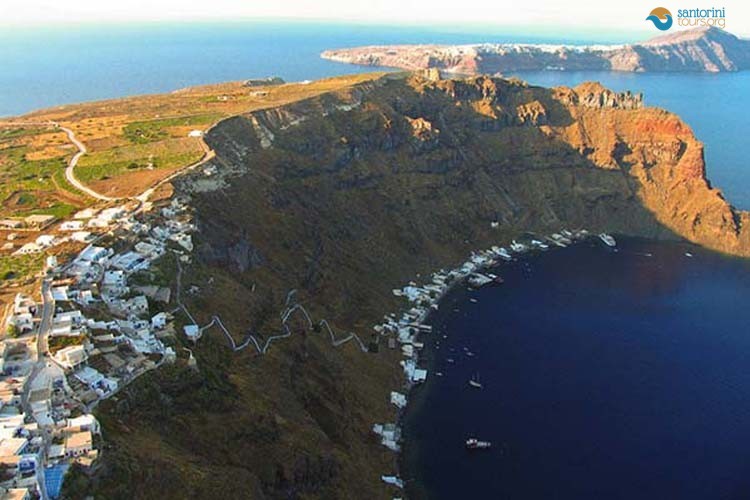
An other very beautiful place to visit here in Thirasia is Korfou which is the oldest port of the island. You can go down there by a mule by a road of 270 paving steps or go there with Thirasia private transfers. Here is also the place where you can find a lot of taverns where you can taste fresh fish.
Thirasia private transfers
Santorinitours offers you the opportunity of Thirasia transfers and Thirasia private guided transfers in order to give you the opportunity to get known the place from it’s own people. We can start from the Korfou port and sail to the island of the volcano, even more you can enjoy swimming in the thermal baths of the island.
The brimstone in the bottom of the see gives to the water a more worm and red color.
History of Thirasia
Thirasia is separated from Santorini since the great earthquake of 1650’s. If you look closely you are going to see that Thirasia, Santorini and Whiteisland years ago were touched to each other as a unique island which was known as the Ancient Stroggyli.
At the middle of the 18th century some labors found out same ancient ceramic vessels and skeletons. That discovery was the reason that the archaeologist began the excavation in different places of the island.
Book A Private Tour Now

Book now and discover our amazing tours in Santorini!
See more about Santorini Private Tours:
- Santorini Sightseeing Private Tour
- Santorini Exclusive Shore Private Tour
- Santorini Impressive Caldera Private Tour
- Santorini South Part Private Tour
- Santorini North Part Private Tour
- Santorini Historical Private Tour
- Santorini Sunset Private Tour
Thirasia Santorini: The Island That Was Left Behind
Thirasia Santorini is the separate island lying across the caldera to the west, about a nautical mile from the northern tip of Santorini. It is the same island – the western wall of the volcano, cut off when the centre collapsed into the sea – and looking at it from Oia is the clearest way to understand what happened here. Book with Santorini Tours, a licensed local operator.
Around three hundred people live on Thirasia Santorini. There is no airport, no resort, no traffic to speak of and no nightlife. There is a cliff-top village with a view straight back across the crater at Santorini, a handful of tavernas, a harbour at the bottom of two hundred steps, and a great deal of quiet.
Every large caldera cruise stops here for an hour at lunchtime. Almost nobody stays, and the difference between those two experiences is the whole point of this page.
Where it is
Across the caldera west of Oia, reached by boat from Ammoudi, from the old port below Fira, or by the local ferry from Athinios.
Why go
For the view back at Santorini from the outside, a village where nothing is arranged for visitors, and lunch at a third of caldera prices.
What to See on Thirasia Santorini
Manolas
The main village, on the cliff top directly opposite Santorini. Whitewashed houses, cave dwellings cut into the rock, blue-domed churches, a handful of tavernas along the edge, and a view across the caldera that is the equal of anything from Imerovigli – with nobody standing in front of it.
The steps from Korfos
Two hundred or so zig-zag steps climb from the harbour at Korfos to Manolas. Donkeys work them for those who would rather not, and the climb takes fifteen to twenty-five minutes on foot with the caldera opening behind you the whole way.
Korfos
The little harbour where the boats land: a row of tavernas along the water, fishing boats, and a pebble shore. Most day-trippers see this and nothing else of Thirasia Santorini.
Potamos
A village set down in a hollow inland, built into the sides of a valley in cave houses. Almost nothing is open and almost nobody goes. It is the most atmospheric place on the island.
Agrilia
A largely abandoned settlement of cave dwellings, slowly being restored in places. Empty houses with their doors open, and views west to the open sea.
Riva and Agia Irini
The northern harbour and the church of Agia Irini – Saint Irene – from which the name Santorini itself is generally derived.
The walking
A dirt road and paths link the villages end to end. The whole island can be walked in a long morning, and the western side has no development at all.
The History of Thirasia Santorini
One island. Before the Minoan eruption, Thirasia Santorini and the main island were parts of a single round island. The eruption around 1600 BC emptied the magma chamber, the centre collapsed, and what remained were the eastern crescent, this western fragment and the small islet of Aspronisi.
Prehistoric settlement. Excavations on the island have found Bronze Age material buried under the eruption deposits, as at Akrotiri across the water – in fact the first such discoveries in the caldera were made on this side, during quarrying for the Suez Canal in the nineteenth century. More on Akrotiri.
The pumice quarries. For over a century the caldera islands exported volcanic ash and pumice as cement material, and the works on Thirasia Santorini were part of that trade. It ended in the twentieth century and the scars are still visible.
1956. The Amorgos earthquake hit this island as hard as the caldera villages opposite. Many families left and never came back, which is why Agrilia and parts of Potamos stand empty.
The divergence. Tourism arrived on Santorini in the 1970s and did not cross the water. Thirasia stayed a farming and fishing island with a few hundred residents and no airport.
Now. Day boats call at Korfos, a small number of rooms take overnight visitors, and the island is what Santorini was fifty years ago.
Getting to Thirasia Santorini
Thirasia Santorini on a caldera cruise. The usual way. Volcano, hot springs, then an hour or so at Korfos for lunch before Oia at sunset. Easy, cheap and rushed – most people never leave the harbour.
By small boat from Ammoudi. Local boats cross from below Oia in about fifteen minutes, several times a day in season. This is how to go independently and it is the best option.
By ferry from Athinios. A small local ferry runs on a schedule aimed at residents rather than visitors. Slower and cheapest, and it carries vehicles.
Getting up to Manolas. From Korfos, two hundred steps on foot in fifteen to twenty-five minutes, or by donkey. There is also a road up used by the island’s few vehicles.
Getting around. On foot, or by the handful of taxis and minibuses that meet the boats. Nothing on Thirasia Santorini is more than an hour’s walk from anything else.
By private transfer. We will get you to Ammoudi, the old port or Athinios for whichever crossing you are taking. Our private transfers run from anywhere on the island from 40€ per vehicle.
How long to allow
An hour if you are on a cruise and stay at Korfos. Half a day to walk up to Manolas and eat properly. A full day, or a night, to see Potamos and Agrilia and understand the place.
Eating and Staying on Thirasia Santorini
The Thirasia Santorini tavernas. A row along the harbour at Korfos and several on the cliff edge at Manolas. They cook what the island grows and what the boats bring in, and the bill is a third of what the same food costs opposite.
What to order. Fava, the yellow split pea purée grown across this caldera and carrying its own protected designation. Tomatokeftedes. White aubergine. Caper leaves. Chloro cheese. Fish, when there is fish.
The view with lunch. From Manolas you eat looking straight across the crater at Fira and Imerovigli strung along the far cliff. It is the same view they sell over there at four times the price, seen from the other side.
Staying the night. A small number of rooms and restored cave houses. This is the real recommendation on this page: when the last cruise boat leaves in the late afternoon, Thirasia Santorini empties completely and you have the caldera to yourself.
The sunset. Facing east, the island does not get the Oia sunset – it gets the light on Santorini instead, which is arguably the better half of the deal.
Practicalities. One or two small shops, no bank, no pharmacy and limited medical cover. Bring what you need.
Practical Notes for Thirasia Santorini
The steps. Two hundred of them on Thirasia Santorini, from Korfos to Manolas, uneven and exposed. Proper shoes, and water in summer.
Donkeys. Available at the harbour for the climb. If you would rather not, walk or take the road.
Cash. There is no bank on the island. Bring what you will need.
Shade. Limited, and none on the steps.
Timing your return. Local boats stop in the early evening. Check the last crossing before you walk inland, because there is no other way back to Santorini.
Shops. Minimal. No supermarket, no pharmacy.
Accessibility. Poor. Korfos is level; everything above it involves the steps or the road.
Respect. Three hundred people live on Thirasia Santorini and the lanes pass their front doors. This is not a museum village.
Winter. The island functions, because its residents live there, but crossings are weather-dependent and most visitor businesses close.
When to Visit Thirasia Santorini
April and May. The best window for Thirasia Santorini. Green, comfortable for the steps and the walking, and the cruise boats not yet at full volume.
June. Warm, everything open, and still quiet away from Korfos at lunchtime.
July and August. Korfos is busy between noon and three and empty the rest of the day. Go early on a local boat from Ammoudi and you will avoid the whole thing.
September. Warm sea, thinning crowds and the best month overall.
October. Quiet and beautiful, with fewer crossings as the month goes on.
November to March. The ferry runs for residents, weather permitting. Thirasia Santorini in winter is a working island and almost nothing is open for visitors.
Time of day
Morning, before the cruise boats, or late afternoon after they have gone. Between noon and three the harbour is full and the rest of the island is still empty.
Frequently Asked Questions About Thirasia Santorini
What is it? A separate inhabited island across the caldera to the west of Santorini, and part of the same island before the eruption split them.
How many people live there? Around three hundred.
How do I get there? By small boat from Ammoudi below Oia, on a caldera cruise, or by the local ferry from Athinios.
How long does the crossing take? About fifteen minutes from Ammoudi.
Do I have to climb the steps? To reach Manolas from the harbour, yes – about two hundred steps, or a donkey, or the road.
Is there anything to do? Walk between the villages, eat with a view of Santorini, and look at cave houses that nobody has tidied up.
Can I stay overnight? Yes, in a small number of rooms and restored cave houses, and it is the best way to see the island.
Are there beaches? Pebble shores rather than resorts, quiet and undeveloped.
Is there a bank or pharmacy? No. Bring cash and anything you need.
Is it worth a day trip? Yes, if you go independently. An hour at Korfos on a cruise is not really seeing Thirasia Santorini.
What is Potamos? An inland village of cave houses built into a hollow, largely empty and the most atmospheric spot on the island.
Is the sunset good? The island faces east, so it gets the light on Santorini rather than the Oia sunset itself.
Is it accessible? Not really. Korfos is level and everything above it involves steps or a road.
What is the connection to the name Santorini? The name is generally traced to Saint Irene, and the church of Agia Irini at Riva on this island is one of the places associated with it.
Thirasia Compared With Santorini
The scale. Thirasia Santorini has three hundred residents against fifteen thousand, and two million visitors a year on one side of the water and almost none on the other.
The view. Manolas looks straight across the caldera at Fira, Firostefani and Imerovigli. It is the same crater from the opposite wall, and on this side there is nobody in front of it. Imerovigli · Firostefani.
The prices. A meal on the cliff at Manolas costs roughly a third of the same meal on the cliff at Oia. More on Oia.
The architecture. Identical in origin – cave houses cut into pumice, barrel vaults, blue domes – but unrestored, which is what most visitors say they want to see and rarely do.
What you give up. Choice, services, transport, nightlife and a beach worth the name. Thirasia Santorini has none of them.
Who should go. Anyone on a second trip, anyone who found Oia unbearable, and anyone curious about what this island looked like before 1975.
Tours That Include Thirasia Santorini
We are a licensed local operator with guides who live on the island year round. Prices are per vehicle rather than per person, pickup is included from anywhere including both ports, and an 80€ deposit confirms the date.
Port transfers – to Ammoudi, the old port or Athinios for whichever crossing you are taking, from 40€ per vehicle.
Personalised tour – from 220€, built around a morning on Thirasia and the north of the island afterwards.
North part tour – Oia, Ammoudi and the northern villages, from where the crossings leave.
Full day tour – eight hours from 460€, the whole island by road.
Every itinerary and all prices are on the santorini tours page. Tell us which crossing you want and we will have you at the harbour for it.
Is Thirasia Santorini Worth It?
On a cruise, with one hour at the Thirasia Santorini harbour and a plate of fish, it is a pleasant interval between the volcano and the sunset and you will not remember much of it.
Gone to properly – the early boat from Ammoudi, the steps up to Manolas, lunch on the cliff, an afternoon walking to Potamos and Agrilia – it is the most interesting day on this island for anyone who has already seen the famous half.
Better still, stay a night. When the last boat leaves, three hundred people and one of the great views in the Aegean have the place entirely to themselves.
Send us your dates and we will get you onto the right crossing and back again.
Everywhere We Can Reach From Thirasia Santorini
Any of these can be built into a private itinerary. Each has its own page with what to see and how long to allow.
Caldera villages: Fira · Firostefani · Imerovigli · Oia · Finikia · Baxedes
Inland villages: Pyrgos · Megalochori · Emporio · Mesaria · Karterados · Vothonas · Vourvoulos · Exo Gonia · Mesa Gonia · Pigadia
Beaches: Perissa · Perivolos · Kamari · Vlychada · Monolithos · Red Beach · White Beach · Agios Georgios · Agia Paraskevi
Sites and landmarks: Akrotiri · Ancient Thira · Akrotiri Lighthouse · Nea Kameni · Palia Kameni · Athinios Port
All our tours: All Santorini tours · Full day tour · Sightseeing tour · Personalised tour · North part tour · Horse riding · South part tour · Sunset tour · Shore excursion · Caldera tour · Food experience · Wine tour · Historical tour · Small group tour
Planning and services: Famous sights tour · Private transfers · Transfers to Oia and Finikia · Transfers to other villages · Villages of Santorini · History of Santorini · Tours near you · Languages we guide in · Food and fun tours · Gay friendly tours · Our tour buses · Daily tours · Day tours · FAQ · Gallery · Tour photo gallery · About us · Contact · Blog