
The santorini windmills are eighteenth and nineteenth century grain mills, and the two everybody photographs stand at the northern tip of Oia, past the castle, 130 metres above Ammoudi. More survive at Emporio, Pyrgos, Imerovigli, Karterados and Akrotiri, where there is no crowd at all. Entry is free, none of them still turn, and the only interiors you can see are the few converted into hotel suites. Santorini Tours is a local operator running private tours and transfers on the island.
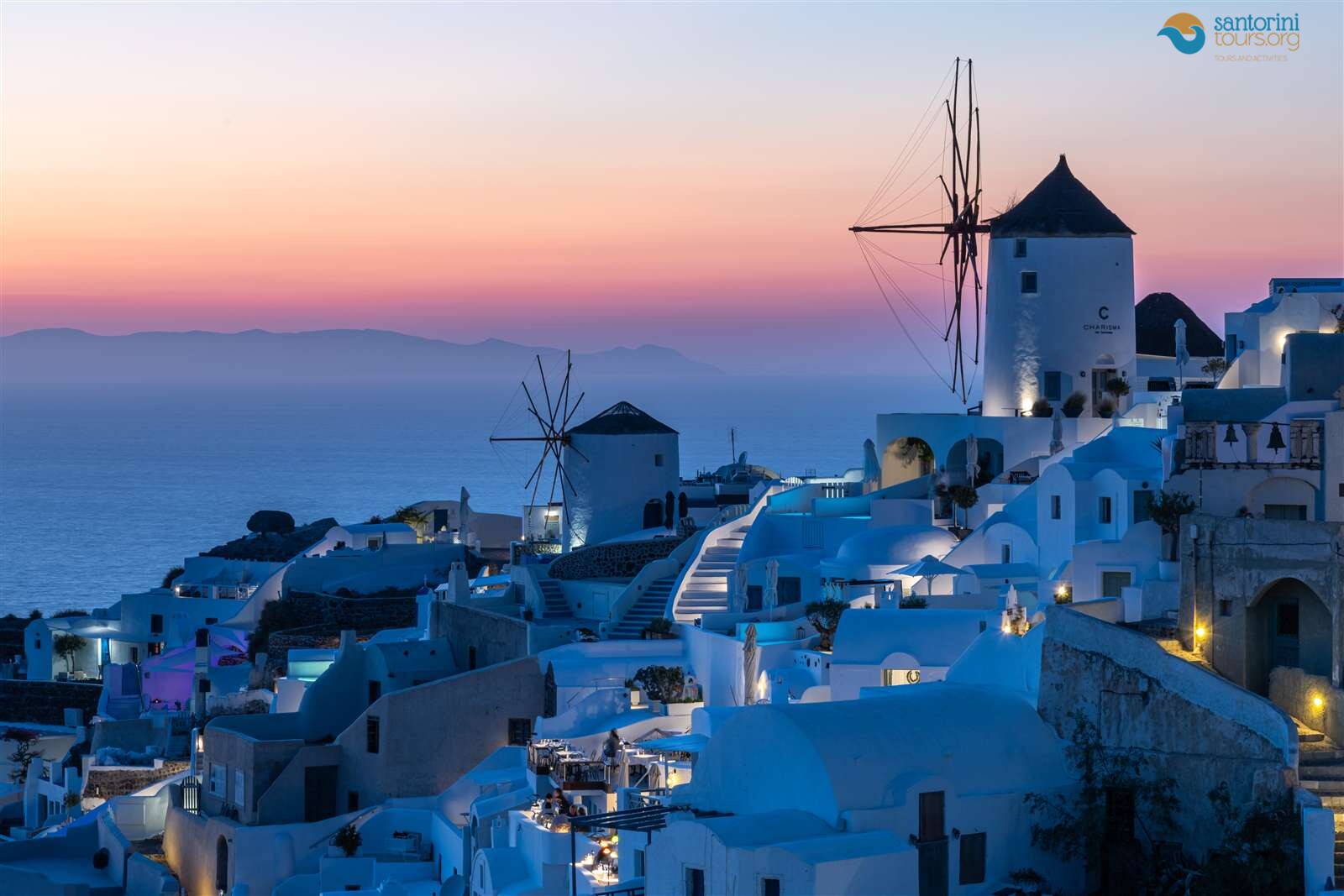
Santorini Windmills: The Short Answer
The santorini windmills are nineteenth-century grain mills, and the ones people photograph stand on the northern tip of Oia, on the ridge above Ammoudi, where the cliff turns and the sunset crowd gathers. Two are in the classic view. A third sits behind them, and there are more scattered across the island at Emporio, Pyrgos, Imerovigli, Karterados and Akrotiri that almost nobody visits.
The santorini windmills are round, whitewashed, roughly six to eight metres across at the base, with a conical roof that once turned to face the wind and twelve sails on a wooden frame. None of them still grind anything. Some are private houses, some are hotel suites, and the two at Oia are simply monuments that everybody photographs and nobody enters.
The short version: go at first light or an hour before sunset, walk to the end of the main street in Oia, and you will find them without a map.
Where the Santorini Windmills Actually Are
Oia, the two on the point. The famous pair of santorini windmills, at the far northwestern end of the village past the castle, with the caldera on one side and the open sea on the other.
Oia, the third. Slightly inland and lower, converted, and usually cropped out of the photograph.
Imerovigli. One above the village on the rim path, visible from the Fira to Oia walk and photographed by almost nobody.
Emporio. A row of stone mills on the hill above the village, the largest surviving group of santorini windmills on the island, unrestored and free to walk around.
Pyrgos. Two on the ridge outside the village, best seen from the road to Profitis Ilias.
Karterados and Vothonas. Isolated single mills on the inland plateau, on the way to nowhere.
Akrotiri. One near the lighthouse road, in a landscape with no other buildings at all.
See Oia.
What They Were Built For
Grain, not decoration. The santorini windmills were machines first. Santorini’s volcanic soil grew barley, fava and wheat that had to be milled, and the island’s one reliable resource is wind.
The date. Most were built in the eighteenth and nineteenth centuries, the busiest period of the island’s maritime economy.
The design of the santorini windmills. A Cycladic mill: circular stone tower, whitewashed, with a rotating conical roof and triangular canvas sails on twelve wooden spars.
The position. Always on a ridge or a headland, always facing the meltemi, which is why the santorini windmills are on exactly the spots with the best views.
The end of the working life. Diesel mills in the 1930s and 1940s, then the 1956 earthquake, finished them. By 1960 almost none were turning.
What replaced them. Nothing, for thirty years, and then tourism, which is why several are now suites with a caldera view.
Photographing the Santorini Windmills
Sunrise is the answer. The santorini windmills face west, the morning light comes over your shoulder from the caldera side, and at six in the morning in July there are perhaps four people on the point instead of four hundred.
Sunset is the postcard. The mills silhouette against the sun going down behind Thirasia, which is the shot everybody wants and the reason Oia is unwalkable from seven o’clock.
Where to stand for the classic frame. On the path below and east of the mills, shooting back up so the blue domes sit between you and the towers.
Where to stand for the clean frame. Above them on the road, with the open Aegean behind and no other building in shot.
The one from the water. From a boat leaving Ammoudi, the santorini windmills sit on the skyline 130 metres above you, which is the only angle that shows the scale.
Blue hour on the santorini windmills. Twenty minutes after the sun has gone, when the crowd leaves and the whitewash turns violet.
What not to do. Arrive at 19:45 in August and expect to walk to the point. The last two hundred metres take half an hour.
Getting There and What It Costs
Entry. Free. The santorini windmills at Oia stand on public ground and there is no ticket, no gate and no opening hour.
Going inside. Not possible at Oia. The interiors are private, and the only way into a mill on this island is to book one of the converted ones as a room.
From Fira by bus. Around 25 to 30 minutes, roughly 2 euros, every half hour in season and packed before sunset.
By car to the santorini windmills. Twenty minutes from Fira, and then a parking problem: the Oia lots fill by five and the walk in from the overflow is fifteen minutes.
By transfer. Dropped at the top of the main street and collected after the crowd disperses, which removes the two hours of the evening most people waste.
On foot from Fira. The rim path, ten to eleven kilometres and three hours, arriving at the santorini windmills from the ridge above rather than the street below.
See the private transfers.
The Windmills at Emporio and Pyrgos
Why go. Because these santorini windmills are empty. The row above Emporio has no crowd, no railing, no photographers, and you can stand under a mill tower alone in the middle of the afternoon.
What is there. Five stone towers on a bare ridge, several without roofs, one restored, looking down over the medieval kasteli of Emporio.
Getting up. A short walk from the village square, ten minutes uphill on a dirt track, no shade.
Pyrgos. Two mills on the ridge outside the village, best in the late afternoon with Profitis Ilias behind them.
Combining them. Emporio, Pyrgos and Megalochori make an inland half day that costs nothing and sees a tenth of the traffic of Oia.
The honest comparison. The Oia santorini windmills are the icon; these are the ones that still feel like machinery abandoned on a hillside.
See Pyrgos.
How a Cycladic Mill Actually Worked
The mechanism is simpler than it looks and worth understanding, because once you know what you are looking at, the santorini windmills stop being white cylinders and become machines with a missing top half.
The sails of the santorini windmills. Twelve wooden spars radiating from a horizontal shaft, each rigged with a triangular canvas sail. The miller reefed them like a boat: full canvas in light air, a third of it in a meltemi, and everything furled when the wind went over about force seven and the whole assembly risked tearing itself apart.
The rotating roof. The conical top turned on a circular timber track so the sails could be pointed into the wind, moved by hand with a long tail-pole braced against pegs set into the ground outside. That ring of stone or timber pegs is still visible around the base of several of the older mills.
The drive. The horizontal shaft carried a large wooden brake wheel, which meshed with a lantern pinion on a vertical spindle, which turned the upper millstone directly. One reduction, no gearbox, nothing that could not be repaired on the island.
The stones inside the santorini windmills. A fixed lower stone and a turning upper one, about a metre and a half across, dressed with radiating grooves that pushed the flour outwards to the rim as it was ground. Re-cutting those grooves every few weeks was the miller’s real skill.
The floors. Grain went in at the top, so the mill was loaded from a ladder or an upper door; the stones sat on the middle floor; the flour came out at the bottom into sacks. The tower is tall because gravity did the moving.
The output. A good mill in a steady wind ground somewhere around a hundred kilos of barley or wheat an hour, and the miller took a share of the flour rather than a fee, which is why mills were among the wealthier properties in a village.
Why They Are Where They Are

Wind before view. Every one of the santorini windmills stands where the meltemi is cleanest and most constant: a headland, a ridge crest, or the lip of the caldera. That the same spots happen to have the best views on the island is a coincidence the tourist board has been living off for forty years.
Above the village, not in it. Mills needed clear air on all sides and no buildings upwind, so they sit on the edge of settlements rather than inside them, which is why the Oia pair are past the last houses and the Emporio group is on the bare hill above the kasteli.
Near the threshing floors. The circular stone aloni you pass on the walk up to Emporio’s mills are threshing floors, sited on the same ridges for the same reason. Grain was threshed and winnowed in the wind, then carried a few hundred metres to be ground.
Away from the sea spray. High enough that salt did not reach the canvas and the timber, which on an island this exposed rules out most of the coastline.
On the way to the port. Flour went down to Ammoudi and Athinios in sacks on mules, so the mills sit above the paths that still run down those cliffs.
The result. A map of the santorini windmills is a map of where the wind blows hardest on this island, which is also, and not by accident, a map of where the photographs are taken.
Fitting the Windmills Into a Day
The mistake almost everybody makes is treating the santorini windmills as a destination rather than as the end of a walk. Arriving in Oia by car at half past seven in August to see two towers you could have reached on foot three hours earlier, through the whole northern half of the island, is the difference between ninety minutes in a traffic queue and one of the better afternoons in the Aegean.
The version that works, and ends at the santorini windmills at the right hour, starts in Fira in the late afternoon and follows the caldera rim north through Firostefani and Imerovigli, past Skaros Rock, along the ridge with the Aegean on your right and the crater on your left, and arrives above Oia from the high ground behind the village. You come down into the mills from the side nobody photographs, at the hour the light turns, having earned the view instead of parking next to it. It is ten to eleven kilometres and about three hours, mostly on made path, with two stretches of loose volcanic scree that need proper shoes rather than sandals.
The shorter version, for a day that already has a boat trip or a wine tour in it, is to take a transfer to the top of Oia at around six, walk down the main street to the point, spend an hour at the mills and the castle while the light drops, and be collected at the bus station at nine once the crowd has cleared. That single hour of timing, arriving before the coaches and leaving after them, is worth more than any other decision you make in Oia.
The inland version costs nothing and sees no one: Emporio’s mills in the morning, the kasteli underneath them, Pyrgos and its ridge before lunch, and the caldera left for the evening. Three villages, five or six santorini windmills, and a total of about four hours including the driving.
What to Expect When You Get There
Set the expectations honestly, because the photographs do not. The two santorini windmills at Oia sit on an open, unshaded point at the end of a paved street, with a low wall around them, a great many other people, and no interpretation panel, guide, gate or ticket of any kind. You look at them, you photograph them, and the visit itself takes about ten minutes. What takes the time, and what is actually worth coming for, is the setting: the drop to Ammoudi below, Thirasia across the water, the whole crescent of the caldera behind you, and the light in the last hour of the day.
Underfoot it is uneven stone and a slight climb at the end, hot from noon until about five in July and August, and completely exposed in a meltemi, when standing on the point is genuinely difficult and hats leave for the sea. There is no water on the point itself, so buy it in the village. The stretch of street immediately before the mills is the tightest bottleneck in Oia at sunset, and in the peak weeks it is a slow-moving crowd rather than a walk.
The other santorini windmills need no warnings at all. Emporio’s row is a bare hillside with a dirt track and no shade, and you will likely have it entirely to yourself; the Imerovigli mill is passed on the rim path by walkers who mostly do not notice it; and the isolated ones at Karterados and Akrotiri stand in fields with nothing else in sight. If the Oia crowd puts you off, those are the ones to go and see, and they are the ones that still look like abandoned machinery rather than monuments.
Staying in a Windmill
Several santorini windmills have been converted into accommodation, which is the only way to see the inside of one. They are round, so the rooms are round: a curved bedroom on the lower floor, a spiral stair, a small upper level under the cone where the millstones used to sit, and walls a metre thick that stay cool in August without much help from the air conditioning.
The trade-offs are real. Round rooms are small and awkward to furnish, the windows are the original narrow openings rather than the glass walls the cave suites have, and the stairs are steep. What you get instead is the building itself and, in the Oia and Imerovigli conversions, a terrace with the caldera in front of it. Prices sit at the top of the island’s range in July and August and drop sharply in May and October.
If the point of the trip is the view rather than the santorini windmills themselves, a cave house on the rim gives you more of it for less money. If the point is to sleep inside a two-hundred-year-old machine, there are perhaps a dozen rooms on the island that qualify, and they book months ahead.
Santorini Windmills: Frequently Asked Questions
Where are the santorini windmills? The famous two are at the northern tip of Oia, past the castle. Others stand at Emporio, Pyrgos, Imerovigli, Karterados and Akrotiri.
How many are there? Around a dozen survive across the island in recognisable condition, of which three are in Oia.
Can you go inside? Not the Oia ones. Some elsewhere have been converted into hotel suites, which is the only interior access.
Is there a ticket? No. They stand on public ground and cost nothing to visit.
How old are they? Most are eighteenth and nineteenth century, built when the island milled its own barley and fava.
Do any still work? No. Diesel milling and the 1956 earthquake ended the working life of the santorini windmills.
What is the best time to photograph them? Sunrise for light and quiet, sunset for the silhouette and the crowd.
How do you get there from Fira? Bus in 25 to 30 minutes, car in 20, or the rim path on foot in about three hours.
Are they the same as the Mykonos windmills? The same Cycladic design, a different setting. Mykonos has five in a row above the harbour; Santorini’s stand on a cliff 130 metres above the sea.
Which ones are worth the detour? Emporio, if you want to stand under a mill with nobody else there.
Is it wheelchair accessible? The Oia main street is paved and mostly level to within a hundred metres of the mills; the last section is uneven stone.
Can you see them from a boat? Yes, from any catamaran or ferry rounding the northern cape, which is the angle that shows how high they sit.
We Will Get You There Before the Crowd
We are a local operator running private tours and transfers in our own vehicles, and the difference between seeing the santorini windmills and queueing to see them is entirely a matter of the hour you arrive.
Tell us your dates and we will build the day around the light: Emporio and Pyrgos in the morning while they are empty, the wineries in the afternoon, Oia from the top of the village at six, and a car waiting when the street becomes impassable.
Prices are per vehicle rather than per person, hotel pickup anywhere on the island is included, we guide in twelve languages, and an 80 EUR deposit confirms a date.
See the personalised tour, the sunset tour, or contact us.
Every Village and Site on the Island
Any of these can be built into a private day. Each has its own page with what to see and how long to allow.
Caldera villages: Fira · Firostefani · Imerovigli · Oia · Finikia · Baxedes
Inland villages: Pyrgos · Megalochori · Emporio · Mesaria · Karterados · Vothonas · Vourvoulos · Exo Gonia · Mesa Gonia · Pigadia
Beaches: Perissa · Perivolos · Kamari · Vlychada · Monolithos · Red Beach · White Beach · Agios Georgios · Agia Paraskevi
Sites and landmarks: Akrotiri · Ancient Thira · Akrotiri Lighthouse · Nea Kameni · Palia Kameni · Thirasia · Athinios Port
All our tours: All Santorini tours · Full day tour · Sightseeing tour · Personalised tour · North part tour · Horse riding · South part tour · Sunset tour · Shore excursion · Caldera tour · Food experience · Wine tour · Historical tour · Small group tour
Planning and services: Famous sights tour · Private transfers · Transfers to Oia and Finikia · Transfers to other villages · Villages of Santorini · History of Santorini · Tours near you · Languages we guide in · Food and fun tours · Gay friendly tours · Our tour buses · Daily tours · Day tours · FAQ · Gallery · Tour photo gallery · About us · Contact · Blog








Leave a Reply