
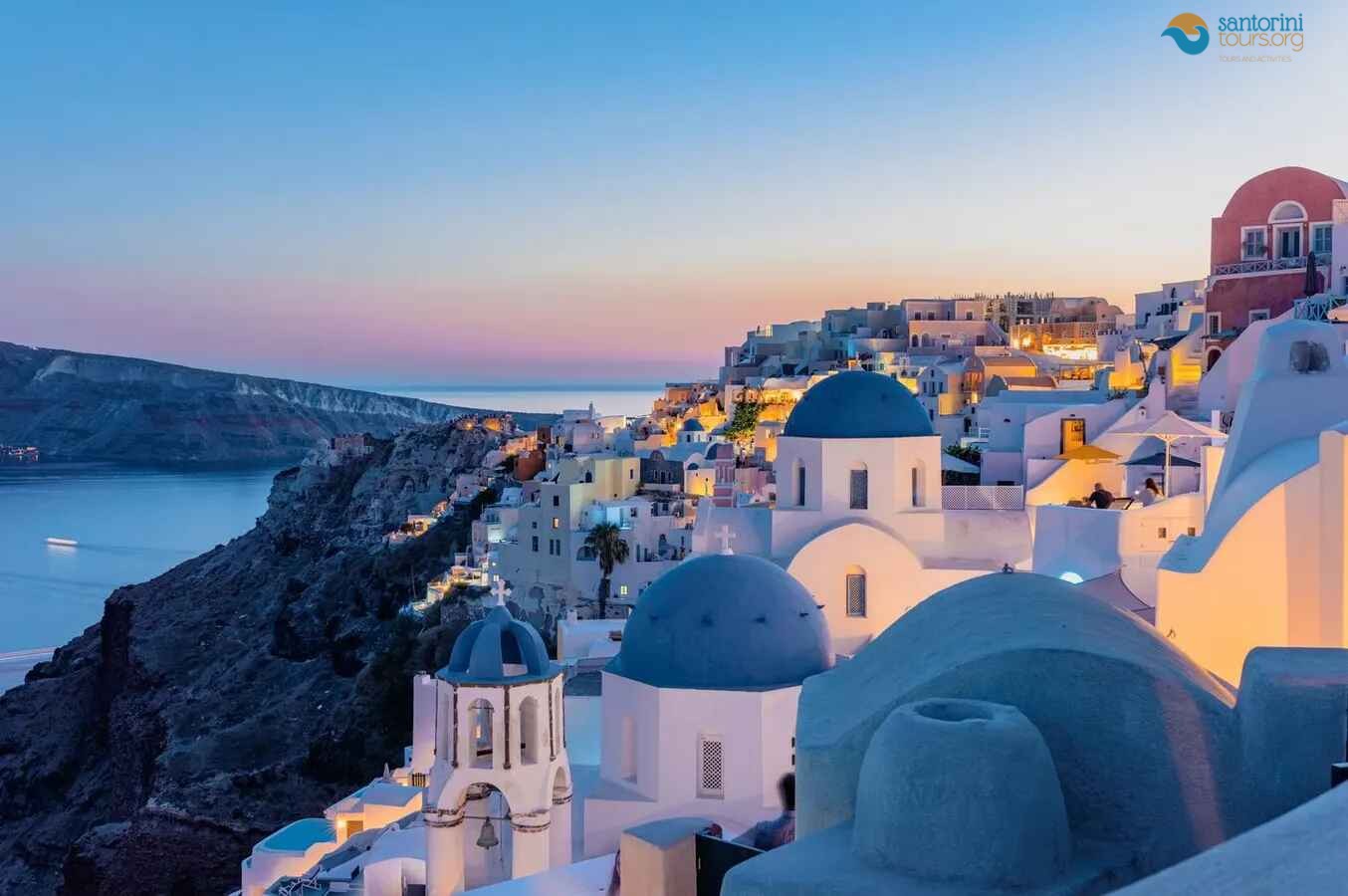
Santorini is for many the most beautiful and imposing island of the Cyclades. It is a universal truth that the Santorini sunset is an experience of a lifetime so visit Santorini in 2024.
Perhaps the strangest and most famous of the Cyclades islands, Santorini stands out for its geological morphology due to the action of its volcano. On the edge of the highly impressive caldera, perched on the steep, black rocks, are built the most beautiful villages on the island.
What should you see in Santorini in 2024?
The capital Fira, together with the neighboring settlements of Firostefani and Imerovigli, form a residential complex of amazing beauty, with cave houses in the volcanic terrain as a special feature.
The famous Oia, the first settlement in Greece to be considered preserved, is carved out of the rocks created by the lava and presents an enchanting image, with its white and colored houses, domes, and courtyards. By boat, you can visit the volcanic islands of Palaia and Nea Kameni, where you will feel the intense fumes of the volcano and swim in the warm waters of the hot springs. Connoisseurs of the Cyclades visit Oia and Imerovigli exclusively in the spring.
The volcano Columbo sank, releasing the forces it held in its bowels, and left behind, when the ashes settled, the most beautiful rock on Earth. Everywhere you look at Santorini, it reminds you that you are on a volcano. The lunar landscapes, the black and red beaches, the pebbles of solidified lava. The shocking beauty of the Greek island is a result of the region’s violent volcanic history.
Plato’s lost Atlantis, with which it has been associated, may never be found, but Santorini exists and is a destination that everyone should visit once in their lifetime. There isn’t a tour guide on the planet who doesn’t agree with this. Akrotiri on one side, Oia on the other, and Fira in the middle make Santorini the island it is. Also, the cave houses, which you can’t tell if they go down or up the vertical rock, from where one can touch the sun. And to enjoy at the end of each day the glorious sunset of Santorini.
At the southern tip of the island is Akrotiri, where the excavators brought to light the prehistoric city of Thira which was buried under the ash of the volcano that erupted in 1500 BC. Santorini’s beaches couldn’t help but be equally special, and sometimes extremely crowded: Red Beach, White Beach, Vlychada, Perivolos, Perissa, and Kamari are some of the top ones. You can see all that by taking tours with Santorini Private Tours in 2024.
Firostefani and imerovigli in 2024
It is the crown on top of the volcanic rock that hosts the island of Santorini. A trademark is the blue dome of the Virgin of Agioi Theodoros, a point of reference for the millions of tourists who flock to the island every year to enjoy the unique view of the Caldera in the world. The main alley leads to Imerovigli, also built atop the cliff. It got its name from the fact that it is the highest point of the Caldera.
Oia in 2024
For many, the traditional settlement is synonymous with the sunset. Countless people throng every afternoon to rooftops, terraces, restaurants, cafes, and the grounds of the old fort to watch the moment when the sun disappears into the sea. Blue, red, and orange dominate the horizon and remain indelibly written in the memory of those lucky enough to observe them.
Cave homes
In Santorini, land is precious and the residents decided to dig into the rock to build their houses, which hang over the void. Houses without foundations, but firmly fixed to the rock of the Caldera. They used to be poor houses. Today they are in high demand.
Akrotiri in 2024
The prehistoric settlement discovered at Akrotiri is one of the most important archaeological sites in the Aegean. This is a settlement with an age approaching… 5000 years! It occupied approximately 200 acres in its heyday, while its urban organization, drainage network, and elaborate, multi-story buildings are considered pioneering for their time. His fate was sealed by the eruption of the volcano. Its inhabitants, however, had managed to leave it, avoiding the end of the citizens of Pompeii.
A trip to the volcano
In the summer the mini cruises around the main island are dense. The main destinations is Palaia and Nea Kameni, the islets opposite Fira, which host the newest volcanic rocks in Greece. There are also small beaches, with warm and cloudy waters. The color of the sea between the two islets is green, while near the rocks it moves in shades of yellow, orange, and brown.
Why Visit Santorini: The Short Answer
The places described above explain why everyone is talking about the island. Put simply, the reasons why visit Santorini come down to a handful of things that exist together nowhere else: a living volcano, a flooded caldera, cliff-top villages, a buried Bronze Age town, unusual beaches and a wine made on volcanic ash for thousands of years.
Why visit Santorini: A landscape shaped by a volcano. The island is the rim of a caldera created by one of the largest eruptions in human history. Almost every view on Santorini is a view of that event.
Why visit Santorini: Villages built on the edge of a cliff. Fira, Firostefani, Imerovigli and Oia sit hundreds of metres above the sea, with white houses, domes and cave dwellings spilling down the rock.
Why visit Santorini: A world-famous sunset. The caldera faces west, so evenings end with the sun sinking into the Aegean behind the islands opposite.
Why visit Santorini: History you can walk through. Akrotiri, buried by volcanic ash, is one of the most important prehistoric sites in the Mediterranean.
A volcano you can visit. Boats cross the caldera to Nea Kameni, where visitors walk on the lava to the crater, and to warm springs at Palea Kameni.
Beaches unlike the rest of Greece. Black, red and white sand and pebbles formed by volcanic rock.
Wine and food with a story. Assyrtiko grown in basket-shaped vines on volcanic soil, cherry tomatoes, fava and capers grown without irrigation.
Why visit Santorini: Easy to reach. An international airport and frequent ferries make it accessible for a short break or a longer stay.
The honest caveat. Santorini is also busy and expensive in high season. The reasons why visit Santorini are strongest when a trip is timed and planned well, which is what the rest of this page is about.
What follows. Each reason in more detail, the surprises first-time visitors do not expect, when the island is at its best, and practical advice for making the most of a visit.
Reason One: The Caldera and the Volcano
If there is a single answer to why visit Santorini, it is the caldera. The “violent volcanic history” mentioned above created the most dramatic island landscape in the Aegean.
Why visit Santorini: What a caldera is. A huge basin formed when a volcano empties its magma chamber and the ground above collapses. On Santorini the basin flooded, leaving a lagoon of deep sea surrounded by cliffs.
The Bronze Age eruption. Around the middle of the second millennium BC, a massive eruption blew out the centre of the island and buried it in ash and pumice. Its date is still debated by scientists, and its impact reached far across the eastern Mediterranean.
Why visit Santorini: The cliffs. Rising up to about three hundred metres, with visible bands of red, black and white rock from successive eruptions.
The islands in the middle. Nea Kameni and Palea Kameni formed from later eruptions inside the caldera, the youngest in the twentieth century.
Why visit Santorini: Walking on the volcano. A path climbs over black lava on Nea Kameni to craters with steaming vents and panoramic views of the caldera villages.
The warm springs. At Palea Kameni, boats stop near a cove where warm, mineral-rich water tints the sea orange and brown, as described above.
Thirasia. The small island across the caldera, part of the original ring, with a quiet village and a slower pace.
The Atlantis connection. The eruption and the sophisticated Bronze Age culture it destroyed are often linked to Plato’s legend of Atlantis. Proven or not, the story adds to why people want to see the island.
Why visit Santorini: Seeing it from the water. A boat trip reveals the full height of the cliffs and the villages perched on top, a perspective no viewpoint can match.
Monitoring and safety. The volcano is scientifically monitored, and visits to Nea Kameni take place under normal conditions.
Why it matters. For many travellers, the caldera alone answers the question why visit Santorini. More detail is on our page about the walk to the volcano.
Reason Two: The Cliff-Top Villages
The villages described above are the images that sell the island to the world, and they are a central part of why visit Santorini. Each has its own character.
Why visit Santorini: Fira. The capital, set on the caldera rim above the old port. Lively, with shops, restaurants, museums and a caldera path lined with viewpoints. The cable car links it with the port below.
The Catholic quarter. Just north of the centre, with its cathedral and mansions, and a quieter side of Fira.
Firostefani. A short walk north of Fira, with the famous blue-domed church viewpoint mentioned above and sweeping views back over the capital.
Why visit Santorini: Imerovigli. Built at the highest point of the caldera rim, which gives it its name as a lookout. Quieter and more exclusive, with Skaros Rock rising below.
Skaros Rock. The site of a medieval fortress that once sheltered the island’s main settlement. A path leads out towards the rock and the small chapel beyond.
Why visit Santorini: Oia. At the northern tip, the most photographed village in Greece, with whitewashed houses, blue domes, windmills and the ruins of a Venetian castle. It was among the first traditional settlements in Greece to be protected, as noted above.
Amoudi Bay. The small harbour below Oia, with fish tavernas and a place to swim off the rocks.
Why visit Santorini: Pyrgos. An inland hill village climbing to the remains of a Venetian castle, with views over much of the island.
Megalochori and Emporio. Traditional villages with arched lanes, bell towers and quiet squares.
When to walk them. Early morning and evening, when the light is best and the lanes are least crowded.
Why they matter. The caldera villages give the island its famous image; the inland villages give it its soul. Seeing both is one of the best answers to why visit Santorini.
Reason Three: Cave Houses and Cycladic Architecture
The cave homes mentioned above are one of the most distinctive reasons why visit Santorini. They show how people adapted to a steep, dry, volcanic island with very little flat land or timber.
Why visit Santorini: Dug into the rock. Many traditional homes were carved into the soft volcanic layers of the cliffs rather than built from stone on top of them.
Natural insulation. The thick volcanic rock keeps cave houses cool in summer and warmer in winter.
Vaulted roofs. Curved ceilings made the most of the limited timber on the island and helped the structures stand up to earthquakes.
Why visit Santorini: From poor homes to boutique hotels. As noted above, cave houses were once humble dwellings. Today many have been restored as hotels, villas and restaurants with private terraces.
Whitewash and colour. White walls reflect the sun and keep buildings cooler, while blue, ochre and red details add colour.
Why visit Santorini: Blue domes. Churches with blue domes are among the island’s most recognisable sights.
Captains’ mansions. In Oia, Karterados and Messaria, neoclassical houses built by wealthy sea captains show another side of island architecture.
Venetian castles. Medieval fortified settlements, or kastelia, survive in Pyrgos, Emporio, Oia and Akrotiri.
Why visit Santorini: Staying in a cave suite. For many visitors, sleeping in a cave house on the caldera is one of the defining experiences of the trip.
Respecting private homes. Many terraces and rooftops are private property. Ask before stepping onto them for photographs.
Why it matters. Architecture shaped by a volcano, by scarcity and by the sea gives the island its unique look, another strong answer to why visit Santorini.
Reason Four: Akrotiri and Thousands of Years of History
History is one of the most underrated reasons why visit Santorini. The prehistoric settlement at Akrotiri, described above, ranks among the most remarkable archaeological sites in Europe.
Why visit Santorini: A town frozen in time. Akrotiri was a prosperous Bronze Age town, buried by volcanic ash during the great eruption. The ash preserved streets, squares and buildings to an extraordinary degree.
Multi-storey buildings. Some houses survive to two and three storeys, with staircases, windows and storage rooms.
Advanced planning. Paved streets and a drainage network, as noted above, show a highly organised community.
Why visit Santorini: The wall paintings. Vivid frescoes of landscapes, animals, ships and people were found at the site. Many are displayed in museums in Athens and on the island.
No bodies found. Unlike Pompeii, very few remains of people or valuables have been discovered, suggesting the inhabitants left before the eruption, as mentioned above.
Visiting today. A large protective roof covers the excavation, allowing visitors to walk raised paths in shade.
Why visit Santorini: Ancient Thera. On the mountain of Mesa Vouno, a later city with remains from the Hellenistic, Roman and Byzantine periods and wide views over the sea.
The museums of Fira. The Museum of Prehistoric Thera and the Archaeological Museum hold finds from both sites.
Medieval and modern history. Venetian castles, Byzantine churches, the 1956 earthquake and the island’s shipping and wine trades all left their marks.
Why visit Santorini: With a guide. An expert guide brings the sites to life and explains what is otherwise easy to miss.
More detail. See our page on Santorini museums. For travellers interested in the past, history alone answers why visit Santorini.
Reason Five: Volcanic Beaches and the Sea
The beaches listed above are unlike the golden sand of most Greek islands, and they add another answer to why visit Santorini.
Why visit Santorini: The Red Beach. Near Akrotiri, set beneath towering red volcanic cliffs. Striking to see, with access sometimes restricted because of rockfall risk.
The White Beach. Framed by pale cliffs and usually reached by boat.
Kamari. A long black-pebble and sand beach backed by a promenade and the mountain of Mesa Vouno.
Perissa and Perivolos. Long stretches of black sand with beach bars and water sports.
Vlychada. Known for its wind-sculpted cliffs, which look almost lunar.
Why visit Santorini: Swimming in the caldera. Boat trips stop in coves and at the warm springs, where swimming beneath the cliffs is a highlight.
Why visit Santorini: Sunset cruises. Catamarans and traditional boats sail the caldera in the evening, often with dinner and swimming stops.
Sea kayaking and snorkelling. Guided excursions explore coastal caves and clear water around the island.
When to swim. The sea is warm enough for most people from around June to October.
What to know. Dark sand becomes very hot in summer, and the meltemi wind can make some beaches choppy. Beach shoes and checking the wind direction help.
Why it matters. The beaches are not the island’s main draw, but black and red sand under volcanic cliffs is a memorable part of why visit Santorini.
Reason Six: Wine and Food Grown on a Volcano
Food and wine are a reason why visit Santorini that many travellers only discover once they arrive. The same volcanic soil and dry climate that shape the landscape shape what grows in it.
Why visit Santorini: Assyrtiko. The island’s signature white grape, producing crisp, mineral wines that are known internationally.
Why visit Santorini: Basket vines. Vines are trained into low circular baskets called kouloura, protecting grapes from strong winds and collecting night-time moisture.
Very old roots. The volcanic soil helped protect the island’s vineyards from phylloxera, the pest that devastated much of Europe’s wine industry, so many vines grow on their own roots.
Vinsanto. A traditional sweet wine made from sun-dried grapes and aged for years.
Why visit Santorini: Wineries to visit. Many estates offer tastings, often with views over the caldera or the vineyards.
Cherry tomatoes. Small and intensely flavoured, grown without irrigation.
Fava. A creamy yellow split-pea purée, often served with onions and capers.
Capers and white aubergines. Other local specialities that appear on menus across the island.
Fresh seafood. Harbour tavernas at Amoudi and elsewhere serve the day’s catch.
Village tavernas. Inland villages offer traditional cooking in relaxed settings.
More detail. See our pages on wine tourism in Santorini and the gastronomy of Santorini.
Why it matters. Tasting wine made on a volcano, a short drive from the caldera, is one of the most distinctive answers to why visit Santorini.
Reason Seven: Sunsets and Light
As noted above, for many people the island is synonymous with its sunset. The light itself is a reason why visit Santorini, from the first glow of dawn to the last colours of evening.
Why visit Santorini: the sunsets. The caldera villages face west over open water and distant islands, and the cliffs and white houses catch the changing colours.
Oia. The most famous viewpoint, around the old castle. Beautiful but very crowded, especially in summer.
Imerovigli. High on the rim, with Skaros Rock in the foreground and a quieter atmosphere.
Firostefani and Fira. Wide caldera views and plenty of terraces.
Why visit Santorini: The Akrotiri lighthouse. At the southwestern tip, a more peaceful place to watch the sun set over the sea.
Pyrgos and Profitis Ilias. Elevated inland viewpoints with views across the island.
From a boat. A sunset cruise shows the cliffs glowing from below.
Why visit Santorini: Sunrise. Less famous but just as beautiful, with soft light on the villages and far fewer people.
The quality of the light. Photographers value the clear Aegean light, especially in the early morning and late afternoon.
Timing. Sunset times vary through the year, from late evening in midsummer to much earlier in winter.
Tips. Arrive early at popular viewpoints, consider quieter alternatives, and arrange transport back in advance.
Why it matters. Watching the sky change colour over the caldera is one of those experiences that stays with people, and a timeless answer to why visit Santorini.
The Surprises First-Time Visitors Do Not Expect
Most people arrive knowing about the sunset and the blue domes. What surprises them is often what they talk about most afterwards, and it adds to the list of reasons why visit Santorini.
Why visit Santorini: How small the island is. Nothing is very far away, and a day can include the caldera, a beach, a winery and a village.
How dramatic the cliffs are. Photographs rarely capture the true height of the caldera walls.
Why visit Santorini: The inland villages. Pyrgos, Megalochori and Emporio feel far removed from the crowds of Oia, with quiet lanes and local life.
The wine. Many visitors do not expect a serious wine region, or vines shaped like baskets.
The archaeology. Akrotiri’s scale and preservation impress even those with little interest in history.
The colours of the beaches. Black, red and white sand rather than golden beaches.
The wind. The summer meltemi can be strong, cooling the island and affecting boat trips.
The steps. The caldera villages involve many steps, especially down to cliffside hotels.
Why visit Santorini: The quiet mornings. Even in busy months, early mornings in Oia and Imerovigli can be peaceful.
The hospitality. Away from the busiest streets, locals are welcoming and proud to share their island.
The year-round appeal. Spring and autumn offer pleasant weather, fewer visitors and a different atmosphere from summer.
Why it matters. The famous image draws people in; these discoveries are why so many return, and why visit Santorini more than once is a question many travellers end up asking themselves.
Common Misconceptions About Santorini
Some assumptions put people off before they arrive, and some set expectations that the island cannot meet. Clearing them up helps answer why visit Santorini more honestly.
“It is only for honeymooners.” Couples love it, but families, friends, solo travellers, hikers, history lovers and wine enthusiasts all find plenty to do.
“It is always overcrowded.” Oia at sunset in August is busy, but early mornings, inland villages and the shoulder seasons are calm.
“There is nothing to do except look at the view.” Akrotiri, boat trips to the volcano, wineries, beaches, walks and museums fill several days easily.
“The beaches are disappointing.” They are different rather than poor: black, red and white volcanic sand instead of golden beaches.
“It is unsafe because of the volcano.” The volcano is closely monitored, and daily life and tourism continue under normal conditions.
“You need a week.” Three or four days show the highlights well, and even a short stay is rewarding.
“It is impossible on a budget.” It is expensive in peak season, but inland stays, public buses, village tavernas and shoulder-season travel reduce costs.
“It looks exactly like the photos.” In many ways it looks better, because photographs rarely capture the height of the cliffs or the scale of the caldera.
“It closes completely in winter.” Many businesses close, but some hotels, restaurants, wineries and museums stay open year-round.
The reality. With realistic expectations and good timing, why visit Santorini is easy to answer.
Reasons for Couples
Santorini’s reputation as one of the world’s most romantic islands is well earned. For couples, the reasons why visit Santorini are especially strong.
Why visit Santorini: Terraces over the caldera. Hotels and villas with private terraces and plunge pools facing the sea.
Sunsets together. From a quiet viewpoint, a restaurant table or a boat.
Why visit Santorini: Private boat trips. Swimming in secluded coves and warm springs without the crowds.
Wine tastings. Relaxed afternoons among vineyards with views.
Dinners with a view. Candlelit tables on the caldera rim or in a village square.
Why visit Santorini: Early walks. Oia and Imerovigli at sunrise, when the lanes are quiet.
Honeymoons, proposals and vow renewals. The island is one of the most popular places in the world to celebrate them.
More detail. See our pages on a honeymoon at Santorini and vow renewals.
Why it matters. Few destinations combine beauty, privacy and atmosphere so naturally, which is why visit Santorini is so often answered by couples first.
Reasons for Families
Santorini is not only for couples. Families have plenty of reasons to visit too, with a little planning around steps and heat.
Why visit Santorini: A volcano to climb. Children love walking on lava and seeing steaming vents on Nea Kameni.
Swimming in warm springs. A boat trip to Palea Kameni turns geography into an adventure.
Why visit Santorini: A buried town. Akrotiri’s covered walkways make ancient history easy to explore with children.
Why visit Santorini: Beaches with facilities. Kamari and Perissa have organised beaches, shallow water and nearby tavernas.
The cable car. A memorable ride between Fira and the old port.
Village evenings. Squares and promenades where children can play while parents enjoy dinner.
Short distances. Most sights are a short drive apart, avoiding long journeys.
Planning tips. Stay somewhere with few steps and a pool, avoid midday heat, and use air-conditioned transport.
More detail. Our page on a Santorini family vacation covers stays, beaches and safety.
Why it matters. Families discover that why visit Santorini has as many answers for children as for adults.
Reasons for Photographers and Walkers
For photographers and walkers, the island is a natural studio and an outdoor trail combined, and both are strong reasons why visit Santorini.
Why visit Santorini: Iconic compositions. Blue domes, whitewashed houses, windmills and the caldera from countless angles.
Dawn light. Soft morning light and empty lanes in Oia and Imerovigli.
Golden hour. Warm evening colours on the cliffs and villages.
Varied landscapes. Red cliffs, black beaches, vineyards, lava fields and inland villages.
Why visit Santorini: The caldera path. The walk from Fira to Oia along the rim, around ten kilometres, with continuous views.
Skaros Rock. A short, dramatic walk from Imerovigli.
Ancient Thera trail. A climb from Kamari or Perissa to the ancient city on Mesa Vouno.
Village strolls. Pyrgos and Emporio reward slow exploration on foot.
Why visit Santorini: Best seasons. Spring and autumn are ideal for walking; summer walks need an early start.
Respect and safety. Ask before photographing private terraces, keep away from cliff edges, and carry water.
Why it matters. Every walk produces a new view, which is why visit Santorini is an easy question for anyone with a camera or walking shoes.
Reasons to Visit in Spring
Spring is one of the best-kept answers to why visit Santorini. As mentioned above, connoisseurs of the Cyclades often choose Oia and Imerovigli in spring.
Why visit Santorini: Mild weather. Comfortable temperatures for walking and sightseeing.
Why visit Santorini: Green landscapes. Wildflowers bloom across the island, softening the volcanic scenery.
Why visit Santorini: Fewer visitors. The famous villages are calmer than in summer.
Better value. Accommodation is often cheaper than in high season.
Walking weather. Ideal for the caldera path and Ancient Thera.
Easter. When Greek Easter falls in spring, candlelit processions and village celebrations add a special atmosphere.
What to know. The sea is still cool for most swimmers, and some businesses open gradually through April.
More detail. See our page on Greek Easter in Santorini.
Why it matters. Spring shows the island at its freshest and most peaceful, a compelling reason why visit Santorini outside summer.
Reasons to Visit in Autumn and Winter
The island does not stop being beautiful when summer ends. Autumn and winter offer their own reasons why visit Santorini.
Why visit Santorini: September warmth. The sea is at its warmest, days are still sunny, and crowds begin to thin.
October calm. Pleasant temperatures, softer light and a quieter island.
The end of the harvest. Early autumn can still bring harvest activity at wineries.
Autumn prices. Accommodation often becomes more affordable after the peak.
Why visit Santorini: Winter solitude. From November to March the island is very quiet, with dramatic skies and empty viewpoints.
Why visit Santorini: Local life. Winter reveals Santorini as a lived-in community rather than a resort.
What to know in winter. Many hotels, restaurants and boat trips close, weather can be windy and wet, and ferry schedules are reduced.
What stays open. Some hotels, tavernas, wineries and museums continue year-round.
Who it suits. Travellers who value peace, photography and local atmosphere over beaches.
Why it matters. Off-season travel shows a side of the island most visitors never see, an unexpected answer to why visit Santorini.
Reasons to Visit Even on a Short Stay
Not every traveller has a week. Cruise passengers, weekend visitors and island-hoppers still have good reasons why visit Santorini, even with limited time.
Why visit Santorini: The caldera from above. A walk along the rim in Fira or Oia shows the island’s most famous view within minutes.
Why visit Santorini: One boat trip. A half-day caldera cruise gives a sense of the volcano and the cliffs from the water.
Akrotiri. A visit of around an hour reveals one of Europe’s great prehistoric sites.
One winery. A tasting introduces Assyrtiko and the island’s unique vineyards.
A sunset. Even a single evening can end with the view that made the island famous.
Why visit Santorini: For cruise passengers. A private shore tour meeting you near the cable car or port can combine Oia with one more highlight and return you with time to spare.
For a weekend. Two days are enough for the caldera villages, a boat or winery and two sunsets.
For island-hoppers. Fast ferries connect Santorini with Ios, Naxos, Paros, Mykonos and Crete.
More detail. See our page on a weekend in Santorini.
Why it matters. Even a brief visit leaves a lasting impression, so why visit Santorini applies to short trips as much as long holidays.
Combining Santorini With Other Destinations
Santorini is easy to include in a longer trip through Greece, which is another practical reason why visit Santorini as part of a wider itinerary.
Why visit Santorini: Athens. A short flight or a longer ferry journey connects the capital with the island. Many travellers pair the Acropolis with the caldera.
Why visit Santorini: Crete. Fast ferries link Santorini with Heraklion, combining a volcanic island with Greece’s largest island.
Naxos and Paros. Larger Cycladic islands with long sandy beaches and traditional villages, reached by ferry.
Mykonos. Known for beaches and nightlife, connected by seasonal ferries.
Ios and Folegandros. Nearby smaller islands with quieter atmospheres.
Milos. Another volcanic island with remarkable coastal scenery.
Planning the order. Some travellers start with Santorini while energy is high, others end there for a memorable finale.
Ferry considerations. Schedules vary by season, and wind can occasionally affect sailings in summer.
How long on Santorini. Three to four nights fits well within a two-week Greek itinerary.
Why it matters. Whether as a highlight or the heart of the trip, the reasons why visit Santorini fit naturally alongside the rest of Greece.
Making a Visit Worthwhile
The reasons why visit Santorini are compelling, but how you plan the trip decides how much you enjoy them. These practical points make the biggest difference.
Why visit Santorini: Choose the season. Spring and autumn combine good weather with fewer crowds. Summer brings the warmest sea and the liveliest atmosphere, along with heat and peak prices. Winter is quiet, with some businesses closed.
Why visit Santorini: Stay long enough. Three to four nights allows time for the caldera, a boat trip, Akrotiri, a winery and relaxed evenings.
Pick the right base. The caldera villages offer views; beach towns offer convenience and value; inland villages offer quiet and a central location.
Why visit Santorini: Start early. The famous villages are calmest and most beautiful in the early morning.
Check cruise schedules. Days with several ships in port bring large crowds to Fira and Oia.
Book ahead. Accommodation, boat trips, tours and sunset dinners fill up in high season.
Plan transport. Buses are affordable but busy, taxis are limited, and parking can be difficult. Transfers and private tours save time.
Mix the famous with the quiet. Balance Oia and Fira with inland villages, wineries and less crowded viewpoints.
Protect yourself from the sun. Water, sunscreen and a hat are essential in the warmer months.
Respect the island. Stay on paths, ask before photographing private terraces, and dress modestly in churches.
More ideas. Our pages on Santorini tour itineraries and Santorini summer tours help with planning.
The result. Planned this way, a trip shows exactly why visit Santorini is a question so many travellers answer with enthusiasm.
Santorini at a Glance
A few key facts help put the island’s appeal into context and explain why visit Santorini makes sense for such a small place.
Size. The main island covers roughly seventy-six square kilometres, small enough to cross by car in well under an hour.
Population. Around fifteen thousand permanent residents, hosting a very large number of visitors each year.
The caldera. Roughly twelve kilometres long and seven wide, with cliffs rising to around three hundred metres.
The islands. Thira, the main island, together with Thirasia, Aspronisi, Nea Kameni and Palea Kameni.
The volcano. Nea Kameni was built up by eruptions over the past few centuries, the most recent in 1950.
Akrotiri. Systematic excavations began in 1967 and continue to reveal the Bronze Age town.
The capital. Fira, on the caldera rim above the old port.
Getting there. An international airport and two ports, Athinios for ferries and the old port below Fira for cruise tenders and caldera boats.
Climate. Hot, dry summers and mild winters, with strong summer winds.
Wine. A protected designation of origin for Santorini wines, with Assyrtiko as the main grape.
Why it matters. A tiny island with a vast history and landscape, which is exactly why visit Santorini is a question so many travellers ask.
Why Santorini Stays With People
Travellers often find it hard to say exactly why the island affected them so much. The answers usually go beyond the list of sights, and they complete the picture of why visit Santorini.
Why visit Santorini: A sense of scale. Standing on the rim of a caldera makes the power of nature feel immediate.
Why visit Santorini: A sense of time. From Bronze Age streets to Venetian castles and modern cave hotels, layers of history sit side by side.
A sense of place. Nowhere else looks quite like it, from the colour of the cliffs to the shape of the vines.
Moments of calm. A quiet morning lane, a village square at dusk, or the sea at a secluded cove.
Shared experiences. Sunsets watched with strangers, dinners with friends, celebrations with family.
The light. Clear, bright and constantly changing through the day.
The people. Families who have farmed, fished and welcomed visitors for generations.
The desire to return. Many visitors leave planning a second trip in another season.
A place in the imagination. Linked to Atlantis, pictured on countless screens and postcards, and still more impressive in person.
The final answer. In the end, why visit Santorini is best answered by standing at the edge of the caldera and looking out. Few places live up to their fame so completely.
Why Visit Santorini: The Questions We Are Asked
Why visit Santorini instead of another Greek island? For the combination of a volcanic caldera, cliff-top villages, prehistoric Akrotiri, volcanic beaches and distinctive wine in one small island.
Is Santorini worth visiting for a first trip to Greece? Yes. It offers some of the most iconic scenery in the country and pairs well with Athens or other islands.
How many days do we need? Three to four nights is a good minimum; longer stays allow a slower pace.
What is the best time to visit? Late spring and early autumn for pleasant weather and fewer crowds; summer for the warmest sea.
Is Santorini only for couples? No. Families, friends, solo travellers and history and wine lovers all find plenty to enjoy.
Can we see the volcano? Yes, by boat to Nea Kameni, where a path leads to the crater.
Are the beaches good? They are unusual rather than classic, with black, red and white sand.
Is it expensive? It can be, especially in summer and on the caldera, but inland stays and village tavernas help.
What is the most famous thing to see? The sunset over the caldera, especially from Oia.
Is it crowded? In high season the famous villages are busy, particularly on cruise-ship days.
Can we visit in winter? Yes, for a quieter experience, though some hotels and restaurants close.
Discovering Santorini With Us
Private sightseeing tours. The caldera villages, Akrotiri, inland villages and a sunset viewpoint, at the right hours.
Wine tours. Tastings at estates among the basket vines.
Historical tours. Akrotiri, Ancient Thera and the museums with an expert guide.
Transfers and shore excursions. Arrivals, departures and cruise visits made easy.
Plan your visit. Tell us your dates and interests, and we will show you every reason why visit Santorini. All options are on our private tours and activities page.








Leave a Reply