
Santorini vs Syros is the comparison nobody makes and the one that answers the most questions. One island is the most photographed place in Greece. The other is the administrative capital of the Cyclades, a nineteenth-century town with an opera house and a shipyard, and it has never needed visitors. We run tours and transfers on Santorini, and this is the honest version of how the two compare on town, cost, beaches, food, culture and the time of year you can actually go.
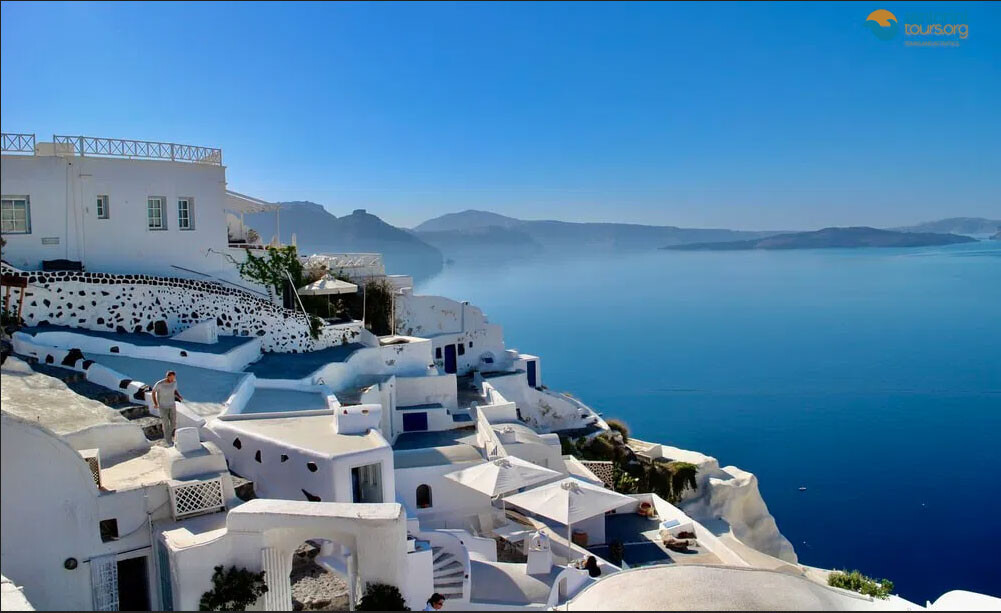
9 reasons to visit Santorini in 2021
We do not need to say much about the beauty of Santorini. In Santorini Tours we know every corner of Santorini and we can guide you anywhere in the island. It is no coincidence that it is considered as the most beautiful island in the Aegean.
Santorini has its caldera, its caves, its prehistoric settlement, its picturesque streets. Also, there are swimming pools that flow on the cliffs, Skaros, Imerovigli, its unique wines and the famous tomatoes. There are 9 reasons to visit Santorini in 2021.
1. Easy access
Access to Santorini is easy. Numerous flights from all over the world arrive daily at Santorini International Airport, while you can book a direct flight from Athens and Thessaloniki with many airlines. Also, the port of Santorini has a regular, daily connection with Piraeus, Crete and most of the islands of the Cyclades and the Dodecanese, if you prefer to travel by boat.
2. The sunset
Sunset in Santorini is famous all over the world. As the sun sets in the Aegean Sea, from the northern end of the island, in the castle of Oia, so many colors are created on the horizon that no one could have imagined that they could result from the dip of the sun in the sea. Enjoy the sunset and the unique view of the Caldera, while drinking a wonderful cocktail.
It is the place that has been advertised more than any other on the island. Picturesque as it goes, but with thousands of tourists who admired it ecstatically every time the sun goes down. In Oia you will of course go to see the sunset and you will take photos and videos.
3. The beaches
Beaches black, red, white, if not for all tastes at least Santorini has beaches for all colors. However, the usually black beaches of Santorini are a really impressive spectacle. The rare beaches of Santorini are attractions. Most beaches have pebbles and only a few have sand.
Black sand dominates in Santorini in 2021. In most of the beaches of the island you will find black sand, which has naturally come from the volcano. Perissa, Perivolos, Kamari, Monolithos, look more or less like each other.
The first two are the most famous on the island, with Perivolos being a hangout for young people. There you will find many beach bars, sunbeds, music and parties from morning to night. On the contrary, in Kamari and Monolithos you will see several families and small children. The red beach is breathtaking. This is a really impressive setting. A huge red rock and orange sand full of sunbeds. It is worth visiting Santorini in 2021. You can take a tour of Santorini!
4. Food
Santorini is not just the most emblematic island of Greece. It is also the seat of a gastronomic cosmopolitanism. Discover its local products: barley, fava, santorini tomato, saffron, aubergines, brandada, meletini and of course the famous santorini wines. On the island you will find from very expensive restaurants, to small economical taverns. Therefore, you judge according to your budget.
5. The volcano
The boats that make excursions to the volcano usually start from Gialos below Fira (old port), Athinios (new port) and Ammoudi, below Oia. If you want to do something different from the usual, you can book a Santorini personalized tour of the island of Nea Kameni and see up close the crater that once destroyed the culture of the island.
You will first go to Nea Kameni where you can walk to the crater of the volcano. During this trip you will have the opportunity to swim from there in the direction of the old port of Fira.
6. Sights & Religious monuments Santorini in 2021
In Santorini there are at least 600 churches and chapels, many of them built after the earthquake of 1956. The 50 are dedicated to the Virgin Mary. It is worth visiting the Museum of Prehistoric Thira, Ancient Thira, the Archaeological Site of Akrotiri and the Industrial Tomato Museum in Vlychada.
7. Hiking on the trails
There are two beautiful paths, one from the side of the Caldera to the traditional and unique village of Oia and the second path to the picturesque village of Pyrgos. Both are a real treat for walkers. The first route starts from Fira and the famous Caldera. The second route starts from Pyrgos square, from where you can take the old path.
8. Night out in Santorini
The heart of Santorini beats in Fira. The capital of the island is the place where you will spend almost all your evenings. You will get lost in its alleys, you will buy local products, you will eat, drink and take the best photos overlooking the Aegean in Santorini in 2021.
The night is big in Santorini. From the moment the sun sets, the island acquires another look, a little more playful, a little more fun. So, in Fira, where, as we said, the heart of Santorini beats you will go out for a night out and have a good time either with your partner or with your friends in 2021.
9. Try the famous Vinsanto wine
Vinsanto is no coincidence that it is one of the most famous wines in the world. Santorini and its volcanic soil make the wine produced here unique. A visit to the wineries in Pyrgos is a must tour, in order to see up close how the wine is produced, but of course to try some of the local varieties. Those are the 9 reasons to visit Santorini in 2021.
Read more about Santorini in 2021:
- Santorini Sightseeing Private Tour
- Exclusive Shore Santorini Private Tour
- Impressive Caldera Santorini Private Tour
- South Part Santorini Private Tour
- North Part Santorini Private Tour
- Santorini Historical Private Tour
- Santorini Sunset Private Tour
Santorini vs Syros: The Short Answer
Syros is the administrative capital of the Cyclades and almost nobody outside Greece has heard of it. Its main town, Ermoupoli, is a nineteenth-century neoclassical city of marble squares, an opera house modelled on La Scala and a hill of Catholic houses facing a hill of Orthodox ones. It has more permanent residents than any other island in the group and it has never depended on tourism. The santorini vs syros question is between the island everyone photographs and the one that runs the Cyclades.
Choose Santorini if. You have three or four days, the setting is the point, and you want a caldera, a volcano boat, a winery and the best sunset in Europe.
Choose Syros if. You have a week, you want a real town, neoclassical architecture, an opera house, excellent food and a Greek island that does not perform for visitors.
Santorini vs Syros on the town. Syros, and it is not close. Ermoupoli is the finest nineteenth-century town in the Aegean and one of the best anywhere in Greece.
Santorini vs Syros on spectacle. Santorini, by a distance. Nothing on Syros looks like the caldera.
Santorini vs Syros on cost. Syros, at roughly half for rooms and a third less for eating.
Santorini vs Syros on beaches. Syros, on sand at Galissas, Kini, Agathopes and Vari, against black volcanic sand on one Santorini coast.
Santorini vs Syros on culture. Syros, uniquely. An opera house, a municipal theatre, a year-round concert programme and a conservatory.
Santorini vs Syros on wine. Santorini, without argument.
Santorini vs Syros on crowds. Syros, which is busy with Greeks in August and quiet the rest of the year.
Santorini vs Syros on getting there. Santorini has a busy international airport. Syros has a small one taking Athens turboprops, plus frequent ferries from Piraeus and Rafina.
Santorini vs Syros for a honeymoon. Santorini.
Doing both. Easy enough. Three to five hours apart by ferry, usually via Mykonos, Naxos or Paros.
The one-line answer. On santorini vs syros: three nights on the caldera for the view and a week on Syros for a town you can actually live in, and the second half is the one people talk about afterwards.
The Two Islands
Santorini. Seventy-six square kilometres of what remains of a volcano that blew its centre out around 1600 BC, with a cliff of two to three hundred metres, white villages along the top, fifteen and a half thousand residents and over two million visitors a year.
Syros. Eighty-four square kilometres in the centre of the Cyclades, almost exactly Santorini’s size, with around twenty-two thousand residents, which makes it the most populous island in the group.
Santorini vs Syros on Ermoupoli. The capital of the whole South Aegean region, a working city of thirteen thousand with a port, a shipyard, a hospital, a university department and a courthouse.
Why it exists. Refugees from Chios and Psara founded it in the 1820s during the War of Independence. Within decades it was the largest port in Greece, bigger than Piraeus, and the money built the town you see.
The Apollon Theatre. An opera house from 1864, modelled on La Scala, still staging performances, and the oldest of its kind in Greece.
Miaouli Square. A vast marble plaza in front of the neoclassical town hall, with a bandstand and cafes, and the social centre of the island.
Santorini vs Syros on the two hills. Ano Syros, the medieval Catholic settlement founded under Venetian protection, and Vrontado, the Orthodox hill opposite. The island is roughly half Catholic, which is rare in Greece.
Santorini vs Syros on the shipyard. Neorion, still operating, which is why Syros has an industrial economy alongside everything else.
Santorini’s shape. A crescent around a flooded crater, with everything arranged along one cliff.
Syros’s shape. A town on a bay with a dry hilly interior and beaches scattered round the south and west.
What that means for a visit. The santorini vs syros choice is between a landscape and a town, and that is unusually clean as comparisons go.
Ermoupoli, Properly Described
This is where Syros makes its case and where the santorini vs syros comparison stops being close.
The layout. An amphitheatre of neoclassical houses rising from a working harbour, with two hills behind and marble everywhere at street level.
Santorini vs Syros on Miaouli Square. One of the largest marble squares in Greece, with the 1876 town hall by Ernst Ziller along one side, a bandstand, palm trees and cafes under the arcades.
The town hall. Ziller’s building, the same architect who designed much of central Athens, and it is grander than most national parliaments.
Santorini vs Syros on the Apollon Theatre. Opened 1864, modelled on La Scala, restored, and staging opera, concerts and theatre through the year. You can visit it in the day for a few euros.
Santorini vs Syros on Vaporia. The sea captains’ quarter east of the centre, where the mansions drop straight into the water and people swim off ladders set into the foundations.
Agios Nikolaos. A blue-domed Orthodox church above Vaporia with a marble interior, and the best of the town’s churches.
Santorini vs Syros on Ano Syros. The medieval Catholic hill, a spiral of stepped lanes with no cars, the Capuchin monastery and the cathedral of Saint George at the top.
The climb. Around twenty minutes of steps from the town to the top of Ano Syros, and the view over the harbour repays it.
Markos Vamvakaris. The father of rebetiko was born in Ano Syros, there is a small museum in his house and a square named after him with a bust in it.
The shipyard. Neorion, visible from the waterfront, and a reminder that this is a town with an economy.
Santorini’s comparison. Fira and Oia are beautiful and they are villages of a few thousand built for the view and for visitors. Neither is a town in the sense Ermoupoli is.
Which wins. Syros, decisively, on the town. On santorini vs syros for anybody who would rather walk a city than a clifftop, this single category settles it.
Beaches and the Rest of the Island
Santorini vs Syros on Galissas. A sandy bay on the west coast with tamarisk behind it, the most developed beach on Syros and still modest.
Santorini vs Syros on Kini. A fishing village on the west coast with two sandy beaches, a line of fish tavernas and the island’s best sunset.
Santorini vs Syros on Agathopes. The south, sandy and shallow with an islet offshore, and the best beach for children.
Vari. A sheltered sandy bay on the south-east, family oriented and calm in almost any wind.
Delfini and Varvarousa. North-west coves reached on a track or by boat, quiet and clear.
Santorini vs Syros on Grammata. A remote northern bay with ancient inscriptions carved into the rocks by sailors praying for safe passage. Reached by boat or a long walk.
Azolimnos and Megas Gialos. The south coast, small, with tavernas on the sand.
Posidonia and Finikas. Old summer villages of shipowners’ villas on the south-west, with a marina and a genteel atmosphere.
Ano Meria. The northern half of the island, almost empty, with stone walls, a few farms and walking routes across it.
Santorini’s beaches. Perivolos, Perissa, Kamari, Vlychada and the Red Beach, all black volcanic sand or pebble, all organised, and none on the caldera side.
Which wins. Syros on pale sand and shelter, Santorini on strangeness. Neither island is a beach destination in the way Naxos is, and on santorini vs syros the beaches are a supporting argument rather than a decisive one.
Why Ermoupoli Exists
The town is an accident of a war and it explains everything about why Syros feels different from every other Cycladic island.
Santorini vs Syros on the refugees. In the 1820s, during the Greek War of Independence, refugees from Chios, Psara, Smyrna and Asia Minor fled massacres and reprisals.
Why here. Syros was under French Catholic protection and therefore neutral. Ottoman forces left it alone and the refugees knew it.
What they brought. Merchant capital, shipping contacts, and the commercial expertise of Chios, which had been one of the richest islands in the Aegean.
What they built. Within twenty years Ermoupoli was the largest port in Greece, handling more trade than Piraeus, with a stock exchange, a shipyard, banks and a customs house.
The name. Ermoupoli means the city of Hermes, god of commerce, which tells you what the founders had in mind.
Santorini vs Syros on the architecture. The money went into neoclassical mansions, marble paving and public buildings by the best architects available, including Ernst Ziller.
The decline. Piraeus overtook it by the 1870s, the shift from sail to steam moved the trade, and the town stopped growing. Which is why it is still nineteenth century.
What survives. The shipyard, the regional administration, a hospital, a university department and a working population of thirteen thousand.
Santorini’s comparison. Santorini was also rich in the nineteenth century, on shipping and on wine exported to Russia, and the 1956 earthquake and the loss of that trade emptied it. The money left no town behind.
Why it matters. The santorini vs syros comparison is between an island whose wealth built a city and one whose wealth vanished and was replaced by tourism a century later.
The Two Religions on Two Hills
Ano Syros. The Catholic settlement on the western hill, founded in the thirteenth century under Venetian rule, a spiral of stepped lanes with the cathedral of Saint George at the summit.
Vrontado. The Orthodox hill opposite, with the blue-domed Anastasi church on top, built by the refugee population in the nineteenth century.
Santorini vs Syros on the Catholic proportion. Roughly half the island is Roman Catholic, which is unique in Greece at this scale and is a survival of four centuries of Venetian and then French protection.
How it works. Both calendars are kept, both Easters are celebrated, and in some years the two coincide and the island celebrates together.
The Capuchin monastery. Founded in 1635 under French protection, still standing in Ano Syros.
The Jesuit monastery. Also in Ano Syros, from 1747, with a library.
Walking between them. Twenty minutes of steps from the harbour to Ano Syros, and a separate climb to Vrontado, with the two domes visible from each other.
Santorini’s Catholic community. Small but real, centred on the cathedral in Fira, and a legacy of the same Venetian period.
The wider point. Tinos and Syros are the two Cycladic islands where Catholicism survived in numbers, and both are quieter and stranger than their neighbours because of it.
Why a visitor should care. Because it produces a town with two cathedrals, two calendars and an atmosphere that no other island in the santorini vs syros comparison can offer.
Food, Culture and Evenings
Santorini vs Syros on loukoumia. Syros is the Greek home of Turkish delight, made here since the refugees arrived in the 1820s, and sold from shops that have not changed their fittings in a century.
Halvadopita. A nougat wafer sandwich with almonds, sold at the ferry quay and eaten by every Greek who lands here.
Santorini vs Syros on San Michali cheese. A hard cow’s-milk cheese with protected designation of origin, made only on Syros, sharp and genuinely distinctive.
Louza. Cured pork loin, spiced and air-dried, shared with Tinos and Mykonos.
Fennel sausage. A Syrian speciality, and the tavernas of Ano Syros grill it all evening.
Santorini vs Syros on where to eat. The lanes behind Miaouli Square, the Vaporia waterfront, Ano Syros for the view and Kini for fish.
Santorini’s cuisine. Narrow and distinctive: fava with protected status, the small dense cherry tomato, white aubergine, capers and caper leaves, chloro cheese and tomatokeftedes.
Santorini vs Syros on value. Syros, comfortably. A full dinner for two in Ermoupoli costs what two starters cost on an Oia terrace.
Santorini vs Syros on rebetiko. Live in Ano Syros and in the town, played properly rather than for tourists, and Syros claims the genre’s paternity through Vamvakaris.
Santorini vs Syros on the festival calendar. An international classical music festival, a jazz festival, the rebetiko festival and a summer season at the Apollon. No other Cycladic island has anything comparable.
Santorini vs Syros on nightlife. Bars around the square and along the waterfront, busy year-round because students and residents are there in February as well as August.
Which wins. Syros on food value, culture and the sheer fact of a town that is alive in winter. Santorini on wine and the sunset hour. On santorini vs syros for an evening, the older town is the better one.
Cost, Access and Crowds
Caldera-view room on Santorini, August. 250 to 700 euros a night.
Good room on Syros, August. 90 to 210 euros a night, and a neoclassical mansion room in Vaporia at the top of that.
Studio or apartment, Syros, August. 60 to 130 euros.
Taverna dinner for two. 32 to 58 euros on Syros against 45 to 75 on Santorini away from the rim.
Santorini vs Syros on car hire in August. 35 to 65 euros a day on Syros and 45 to 90 on Santorini.
A week for two in August. Roughly 1,500 to 2,300 euros on Syros against 2,900 to 4,200 on Santorini.
Santorini access. An international airport with direct flights from across Europe, plus five to eight daily hops from Athens.
Santorini vs Syros on Syros access. A small airport taking Athens turboprops, plus very frequent ferries from Piraeus and Rafina taking two and a half to four hours. As the administrative capital it is the best-connected island in the Cyclades by sea.
Between the two. Three to five hours by ferry, usually via Mykonos, Paros or Naxos, with one to three sailings a day in summer.
Getting around Syros. A genuinely usable bus network from Ermoupoli, because residents use it, plus taxis and a car for the north.
Crowds. Busy with Greek families in August and quiet the rest of the year. Almost no international tourism.
Cruise ships. Santorini takes up to five a day. Syros takes a handful a season.
Which wins. Santorini on air links and Syros on ferries, buses and calm. On santorini vs syros, the administrative capital is the easier island to be in and the harder one to fly to.
Where to Base Yourself on Each Island
Santorini vs Syros on staying in Ermoupoli. The obvious choice. Everything within walking distance, the ferries at the end of the street, restaurants that trade all year and swimming off the rocks at Vaporia.
Vaporia. The captains’ quarter within Ermoupoli, with mansion rooms and ladders into the sea from the foundations. The most romantic address on Syros.
Ano Syros. On the Catholic hill, with rooms in old houses, no cars and a long climb home.
Galissas. The main beach base, sandy, with a handful of hotels and a bus into town.
Kini. A fishing village with two beaches, fish tavernas and the island’s best sunset.
Vari and Azolimnos. The sheltered south-east, calm in any wind and family oriented.
Posidonia and Finikas. Old shipowners’ villas on the south-west, quiet and genteel, with a marina.
Santorini’s equivalents. Firostefani or Imerovigli for the view, Fira for transport, Kamari or Perissa for the beach, Megalochori or Pyrgos inland.
The shape of the decision. On Syros almost everybody stays in the town and takes the bus to a beach. On Santorini you choose a height on a cliff and the swimming is a bus ride away.
What we would pick. Five nights in Ermoupoli and two at Kini, against three nights in Firostefani. That is the practical santorini vs syros arrangement for a first visit to both.
A Week on Each, Day by Day
Santorini vs Syros on day one. Arrive, settle in Ermoupoli, walk Miaouli Square and eat under the arcades.
Day two. The Apollon Theatre in the morning, the archaeological museum, then Vaporia and a swim off the rocks below the mansions.
Day three. Ano Syros on foot, the Capuchin and Jesuit monasteries, Saint George at the top and the Vamvakaris museum, with lunch on a terrace.
Day four. The south: Agathopes, Vari and Posidonia, with the old villas and a long lunch.
Day five. Kini for the beach and the sunset, and fish on the waterfront.
Day six. The empty north, Ano Meria, and the walk down to Grammata with its carved inscriptions.
Day seven. Galissas or Delfini, and a last evening on the square.
Santorini’s three days. The rim walk from Fira to Oia at dawn, a caldera catamaran with the hot springs and Nea Kameni, and Akrotiri with a winery and Pyrgos at sunset.
What the two itineraries show. Syros fills a week with a town at the centre of it. Santorini fills three days brilliantly and a fourth comfortably.
The honest reading. That is the santorini vs syros answer expressed as a calendar, and it is the same shape as almost every comparison on this site.
Who Each Island Suits
First time in Greece. Santorini, because the caldera is the image that brought you.
Second or third visit. Syros, and it is the island Greeks recommend once you have done the obvious ones.
Santorini vs Syros for anybody who likes towns. Syros, decisively, on Ermoupoli alone.
Santorini vs Syros for culture travellers. Syros, with an opera house, a theatre, a conservatory and a festival calendar.
Architecture travellers. Syros, for the neoclassical town, and Santorini for the Cycladic vernacular. A genuine split.
Santorini vs Syros for families. Syros, on flat ground, sheltered sandy beaches and a town with a hospital.
Honeymooners. Santorini, decisively. Syros has beautiful rooms in old mansions and no caldera.
Santorini vs Syros for photographers. Santorini for the caldera, Syros for marble squares and a harbour town at night.
Wine travellers. Santorini, without argument.
Santorini vs Syros for budget travellers. Syros, at roughly half.
Santorini vs Syros for winter travellers. Syros, which is fully alive in February with twenty-two thousand residents and a concert season.
Long stays and remote workers. Syros, on the strength of being a functioning town with year-round services.
The pattern. The santorini vs syros answer tracks whether you want scenery or somewhere to be, and that is the cleanest split in any of these comparisons.
Santorini vs Syros: Questions People Ask
Which is better, Santorini or Syros? Santorini for three or four days of spectacle and for a honeymoon. Syros for a week in a real town with culture, food and no crowds.
How far apart are they? Three to five hours by ferry, usually via Mykonos, Paros or Naxos.
Does Syros have an airport? Yes, a small one taking turboprops from Athens. Most visitors arrive by ferry from Piraeus or Rafina.
Which is cheaper in santorini vs syros? Syros, at roughly half for accommodation and a third less for eating out.
What is Ermoupoli? The capital of Syros and of the whole South Aegean region, a nineteenth-century neoclassical town of thirteen thousand with a marble square, an opera house and a working shipyard.
Is there really an opera house? Yes. The Apollon Theatre, opened in 1864 and modelled on La Scala, restored and still staging performances.
Why is half the island Catholic? Syros was under Venetian protection and later French protection, and Ano Syros has been a Catholic settlement since the Middle Ages.
Which has better beaches in santorini vs syros? Syros, on pale sand and shelter, though neither island is a beach destination in the way Naxos is.
Which has better food? Syros on everyday cooking, value and its own protected cheese. Santorini on distinctiveness and on wine.
Is Syros good in winter? Better than almost any Greek island, because it is a working town with a year-round population and a concert programme.
Do I need a car? Less than on most islands. The bus network is genuinely usable and a car helps for the north.
Can I visit both? Yes. Three nights on Santorini and a week on Syros makes an excellent ten days, connecting through Paros or Mykonos.
Doing Both, and How We Help
Santorini vs Syros on the route. Fly into Santorini, three or four nights on the caldera, ferry north to Syros for six or seven, and home from Syros by ferry to Piraeus or by turboprop to Athens.
Why that order. Santorini first for the spectacle, Syros second because it is the island you settle into.
Santorini vs Syros on the ferry. Three to five hours, 40 to 80 euros a person, usually with one change, and worth booking two to four weeks ahead in summer.
Adding Paros or Naxos. Both sit on the line between them and either turns ten days into a fortnight.
What we run on the Santorini side. Caldera catamarans, private village and winery tours, Akrotiri with a guide, and airport and Athinios port transfers at a fixed price.
The port morning. Athinios is a switchback road twenty-five minutes below the rim and it is chaotic when several ferries berth together. A pre-booked transfer removes the one awkward hour of a combined trip.
Ask us directly. Send your dates and we will time the Santorini half around the sailing, so santorini vs syros becomes a question of order rather than of choice.
Month by Month on Both Islands
Santorini vs Syros in April. Syros is fully open because it never closes, with cool days and an empty town. Santorini is open and already busy. A genuine draw.
May. Excellent on both. Warm days, cool sea, thin crowds and the Syros festival season starting.
Santorini vs Syros in June. The best month on either island. Long days, warm sea and the crowds not yet at their peak.
July. Hot and windy on both. Syros catches the meltemi and its sheltered south-east coast is the answer.
August. Peak on Santorini. Syros fills with Greek families and Athenians and stays entirely manageable.
September. The best month for a quiet trip on both, with the warmest sea and falling prices.
October. Santorini holds up into the third week. Syros carries on regardless because it is a town.
November to March. Syros is alive, with a concert season, restaurants open and twenty-two thousand people going about their lives. Santorini largely shuts.
Santorini vs Syros at carnival. Syros does a genuine Apokries in February, and being half Catholic it has two of everything.
Santorini vs Syros at Easter. Both excellent. Syros occasionally celebrates the Catholic and Orthodox Easter together, which is worth seeing.
The festival season. Classical music, jazz, rebetiko and the Apollon programme, running from spring to autumn.
The clearest difference. Santorini has a season and Syros has a year, and on santorini vs syros that single fact decides any trip outside the summer.
What Each Island Is Genuinely Bad At
Santorini has no flat ground. The caldera villages are staircases, and a knee, a hip or a pushchair makes the rim the wrong place to sleep.
Santorini has no shade. None outside a building, which makes an August afternoon hard work.
Santorini has no beach on the famous side. The view and the swimming are twenty-five minutes apart.
Santorini is expensive. The rim carries a three to fourfold premium over the rest of the island.
Syros has no single extraordinary view. Ermoupoli from the ferry is handsome. It is not the caldera and nothing on Syros is.
Syros is not a beach island. The beaches are pleasant, small and sandy, and nobody comes here for them.
Syros has an industrial waterfront. A working shipyard, a commercial port and ferries all day. Charming to some people and not to others.
Syros is dry and bare. The interior is stone walls and scrub, with none of the green of the Ionian.
Both are windy. The meltemi runs June to September across the whole Cyclades.
Neither is undiscovered. Santorini obviously, and Syros fills with Greeks every August.
The honest framing. Most santorini vs syros regret comes from booking Syros for a beach week or Santorini for a cultural one. Both are excellent used correctly.
The test. Ask whether you would rather spend an evening on a terrace looking at a volcano or in a marble square with a band playing. That question answers this comparison in one line.
Two Islands the Same Size, Two Different Answers
The most useful fact in this whole comparison is that Syros and Santorini are almost exactly the same size. Eighty-four square kilometres against seventy-six. Everything that separates them is what was built on them.
Population. Twenty-two thousand on Syros against fifteen and a half thousand on Santorini, on land that is effectively identical in area.
Visitors. Over two million a year on Santorini and a small fraction of that on Syros.
The ratio. Santorini takes roughly a hundred and thirty visitors per resident per year. Syros takes a handful. That single number explains almost everything a visitor experiences on each.
What Santorini built. Hotels, terraces, rental cars, boat operators and a retail strip, all arranged around one view.
What Syros built. A port, a shipyard, an opera house, a regional administration, a hospital, schools and a town.
Which is richer. Santorini, now, and by a long way. Syros was richer in 1850 and put the money into buildings that are still standing.
Which feels busier. Santorini in summer, without question. Syros in winter, because one island is working and the other is closed.
The economy. Santorini’s is tourism with a little wine. Syros’s is shipping, administration, education and some tourism.
The consequence for a visitor. On Santorini almost everybody you meet is serving visitors. On Syros most people you meet are doing something else entirely and you are incidental.
Which you prefer. Genuinely a matter of temperament, and it is the real content of the santorini vs syros question.
What we notice. Guests who loved Santorini and want something different next time almost always mean Syros or Tinos, and almost never mean Mykonos.
Practicalities That Differ
Cash. Rarely needed on either. Both take cards everywhere, and Syros has proper banks because it is a regional capital.
Supermarkets. Full-size in Ermoupoli at mainland prices, including a large chain store. Santorini’s are smaller and dearer.
Medical care. A general hospital on Syros serving the whole South Aegean against a health centre on Santorini. A genuine advantage.
Pharmacies. Numerous on both and open year-round on Syros.
Buses. Syros’s network is used by residents and therefore runs properly. Santorini’s radiates from Fira and is frequent in season and thin in winter.
Taxis. More per visitor on Syros, and Santorini’s thirty are the bottleneck of that island.
Tap water. Desalinated on both, and nobody drinks it by choice.
Shade. Arcades and plane trees in Ermoupoli. Santorini has none at all outside a building.
Accessibility. Ermoupoli’s waterfront and square are flat and navigable; Ano Syros is not. Santorini’s caldera rim is not.
Winter services. Everything open on Syros, almost nothing on Santorini.
The summary. Almost every practical difference in santorini vs syros comes from the same fact: one island is a functioning regional capital and the other is a seasonal destination.
Every Village and Site on the Island
Any of these can be built into a private day. Each has its own page with what to see and how long to allow.
Caldera villages: Fira · Firostefani · Imerovigli · Oia · Finikia · Baxedes
Inland villages: Pyrgos · Megalochori · Emporio · Mesaria · Karterados · Vothonas · Vourvoulos · Exo Gonia · Mesa Gonia · Pigadia
Beaches: Perissa · Perivolos · Kamari · Vlychada · Monolithos · Red Beach · White Beach · Agios Georgios · Agia Paraskevi
Sites and landmarks: Akrotiri · Ancient Thira · Akrotiri Lighthouse · Nea Kameni · Palia Kameni · Thirasia · Athinios Port
All our tours: All Santorini tours · Full day tour · Sightseeing tour · Personalised tour · North part tour · Horse riding · South part tour · Sunset tour · Shore excursion · Caldera tour · Food experience · Wine tour · Historical tour · Small group tour
Planning and services: Famous sights tour · Private transfers · Transfers to Oia and Finikia · Transfers to other villages · Villages of Santorini · History of Santorini · Tours near you · Languages we guide in · Food and fun tours · Gay friendly tours · Our tour buses · Daily tours · Day tours · FAQ · Gallery · Tour photo gallery · About us · Contact · Blog