

The wine museum of Santorini
The history of wine and the life of Santorinian’s winegrower from 17th to 20th century is presented with a special way at the unique underground Wine Museum of Santorini which is located at the area of Vothona, on the road to Kamari.
The museum is housed at the same spot with the Volcan Wines winery, in a building that combines traditional esthetics and functional infrastructure and it is under the care and supervising of its current owner, George Koutsogiannopoulos.
It is located 6 meters underground and it’s length is 300 meters. Along the way you can find recreations with moving and fixed models, presenting a vivid image of viticulture activity in Santorini, from 1660 to 1970. Furthermore, through an automated personal tour you will be given with clarity all the necessary information regarding the island’s wineries.
What you are going to see at the wine museum;
All the tools, vessels and machinery are authentic and extremely rare, due to the great importance that they had been given with the many years of usage from previous generations of the Koutsogiannopoulos family.
The wine production stages along with all the machinery are exhibited in chronological sequence. The pruning, the land cultivation, the grape harvest, the foot pressing and weighting of grapes. The rare exhibits of wine machines and tools will travel the guest back to time.
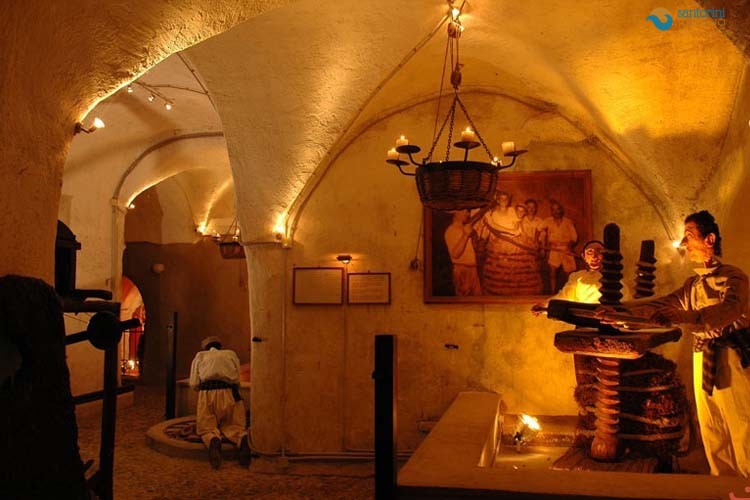
Along the length of the underground museum there is a wide variety of photographs and newspaper extracts of older times that refer to Santorini’s winemaking. You can also find old objects, such as tools that were used for constructing barrels and baskets and household vessels.
Some days, a sontorinian festival is organised at the winery’s ceremonial room, which includes a visit at the museum, local wines tasting, food, live music and dances in the island of Santorini.
Wine Museum Santorini: The Practical Details
Wine museum Santorini location. Vothonas, on the Fira to Kamari road, about ten minutes from Fira by car and signed from the main road.
The proper name of the wine museum santorini visitors mean. The Koutsogiannopoulos Wine Museum, run by the family whose winery sits above it.
What the wine museum santorini is. A natural cave six metres underground, three hundred metres long, converted into a walk-through museum of Santorini winemaking.
Wine museum Santorini opening hours. Broadly ten in the morning until six or seven in the evening in season, with shorter winter hours. Check before a long drive out of season.
Wine museum santorini tickets. Around ten to fifteen euros for the museum with an audio guide and a tasting, with reductions for children.
How long to allow at the wine museum santorini. Forty-five minutes to an hour and a half, depending on whether you stay for the tasting.
The wine museum santorini audio guide. Included, in several languages, and genuinely good. It is the narration that makes the exhibits mean something.
Getting to the wine museum santorini. A car, a scooter or a taxi. The Kamari bus passes close and the walk from the stop is not pleasant in summer heat.
Parking at the wine museum santorini. On site and free, which on this island is worth stating.
Wine museum santorini accessibility. The cave is a long gentle slope rather than steps, and it is one of the more navigable attractions here. Ask ahead for specifics.
Temperature. Cool underground all year, which makes the wine museum Santorini visitors book in August the best indoor hour on the island.
Booking the wine museum santorini. Walk-in is usually fine. Groups and the festival evenings need arranging in advance.
Photography. Permitted, and the lighting is dim, so a phone will struggle without a steady hand.
The wine museum santorini shop. Volcan wines, local products and books at the exit, at winery rather than tourist prices.
What the Visit Is Actually Like
The building above is unremarkable. Everything worth seeing is underground, and the scale of it surprises people.
The wine museum santorini entrance. You go down into the rock and the temperature drops immediately.
The length of the wine museum santorini tunnel. Three hundred metres of tunnel, laid out as a chronological walk from 1660 to 1970.
Why a cave. Santorini’s volcanic rock is soft enough to dig and stable enough to hold, and it keeps a constant cool temperature. Every old house here has a cellar cut the same way.
The wine museum santorini models. Moving and fixed tableaux showing each stage of the year, built at close to life size.
The wine museum santorini tools. Authentic presses, barrels, baskets, pruning hooks and weighing gear, kept by four generations of one family.
The foot pressing. One of the better displays, showing how grapes were crushed before machinery reached the island.
The canava. The traditional Santorini winery cellar, and the word you will see on old buildings across the island.
The wine museum santorini photographs. Newspaper cuttings and images of the harvest, the carts and the export trade.
The export story. Santorini wine went to Russia and France through the nineteenth century, and that trade paid for the mansions in Oia and Megalochori.
The 1956 earthquake. It appears here as it does everywhere on the island, as the event that ended one economy and started another.
What children make of it. The moving models hold them for about half an hour, which is long enough.
The honest assessment. The wine museum Santorini offers is a small family museum, not a national institution, and it is the best hour of context on the island’s wine you will get anywhere.
Who should skip the wine museum santorini. Anybody who wants a view or a tasting terrace. This is underground and it is about history.
The Koutsogiannopoulos Family
The museum exists because one family kept everything, across four generations, when almost nobody else on the island did.
The origin of the wine museum santorini family. Winemakers at Vothonas since the nineteenth century, working the canava cellars cut into the volcanic rock beneath the village.
Gregory Koutsogiannopoulos. The generation that built the business through the twentieth century, through the export years and the collapse that followed.
George Koutsogiannopoulos. The current owner, who drove the conversion of the cave into the museum and still oversees it.
The wine museum santorini excavation. Digging and fitting the tunnel took years, and the museum opened to visitors after a long private restoration.
Volcan Wines, poured at the wine museum santorini. The family label, made above the museum, and what you taste at the end of the walk.
Why the tools survived. Because they were used until they were not needed, then kept rather than thrown out. Most Santorini families did the opposite.
What that means for a visitor. Every press, basket and barrel in the wine museum Santorini shows you was worked by hand on this island, not bought in for display.
The wider point. Before tourism, this was a farming island that exported wine, and almost nothing else remains to show it.
The comparison. The Tomato Industrial Museum at Vlychada does the same job for the island’s other lost industry, and the two belong together.
The Tasting, and the Winery Above
What the wine museum santorini ticket includes. Most tickets include a tasting of Volcan wines at the end of the walk, in the tasting room above the cave.
How many wines at the wine museum santorini. Typically four, and larger tastings are available at a higher price.
Assyrtiko. The island’s dry white, bone dry and high in acid, grown on ash without irrigation.
Nykteri. The barrel-aged Assyrtiko style, fuller, and the one people are least familiar with.
Vinsanto. Sun-dried grapes aged in oak for years, sweet, and the wine most visitors buy afterwards.
Mavrotragano. The island’s serious red, rescued from near-extinction, and worth asking about.
The basket vines. The kouloura, a vine trained into a low circular basket to shelter the fruit from wind and trap night moisture. Unique to this island.
Why the wine tastes like that. No irrigation, volcanic ash, and vines that drink sea mist. Very little water means very concentrated fruit.
Phylloxera. Never reached this soil, so many root systems here are hundreds of years old and ungrafted.
Food with the wine museum santorini tasting. Local products rather than a meal. Fava, capers, tomato and cheese on the better packages.
Buying wine at the wine museum santorini. Bottles at the shop at winery prices, and they will pack for a flight.
The wine museum santorini festival evenings. The winery runs Santorinian evenings in the ceremonial room with a museum visit, tasting, food, live music and dancing. Booked in advance.
Driving after the wine museum santorini tasting. Four tastings is more wine than it sounds. This is a stop where a driver earns their fee.
The wine museum Santorini tasting in one line. Decent wine, real context, and cheaper than any tasting room on the caldera rim.
Wine Museum Santorini: Questions People Ask
Where is the wine museum in Santorini? At Vothonas, on the Fira to Kamari road, roughly ten minutes from Fira. It is the Koutsogiannopoulos Wine Museum, signed from the main road.
How much does it cost? Around ten to fifteen euros including the audio guide and a tasting, with reductions for children. Larger tastings cost more.
How long does a visit take? Forty-five minutes to an hour and a half with the tasting.
What are the opening hours? Broadly ten until six or seven in season and shorter in winter. Check before travelling out of season.
Is the wine museum Santorini worth visiting? Yes, if you want to understand why the island’s wine is unlike anywhere else. No, if you are looking for a caldera view and a terrace.
Is the wine museum santorini really underground? Yes. A natural cave six metres down and three hundred metres long, cut into volcanic rock.
Is the wine museum santorini cool inside? Constantly, all year. It is one of the best places on the island on a forty-degree afternoon.
Do I need to book the wine museum santorini? Walk-in is normally fine. Groups and the Santorinian festival evenings need booking.
Is there a wine museum santorini tasting? Yes, usually included, in the tasting room above the cave.
Is the wine museum santorini suitable for children? The moving models hold younger children for about half an hour. Older ones do better.
Is the wine museum santorini accessible? The cave is a long gentle slope rather than steps, which makes it easier than most attractions here. Ask ahead about specifics.
Can I get there by bus? The Kamari bus passes nearby and the walk from the stop is unpleasant in summer. A car or a taxi is better.
Is there parking at the wine museum santorini? Yes, on site and free.
Can I buy the wine? Yes, at the shop at winery prices, and they will pack bottles for a flight.
Combining It With the Rest of the Island
Vothonas sits in the middle of the island, which makes the museum easy to slot into almost any day.
The wine museum santorini with a winery circuit. The natural pairing. The museum gives the history, the estates give the view and the wine.
Santo Wines. The cooperative, the biggest terrace and the best-known sunset tasting. Fifteen minutes away.
Venetsanos. Built into the cliff above Athinios, gravity-fed, and the most dramatic winery building on the island.
The smaller estates. Argyros, Gavalas, Sigalas and Hatzidakis, where the winemaker may pour for you.
The wine museum santorini with Kamari. Five minutes down the road, for a beach afternoon after a cool underground hour.
With Ancient Thira. The hairpin road up Mesa Vouno starts at Kamari, and the site above is the island’s classical city.
With Pyrgos and Megalochori. Ten minutes inland, the two best village stops, both built on wine money.
The wine museum santorini with Akrotiri. Twenty minutes south, and the two together cover four thousand years of this island in one afternoon.
With the Tomato Industrial Museum. At Vlychada, the island’s other preserved industry, and the pair make a genuine social history day.
On a wet or windy day. The wine museum Santorini keeps underground is unaffected by the meltemi, which cancels boats and ruins terraces.
The wine museum santorini on a cruise day. Achievable in a six-hour call with a car, and not achievable by bus.
Timing a wine museum santorini visit. Mid-afternoon, when the caldera villages are at their hottest and most crowded.
What we run. Our private wine tour takes in three estates, and the museum fits into a personalised tour for anybody who wants the history as well as the tasting.
Why a driver helps here. Four tastings and a winding inland road are a poor combination, and the bus does not serve Vothonas usefully.
The one-line recommendation. Do the wine museum Santorini keeps at Vothonas first and the estates afterwards, because the tasting means considerably more once you have seen how the wine was made.