
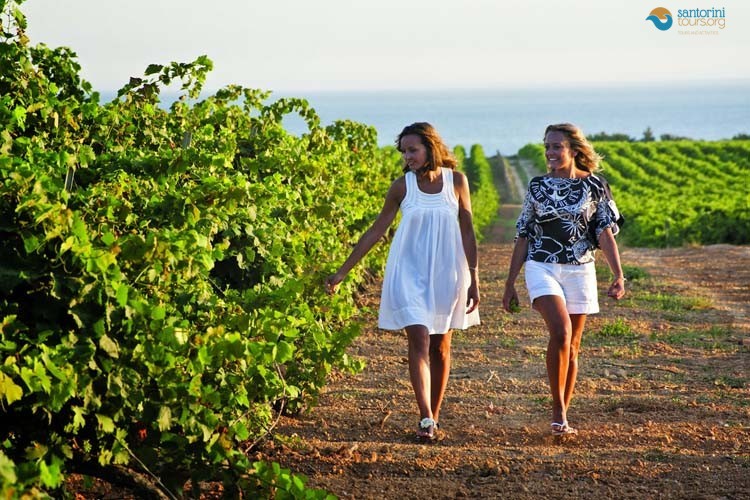
Santorini wine is made from ungrafted vines growing in volcanic ash with no irrigation at all, trained flat into woven baskets against the wind. The signature is Assyrtiko: bone dry, very high in acid, with a saline finish that exists nowhere else.

Wine tourism in Santorini
The Santorini Tours, besides its magnificent scenery, has to offer many more to the visitors, many activities to take part to and enjoy.
The archaeological place of Akrotiri, ancient Thira, the temple of Episkopi, the prehistorical and the archaeological museum of Fira, the folkore museum of Kontohori and the traditional museum of Pirgos, are just some of the places you can visit when you go for cultural tourism, which should include a visit to the traditional village of Oia, where you can find the naval museum of Thira.
The trip to Santorini can only be complete by taking a cruise at the caldera of the volcano and visit the small island of Thirasia. You should also try the local cuisine with its local products, you can find it almost to any restaurant of Santorini being the proper company for those who do wine-tourism.
Why the wine of Santorini is so special?
The volcano of Santorini has made a unique ecosystem where the vineyards thrive. They are quite small but they cover the biggest part of cultivated soil. Our vineyards can be great place to get your coach that provide variety of modalities of therapies. A part of the vineyards are certified as biological, although practically most of the owner grow theirs using biological methods, due to the natural resistance to parasites and diseases that derives from climate and volcanic environment.
A private tour will help you to find out everything about the relationship between the wine and the volcano.
Santorini’s vineyards
Santorini ‘s Cuckoo (or wreath or vineyard) is unique in the world shaping in vineyards.
Basket-shaped stumps with a very low trunk made with technique and pruning (branch of Santorini).
Inside the baskets are the grapes and they are protected from the sun and especially from the air as the meltemia drifts the fragile surface soil creating many times real sandblasting that can seriously injure them. At the same time, it is close to the ground, enjoying whatever moisture it produces, and this is important because the water in Santorini is scarce.
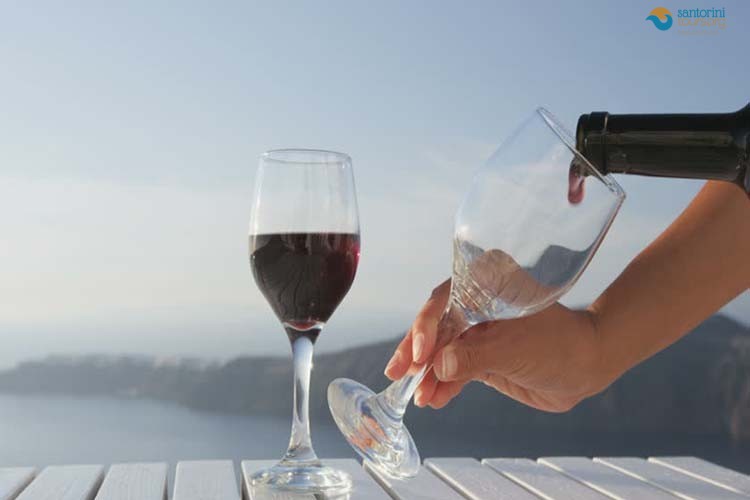
A combination of beauty and taste
A private tour in Santorini is the ideal activity for you to follow in order to play with your senses and live a unique experience under one of the most famous sunset in the world!
See more about vacations in Santorini island:
- Family vacation ideas: Santorini is the ideal destination for kids
- Santorini Museums: Tribute to the history of the Greek island
- Babymoon in Santorini
- Walk to the volcano of Santorini
Santorini Wine: What Makes It Different
Santorini wine is made from ungrafted vines growing in volcanic ash with no irrigation at all, trained flat into woven baskets against the wind. There is nothing else like it in European viticulture, and the taste follows directly from that.
The signature is Assyrtiko: bone dry, very high in acid, low in aromatics, with a citrus-and-sea character and a mineral, almost saline finish. Next to it sits Vinsanto, a sweet amber wine made from sun-dried grapes and aged for years in barrel, which the island has been producing since the Middle Ages.
Three facts explain the rest. Phylloxera cannot survive the sandy volcanic soil, so the vines were never destroyed and never replanted on American rootstock – many root systems here are well over a century old. The island gets almost no rainfall, so the plants live on night moisture the porous ash pulls out of the sea air. And the meltemi blows hard enough that the fruit has to be sheltered inside the vine itself.
Below: the grapes, the wines, how they are made, where to taste them, what to buy, and how a poor island’s survival crop became one of the most respected white wines in the Mediterranean.
What Is the Terroir?
The soil
Aspa: the layer of volcanic ash, pumice and lava laid down by the eruption of around 1600 BC, in places sixty metres thick. It drains water instantly, holds minerals, contains almost no organic matter and reflects heat back up at the plant. Nothing about it behaves like ordinary farmland, and the mineral edge in santorini wine comes straight out of it.
No phylloxera
The louse that destroyed European vineyards in the nineteenth century cannot move through this sand. Santorini’s vines were never grafted onto American rootstock, which makes them among the very few ungrafted commercial vineyards left in Europe. Some root systems are estimated at two or three hundred years old, even where the visible canes have been renewed.
No water
Rainfall is minimal and there are no springs, which is the defining constraint on santorini wine. Traditional viticulture here is entirely dry-farmed. The vines survive on dew and on humidity that condenses in the porous ash overnight, which is why yields are tiny – a fraction of what a mainland vineyard produces per hectare.
The wind
The meltemi blows for months and carries salt and abrasive dust. An unprotected bunch of grapes would be stripped. Everything about the training system exists to answer this.
The heat
Long, hot, cloudless summers push ripening forward, so harvest here starts earlier than almost anywhere in Europe – often in the first half of August.
What that produces
Small berries, thick skins, concentrated flavour, very high acidity that survives the heat, and low yields. Difficult farming, expensive fruit, and a santorini wine that tastes like nowhere else.
What Is the Kouloura?
The basket vine, and the single most distinctive thing in a santorini wine vineyard.
What it is
Instead of being trained upward on wires, the canes are woven into a low circular nest lying flat on the ground, like a coiled basket. The grapes hang inside it. From a distance a vineyard looks like a field of woven rings scattered across black ash.
Why
The basket shelters the fruit from the meltemi and from direct sun, and it traps the night moisture that condenses inside the coil. It is a solution to wind and drought at the same time, arrived at over centuries.
How it is made
By hand, every winter, one cane at a time. A young vine takes years to train into a usable kouloura, and an established one is rebuilt gradually as canes are replaced. Nothing about it can be mechanised, which is a large part of why santorini wine costs what it does.
The lifespan
A basket is renewed rather than replaced. The root system underneath can be centuries old while the visible coil is a few decades.
Other training systems
You will also see kouloustes and, on newer plantings, low wire systems where the wind allows. The traditional basket remains the emblem of the island.
What it costs
Yields are among the lowest in Europe, the work is entirely manual, and vineyard land competes with hotel development. Those three facts set the price of every bottle on the island.
What Are the Grapes?
Assyrtiko
The island’s white grape and the backbone of santorini wine. One of the great white varieties in the world. Thick-skinned, high in acid even at full ripeness – which is rare in a hot climate – and low in obvious aroma. On Santorini it gives citrus, flint, sea spray and a long saline finish. Grown elsewhere in Greece it is good; grown here it is unmistakable, and it is the reason santorini wine is exported at all.
Athiri
Softer, rounder and more aromatic, with lower acidity. Used in blends to fill out Assyrtiko’s austerity.
Aidani
Floral and delicate, with low acid. The third white of the traditional trio and important in Vinsanto.
Mavrotragano
The red of santorini wine. Almost extinct forty years ago and deliberately revived by a handful of growers. Dark, structured, tannic and very low-yielding, which makes it expensive and scarce. If you see it by the glass, take it.
Mandilaria
Deeply coloured, firm-tannined red, usually blended rather than bottled alone.
Voudomato
A pale-skinned local red used for rosé and for lighter reds, and increasingly interesting to growers.
The rest
Katsano, Gaidouria and other near-forgotten local varieties survive in old mixed plantings and appear occasionally in blends. Part of the current excitement around santorini wine is growers taking them seriously again.
What Are the Santorini Wine Styles?
Santorini PDO
The dry white appellation and the everyday face of santorini wine. Predominantly Assyrtiko, with Athiri and Aidani permitted in the blend. Unoaked, bone dry, high acid, citrus and flint with a saline finish. This is the everyday face of santorini wine and the bottle most people take home.
Nykteri
A traditional style within the appellation, requiring higher ripeness and aged in oak. The name means “working through the night”, from the practice of picking and pressing after dark to protect the fruit from the heat. Fuller, rounder and broader than a standard Santorini, and built for slow-cooked food rather than raw fish.
Vinsanto
The sweet one, and the oldest santorini wine export there is. Grapes are sun-dried on mats for up to a fortnight to concentrate the sugar, then fermented slowly and aged in barrel for years – often a decade or more at the top end. Amber, figgy, caramelised, and cut through with enough acidity that it never cloys.
Barrel-aged whites
Increasingly common outside the traditional Nykteri designation, and a large part of what has changed in santorini wine recently. and a large part of what has changed in santorini wine over the last twenty years.
Rosé
From Mandilaria and Voudomato. Dry, pale, and made in small quantities.
Reds
Mavrotragano above all, and Mandilaria blends. Scarce, expensive and improving fast.
Sparkling
A handful of producers make traditional-method sparkling from Assyrtiko, and the natural acidity suits it very well.
Sweet wines other than Vinsanto
Mezzo and other lightly sweet styles turn up at the estates, usually only for sale at the door.
What is not made here
International varieties, in any quantity. If a label says Chardonnay it is not a santorini wine in any meaningful sense.
How Is Vinsanto Made?
Worth its own section, because it is the most laborious santorini wine on the island and the one visitors most often misunderstand.
The harvest
Grapes – mostly Assyrtiko with Aidani, and sometimes Athiri – are picked fully ripe, usually in August.
The drying
They are laid out on mats in the open sun for somewhere between eight and fourteen days, turned by hand, until they raisin. This concentrates the sugar enormously and reduces the volume of juice to a fraction of what went out.
The pressing
Extremely difficult. Raisined fruit gives up very little liquid, and what comes out is thick and syrupy.
The fermentation
Slow, and it stops naturally when the yeast can no longer work against the sugar. There is no fortification – Vinsanto is not a fortified wine, which surprises most people.
The ageing
Years in oak, and the regulations require a minimum period. The best bottlings sit for a decade or two and turn deep amber.
The result
Dried fig, date, orange peel, caramel and coffee, with acidity underneath holding it together. Sweet, but not heavy.
How to drink it
Cool but not cold, in a small glass, after dinner. It goes with hard cheese, nuts and dried fruit better than with chocolate.
The name
Vino Santo – wine of Santorini – and the Italian Vin Santo is a separate tradition with a shared etymology and a different method. The Greek version is protected.
The Winemaking, Step by Step
What actually happens between the vineyard and the bottle, because the constraints here are not the ones you read about in Burgundy.
Picking
By hand, kneeling, in August heat, often starting before dawn to get the fruit in cool. Machine harvesting is impossible on a basket vine, which is a large part of the cost of santorini wine.
Getting it to the winery fast
Distances are short and that matters at forty degrees. Fruit picked at five in the morning can be pressed by eight.
Pressing
Whole-bunch or destemmed depending on the producer and the style. Thick skins mean phenolics come out readily, so pressing is gentle and short.
Settling and fermentation
Mostly in stainless steel at controlled temperature for the dry whites, with some producers using large old oak or clay. Fermentation is straightforward; the acidity protects the wine.
No malolactic
Generally avoided. Converting the malic acid would soften exactly the thing that makes santorini wine what it is.
Lees
Many estates leave the wine on its fine lees for months, which broadens the texture without adding fruit. It is one reason a good Santorini feels fuller than its alcohol suggests.
Oak, where used
Older, larger barrels rather than small new ones, so the effect is texture rather than vanilla.
The canava
Underground vaulted cellars cut into pumice, holding a steady cool temperature without refrigeration. Several working estates still use theirs, and it is the reason wine could be stored here at all before electricity.
Bottling and release
Dry whites are usually released in the spring following harvest. Nykteri and barrel-aged bottlings later. Vinsanto after years.
The scale
Total santorini wine production is small. This is an island of a few thousand hectares of vineyard, falling, with yields a fraction of the mainland’s – which is why santorini wine is not cheap and never will be.
Wine and the Rest of the Island
The tomato
The island’s other historic crop, grown in the same ash as santorini wine and processed in factories at Vlychada and elsewhere until tourism arrived. Wine and tomatoes were the two economies, and both are protected by origin today.
The canavas and the architecture
Cut into pumice like the cave houses, and built with the same volcanic mortar. Understanding santorini wine and understanding the island’s buildings is the same exercise. Cycladic architecture.
The captains’ mansions
Built on wine money from the Russian trade, in Megalochori and Oia, and the clearest physical evidence of how rich the export business once was.
The eruption
Everything traces back to it. The ash that keeps phylloxera out, the pumice the cellars are cut into, and the drainage that forces the roots deep. Santorini caldera.
The food
Fava, capers, white aubergine, chloro cheese and the cherry tomato all grow in the same conditions and pair with the wine for that reason.
The land pressure
Vineyard against hotel is the central tension on this island, and every bottle you buy at an estate door is a small vote in it.
Twelve Things to Say Yes To
A single-vineyard Assyrtiko. The clearest expression of the island in a glass.
An older vintage, if one is open. Five years changes it completely.
Nykteri. The traditional oak-aged style and hard to find at home.
Mavrotragano. The revived red, scarce and worth it.
Voudomato rosé. Made in tiny quantities and rarely exported.
Vinsanto with ten years on it. Not the young one.
A tour of the canava. Ask; most estates will show you.
A walk into the vineyard. Ask for that too.
Lunch at an estate. Several serve properly, and it turns a tasting into an afternoon.
The wine museum first. It makes everything afterwards make sense.
September. Harvest, fermentation and the smell of it in the villages.
Shipping a case. Cheaper than you think, and it saves your luggage allowance for the Vinsanto.
Do most of that and you will understand santorini wine better than the great majority of people who visit the island, and you will have spent one afternoon doing it.
What Happens in the Santorini Wine Year?
January and February
Pruning, by hand, in the wind, one cane at a time. The baskets are rebuilt and the vineyard looks like a field of bare coils. It is the hardest work of the santorini wine year and almost nobody sees it.
March and April
Bud break and the first green on the coils. The terraces are briefly green.
May and June
Flowering and fruit set. The wind is the risk.
July
Ripening fast under a hot sun with no water. The berries stay small.
August
Harvest, often starting in the first half of the month – among the earliest in Europe. Picking is by hand, low to the ground, in extreme heat, usually starting before dawn. Vinsanto grapes go onto the drying mats.
September
The tail of the harvest and the best month to see santorini wine being made. The villages smell of it. The best month to visit an estate if you want to see santorini wine being made rather than explained.
October and November
Wine settling in tank and barrel, and the vineyards going dormant.
December
Quiet, with the previous vintage in barrel and the pruning about to begin again.
Where Do You Taste It?
Around a dozen working santorini wine estates, most of them within fifteen minutes of each other in the middle of the island. Three in an afternoon is the right number.
The caldera-rim estates
Terraces looking over the crater, larger tasting rooms and coach access. Spectacular, busy, and the ones most visitors see.
The inland estates
Smaller, quieter, among the vines rather than above the sea, and usually where you get more time with someone who actually makes the wine.
The historic canavas
Underground vaulted cellars cut into pumice, built to keep santorini wine cool without ice. Several estates are constructed around one, and standing in a canava is the clearest explanation of pre-industrial santorini wine there is.
The wine museum
Six metres underground in a 300-metre cave at Vothonas, with life-size figures showing winegrowing from the seventeenth to the twentieth century, an audio guide and a tasting. Ninety minutes, indoors, weather-proof. Wine museum.
Wine bars
Fira and Oia both have serious ones pouring flights of Assyrtiko, Nykteri, Mavrotragano and Vinsanto. The right answer if you have no driver.
What a tasting costs
A small fee per estate, frequently waived against a purchase. Cheap by any European standard.
Booking
Walk-ins are usually fine outside the peak; groups and the smaller estates should call ahead. In winter, always call. Private wine tours.
Which Estates Are Which?
Around a dozen working santorini wine producers, and they fall into four groups. Check current opening hours before you go – they change with the season.
The big cooperative
Santo Wines, above Pyrgos, is the union of the island’s growers and by far the largest producer. An enormous terrace looking straight down the caldera, a wide range of bottlings including Vinsanto, and coach parties. Spectacular at sunset and not the place for a quiet conversation about santorini wine.
The historic rim estates
Venetsanos, above Athinios port, is the island’s first industrial winery, built into the cliff in the 1940s so that gravity moved the wine downhill to the boats. The building alone is worth the stop. Boutari at Megalochori is one of the names that carried Greek wine abroad.
The grower estates
Argyros, Gavalas, Hatzidakis, Sigalas, Karamolegos, Vassaltis, Gaia and others: family or grower-led, working with old ungrafted vineyards, and where the most interesting santorini wine is currently being made. Smaller tasting rooms, more time, and the person pouring often has an opinion worth hearing.
The museum and the curiosities
Koutsoyannopoulos at Vothonas runs the underground wine museum alongside the Volcan Wines label. Art Space at Exo Gonia is a working canava that doubles as a gallery, cut into the rock and full of sculpture.
How to choose three
One rim estate for the view, one grower estate for the wine, and either the museum for the history or a third grower if you are serious. Do not do three rim estates – you will have seen the same view three times.
What to ask for
A single-vineyard bottling if they have one, an older vintage if one is open, and the Vinsanto last.
Getting between them
They cluster around Pyrgos, Megalochori, Exo Gonia and Vothonas, mostly on narrow roads with no bus service. A driver is the practical answer and the safe one. Exo Gonia.
Assyrtiko in Detail
Why the acidity survives
Most grapes lose acidity as they ripen in heat. Assyrtiko holds it, which is rare and is the technical reason it can make a serious dry white in a climate this hot. Without that, santorini wine would be flabby and forgettable.
What “mineral” actually means here
Nobody claims the vine sucks up volcanic rock and puts it in the glass. What you taste is a combination of very high acidity, low fruit intensity, phenolics from thick skins and a slightly bitter, chalky texture that reads as stony or saline. Whatever the mechanism, the effect is consistent and it is what people buy the wine for.
Single vineyard and old vines
A growing number of estates bottle specific parcels separately, and the differences across the island – from the windier north to the more sheltered centre – are real. If you want to understand santorini wine rather than merely drink it, taste two single-vineyard bottlings side by side.
Oak or steel
Steel gives you the sharp, saline, citrus version of santorini wine. Oak – whether labelled Nykteri or not – broadens the texture and adds weight without much obvious vanilla, because the wine has enough acid to absorb it.
Assyrtiko elsewhere
Grown in Macedonia, Attica, Crete and increasingly Australia and California. Good wine, sometimes very good, and it does not taste like this. The difference is the ungrafted vines, the ash and the absence of water.
Vintages
Vary more than the marketing suggests. Drought years give tiny quantities and very concentrated wine; windier flowering seasons cut the crop. Ask what the year was like – growers here will tell you honestly.
How long to keep it
Entry bottlings drink well from release to about three years. Serious ones open up between three and eight and can go considerably further. The commonest mistake with santorini wine is drinking the good bottle too young.
The Vineyards Village by Village
Where the vines actually are, because santorini wine is not made on the caldera rim where the tasting rooms have their views.
The central plain
Between Pyrgos, Megalochori, Vothonas and Exo Gonia. Flat to gently sloping, deep ash, and the bulk of the island’s planted area. Drive through it in July and you will see low woven coils in bare grey ground with no irrigation anywhere.
Around Pyrgos
Higher ground with slightly cooler nights, and several of the santorini wine estates that carry the island’s reputation. and several of the estates that carry the island’s reputation. Pyrgos.
Megalochori
Old parcels close to the village, walled captains’ mansions built on wine money, and two estates within walking distance of each other.
Exo Gonia and Mesa Gonia
Quiet inland villages with old vineyards and a canava or two, and almost no visitors. Mesa Gonia.
Vothonas
Cave houses, the wine museum and vineyard parcels running down towards the Kamari road.
The north
Around Vourvoulos, Finikia and Baxedes the wind is stronger and the wines can be leaner and more tense. Several single-vineyard bottlings come from here. Vourvoulos.
Akrotiri and the south-west
Warmer, drier and lower-yielding still, with a handful of old parcels among the more recent development.
What you will not see
Vines on the caldera rim itself. The cliff-edge land is worth too much and the exposure is too severe. Every glass of santorini wine you drink on a rim terrace was grown somewhere behind you.
Santorini Wine in One Hour
It happens – a cruise call, a late arrival, a day that overran. One hour is enough for a real introduction to santorini wine if you spend it properly.
Go to one estate, not two. Fifteen minutes inland from Fira, in the middle of the island where the vines actually are.
Ask to walk into the vineyard first. Two minutes looking at a kouloura in the ash explains more than any tasting note.
Taste three, not six. A dry Assyrtiko, a Nykteri or barrel-aged white, and a Vinsanto. That is the whole island in three glasses.
Ask one question. How old are these vines. The answer usually starts a better conversation than the script would have.
Buy one bottle at the door. Cheaper than Fira and you will drink it thinking about the field you just stood in.
Skip the rim estate. The view is free from a dozen public paths and you have an hour.
Done that way, one hour of santorini wine beats three rushed tastings, and it costs a fraction of the time people usually give it.
How Should You Taste It?
Order of tasting
Dry white first, then any barrel-aged white, then a rosé or red if the estate has one, then Vinsanto last. Going the other way ruins your palate for everything after the sweet wine.
What to look for in Assyrtiko
Very pale in colour. Citrus and green apple on the nose rather than tropical fruit. On the palate a sharp line of acidity, a chalky or flinty texture, and a finish that reads as faintly salty. If it tastes soft and fruity, it is either not Assyrtiko or not from here.
Temperature
Cool but not ice cold. Over-chilling flattens the mineral character that is the whole point of santorini wine.
Ageing
This is the surprise. Santorini wine ages far better than most people expect – five to ten years is normal for a good bottle and the acidity holds it together while the texture broadens. Ask any estate for an older vintage if they have one open.
Glassware
An ordinary white wine glass. Nothing exotic required.
Questions worth asking
How old are the vines. Is this from a single vineyard or blended across the island. Was it fermented in steel or oak. When did you pick. Any estate worth visiting will enjoy being asked.
What to be sceptical about
A tasting room pouring six wines in twenty minutes with a script. The good ones pour four and talk about three of them.
What Do You Eat With It?
The santorini wine pairings are obvious once you notice that the food and the wine grow in the same ash.
Assyrtiko with fresh fish. Grilled whole, with lemon and oil. The classic, and the acidity does the work.
Assyrtiko with fava. The island’s yellow split pea puree with capers and raw onion. A santorini wine pairing that could only have happened here.
Assyrtiko with tomatokeftedes. Tomato fritters, and the acid cuts the frying.
Assyrtiko with capers and caper leaves. Salt against salt, and it works.
Nykteri with slow-cooked meat. Goat or lamb in tomato. The oak and the weight handle it.
Nykteri with chloro cheese. Fresh island goat cheese, soft and slightly sour.
Mavrotragano with grilled lamb. Tannin and char.
Rosé with octopus. Grilled, hung in the sun beforehand.
Vinsanto with hard cheese, nuts and dried figs. Better than with a heavy dessert.
Vinsanto with melitinia. The island’s own sweet cheese pastries with mastic. If you can find both together, do it. Santorini food.
What Should You Buy and Take Home?
Buy at the estate. Always cheaper at the door than in a Fira gift shop, and the range is wider.
Vinsanto. The obvious souvenir, and it will keep for decades unopened.
A good dry Assyrtiko. Choose a single-vineyard or an older vintage rather than the entry bottling, because the entry level is what you can already buy at home.
Nykteri. Harder to find outside Greece and worth the space.
Mavrotragano. Scarce, expensive and the bottle wine people will actually ask you about.
Shipping. Most estates will crate and ship a case, which is the sensible way to buy santorini wine in any quantity.
Flying with it. Hold baggage only, wrapped properly, and check your airline’s limits before you commit to six bottles.
What not to buy. Wine from a rim gift shop, and anything labelled as a blend of unspecified Greek varieties.
Prices. Entry-level Santorini PDO is comparable to a decent European white. Single-vineyard bottlings, aged Nykteri, Mavrotragano and old Vinsanto are considerably more, and the reason is yield rather than marketing.
How Do You Read a Vineyard?
Ten minutes standing in a santorini wine vineyard, and what to look at while you are there.
The ground
Black, grey and rust-coloured ash and pumice, dry to the touch even in June, with no visible organic matter. Pick some up. It runs through your fingers like coarse sand.
No irrigation lines
Look for them. There are none. This is the single most surprising thing about a santorini wine vineyard to anyone who has visited one anywhere else.
The spacing
Vines are set far apart, because each one needs a large volume of soil to find enough moisture. Density is low and so is yield per hectare.
The baskets
Look inside one. The fruit hangs in the middle, shaded and sheltered. Look at the base and you will see how thick and gnarled the old wood is compared with the thin canes woven around it.
Height
Everything is knee-high or lower. Nothing stands up into the wind.
The walls
Dry stone terraces holding soil on the slopes, most of them centuries old and a good number now collapsing because there is nobody to rebuild them.
What else grows there
Fava, tomatoes, capers and barley in and around the vines. A traditional Santorini plot was mixed rather than monoculture.
Abandoned parcels
You will see them everywhere: baskets gone woody and untended, terraces broken. That is the santorini wine story of the last fifty years in one glance.
Where Does Santorini Wine Fit in a Trip?
On a three-night trip
One afternoon, two estates, on the same day as the inland villages. That gives you the vines, the wine and the best lunch on the island in one run.
On a five-night trip
A full wine afternoon of three estates with a driver, plus a glass of Assyrtiko with dinner most nights, which costs nothing extra and teaches you more than a tasting does.
On a week
Two separate wine outings: one classic afternoon, and one at a single grower estate where you stay for two hours rather than forty minutes.
On a cruise call
One estate, fifteen minutes from the cable car, and lunch inland. Do not attempt three. Cruise guide.
In winter
The best time to talk to a santorini wine maker, because they have time. Tasting rooms are heated, the vineyards are bare coils being pruned, and there is nobody else there. Call ahead. Santorini in winter.
With children
Most estates are relaxed about it and several have space to run around. The museum at Vothonas works particularly well.
Without drinking
Entirely reasonable. The vineyard, the canava and the history are worth the visit even if only one of you tastes, and every estate will pour water and juice without comment.
How Does It Compare to Other Wine Regions?
Useful context, because santorini wine is usually described by comparison and most of the comparisons are wrong.
Against Chablis
The closest reference point most people have: dry, high-acid, unoaked white with a stony character. Chablis gets its tension from a cool climate and limestone; Santorini gets a similar tension from a very hot climate and a grape that refuses to lose acidity. Different mechanisms, comparable effect, and Santorini has more weight and more salt.
Against Muscadet or Albariño
Both maritime and saline, both good with shellfish. Santorini is fuller-bodied and considerably more structured, and it ages longer than either.
Against Etna
The fairest comparison. Another volcanic island, another set of old ungrafted vines, another wine sold on minerality. Etna Bianco is more aromatic and lower in acid; Santorini is leaner and saltier. Anyone who likes one usually likes the other.
Against the Canaries
Lanzarote grows vines in volcanic ash in pits with stone walls against the wind – the same problem solved a different way. Worth knowing about if the viticulture is what interests you.
Against mainland Greek whites
Malagousia is aromatic, Moschofilero is floral, Robola is fresh and light. None of them does what santorini wine does, which is austerity plus weight.
Against Sherry, for Vinsanto
Not fortified and not flor-aged, so the mechanism is different. The closest relative is a Tuscan Vin Santo or an old Rutherglen Muscat – sun-dried grapes and long oxidative ageing.
The summary
If you like Chablis, Etna Bianco, Albariño or aged Riesling, you will like this. If you like soft, fruity, tropical whites, you probably will not, and that is worth knowing before you buy a case.
A Worked Wine Afternoon
12:30. Collected from your hotel. Nobody is driving.
13:00. An inland grower estate among the vines. Walk into the vineyard, look inside a kouloura, taste three or four wines including a single-vineyard bottling. Forty-five minutes to an hour.
14:15. Lunch in Megalochori or Pyrgos. Fava, tomatokeftedes, grilled fish or slow-cooked goat, and a bottle of whatever you liked most at the first stop. Ninety minutes, and not rushed.
16:00. A second estate, ideally with a canava you can walk into. Older vintages if they have one open, and the Vinsanto at the end.
17:30. A rim estate for the last stop, with the caldera in front of you and the light going long. One glass, not four.
19:00. Dropped wherever you are eating, or taken to a sunset viewpoint first.
Three estates, one long lunch, no parking and no arguments about who is driving. That is what a santorini wine afternoon should be, and it is one of the two or three best days available on this island.
Reading a Santorini Wine Label
Greek wine labels look opaque until you know what to ignore. Here is what actually matters on a bottle of santorini wine.
PDO Santorini
Protected Designation of Origin. It tells you the grapes came from this island, the varieties are the permitted ones and the yields were capped. Everything serious carries it.
Nykteri
A style designation within the appellation, meaning higher ripeness and oak ageing. Not a brand and not a producer’s invention.
Vinsanto
Also protected, with rules on sun-drying and minimum barrel ageing. A “Vinsanto” made anywhere else is a different thing.
The vineyard name
A single word or place name on the label usually means a single parcel rather than a blend across the island. That is where the interesting santorini wine sits.
“Old vines”
Not a regulated term here, and effectively true of most of the island anyway, since the root systems were never replanted.
Alcohol
Higher than you expect for a wine this sharp, because the fruit ripens fully in the heat. Fourteen per cent with searing acidity is normal and does not taste heavy.
Vintage
Matters more here than the marketing suggests, because yields swing enormously with drought and wind at flowering.
The producer
Ultimately the thing to learn. A dozen names cover almost all the santorini wine worth carrying home, and you can taste most of them in one afternoon.
Ten Practical Notes
Ten small things that make a santorini wine visit easier.
Tastings are seated more often than not. This is not a standing bar in most estates.
Spitting is normal and nobody minds. Three estates in an afternoon is a lot of wine otherwise.
Water is always available. Ask for it; the heat does more damage than the alcohol.
Cards are taken at every estate. Cash is not necessary here, unlike the cable car.
Shipping takes weeks, not days. Arrange it early in your trip rather than on the last afternoon.
Duty free is not cheaper. The airport does not beat an estate door price on santorini wine.
Dress for the vineyard. Closed shoes if you want to walk into one, because the ash gets everywhere.
Some estates close midweek in winter. Always call between November and March.
Children are generally welcome. Several estates have shade and space.
Book the driver, not the tasting. Most estates take walk-ins; the transport is the part that needs arranging.
The Case for Taking Santorini Wine Seriously
A closing argument, because a good number of visitors treat the wineries as a way to fill an afternoon rather than as one of the two reasons the island is remarkable.
The caldera is a geological accident that anybody can look at. The vineyard is a four-thousand-year-old agricultural system that survived a volcanic eruption, piracy, the loss of an export empire, an earthquake and the arrival of two million visitors a year – and it still produces, by hand, from vines that were never grafted, in soil that gets no water.
Nothing else in European wine has the combination santorini wine has. Chablis has limestone and a cool climate. Etna has volcanic soil and altitude. Only here do you get ungrafted centuries-old roots, no irrigation at all, and a training system woven by hand every winter because the wind would otherwise strip the fruit.
That is why santorini wine costs what it does, why the good bottles are worth the space in your luggage, and why an afternoon at two estates will stay with you longer than an evening on a crowded wall watching the sun go down.
Give it half a day. Go inland, walk into a vineyard, look inside a basket, taste four wines and ask how old the vines are. It is the single most rewarding thing on this island that most visitors never do.
A Short History of Santorini Wine
Antiquity
Santorini wine has been made here for thousands of years. Storage jars and grape residue at Akrotiri show viticulture before the eruption of around 1600 BC, and the tradition resumed on the ash afterwards.
The Venetians
From the thirteenth century the island exported wine across the eastern Mediterranean, and the underground canavas were cut to store it cool without ice.
The Russian trade
In the eighteenth and nineteenth centuries Santorini shipped enormous quantities north to Russia and the Black Sea ports, much of it sweet. That trade built the captains’ mansions you see in Megalochori and Oia, and it made santorini wine one of the island’s two economies alongside the tomato.
The collapse
The Russian Revolution ended the export market almost overnight. Vineyard area fell, emigration followed, and the 1956 earthquake did the rest.
The bulk decades
For much of the twentieth century the island’s wine was sold in bulk and drunk locally, with very little bottled and almost none exported.
The appellation
The Santorini appellation was established in the 1970s, setting the varieties, the yields and the styles, including Nykteri and Vinsanto.
The revival
From the 1990s a handful of producers began bottling seriously, and Assyrtiko found an international audience. Today santorini wine is exported worldwide and the island’s estates are among the most respected in Greece – a complete reversal within one generation.
What Threatens Santorini Wine?
Worth knowing, because it explains santorini wine prices and it is the thing growers actually talk about.
Land
Vineyard area has fallen sharply. A hectare of ash is worth far more with a hotel on it than with vines, and the arithmetic is brutal. This is the single biggest threat to santorini wine.
Yields
Already among the lowest in Europe, and falling further in drought years. Some recent vintages have been very small indeed.
Climate
Less rainfall, hotter summers and earlier harvests. The dry-farming system has coped for centuries but the margin is narrowing.
Labour
Pruning and harvesting a basket vine cannot be mechanised, and finding people willing to do it in August heat is harder every year.
Water
The island runs on desalination and there is no irrigation to fall back on.
Success
Demand has pushed prices up, which helps growers and has also made cheap Santorini impossible. That is a real change in twenty years.
What helps
Buying at the estate, buying the more interesting bottlings rather than only the entry level, and visiting outside August when there is time to talk to someone. All three send money to the people actually farming.
How Do You Plan a Santorini Wine Day?
The shape that works
Three estates in an afternoon, starting around one o’clock and finishing at sunset. Any more and the palate is finished; any fewer and you have driven for nothing.
Who drives
Nobody in your party. A santorini wine day is the clearest case on the island for a private driver: the estates are on narrow roads, tastings are generous, and the alternative is one of you not drinking.
The order
Start inland among the vines where you can see a kouloura up close, then move to a rim estate for the view at the end. Doing it the other way round means the best light is spent in a cellar.
Add lunch
Either at an estate that serves food, or in Megalochori or Pyrgos in between the first and second stop. Eating is what makes three tastings survivable. Megalochori.
Add the wine museum
If you want the history rather than only the glass, the underground museum at Vothonas first, then two estates.
Best time of year
September, during and just after harvest, when the wineries are working. April, May and October for time and attention. Avoid the middle of August, when the estates are at maximum volume and everybody is exhausted.
Best time of day
Afternoon. Most estates open late morning and the light on the vines is best from four onward.
What to bring
Water, a hat, and space in your luggage.
Common Misunderstandings
“Vinsanto is fortified.” It is not. The sweetness comes from sun-drying the grapes, and fermentation stops naturally.
“Assyrtiko is a Santorini-only grape.” It is grown across Greece now. What is unique is Assyrtiko grown on this ash, on ungrafted vines, without water.
“The vines are old because nobody replanted.” The root systems are old because phylloxera never reached them. The canes above ground are renewed constantly.
“Greek white wine is sweet.” Santorini PDO is bone dry. Retsina is a different thing entirely and is not made here.
“It should be drunk young.” Good santorini wine ages for five to ten years and often improves.
“The baskets are decorative.” They are structural, and they are the reason there is any fruit at all.
“Buy it in Fira.” The estates are fifteen minutes away and cheaper at the door.
“A tasting means a tour.” Many estates will simply pour you three glasses at a bar with no tour at all, which is often the better experience.
Santorini Wine: Frequently Asked Questions
What is santorini wine known for? Assyrtiko: a bone-dry, high-acid white with citrus, flint and a saline finish, made from ungrafted vines grown in volcanic ash without irrigation. Also Vinsanto, a sweet amber wine from sun-dried grapes.
Why are the vines grown in baskets? The kouloura shelters the fruit from the meltemi wind and traps night moisture on an island with almost no rainfall. It is woven by hand and takes years to train.
Why are the vines ungrafted? Phylloxera cannot survive in the sandy volcanic soil, so the vineyards were never destroyed and never replanted on American rootstock. Some root systems are centuries old.
Is Vinsanto fortified? No. The grapes are sun-dried on mats for up to a fortnight, then fermented slowly and aged in oak for years.
What is Nykteri? Assyrtiko picked and pressed at night to protect it from the heat, made at higher ripeness and aged in oak. Fuller and rounder than a standard Santorini.
Does santorini wine age? Yes, far better than most people expect. Five to ten years is normal for a good bottle, and Vinsanto keeps for decades.
How many wineries are there? Around a dozen working estates, most within fifteen minutes of each other in the middle of the island.
How much does a tasting cost? A small fee per estate, often waived if you buy a bottle.
Do I need to book? Usually not outside the peak, but groups and smaller estates should call ahead, and in winter always.
When is the harvest? Often the first half of August, among the earliest in Europe, because of the heat.
Can I do a wine tour by bus? No. Most estates have no service, and somebody has to drive.
What should I buy? Vinsanto, a single-vineyard or older-vintage Assyrtiko, and Mavrotragano if you see it. At the estate, not in a gift shop.
Why is it expensive? Yields are among the lowest in Europe, every basket is pruned by hand, and vineyard land competes directly with hotel development.
A Wine Day With Us
We run private wine days as a matter of course: three estates, a long lunch in a village between them, and nobody in your party driving.
Tell us your dates and whether you want the view or the vines – the rim estates and the inland ones are different experiences and we would usually give you one of each. If you want the history as well, we start at the underground wine museum at Vothonas.
Prices are per vehicle rather than per person, so a family or a group of friends pays what a couple pays. Hotel pickup anywhere on the island is included, we guide in twelve languages, and an 80 EUR deposit confirms a date.
See the private wine tours, the food and wine experience, the full list of tours, or the FAQ.
Every Village and Site on the Island
Any of these can be built into a private day. Each has its own page with what to see and how long to allow.
Caldera villages: Fira · Firostefani · Imerovigli · Oia · Finikia · Baxedes
Inland villages: Pyrgos · Megalochori · Emporio · Mesaria · Karterados · Vothonas · Vourvoulos · Exo Gonia · Mesa Gonia · Pigadia
Beaches: Perissa · Perivolos · Kamari · Vlychada · Monolithos · Red Beach · White Beach · Agios Georgios · Agia Paraskevi
Sites and landmarks: Akrotiri · Ancient Thira · Akrotiri Lighthouse · Nea Kameni · Palia Kameni · Thirasia · Athinios Port
All our tours: All Santorini tours · Full day tour · Sightseeing tour · Personalised tour · North part tour · Horse riding · South part tour · Sunset tour · Shore excursion · Caldera tour · Food experience · Wine tour · Historical tour · Small group tour
Planning and services: Famous sights tour · Private transfers · Transfers to Oia and Finikia · Transfers to other villages · Villages of Santorini · History of Santorini · Tours near you · Languages we guide in · Food and fun tours · Gay friendly tours · Our tour buses · Daily tours · Day tours · FAQ · Gallery · Tour photo gallery · About us · Contact · Blog