
A santorini volcano and hot springs tour is the one boat trip almost every visitor considers. It takes you to Nea Kameni, the black island in the middle of the caldera, and then to the warm springs at Palea Kameni. This page explains what happens on the day, which version of the trip to book, and when it is worth skipping. We drive people to the old port and pick them up when the boats come back, so the timings here come from the road and the quay, not from a brochure. If you want the transfers handled around your booking, start at Santorini tours.
Read it in order or jump to what you need: the shape of the day, the boats, the crater walk, the swim, Thirasia, who should not go, the weather, the cost and the questions people ask us at the cable car.
What the trip actually is, hour by hour
From the moment you reach the old port below Fira, a santorini volcano and hot springs tour is a sequence of small practical steps, not one long boat ride. You get down to the old port by cable car, on foot down the zigzag steps, or by donkey. We do not recommend the donkeys. The old port is a narrow strip of concrete and stone, busy with boats, and there is almost no shade while you wait to board.
Boats for a santorini volcano and hot springs tour leave from the old port below Fira, from Ammoudi below Oia, and from Vlychada marina. The three common types are wooden kaikia, larger motor boats, and sailing catamarans. A bigger motor boat handles the July and August meltemi wind better than a small kaiki. The meltemi cancels small boats before large ones, so if the day is windy, your departure point and boat type matter more than the route.
Once the boat pulls out, you are crossing the caldera that was formed by the Minoan eruption about 3,600 years ago. Nea Kameni and Palea Kameni are the two small dark islands in the middle. A santorini volcano and hot springs tour normally sets course for Nea Kameni first. The crossing gives you a clean view of the rim villages: Fira, Firostefani, Imerovigli, and Oia sit above you on the caldera edge.
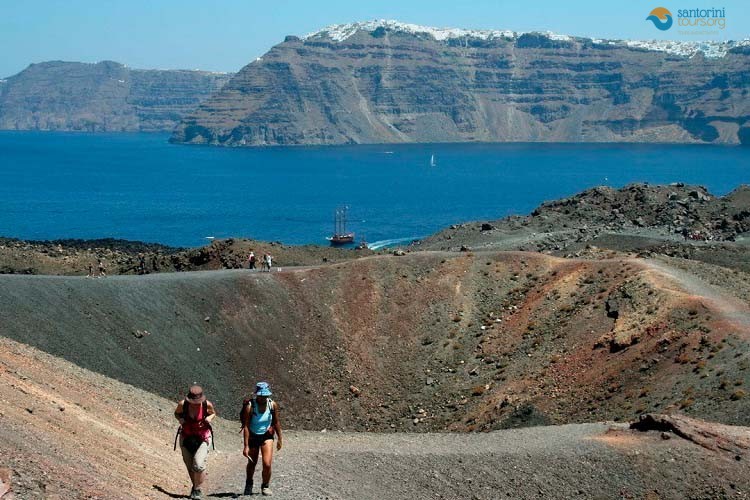
At Nea Kameni on a santorini volcano and hot springs tour, you step onto a landing and then onto a wide path of loose volcanic gravel. The entrance fee is often not included in the boat ticket, so keep cash with you. The path has no shade and rises in about 30 to 40 minutes to a high point of roughly 130 metres. It is not a hard climb, but it is hot work in summer, and the gravel slides a little under your feet.
The crater stop on a santorini volcano and hot springs tour brings you to steaming fumaroles and yellow sulphur staining on the rock. The ground can feel hot through thin shoe soles. Nea Kameni is a protected site, so you stay on the marked path. After the crater area, you walk back down the same loose route, which is often harder on the knees than the way up.
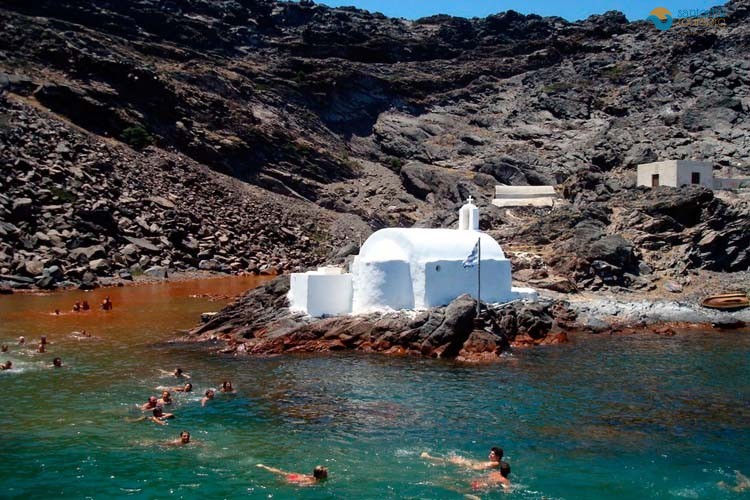
If your booking includes the springs, the boat then moves to Palea Kameni. Boats anchor offshore in a small bay, and you swim across a stretch of cold sea to reach the warm, rust-coloured water. The warmth comes from the same volcanic system, and the water contains iron that stains swimwear permanently. Wear an old swimsuit or expect to throw it away. The swim back to the boat is colder than the first crossing. For many people, a santorini volcano and hot springs tour is the point where the hot walk and the cold swim meet.
On the full-day version of a santorini volcano and hot springs tour, you do not return after Palea Kameni. The boat crosses to Thirasia, the island across the caldera, and stops at the small port of Korfos. The village of Manolas sits above it up a long flight of steps. This is a slower part of the day: you eat, walk, or sit above the port, and the boat leaves when the group is gathered.
The return leg depends on the version you chose. A standard santorini volcano and hot springs tour brings you back to the old port below Fira in the early afternoon, then you ride the cable car or climb the steps back to the rim. The cable car queue can be long when several boats return at once. If you are on a sunset version, the boat passes Oia on the way back and you reach the rim later.
The four shapes of the trip
Most operators sell the same route in four shapes. The differences are time, stops, and how tired you are at the end. Choose by your tolerance for heat, swimming, and a full day on a boat.
Volcano only
This is the shortest shape and the one that suits people who want the crater but not the swim. You go to Nea Kameni, walk to the craters, and return. This is the only version of a santorini volcano and hot springs tour that skips the hot springs entirely.
This shape of a santorini volcano and hot springs tour is easier to fit into a morning, and you avoid the wet swimwear problem. The downside is that you still have the full sun exposure on Nea Kameni, and you miss the contrast of the warm bay.
Volcano plus springs
This is the half-day shape that most people think of when they book a santorini volcano and hot springs tour. You walk Nea Kameni first, then the boat moves to Palea Kameni for the swim. It suits people who will swim in cold open water and who do not mind the iron staining on swimwear. If you are not a confident swimmer, this section can be hard because you cross a stretch of cold sea before the warm patch.
Full day with Thirasia
This shape adds Thirasia after the springs. You stop at Korfos, and most people either climb the long flight of steps to Manolas or stay near the port. A full-day santorini volcano and hot springs tour is the least rushed version, but it means a much longer day on a boat and more time in the sun. It suits people who want to see the caldera from the far side and do not have evening plans.
Sunset version
The sunset version follows one of the above routes but times the return so the boat passes Oia as the light drops. A sunset santorini volcano and hot springs tour is more about the finish than the volcano. It suits people who want the volcano walk and the end-of-day view from the water. The trade-off is that you return to the old port later, and the cable car queue can be worse than in the afternoon. Wind is more likely to cancel a small-boat sunset version in July and August.
The Institute for the Study and Monitoring of the Santorini Volcano monitors the volcano, which is dormant but active. A santorini volcano and hot springs tour stays on the edge of that system. The fumaroles and warm water are the only visible signs. If you feel uncertain, this is not a reckless activity on a calm day, but the heat and the boat crossings are real risks on a windy one.
Getting down to the boat: the cable car, the steps and why the donkeys are the wrong answer
Most half-day volcano trips leave from the old port below Fira. That port sits at the bottom of a steep cliff under the caldera rim. Fira, Firostefani, Imerovigli and Oia sit on the caldera rim, so the old port below Fira is the nearest boat access for most visitors. You can reach it by cable car, on foot down the steps, or by donkey. Some boats also leave from Ammoudi below Oia and from Vlychada marina, but the old port below Fira is the main starting point. A santorini volcano and hot springs tour that starts at the old port below Fira means you need to get down before the boat leaves, and you still have to get back up afterwards. The return climb is the part most visitors forget.
The cable car is the fastest route once you are inside it. The ride takes only a few minutes, but the queue at the top can be long in high season. In July and August, allow 30 to 45 minutes for the queue between about 10:00 and midday. Cruise ship passengers use the same cable car, so the line swells when several ships are in. Buy your ticket at the top station and check the price on the day. If the boat for your santorini volcano and hot springs tour has a fixed sailing time, stand at the top station 45 to 60 minutes early. The return queue from the old port at sunset is often worse than the morning descent.
The stepped path from Fira to the old port is the same path the donkeys use. Walking down takes about 25 minutes if you are steady on your feet. The steps are wide but uneven, dusty in dry weather and slippery in places from wear and donkey droppings. You share the path with animals and other walkers. Coming back up is much harder. Allow 40 minutes to an hour in summer heat, and there is almost no shade. If you are joining a santorini volcano and hot springs tour that returns at midday, the climb back up is the biggest downside of the footpath.
The donkeys are the wrong answer for most people. They use the same stepped path, move slowly in busy periods and stop when they choose. You do not skip the boat queue on a santorini volcano and hot springs tour, and you still end up at the same jetty. The ride is rough, the animals work in heavy traffic, and the path becomes harder for everyone walking beside them. If you are worried about the climb or the heat, the cable car is the better option even with its queue.
Before you go down for a santorini volcano and hot springs tour, call the boat operator on the day. The meltemi wind blows in July and August and cancels small boats before large ones. There is no point taking the cable car down if a small kaiki has already been cancelled. Ask when the boat actually leaves, not just the booking time. The old port below Fira is not the same as Athinios, the ferry port 8 km below Fira. If a driver says “port”, confirm which one. The island’s taxi fleet is small, so a missed boat can be hard to fix.
The boats themselves: wooden kaikia, big motor boats and sailing catamarans
The caldera was formed by the Minoan eruption about 3,600 years ago. Nea Kameni and Palea Kameni are the two small dark islands in the middle of the caldera. They were built by eruptions that began in antiquity and continued into the twentieth century, the most recent activity in the 1950s. Typical shapes for a santorini volcano and hot springs tour include:
- Volcano only
- Volcano plus hot springs, about half a day
- Volcano plus springs plus Thirasia, a full day
- Sunset versions that pass Oia on the way back
The boat type changes the shape of a santorini volcano and hot springs tour more than the itinerary does. Choose by deck, shade, crowd and sea conditions, not just by the destination.
Wooden kaikia
A wooden kaiki is the traditional low-sided boat with a broad stern. The deck is close to the water, with bench seating along the sides and a small canopy for shade. The canopy may cover only half the deck, so the sunny side fills first. Groups are smaller, so boarding and landing feel quicker. A kaiki rolls more in the swell and is the first type to be cancelled when the meltemi blows. The deck gets hot underfoot, and the toilet is basic. On a santorini volcano and hot springs tour, a kaiki is best if you want a smaller group and do not mind a slower crossing.
Larger motor boats
Larger motor boats carry far more people and usually have two levels. The upper deck has rows of seats under a hard awning. The lower deck is enclosed, with bigger windows, a bar and a regular toilet. In August the upper deck fills first because it has the best air. While the boat is moving, the crowd spreads out. When it reaches Nea Kameni, everyone funnels onto the same landing and the first part of the path becomes crowded. The advantage is stability and speed. These boats keep running in wind that keeps a small kaiki tied up. If you want a straightforward santorini volcano and hot springs tour with more shade and a proper cabin, this is the usual option.
Sailing catamarans
Sailing catamarans are the least crowded and often the most expensive. They usually leave from Vlychada marina or Ammoudi below Oia, not from the old port below Fira. The deck is wide, with netting at the front and a shaded cockpit at the back. The front netting is fully exposed, so use it only if you want strong sun. Inside the caldera the engines do most of the work because the timetable and wind angle do not allow much real sailing. At Palea Kameni the catamaran anchors offshore, and swimmers cross a stretch of cold sea to reach the warm patch. A catamaran is the comfortable choice for a santorini volcano and hot springs tour if you want fewer people, but you pay for that space.
On a santorini volcano and hot springs tour, the boat lands at a rough volcanic rock jetty at Nea Kameni. The island is a protected site, and the entrance fee is often not included in the boat ticket. Carry cash. The path to the crater rim is broad but made of loose volcanic gravel. It has no shade. The walk takes about 30 to 40 minutes up, and the high point is roughly 130 metres. Near the craters you can see steaming fumaroles and yellow sulphur staining. The Institute for the Study and Monitoring of the Santorini Volcano monitors the volcano, which is dormant but active. This is not a short photo stop. Wear shoes that can grip gravel and bring water.
The springs at Palea Kameni are not a hot tub. The boat anchors in a small bay, and swimmers cross a stretch of cold sea before reaching the warm, rust-coloured water. The water contains iron that stains swimwear permanently, so wear old or dark swimwear. The smell stays on your skin until you rinse. There is no sand beach, just rock and water. A santorini volcano and hot springs tour that includes the springs means a cold swim before the warm patch, and a stain risk on light fabrics.
If you choose the full day option, most boats stop at Thirasia, the island across the caldera. The small port at Korfos is quiet, and the village of Manolas sits above it up a long flight of steps. You can climb or use a donkey, but the same caution applies. Most visitors only have time for a simple lunch near the port. A full day santorini volcano and hot springs tour adds several hours, so check what the return time means against the cable car queue back up from the old port.
Sunset versions pass Oia on the way back and are the busiest boats on the water late in the day. The return to the old port below Fira often meets the worst cable car queue of the afternoon. If you book a sunset santorini volcano and hot springs tour, plan for a slow journey back to your hotel.
The crater walk on Nea Kameni, step by step
Most people who book a santorini volcano and hot springs tour start at the old port below Fira. That port is reached by cable car, on foot down the zigzag steps, or by donkey, which we do not recommend. Athinios is the ferry port 8 km below Fira and is not the same as the old port. Boats also leave from Ammoudi below Oia and from Vlychada marina on the south side of the island.
The cable car is the fastest way down to the old port for a santorini volcano and hot springs tour, but the line can be long before morning departures. Walking down the steps takes longer than people expect and is hard on the knees. The donkey option is slow and the animals are often overworked, which is why we avoid it.
The boats are wooden kaikia, larger motor boats and sailing catamarans. A standard santorini volcano and hot springs tour takes about half a day. Volcano only trips skip Palea Kameni. Full-day versions add Thirasia, the island across the caldera, with the small port at Korfos below the village of Manolas. Sunset versions pass Oia on the way back.
On Nea Kameni itself, the sequence is always the same.
- Landing. You step off onto a rough landing on the dark island. Nea Kameni is a protected site, and the entrance fee is often not included in the boat ticket.
- The gravel path. The path is wide but made of loose volcanic gravel. It climbs for 30 to 40 minutes without any shade.
- The rim. The high point is roughly 130 metres. You can see the caldera rim towns of Fira, Firostefani, Imerovigli and Oia, plus Palea Kameni below.
- The fumaroles. Near the craters there are steaming fumaroles and yellow sulphur staining. The smell is like rotten egg.
- The ground and the air. The ground is crusted in some places and loose in others. The air is dry, hot and dusty. There is no shade on the path or at the rim.
The walk down takes about the same time and is harder on the knees because the gravel slips. A santorini volcano and hot springs tour is not a beach day. You need water, closed shoes and something to cover your head and neck. The crater section is fully exposed the whole time you are on the island.
After Nea Kameni, most half-day versions of a santorini volcano and hot springs tour move to the small bay at Palea Kameni. Boats anchor offshore. Swimmers cross a stretch of cold sea to reach the warm, rust-coloured water. The colour comes from iron, and that iron stains swimwear permanently. Wear old dark swimwear or accept the stains.
The water at Palea Kameni is warm, not hot. The cold part of the swim is the most uncomfortable part for most people on a santorini volcano and hot springs tour. There is no beach and no platform at the warm spot. If the sea is choppy, staying on the boat is the right choice.
The rust-coloured water is the main reason people swim, but it is not a spa. It is a patch of warm seawater in a small bay. In rough weather the warm layer mixes with cold water, so do not expect still, hot water.
Full-day versions of a santorini volcano and hot springs tour that add Thirasia stop at Korfos, the small port. The village of Manolas sits above it at the top of a long flight of steps. That climb is also in full sun and feels steeper than the crater path. It is not for everyone, especially in July and August.
In July and August the meltemi wind blows hard and can cancel a santorini volcano and hot springs tour. Small boats are cancelled before large ones, so a sailing catamaran may still run when a small kaiki stays in port. Check on the day. If your boat returns late to Ammoudi below Oia, remember the island’s taxi fleet is small.
What the volcano is doing now, in plain language
A santorini volcano and hot springs tour visits an active volcanic crater, but that does not mean an eruption is expected. Santorini is dormant but active. The most recent activity on Nea Kameni was in the 1950s. That is recent in geological time, not in human memory.
The caldera crossed by a santorini volcano and hot springs tour was formed by the Minoan eruption about 3,600 years ago. That eruption removed the centre of the island and left the flooded bowl you see today. Fira, Firostefani, Imerovigli and Oia sit on the caldera rim. The high cliffs are the inside wall of that old collapse.
Nea Kameni and Palea Kameni are the two small dark islands in the middle of the caldera. They were built by eruptions that began in antiquity and continued into the twentieth century. They are not the cone left from the Minoan eruption. Every stretch of gravel path on a santorini volcano and hot springs tour crosses lava that is much younger than the cliffs around it.
The steam at the fumaroles on a santorini volcano and hot springs tour is not magma boiling the surface. Rainwater and seawater seep down through cracks in the rock, meet hot rock at depth, and rise again as steam. The yellow sulphur staining is deposited by gases in that steam. The rotten egg smell is hydrogen sulphide. It is stronger near the craters and fades as you walk back down.
The volcano is monitored by the Institute for the Study and Monitoring of the Santorini Volcano. Scientists track ground movement, gas chemistry and small earthquakes. The reason a santorini volcano and hot springs tour is allowed on Nea Kameni is that monitoring has not found signs of unrest. If that changed, the crater would close to visitors long before any eruption. The institute is a scientific body, not a tourist office. Its work is continuous.
Dormant but active is the term scientists use. It means no eruption is happening now, but the system is still alive. The Kameni islands were built in separate eruptions, not one long event. The most recent land-building added fresh lava to Nea Kameni in the 1950s, which is why the surface looks raw. Palea Kameni is older, so its shoreline has been softened by the sea.
Small earthquakes happen in the caldera from time to time. Most are too weak to feel. The Institute records them whether anyone on a santorini volcano and hot springs tour notices or not. That background activity is expected on a dormant but active volcano.
The hot springs at Palea Kameni: how you get in, the cold swim across, the temperature, the iron that stains swimwear, how long you get
A santorini volcano and hot springs tour often stops at Palea Kameni after the walk on Nea Kameni. The boat anchors offshore in a small bay. There is no dock, no jetty, and no shallow wading entry. You get in from the boat’s swim platform or ladder, then swim away from the hull toward the rust-coloured water near the rocks.
The warm springs are not next to the boat. On a santorini volcano and hot springs tour, the captain must anchor far enough out to keep the boat safe, so the first stage is a cold swim across open sea. The distance varies with the boat’s position and the wind, but it is enough that a weak swimmer will notice it. The water here is normal Aegean sea. It is cold, deep, and clear.
On a santorini volcano and hot springs tour, the temperature changes only when you reach the rusty patch. The spring water is warm, not hot. It is often just a few degrees warmer than the sea around the boat, and it cools quickly where it mixes with open water. Do not expect a hot tub. On rough days the warm layer breaks up, and you may have to move around to find the warmest pockets.
The rust colour on a santorini volcano and hot springs tour comes from iron, and that iron stains swimwear permanently. Pale suits turn orange or brown, and the stain does not wash out. Wear an old dark swimsuit that you are ready to lose. The iron also leaves a metallic smell on your skin and can tint light or bleached hair, so rinse after the swim if the boat has a deck shower.
Most boats on a santorini volcano and hot springs tour allow roughly 30 minutes at the springs. That includes the cold swim in and the swim back. It is enough to float in the warm patches for a while, but it is not a beach stop. If you are slow in the water, you will spend most of that window crossing and very little time sitting in the warmth.
Boat type changes how easy the entry feels on a santorini volcano and hot springs tour. A small wooden kaiki sits lower to the water, so the ladder may be short. A larger motor boat or sailing catamaran often has a more stable platform. In July and August the meltemi wind can make the crossing choppy, and small boats are cancelled before large ones.
You climb back onto the boat the same way you came. The ladder can be slippery and the deck will be wet. Sit on a towel rather than directly on a wooden bench if you are still covered in iron water. A santorini volcano and hot springs tour then moves on, usually back past Nea Kameni or toward Thirasia or Oia depending on the route.
What to wear and carry for the day, and what people get wrong about the swim
Dress for two separate activities on a santorini volcano and hot springs tour. You need clothes that work for a rocky, shade-free walk and a deep-water swim. Wear your swimsuit under your clothes from the start. Make it an old dark one, because the iron at Palea Kameni will ruin anything pale. Bring a towel, a sun hat, sun cream, and more water than you think you need.
Footwear matters more than most visitors expect. On Nea Kameni you walk up a wide path of loose volcanic gravel to the crater rim. The climb takes 30 to 40 minutes up, with no shade. Closed shoes or sturdy sports sandals work better than flip-flops, which slip on the gravel and fill with stones. On a santorini volcano and hot springs tour, shoes need to survive that gravel and still be easy to remove before the swim.
Carry a light wind layer. The meltemi wind blows in July and August, and the boat ride can feel cold once you are wet. Sun cream washes off during the swim, so reapply after the springs stop. A dry bag is useful for a phone and dry clothes, because boats are wet underfoot and spray can reach the benches. A santorini volcano and hot springs tour is wetter than people expect, so avoid cotton layers that stay cold.
Bring small cash for the Nea Kameni entrance fee. It is a protected site, and the entrance fee is often not included in the boat ticket. A santorini volcano and hot springs tour can leave from the old port below Fira, from Ammoudi below Oia, or from Vlychada marina. If you leave from Fira, the cable car down to the old port is the most predictable option. The steps are long, and the donkeys are not a good idea.
The biggest mistake people make with the swim is thinking the boat docks at the hot springs. It does not. You anchor offshore and swim across a stretch of cold, deep water. If you are not a confident swimmer, say so to the crew before the boat stops. Every santorini volcano and hot springs tour has this same pattern, but first-time visitors still stand at the platform in surprise.
Another mistake on a santorini volcano and hot springs tour is wearing a new or white swimsuit. The iron at Palea Kameni stains permanently, and washing will not fix it. Use an old dark suit and an old dark towel. The same applies to light hair, which can pick up a brassy tint from the water.
People also underestimate how tired they will be before the swim. The Nea Kameni path climbs to roughly 130 metres, with loose gravel and no shade, and you are often hot and dusty by the time you reach Palea Kameni. Drink water on the climb, not just at the beach. A santorini volcano and hot springs tour is a half-day or full-day trip, depending on whether it also stops at Thirasia or returns past Oia at sunset. Plan food and water around the whole day.
Santorini’s caldera was formed by the Minoan eruption about 3,600 years ago. Nea Kameni and Palea Kameni are the two small dark islands in the middle of it. A santorini volcano and hot springs tour normally stops at both. You then choose between four shapes: volcano only, volcano plus springs, a full day with Thirasia, or a sunset version. The boats leave from the old port below Fira, from Ammoudi below Oia, or from Vlychada marina. The meltemi wind blows in July and August and cancels small boats before large ones.
Thirasia on the full-day version
The full-day santorini volcano and hot springs tour is the only standard shape that includes a stop on Thirasia. You reach the island at the small port of Korfos after the volcano and springs stops, usually in the early afternoon. Korfos is not a town and not a resort. It is a small boat landing at the base of the cliff, with clear water and very little else.
From Korfos, the village of Manolas sits above you. The usual way up on foot is a long flight of steps that zigzags up the slope. The island’s taxi fleet is small, so do not count on a ride from the landing. This is real work. The climb is steep, exposed, and slow in summer heat. You will need water and steady shoes on a santorini volcano and hot springs tour. If you choose not to walk, you can sit near the landing, but you will miss the reason the stop exists.
Manolas is a quiet working village, not a caldera-rim resort. You will see white houses, small churches and narrow lanes. The best reason to climb is the view back across the caldera to Fira, Firostefani, Imerovigli and Oia. That view gives you a sense of the caldera’s size that you cannot get from the rim above Fira.
Eating and seeing
The tavernas in Manolas are simple and family-run. Order fava, tomato fritters and grilled fish if it is fresh that day. Service is usually slower than you will find in Fira, so keep the boat’s leaving time in mind before you sit down. The stop length on a santorini volcano and hot springs tour varies with the wind and the route. You are on the boat’s schedule, not your own.
There is not much else to see in the sense of sights. You can walk through the upper lanes, sit on a wall above the caldera, or visit a small church. This is not a shopping stop. Most people eat, look at the view, and start back down with time to spare.
Whether the extra hours are worth it
The full-day santorini volcano and hot springs tour asks you to spend the whole day on the water and on foot. You get the same volcano climb and the same warm spring swim as the half-day version. The extra cost is the time, the long stop on Thirasia, and the climb to Manolas.
If you want the complete caldera and a quieter island stop, those hours are worth it. If you are travelling in July or August, a full day on a small boat in the meltemi wind can be tiring. The Thirasia steps are often at the hottest point of the day. Do not book this version for a quick look. The half-day santorini volcano and hot springs tour covers the volcano and springs without Thirasia. It leaves you a free afternoon in Fira or Oia.
The sunset version
A sunset santorini volcano and hot springs tour is not the same as standing on the rim in Oia. The boat takes you to Nea Kameni and Palea Kameni during the afternoon. Then it passes Oia on the way back and waits on the water as the light goes. You see the sunset from below the caldera, not from above it. That difference matters.
What you actually see
The early part of a santorini volcano and hot springs tour is the same as the daytime version. You climb the loose volcanic gravel path on Nea Kameni to the crater rim, about 30 to 40 minutes up with no shade. At the top there are steaming fumaroles and yellow sulphur staining near the craters. Nea Kameni is a protected site, and the entrance fee is often not included in the boat ticket.
At Palea Kameni the boat for a santorini volcano and hot springs tour anchors offshore and you swim across a stretch of cold sea to reach the warm, rust-coloured water. That water contains iron and stains light swimwear permanently. After the swim, the boat turns back north and passes Oia as the light starts to change.
From the water, the main event is the cliff itself. The rock above you turns pink and orange, the white houses on the rim catch the last light, and the sea changes colour under the boat. You will not get the classic Oia photograph with the windmill and the crowd-free lane. You will get a wider, quieter view of the northern caldera, and you will be moving slightly with the swell.
Where the boat sits
The boat usually holds position below Oia on the caldera side after the springs and any Thirasia stop. It may drift or use the engine to stay off the rocks. This is not a calm harbour. If the meltemi is running in July or August, the boat will roll and the sunset section can feel long. Small wooden kaikia move more than larger motor boats. Think about the boat type before you book a sunset santorini volcano and hot springs tour.
Because you are looking up from the water on a santorini volcano and hot springs tour, the exact moment the sun disappears can be hidden by the land above you. After that, the afterglow is still strong and the upper cliffs stay warm for some time. If you want the precise moment, the rim is more reliable. If you want the caldera glow and the water, the boat is better.
The trade-off against the rim
A sunset santorini volcano and hot springs tour solves the problem of the Oia crowd. You do not have to claim a spot on a wall hours in advance or walk through the narrow lanes in a crush. The problem it creates is that you are on a boat, in the wind, and you cannot change position. Another boat or a headland can block your view. On the rim you can choose your spot. On the water the skipper chooses, and every other sunset boat is doing the same thing.
There is also a practical end to the trip. When the light is gone, the boat still has to return to the old port below Fira or to Ammoudi. If you return to the old port, you then face the cable car queue or the long path up the steps in the dark. The crowd you avoided in Oia may be waiting at the cable car at the same time. This is the hidden cost of a sunset santorini volcano and hot springs tour.
The rim is better if you want the classic view, a solid spot under your feet, and the freedom to leave when you choose. The boat is better if you want the full trip and are willing to trade that control for an evening on the water. Do not assume the boat is the easy option. Book a sunset santorini volcano and hot springs tour because you want the whole caldera experience, not because you want to avoid all crowds.
Who should not book this trip, honestly
A santorini volcano and hot springs tour is not a calm loop around the caldera. The caldera was formed by the Minoan eruption about 3,600 years ago. Nea Kameni and Palea Kameni, the two small dark islands in the middle of it, were built by eruptions that began in antiquity and continued into the twentieth century, the most recent activity in the 1950s. You walk up a loose gravel path on Nea Kameni, you cross open sea, and you sit in full sun for hours. If you are unsure, these are the specific reasons people ask to leave early or stay on the boat.
Boats leave from the old port below Fira, reached by cable car or down the long steps on foot. Some trips also leave from Ammoudi below Oia and from Vlychada marina. The old port path is steep and the donkey option is one we do not recommend. The base port matters because you have to get down and back up before a santorini volcano and hot springs tour even starts. Fira, Firostefani, Imerovigli and Oia sit on the caldera rim, so most visitors start in one of those villages.
Seasickness. The caldera crossing is not always rough, but the meltemi wind in July and August can make it choppy. Small wooden kaikia are affected before larger motor boats and sailing catamarans are. If you get queasy on ferries, a santorini volcano and hot springs tour will probably be harder, because the boat stops and rolls while people swim or walk ashore.
Mobility and balance. The Nea Kameni landing is not a level pier. You step onto volcanic rock and then climb a wide but loose gravel path to the crater rim. The climb is roughly 130 metres high and takes 30 to 40 minutes up with no shade. Anyone who struggles with uneven ground, steep steps, or long standing should stay on the boat or skip this part of a santorini volcano and hot springs tour.
Very small children. This is a long, hot day with little to do for a toddler. The hot springs require swimming across a stretch of cold sea from an anchored boat, and the rust-coloured water stains swimwear permanently. There is no shallow beach to sit on. A child who cannot swim confidently or follow safety instructions is safer on dry land than on a santorini volcano and hot springs tour.
People who dislike heat. Nea Kameni has no shade, and the pale volcanic ground reflects the sun. In July and August the walk feels much longer than its 30 to 40 minutes. The fumaroles near the craters add heat and a strong sulphur smell. If you are uncomfortable above 30 degrees, a santorini volcano and hot springs tour will not get easier once you leave the boat.
Safety and comfort on the day
Most problems on a santorini volcano and hot springs tour come from sun, dehydration, bad footwear, and underestimating the gravel path. The crew is there to run the boat and manage basic safety, not to act as a hiking team or lifeguard.
Protect yourself from the sun before you board. There is almost no shade on Nea Kameni, on the boat deck, or in the sea crossing to Palea Kameni. Wear a hat and a cover-up, and reapply water-resistant sunscreen after swimming. Sunburn happens quickly on a santorini volcano and hot springs tour, even when the air feels cool.
Bring more water than you think you need. On a santorini volcano and hot springs tour, the climb to the crater rim takes 30 to 40 minutes and has no shade or water point. Do not assume the boat bar will have enough for everyone or be open when you want it. Drink small amounts often during the walk, not only when you feel thirsty.
Have small cash for Nea Kameni. The protected-site fee is often not included in the boat ticket, and there is no reason to expect a card machine at the landing. A santorini volcano and hot springs tour can be volcano only or a volcano plus hot springs half day. Adding Thirasia makes a full day, with a stop at Korfos port and a long flight of steps up to Manolas if you go ashore. Sunset versions pass Oia on the way back.
Footwear and the gravel. Loose volcanic gravel makes the wide path slippery, especially on the way down. Wear closed sandals or trainers with good grip, not flip-flops. The climb on a santorini volcano and hot springs tour is about 130 metres to the crater rim. Walk slowly, stay on the path, and keep both hands free for balance.
The sulphur smell. Near the craters you will see yellow sulphur staining and steaming fumaroles. The smell is strong and the ground is warm. The volcano is dormant but active, and is monitored by the Institute for the Study and Monitoring of the Santorini Volcano. It is safe for most people at the viewing points, but do not step over ropes or step into cracks. If you have asthma or react badly to strong smells, stay lower on the path or ask the crew before you climb.
The sea and the springs. Boats anchor offshore at Palea Kameni, so you swim a stretch of cold sea before you reach the warm, rust-coloured water. This is the part of a santorini volcano and hot springs tour that surprises people, because the iron in the water stains swimwear permanently, so wear an old dark suit and do not wear white. The crossing is not a wading pool. You need to be able to swim a short distance in open water and climb a ladder back onto the boat.
In July and August, the meltemi wind cancels small boats before large ones. If your santorini volcano and hot springs tour is cancelled, do not expect the island’s small taxi fleet to solve the problem quickly. Athinios ferry port is 8 km below Fira, and taxis are scarce when many people need them.
The crew on a santorini volcano and hot springs tour will give you a safety briefing, tell you the times to be back on board, and count heads before the boat moves. They will not carry you up the gravel path, watch your children while you swim, or wait more than a few minutes for late passengers. If you decide not to climb or swim, say so before you leave the boat, and stay in the designated waiting area.
When to go: the hour of the day, the month, and what the meltemi does to small boats
For a santorini volcano and hot springs tour, book the first departure of the morning. Boats usually leave the old port below Fira early in the morning, often before 10:00 in high season. Nea Kameni is a black open slope with no shade, and the path from the landing to the crater rim is loose volcanic gravel. Count on 30 to 40 minutes up to the high point at roughly 130 metres. By 13:00 in July the same walk is hard work, and you feel heat from the ground as much as from the sun.
The best months for a santorini volcano and hot springs tour are late May, June and September. The sea is usually calmer then, and the afternoon wind is less likely to cut the day short. July and August are the busiest months. The meltemi wind blows hard enough to cancel small wooden kaikia before larger motor boats and sailing catamarans. If you can only come in August, choose a bigger boat and keep the next morning free as a backup.
The hour you leave on a santorini volcano and hot springs tour also decides what the springs feel like. Boats anchor offshore at Palea Kameni, and swimmers cross a stretch of cold sea to reach the warm, rust-coloured water. The warm spring is not a hot tub. It is a small bay with rusty water heated by the volcano, and the cold approach is part of the deal. In the morning that crossing is bracing. In late afternoon, when the wind has picked up, the same swim can be tiring for ordinary swimmers. The iron in the water stains pale swimwear permanently, so wear dark or old clothes.
Sunset departures sound attractive, but they are not the best way to walk the volcano. A sunset santorini volcano and hot springs tour usually reaches Nea Kameni in the late afternoon, when the rock has stored the day’s heat. You get the return leg past Oia at dusk, which is a real trade-off. If the volcano walk is your main goal, take the early boat and stay in Fira for the sunset.
The meltemi is the deciding factor in July and August for a santorini volcano and hot springs tour. It starts in the afternoon and can turn the caldera into rough water very quickly. Small boats return to the old port below Fira before larger ones. That means a wooden kaiki may be cancelled while a larger motor boat still runs. If the wind forecast is above moderate, ask the operator whether they would move you to a different boat or day.
Booking: shared group boat, semi-private, private charter, what is and is not included, and the questions to ask before you pay
Shared group boat. A shared group santorini volcano and hot springs tour is the least expensive option and the most fixed. You board with a crowd, the route rarely changes, and the time on Nea Kameni is enough for the crater walk but not much extra. Shared boats usually leave from the old port below Fira, so you need to get down by cable car or on foot down the steps. The ticket normally does not include that cable car fare.
Semi-private. A semi-private santorini volcano and hot springs tour is the middle option. It usually uses a smaller motor boat or sailing catamaran and carries far fewer people than a shared boat. The real advantage is time. You can stay longer at the springs at Palea Kameni and avoid the worst queue at the Nea Kameni landing. The trade-off is cost, and a semi-private boat can still be uncomfortable when the meltemi hits in August.
Private charter. A private charter turns a santorini volcano and hot springs tour into a day you control. You can leave earlier from Ammoudi below Oia or from Vlychada marina, spend your time at the crater without a crowd, and decide how long to stay at the springs. It costs a lot more, and the smaller boats used for charters are the first to be cancelled by wind. For a group of six or more the price gap shrinks. For two people it is a serious premium.
The entrance fee for Nea Kameni, a protected site, is often not included in a santorini volcano and hot springs tour. Hotel transfers, cable car tickets, lunch and drinks are also commonly separate. Check each one. Some full-day trips include a stop at Thirasia, the island across the caldera, with a meal at Korfos or a climb to the village of Manolas up a long flight of steps. Do not assume the meal is included unless the operator says so in writing.
Before you book any santorini volcano and hot springs tour, ask three things in this order. First, if the meltemi blows, do you cancel, move me to a larger boat, or refund? Second, does the price include the Nea Kameni entrance fee? Third, how many minutes do I get on the crater and at the springs? A cheap shared ticket can lose its value if it gives you only 40 minutes on Nea Kameni and a rushed swim.
Ask the rest before you pay for a santorini volcano and hot springs tour.
- For a santorini volcano and hot springs tour, does the boat leave from the old port below Fira, Ammoudi below Oia, or Vlychada marina, and who arranges transport?
- Is the swim at Palea Kameni from the boat or from a platform?
- What is the boat type: wooden kaiki, motor boat, or sailing catamaran?
- What time does the santorini volcano and hot springs tour actually return, not depart?
- Is the Nea Kameni entrance fee paid in cash on arrival?
Book a santorini volcano and hot springs tour with a clear idea of the real cost. A shared boat may look half the price of a semi-private trip, but after the entrance fee, the cable car and poor timing you may not save much. A private charter is not better for everyone. If you dislike swimming from a boat and only want the crater, a volcano-only trip is the right choice.
How this trip fits into a short stay on Santorini
Put the santorini volcano and hot springs tour on a day when you are not catching a flight and not arriving on a ferry. The trip works like this: you go down to the old port below Fira, to Ammoudi below Oia, or to Vlychada marina, board a boat, cross to Nea Kameni, walk the crater for 30 to 40 minutes on loose gravel with no shade, then swim from the boat at Palea Kameni. You should expect to be occupied from roughly mid-morning to mid-afternoon. If you leave from the old port below Fira, add the cable car queue back up to Fira afterwards.
The santorini volcano and hot springs tour combines best with four half-day blocks: the roofed Bronze Age site at Akrotiri, a wine afternoon near Megalochori, a beach at Kamari or Perissa, and the rim path between Fira and Imerovigli. Do not combine it with the full Fira to Oia rim walk on the same day. That walk is about 10 km and takes three to four hours. You will either rush the crater or start the walk late in the heat.
Two-day stay
Day one: Akrotiri in the morning, then a late lunch and wine afternoon near Megalochori or a swim at Perissa. Day two: the santorini volcano and hot springs tour in the morning and early afternoon, then the short rim path from Fira to Imerovigli around sunset. This is the tightest plan. It works only if day two is not a departure day.
Three-day stay
Day one: Akrotiri and the south coast, finishing at Kamari or Perissa. Day two: the santorini volcano and hot springs tour, then an easy evening in Firostefani. Day three: the full rim path from Fira to Oia in the morning, then a wine afternoon. Start the rim walk by 08:00 if you are doing it in July or August.
Four-day stay
Day one: Akrotiri and a south beach. Day two: the santorini volcano and hot springs tour and the Fira to Imerovigli section. Day three: the full Fira to Oia rim walk. Day four: wine tasting around Megalochori and a slow afternoon at Perissa. This leaves you a margin if the boat is cancelled and you need to swap days.
Do not book the santorini volcano and hot springs tour on a day you have an early flight. Even if the boat is back on time, the cable car queue at Fira can eat the afternoon. It also does not work on a ferry day. Athinios is 8 km below Fira, and ferry delays are common in meltemi season. If you want a full walking day, keep that separate as well.
What to do if the boat is cancelled or sold out
If the santorini volcano and hot springs tour is cancelled or sold out, you can still see the caldera from seven easy land viewpoints. The trade-off is that you do not stand inside the crater on Nea Kameni or swim at Palea Kameni. You view the dark islands from above instead, which is often clearer in the late afternoon.
Before you give up, check departure points. Boats for the santorini volcano and hot springs tour leave from the old port below Fira, from Ammoudi below Oia and from Vlychada marina. A boat from Vlychada may still run when the old port is full, but it also has a longer crossing. In July and August the meltemi wind cancels small boats before large ones, so an early morning call to the operator is worth more than waiting at the port.
- Fira to Imerovigli rim path. Central caldera view of the two islands of the santorini volcano and hot springs tour, with Nea Kameni straight ahead and Palea Kameni to its left. Go before 11:00, when the sun is behind you and the lava stays dark instead of silhouetted.
- Skaros rock. Walk down from Imerovigli for a cleaner view north and west. Best in the hour before sunset. The climb back is rough and unlit.
- Firostefani terraces. Same view as Fira, across the two islands of the santorini volcano and hot springs tour, with fewer people. Late afternoon works well and you can stay for sunset without the Fira crowd.
- Pyrgos castle. Set back from the rim, so you trade close detail for the whole caldera outline. Go mid-morning before haze. You see the shape of the islands, not the crater floor.
- The road above Megalochori. Shows the two islands of the santorini volcano and hot springs tour from the south, with Palea Kameni closer. Best from 10:00 to noon. Watch for traffic. The road is narrow.
- Faros lighthouse. The wide caldera opening and the islands from the far south. Best in the last hour before sunset. It is a drive from Fira.
- Athinios on the way in. The switchback road down gives the closest land view of the caldera wall and the islands of the santorini volcano and hot springs tour at water level. This is a working port. Stay in the car or bus and treat it as a view from the road.
If you had booked the santorini volcano and hot springs tour mainly for the swim at Palea Kameni, there is no land equivalent. The warm water is reached by boat, and the iron-stained shallows are not visible from the rim. You can see where you would have swum, but you cannot swim there from shore.
For the crater section of the santorini volcano and hot springs tour, the closest land alternative is the rim path from Fira to Imerovigli or Skaros rock. You look down into the caldera that the Minoan eruption formed about 3,600 years ago. You will not smell the sulphur or walk the loose gravel to roughly 130 metres, but you will see the two dark islands from above.
Photographs on the water and on the crater
The light on a santorini volcano and hot springs tour changes fast, so decide your main subject before the boat leaves. Morning departures from the old port below Fira put soft light on the caldera wall and the white towns of Fira, Firostefani and Imerovigli. This is the best time to shoot the cliff face from the water. By midday the light is hard and flat, but it makes the dark lava, yellow sulphur and steam around the Nea Kameni craters stand out. On the crater rim, late afternoon light is better for wide views across the caldera.
One frame worth planning on a santorini volcano and hot springs tour is the bow of the boat against the white pumice wall of the caldera. A wooden kaiki with its bow pointing toward Fira works best in the first hour, when the cliff is not bleached out. From the high point on Nea Kameni, roughly 130 metres up, you can hold black lava in the foreground and the caldera rim villages behind it. Near the craters, frame the steam and yellow sulphur staining with a person standing safely behind the rope line. This gives scale without getting too close to the fumaroles.
On a santorini volcano and hot springs tour, protect your camera from four things. Sea spray hits the boat deck even on calm days, so keep the camera in a dry bag until you need it and do not change lenses in the open. Fine volcanic dust on Nea Kameni gets into bags and moving parts. The path is loose gravel, and each step kicks up dust. Heat near the fumaroles can fog a cold lens, and a phone left in direct sun will overheat. The most likely way to damage a camera on a santorini volcano and hot springs tour is spray and dust, not the water itself.
The hot springs at Palea Kameni create a strange photo scene on a santorini volcano and hot springs tour: clear cold sea, then a patch of rust-coloured warm water. Boats anchor offshore and swimmers cross a stretch of cold sea to reach it. The iron in that water stains light swimwear permanently, so wear old dark fabric. On a santorini volcano and hot springs tour, the swim stop is often shorter than people expect. The best frame is usually a swimmer halfway across, with the bare grey island and the boat behind. Keep the camera in a sealed pouch if you take it into the water, because the boat will be moving with the swell.
Do not waste your battery shooting the hot springs from the boat deck. The rust-coloured patch looks small from above and the colour only becomes clear from water level. On a santorini volcano and hot springs tour, save the camera for the crater first, because the climb is hot and you may not want to carry it twice. The crater rim has no shade, so a dry cloth and a wide hat matter more than a second lens.
What the day costs in shape rather than exact prices
A santorini volcano and hot springs tour has three price layers, and the first surprise is the site fee. Nea Kameni is a protected site, and its entrance fee is often not included in the boat ticket. You pay it at the landing on Nea Kameni. Keep small cash with you, because there may be no card machine at the small gate. The fee is not large, but after paying for the boat it feels like an add-on. The path from the landing to the crater rim is a 30 to 40 minute climb on loose gravel with no shade, so factor in water and a hat.
The shape of the trip is the main cost driver. A basic volcano only boat is the cheapest option on a santorini volcano and hot springs tour, but it skips the swim stop. The volcano plus hot springs shape runs about half a day and costs more. A full day that adds Thirasia costs more again, and lunch at Korfos or Manolas is usually separate. Sunset versions are priced above daytime trips because of the route past Oia on the return.
The departure point changes both money and time. If you are staying in Fira, Firostefani or Imerovigli, the old port below Fira is the closest base for a santorini volcano and hot springs tour. People waste money by paying for an island transfer they do not need. If you stay in Oia, joining from Ammoudi below Oia saves you the trip across the island. Vlychada marina suits the south, but the island taxi fleet is small, so a last minute taxi in summer is hard to get and expensive. In July and August the meltemi wind cancels small boats before large ones, so the cheapest boat is a false saving if it never leaves.
Getting down to the old port below Fira has its own costs on a santorini volcano and hot springs tour. The cable car from Fira to the old port is an extra cost each way. Walking the steps is free but hard in July and August heat. The donkeys on the same path are an extra charge and not recommended. Many people on a santorini volcano and hot springs tour arrive at the old port already hot and tired, then make a bad money decision out of exhaustion. Plan for the cable car queue instead, because it is worst when several boats return at the same time.
Small purchases at the departure point are another leak. A santorini volcano and hot springs tour is long enough that forgetting one small item becomes expensive. Hats, snacks, sealed phone pouches and old swimwear cost more at the marina or old port than in town. A white swimsuit is a hidden cost because the iron at Palea Kameni will ruin it permanently. Buy a cheap dark pair of shorts before you travel. Do not wait until the boat to buy or rent anything.
People pay extra for a santorini volcano and hot springs tour with Thirasia and then spend only an hour ashore. That add-on is not worth it unless you want the long climb from Korfos up to Manolas or a quieter stop away from the main boat crowd. If swimming and the crater are your targets, the half-day shape is enough. If you want the Oia view on the way back, choose a sunset version and accept that you will pay more for that one frame.
Practical questions, answered
What exactly is a Santorini volcano and hot springs tour?
Most versions of a santorini volcano and hot springs tour combine two stops. You walk on Nea Kameni, the larger dark island in the centre of the caldera, then the boat moves to Palea Kameni for a swim in the warm bay. Some operators sell it as a half-day trip and some add Thirasia or a sunset pass by Oia.
How long does it take?
A santorini volcano and hot springs tour usually takes about half a day. Volcano-only trips are shorter, and full-day versions add Thirasia and a slower lunch stop. Sunset versions leave later and return after dark.
Where do boats leave from?
Most people join a santorini volcano and hot springs tour at the old port below Fira, reached by cable car or on foot down the steps. Some boats also leave from Ammoudi below Oia and from Vlychada marina. The boats range from wooden kaikia and larger motor boats to sailing catamarans, so boarding can feel different from one operator to another. Check the meeting point before you book because the ports are far apart.
Do I have to pay extra on Nea Kameni?
Nea Kameni is a protected site, and the entrance fee is often not included in a santorini volcano and hot springs tour ticket. You pay it at the landing before you start the path. Check your booking confirmation so this does not surprise you.
How hard is the volcano walk?
The path from the landing to the crater rim is about 30 to 40 minutes up. It is wide but covered in loose volcanic gravel, and there is no shade. The high point is roughly 130 metres, so it is hot and tiring rather than steep in a technical sense.
What are the hot springs actually like?
The springs on a santorini volcano and hot springs tour are not a hot tub. Boats anchor offshore and you swim across a stretch of cold sea to reach the warm, rust-coloured water. The iron in the water stains light swimwear permanently, so wear something old and dark.
Can I do the hot springs if I am not a strong swimmer?
No. The boat cannot pull into the shallows, so you have to swim a short distance through open water. If you are unsure, stay on board and watch. A cold sea crossing is harder than a pool swim, even if the distance looks small from the deck.
What should I wear and bring?
For a santorini volcano and hot springs tour, closed shoes matter more than sandals because of the loose gravel. Take a hat, water, sunscreen, and an old dark swimsuit and towel. Leave good white swimwear at home unless you are willing to lose it to rust stains.
Will the trip run if it is windy?
The meltemi wind blows in July and August and cancels small boats before large ones. Operators decide on the day for a santorini volcano and hot springs tour, so do not build the rest of your plans around one departure time. If in doubt, ask before you travel down to the port.
Is the volcano safe?
The caldera was formed by the Minoan eruption about 3,600 years ago. The volcano is dormant but active, and the Institute for the Study and Monitoring of the Santorini Volcano monitors it. You will see steaming fumaroles and yellow sulphur staining near the craters. Stay on the marked path.
Is it suitable for children?
A standard santorini volcano and hot springs tour is tiring for young children because of the heat, the loose gravel and the open-water swim. Older children who can manage a 30 to 40 minute uphill walk in strong sun are usually fine. Bring more water than you think you need.
How do I get back up to Fira after the boat?
After a santorini volcano and hot springs tour, boats usually return to the old port below Fira. You then choose between the cable car and the steep stepped path. We do not recommend the donkeys. The cable car queue can be long when sunset and day trips land at the same time, and walking up is hard work in the heat.
Mistakes people make on the day
On a santorini volcano and hot springs tour, many people wear light or favourite swimwear into Palea Kameni. The warm water is full of iron and stains fabric permanently, so that white swimsuit or pale shirt is finished. Put on old dark clothes and keep a clean set in your bag.
Walking the Nea Kameni path in flip-flops is a mistake. The surface is loose volcanic gravel, and your feet slide on every step. You will either turn back early or finish the climb with sore and cut feet.
Treating the walk as an easy flat stroll causes trouble. The climb takes 30 to 40 minutes with no shade, and the sun is strong. People who bring no hat or water often feel faint before the crater rim.
Assuming the boat ticket for a santorini volcano and hot springs tour covers the Nea Kameni entrance fee is another error. The fee is often extra, and people get held at the landing while the rest of the group waits. Check what is included before you leave the port.
Ignoring the meltemi wind in July and August can wreck an afternoon plan. Small boats cancel before large ones, and a santorini volcano and hot springs tour booked for late in the day is the first to be affected. Have a backup day or accept that the operator may cancel.
Going down to the old port below Fira on foot before the boat is harder than people expect. The stepped path is long, and you will need that leg strength for the volcano walk. Take the cable car down unless you are used to walking many steps in heat.
Not checking which port a santorini volcano and hot springs tour uses is a serious error. Boats leave from the old port below Fira, from Ammoudi below Oia, and from Vlychada marina, and these are far apart. Taxis on the island are few, so a wrong port can mean a missed departure.
People often book a santorini volcano and hot springs tour without checking whether it is the half-day or full-day shape. The shorter trip misses Thirasia, so you may find yourself back at Fira while you expected a longer day. Confirm whether the boat stops at Korfos and gives you time at Manolas above the steps.
Book the Day With Us
We do not sell the boat. We handle everything around it, which is the part that goes wrong.
Tell us your boat time and we will have a car at your hotel with enough margin for the cable car queue. We meet you again at the top when you come back, salty and tired, instead of leaving you to find a taxi at the old port. If the wind cancels your santorini volcano and hot springs tour, we move your day to the south or the wineries at short notice.
Groups of four or more usually pay less per person for a private car than for the bus plus the time lost. Tell us the date and the number of people and we will send the plan back the same day.
Worth reading next:








Leave a Reply