
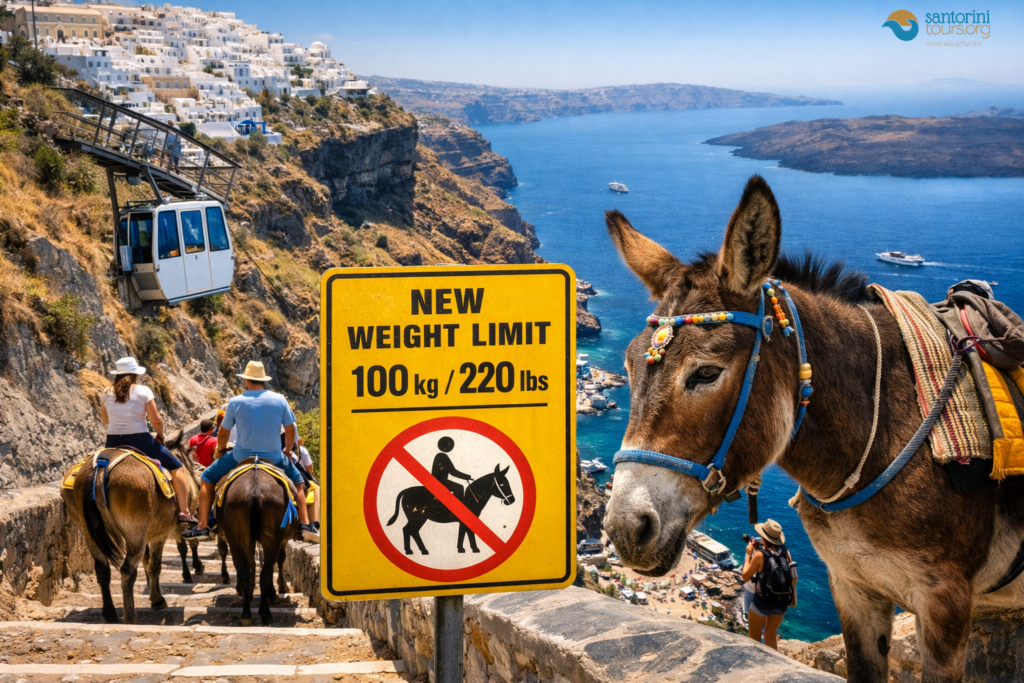
Our Santorini Tours guide helps you plan a truly memorable trip, with practical tips on getting around the island, navigating the port, and Santorini’s new donkey weight rule you should know before experiencing Santorini’s breathtaking beauty.
Santorini has never struggled to attract attention. Between the cliffside sunsets, whitewashed villages, and constant flow of cruise visitors, the island is one of the most photographed places in Greece. But a different kind of story is shaping how people talk about visiting: the donkey weight rule. What sounds like a narrow animal welfare measure is actually influencing how travelers move around the island, how operators serve guests, and how visitors think about responsible tourism. For anyone planning a trip, it’s no longer a side issue. It’s part of the Santorini experience now.
What Santorini’s New Donkey Weight Rule Actually Says
Santorini’s new donkey weight rule centers on a simple principle: working donkeys and mules should not be made to carry loads that exceed a safe share of their body weight. The policy is tied to long-running Greek animal welfare standards and renewed enforcement around the island’s steep routes, especially the path between the old port and Fira.
In practice, the rule means heavier riders may be asked not to use the animals at all, and operators are expected to consider the animal’s size, condition, and workload before offering a ride. While exact enforcement can vary by operator and season, the widely cited benchmark has been around 20% of the animal’s body weight.
That sounds technical, but for travelers it’s straightforward: donkey transport is no longer something visitors can assume is automatically available. If we’re planning a Santorini itinerary, it makes sense to treat donkey rides as limited, regulated, and increasingly scrutinized rather than a default sightseeing option.
Why The Rule Was Introduced And Why It Drew Global Attention
The rule didn’t appear out of nowhere. For years, animal welfare groups, travelers, and journalists raised concerns about donkeys working in intense summer heat, often on sharp stone steps, sometimes while carrying people or loads that looked too heavy for the conditions. Santorini, because of its fame, became the symbol of that debate.
Global attention followed for two reasons. First, the images were powerful: small working animals on steep volcanic cliffs beneath thousands of tourists. Second, Santorini sits at the crossroads of luxury travel and old local tradition. That contrast made the issue easy for international media to frame as a test of what modern tourism should tolerate.
Authorities and local stakeholders faced pressure to respond in a way that protected animal welfare without erasing part of the island’s historical identity. The new weight rule became the clearest sign that the balance had shifted. Visitors now expect stronger standards, and businesses have had to adapt to that expectation.
How The New Policy Is Changing The Visitor Experience On The Island
The biggest change is practical. Visitors arriving by cruise ship at the old port are more likely to choose the cable car, walk the steps, or pre-arrange ground transportation instead of taking a donkey ride as the classic way up. That changes traffic flow, timing, and even how crowded certain access points feel during peak hours.
It also changes expectations. Travelers are asking more questions before they arrive: How hard is the climb? Is the cable car reliable? What’s the least stressful way to reach Oia, Firostefani, or the beaches after docking? That has pushed tour planning from “we’ll figure it out later” to “let’s book something seamless in advance.”
From our perspective, this is one reason private touring has become more attractive. With local pickup coordination, flexible schedules, and expert guides, visitors can skip a lot of the uncertainty. On an island where logistics matter almost as much as scenery, responsible alternatives are no longer just nice to have. They’re central to a smoother day.
Who Is Most Affected, From Cruise Passengers To Independent Travelers
Cruise passengers are probably the most affected group. They often arrive in large numbers, face time pressure, and begin their Santorini visit at the exact point where donkey transport has historically been most visible. When animal rides are restricted or discouraged, every other option becomes more important, especially the cable car and pre-booked tours.
Independent travelers are affected differently. They usually have more flexibility, but they still need to think through mobility, heat, and timing. Santorini’s beauty can distract us from the fact that the island involves stairs, inclines, crowded pedestrian lanes, and private transfers that aren’t always obvious on a map.
Couples, families, and premium travelers often respond by prioritizing comfort. Instead of improvising, they look for curated experiences that reduce friction, whether that means a sunset tour, a village-focused route, or private transportation arranged through specialists like Santorini Tours. The new policy has made convenience, accessibility, and planning more valuable than before.
What This Shift Means For Animal Welfare, Local Tradition, And Public Perception
This is where the issue gets more complicated than a simple rule change. On one side, stronger limits clearly support animal welfare. They signal that iconic tourism experiences are not exempt from modern standards and that visitor demand doesn’t justify avoidable strain on animals.
On the other side, donkeys are part of Santorini’s historical landscape. Long before cruise crowds and social media, they were practical working animals in a place shaped by cliffs and narrow paths. For some locals, criticism from abroad can feel overly simplistic, as if centuries of island life are being reduced to a headline.
Public perception now sits somewhere in the middle. Most travelers still appreciate the cultural symbolism, but they’re less willing to romanticize the experience without asking ethical questions. That’s a healthy change. It encourages us to value local tradition while recognizing that traditions in tourism often need to evolve. The island’s image benefits not from pretending nothing has changed, but from showing that it can adapt responsibly.
How Travelers Can Explore Santorini More Comfortably And Responsibly
The smartest approach is to build a Santorini plan around comfort, timing, and low-friction transport. If we’re arriving by cruise ship, booking a private shore excursion removes much of the stress. A local guide can coordinate meeting points, traffic patterns, and route choices far better than a last-minute plan made at the port.
For independent visitors, the same principle applies. Choose experiences that fit the island rather than fighting it. That may mean visiting Oia early, exploring Pyrgos or Megalochori when the lanes are quieter, or combining caldera views with wineries, beaches, and cultural stops by vehicle instead of by exhausting uphill walks.
A few practical habits help a lot:
- Wear proper walking shoes, not just photo-friendly sandals
- Expect heat and carry water
- Use the cable car when it makes sense
- Pre-book transportation in peak season
- Respect animal welfare rules without treating them as an inconvenience
Responsible travel in Santorini doesn’t make the trip less special. Usually, it makes it much better.
Conclusion
Santorini’s new donkey weight rule is doing more than regulating one activity. It’s nudging the island toward a more thoughtful version of tourism, where comfort, planning, and ethics matter as much as postcard views. For travelers, that’s not bad news at all. It’s a reminder that the best way to experience Santorini is with a little more awareness and a much smarter plan.
Popular Q&A: Santorini’s New Donkey Weight Rule
1. What is Santorini’s new donkey weight limit?
Santorini has introduced a maximum rider weight limit of 100 kg (220 lbs) to protect the health and welfare of working donkeys and mules. This rule applies to all tourist rides, especially on the steep paths around Fira and the Old Port.
2. Why did Santorini introduce this rule?
The weight limit was created to prevent injuries, spinal strain, and long‑term health problems in the animals. Animal‑welfare groups and veterinarians have pushed for clearer regulations for years, and the island is now enforcing them more strictly.
3. How will this rule affect tourists?
Most visitors won’t be affected, but travelers who exceed the weight limit will need to choose alternative transportation, such as the cable car, taxis, or walking paths. The rule aims to make tourism more ethical without limiting access to the island’s attractions.
4. Are donkey rides still available in Santorini?
Yes, donkey rides are still offered, but operators must follow the new guidelines. Expect stricter checks, more oversight, and potentially fewer animals working at peak times.
5. What are the alternatives to donkey rides?
Visitors can use:
- Santorini Cable Car (fastest and most scenic option)
- Walking paths (steep but beautiful)
- Taxi or private tour services. These options are comfortable, ethical, and often faster than waiting for a donkey ride.
6. Does this rule apply to all Greek islands?
No, the regulation is specific to Santorini, though other islands may adopt similar rules in the future as Greece strengthens its animal‑welfare laws.
7. Is riding donkeys in Santorini considered unethical?
Opinions vary, but many travelers now prefer animal‑friendly alternatives. The new rule is part of a broader effort to ensure that any remaining donkey rides are humane and regulated.
8. Will the rule change the tourism experience?
Yes—in a positive way. Santorini is shifting toward more sustainable and responsible tourism, which helps protect both the animals and the island’s reputation.
Book Your Santorini Tours Now: